Do Creosote Logs Work?
Creosote logs can loosen light, flaky soot. They do not replace sweeping or inspection, and they should never be trusted to fix heavy glazed creosote or a blocked flue. Skip that warning, and you risk weak draft, more smoke, chimney fire risk, and a wasted heating season. This guide explains how these logs work, when they are worth using, and when to skip them.
What creosote logs can and cannot do


Yes, but only in a narrow sense. A creosote sweeping log can make some hardened creosote more brittle, and some guides say it helps tarry, sticky deposits dry out and become brittle. That is different from removing buildup. A sweeping log removes nothing from the chimney, and the log stays in the flue.
That is the key decision rule. If you want a mild maintenance aid for soft deposits, a log may be worth using. If you need the chimney cleaned, inspected, or cleared, the log is the wrong tool. CSIA treats chemical products as a supplement to sweeping, not a substitute.
Creosote is mostly made of tar, and it is highly flammable. That matters because fire risk rises as deposits get heavier and burning habits stay poor. A log may loosen some residue, but it does not change the need for a proper sweep or an annual inspection under NFPA 211.
Where a log fits in chimney care
Think of a creosote log as one maintenance step, not a cleanup plan. It can support a sweep by drying or brittle-izing soft deposits so the next mechanical cleaning goes easier. It cannot inspect the flue, measure damage, or remove a blockage.
That means it belongs in a chimney-care routine only after the flue is known to be clear enough for normal use. If the chimney has not been inspected in a year, NFPA 211 still calls for an inspection at least once a year. The inspection comes first when there is any doubt.
What is a creosote sweeping log
A creosote sweeping log is a chemical treatment log, not a brush, vacuum, or mechanical cleaner. It burns in the firebox and sends additives up with the smoke. Those additives change some creosote so tarry deposits dry out and become brittle, but the material stays in the chimney until it is swept out.
That is why the product is often described as a helper rather than a fix. It may make cleanup easier later, but it does not remove ash, flakes, nests, or broken debris. A professional chimney sweep still has to do the physical work and check the flue.
How the product is meant to be used
Follow the manufacturer burn instructions exactly. Most products are meant to be used with a hot fire, because the treatment needs strong draft to carry the additives through the flue. Do not use a log as a cold-season shortcut after months of neglect.
Seasoned dry wood matters more than any additive log. Lower moisture means less smoke, hotter fires, and less creosote formation in the first place. A log may help with existing soft buildup, but dry wood is the better prevention step.
Creosote buildup stages
Creosote buildup is usually described in three stages, and the stage determines whether a log can help. Stage 1 is light and flaky. Stage 2 is thicker, harder, and tar-like. Stage 3 is glazed, shiny, and the highest-risk form. Logs are most useful on the earlier, softer deposits and are poor against glazed creosote.
Stage 1: light and flaky
This is the best case for a creosote log. Loose, dry residue may become more brittle and easier to remove during the next sweep. Even here, the log is a supplement, not a full cleaning. You still need normal chimney maintenance.
Stage 2: thicker and tar-like
Stage 2 is the middle ground. A log may dry some of the tarry material and make it break apart more easily, but results are limited. If buildup is approaching the threshold where a sweep is due, do not use the log as a delay tactic.
Stage 3: glazed and shiny
Stage 3 is the failure case. Glazed creosote is hard, shiny, and far more dangerous. A log is not a reliable answer here, because it cannot remove the layer, break up all of it, or reduce the fire hazard enough to stand in for a sweep.
Say your fireplace sees weekend fires with dry oak, but the liner has a thin, dull coating that rubs off as powder. A log may help dry that residue before a cleaning. Suppose the same chimney has black shiny streaks on the tile. That is a sweep-and-inspect job, not a log job.
Creosote log decision table
| chimney condition | likely creosote stage | whether a log is worth using | next action |
|---|---|---|---|
| Dry-seasoned wood use with light soot, no visible shiny buildup | Stage 1: light and flaky | Yes, as a supplement | Burn a log per the label, then schedule sweeping when due |
| Occasional fireplace use with a light coating and no draft problems | Stage 1 to early Stage 2 | Possibly, if the chimney is already known to be clear | Use the log as directed, then have the flue swept and inspected if it is time |
| Visible glazed buildup on the flue or damper area | Stage 3: glazed/shiny | No | Stop relying on logs and call a professional chimney sweep |
| Smoky fires from wet wood | Fast-forming soft tar and heavy soot | Not as a fix | Switch to seasoned dry wood, then inspect and sweep the chimney |
| Any suspected blockage or damage | Unknown | No | Get an inspection first; do not burn a log until the flue is checked |
How should you use a creosote log
Use a creosote log only after you have read the package directions and confirmed that the chimney is not blocked. The right use is simple: light a hot fire, add the log as directed, and let the treatment travel up the flue with the smoke. That is how the additives reach the creosote deposits.
The log is not a stand-alone cleanup. After the burn, loosened debris may remain in the chimney or fall to the firebox, smoke shelf, or base of the flue. It still has to be removed mechanically during sweeping.
Steps to follow
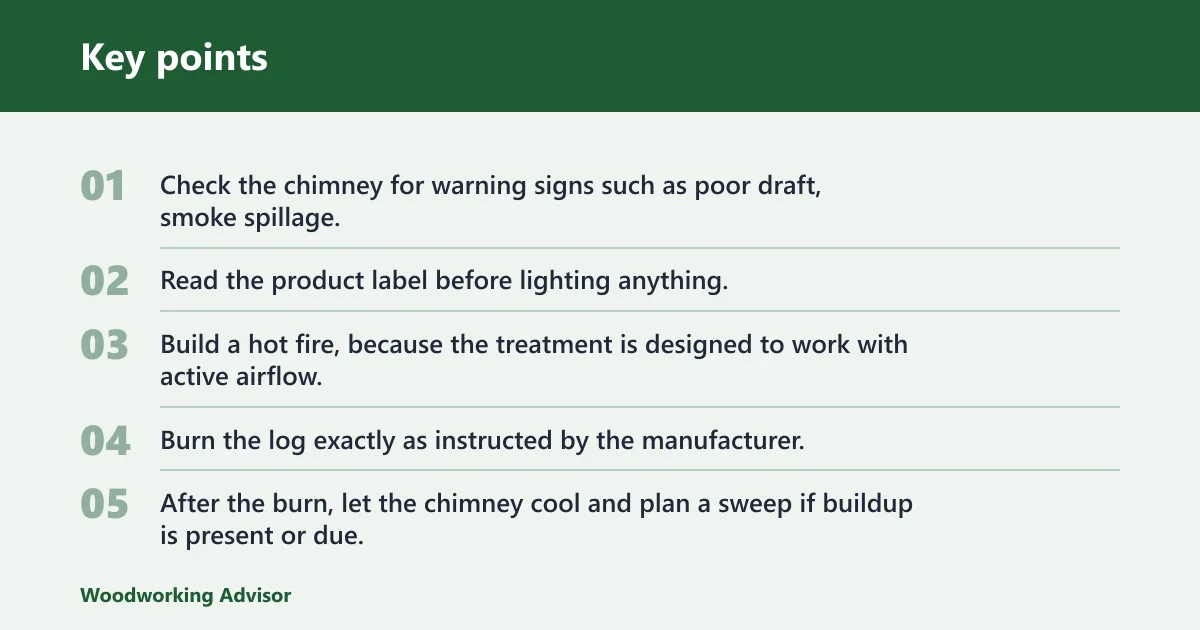
- Check the chimney for warning signs such as poor draft, smoke spillage, or a history of blockage.
- Read the product label before lighting anything.
- Build a hot fire, because the treatment is designed to work with active airflow.
- Burn the log exactly as instructed by the manufacturer.
- After the burn, let the chimney cool and plan a sweep if buildup is present or due.
What to do after the burn
Expect loosened material, not a clean flue. The debris may collect where the chimney narrows, on the smoke shelf, or in the firebox. That is normal. It is also the reason sweeping still matters after a treatment log is used.
A common first-timer mistake is to treat a single log as proof the chimney is safe for the rest of the season. That is not a sound assumption. If buildup is near 1/8 inch, or if the chimney has not been inspected this year, the next action is still a sweep and inspection.
When do you need a chimney sweep instead?
You need a chimney sweep instead of a log when the chimney has glazed buildup, suspected blockage, damage, or any sign that the flue has not been checked in time. CSIA guidance treats chemical products as a supplement, not a replacement, and NFPA 211 still calls for an inspection at least once a year.
A professional chimney sweep does two jobs a log cannot do. First, the sweep mechanically removes loosened debris. Second, the sweep checks for cracked tiles, liner damage, nests, and blockages. That is why the sweep comes first when the chimney condition is uncertain or visibly poor.
Why inspection comes before reliance on a log
A log cannot tell you whether the flue is sound. It cannot see cracked clay tiles, damaged metal liner sections, or a nest that blocks draft. It also cannot tell you whether the buildup has crossed the point where the chimney needs physical cleaning.
If the chimney is neglected, assume the log is not enough. Neglected chimneys are more likely to have heavy creosote, hidden damage, and restricted airflow. In that case, a sweep and inspection are the safe path, not repeated chemical treatment.
Frequently asked questions
Do creosote logs work?
Yes, in a limited way. They can help loosen some light, flaky, or tarry deposits so a later sweep is easier. They do not remove material from the chimney, inspect the flue, or fix heavy glazed creosote. Their value is as a supplement, not a substitute.
Do creosote logs work to clean chimney?
Not by themselves. A creosote log may dry out deposits and make them more brittle, but the material stays in the chimney until it is physically removed. If you need a truly clean flue, you still need a chimney sweep with the right tools.
Are creosote sweeping logs safe?
They are generally intended for use when the chimney is already serviceable and the label is followed closely. They are not safe to rely on if the flue may be blocked, damaged, or heavily glazed. The safe use case is limited maintenance, not problem solving.
Do creosote burning logs work?
They can change some creosote, but they do not clean the chimney on their own. The real effect is partial: softer deposits may dry out and become brittle. If the chimney has stage 3 glazed buildup, the log is not the right answer.
Do creosote buster logs work?
“Buster” is just another product label, so the same limits apply. These logs may help with soft, tarry deposits and can support a future sweep. They cannot inspect the chimney, clear a blockage, or replace annual inspection and cleaning.
Sponsored / affiliate links. As an Amazon Associate I earn from qualifying purchases. I may earn additional commission from eligible campaigns.