Floating Shelves vs Bracket Shelves: Which to Build?
Choose Bracket Shelves for drywall, plaster, or heavy loads above about 30 lb per shelf; choose Floating Shelves only for lighter loads or if you can anchor into studs or solid masonry. Pick the wrong system and shelves can sag, pull out, or fail under everyday use. This guide compares wall type, load, build difficulty, and DIY risk so you can choose the safer shelf to build.
This guide is part of our Woodworking project ideas and plans series.
| Decision factor | Floating Shelves | Bracket Shelves | Winner |
|---|---|---|---|
| Typical load planning range | 15–50 lbs per shelf | 30–75+ lbs per shelf | Bracket Shelves |
| Install difficulty | Moderate to hard | Easier and more forgiving | Bracket Shelves |
| Wall dependency | Strongly favors studs or solid masonry | Works well with studs, and more often tolerates simpler layouts | Bracket Shelves |
| Appearance | Cleaner and minimalist | Hardware is visible | Floating Shelves |
| Serviceability | Harder to re-level, re-anchor, or repair | Easier to reposition or replace | Bracket Shelves |
| DIY cost, installed | $25–$120 per shelf | $10–$40 per shelf | Bracket Shelves |
Hidden vs visible support and how load transfers
The core trade-off is simple: Floating Shelves hide the support and ask more of the wall and layout, while Bracket Shelves put the support on display and carry load more directly. That difference matters more than style preference when you are building for books, kitchen items, or a deep shelf span.
Traditional Beams notes that these two shelf types create completely different results once installed. That is true in appearance and in failure risk.
What each shelf style actually uses for support
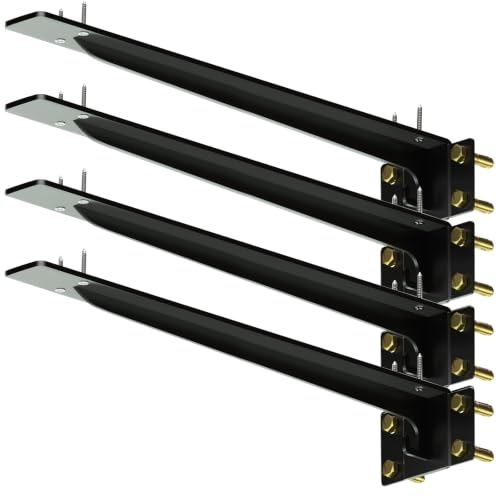
Floating shelves rely on hidden hardware, often concealed supports or a hidden rod-and-sleeve system. Wallniture describes hidden bracket shelves as using steel rods anchored into wall studs, and the shelf must be drilled to match that hardware precisely.
Bracket shelves use visible L-brackets or angle brackets underneath. The support is easier to inspect, easier to align, and easier to swap later if a bracket bends or a shelf changes size.
How the load gets transferred
Floating shelves put more stress into the hidden connection and the wall fasteners. Deep shelves increase bending force, so a 10- or 12-inch shelf can ask more of the mounting system than a narrow display shelf.
Bracket shelves move load through the visible support below the shelf, which is why they are the safer choice for heavier items and deeper boards.
📊 Family Handyman gives the floating-shelf project a cost range of $200–$250. Source: Familyhandyman.
Which shelf style holds more weight?
Bracket Shelves usually hold more because the support is visible, direct, and easier to size for the load. Floating shelves can still be strong, but their practical load range is narrower, especially when you are mounting to drywall or using a deeper shelf. For planning, treat floating shelves as a light-to-moderate load solution and bracket shelves as the better pick for heavier use.
Practical load zones by item type
For décor, framed art, small plants, or a few paperbacks, floating shelves are often the better fit. For vinyl records, dishware, stacks of hardcovers, or hand tools, bracket shelves usually give you more margin.
Say your shelf is 72 inches long and 11 inches deep, like a common floating-shelf project size. If you want it to hold rows of books or a line of plates, the hidden hardware has to do more work than it would for candles or small display objects.
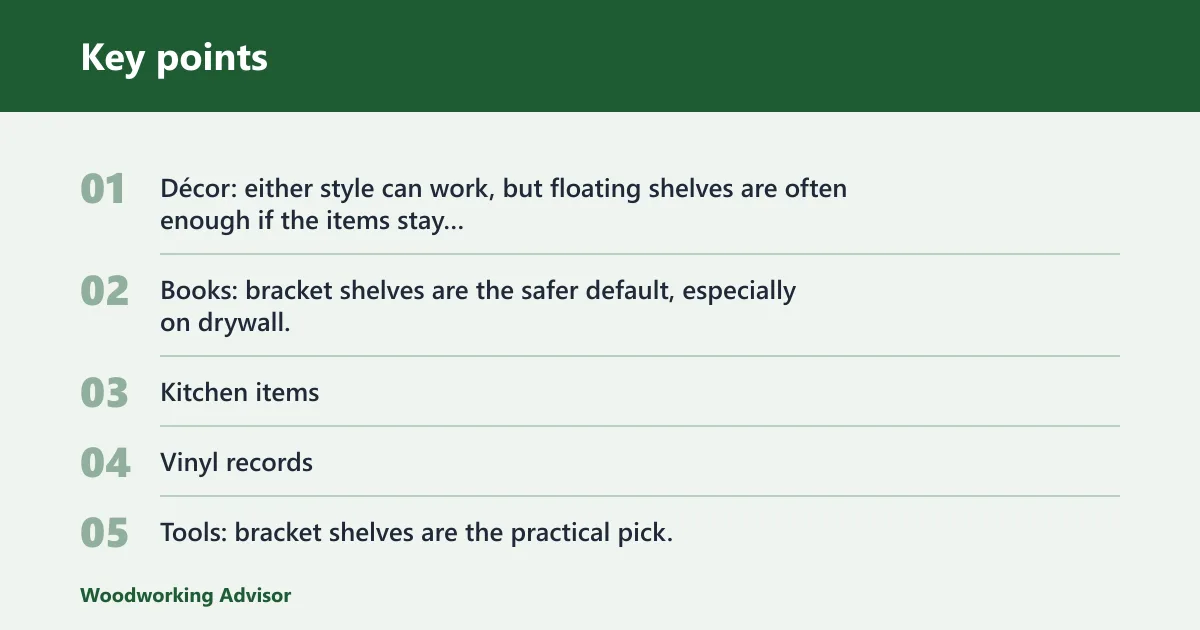
- Décor: either style can work, but floating shelves are often enough if the items stay light.
- Books: bracket shelves are the safer default, especially on drywall.
- Kitchen items: bracket shelves are usually the better build because loads vary and shelves often get deeper.
- Vinyl records: bracket shelves are the better choice unless the shelf is short, shallow, and well anchored.
- Tools: bracket shelves are the practical pick.
How shelf depth changes stress
Depth changes the load picture fast. A deeper shelf places the weight farther from the wall, which raises the bending force on the hardware and fasteners.
This issue hits floating shelves harder because the support is hidden inside the shelf body. Bracket shelves still care about depth, but the visible support gives you more room to size the brackets for the job.
Which is easier to build and install?
Bracket Shelves are easier to build and install for most DIYers. Floating shelves ask for tighter drilling, cleaner layout, and more confidence with hidden hardware, while bracket shelves are more forgiving if a hole lands slightly off or a layout needs adjustment.
Hidden rod-and-sleeve systems
Hidden rod-and-sleeve hardware is the exacting path. The rods need to line up with pre-drilled holes in the shelf, and the shelf must sit square on the wall or the fit can be frustrating.
That does not make floating shelves impossible. It does mean they reward careful measuring and punish small layout errors more than visible bracket systems do.
Visible L-brackets and angle brackets
Visible brackets are simpler because the hardware is exposed and the shelf does not need concealed bore holes to the same degree. Wallniture also notes that visible bracket shelves can be easier for first-time installers.
That extra forgiveness matters when you are drilling into a wall you have not mapped carefully, or when you need the shelf up without a full day of precision work.
Build time and cost
Floating shelves can cost $25–$120 per shelf, installed, and the example project cited takes a full day of build time. Family Handyman lists that floating-shelf project as beginner complexity, with a cost range of $200–$250 and support of about 50 lbs each. (Familyhandyman)
Bracket shelves usually run $10–$40 per shelf, installed. For a DIY builder, that often means less hardware cost, less layout risk, and less labor time.
Which shelf style is better for drywall or plasterboard?
Bracket Shelves are the safer choice for drywall or plasterboard when you do not have a dependable stud layout. Drywall is a lower-capacity substrate, so overloaded floating shelves are a common failure risk if the load path depends on cavity fixings alone.
Why studs matter most
Studs are the primary anchor point for both shelf styles, but they matter especially for floating systems. Hidden supports need a solid anchor because the shelf’s load is carried through a small number of fasteners.
If you can hit studs, both styles improve. If you cannot, the floating option becomes the riskier one first.
When drywall-only mounting becomes risky
Drywall or plasterboard without studs usually calls for cavity fixings or specialist anchors, and those are not a free pass for heavy loads. The UK guide cited here lists a nylon self-drill plasterboard plug at 8 kg in 12.5 mm plasterboard and 7 kg in 9.5 mm board.
That explains why floating shelves should stay on the light side unless the wall structure is excellent and the anchor layout is conservative.
Masonry walls
Masonry walls are a better substrate for either style when you use the right plugs and screws. Brick or block can support more reliable fastening than drywall, but the hardware still has to match the wall material and shelf load.
In masonry, floating shelves become more realistic for moderate loads. Bracket shelves still remain the easier path when the shelf is deep or the contents are heavy.
Floating shelf decision matrix
This table turns wall type, depth, and load into a quick build decision. Use it as a planning tool, not a guarantee, because the exact hardware still has to match the wall and the shelf span.
| Wall type | Shelf depth | Intended load | Recommended build style |
|---|---|---|---|
| Stud-mounted drywall | Up to about 10 in | Light décor or small display items | Floating Shelves |
| Stud-mounted drywall | 11 in or deeper | Books, dishware, or mixed household storage | Bracket Shelves |
| Drywall or plasterboard without studs | Any depth | Anything beyond light décor | Bracket Shelves |
| Masonry wall | Shallow to moderate | Light-to-moderate loads | Floating Shelves |
| Masonry wall | Deep shelf | Heavy books, tools, or kitchen storage | Bracket Shelves |
Quick read
If the wall gives you solid anchors and the shelf will stay light, floating shelves are a fair build. If the shelf gets deep, the wall is weak, or the items are heavy, bracket shelves are the safer choice.
Choose Floating Shelves if… / Choose Bracket Shelves if…
Choose Floating Shelves if you want a cleaner visual line, can hit studs or mount into solid masonry, and plan to store light-to-moderate items. They fit better when the shelf is shallow and the installation can be measured carefully.
Choose Bracket Shelves if you need higher capacity, want an easier install, need to rework the shelf later, or are mounting into drywall with uncertain stud placement. They are the better pick for books, kitchen items, and tools.
A common first-timer mistake is choosing floating shelves for a deep span in drywall because the shelf looks neat on paper. A 12-inch-deep shelf loaded with books puts the wall and hidden hardware under far more stress than a shallow display shelf does.

When should you avoid floating shelves?
Avoid Floating Shelves when the wall is drywall-only, the shelf is deep, the load is heavy, or you cannot confirm stud locations. Those conditions increase the chance of sagging, pullout, or a shelf that feels solid at first and then loosens over time.
Floating shelves vs bracket shelves checklist
- You cannot anchor into studs and the wall is only drywall or plasterboard.
- The shelf is meant for books, dishware, vinyl, or tools.
- The shelf depth is 11 in or more.
- You need to install quickly and cannot spend time on precise alignment.
- You want an easy repair or replacement later.
- The hardware requires a hidden rod-and-sleeve layout, but you are not set up for exact drilling.
Failure scenarios that point to brackets instead
Suppose you are building a 36-inch shelf over a desk for textbooks and a printer. Even if the shelf looks fine empty, the load and depth make visible brackets the safer choice.
Or picture a kitchen shelf over tile on a block wall. That is a good place for either style if the fastening is right, but the moment the shelf gets deep and the contents get heavy, brackets become the more practical build.
Frequently asked questions
Are floating shelves stronger than bracket shelves?
No, not in the general case. Floating shelves can be strong when they are anchored into studs or solid masonry and built for a modest load, but bracket shelves usually carry more weight and tolerate more real-world variation. The support path is simpler and more forgiving.
Which is easier to build: floating shelves or bracket shelves?
Bracket shelves are easier for most DIYers. Floating shelves need precise layout, hidden hardware alignment, and a cleaner fit between the shelf body and the support system. Visible brackets reduce that difficulty because the hardware is easier to place and adjust.
How much weight can floating shelves hold?
A practical planning range is 15–50 lbs per shelf, but the real limit depends on studs, anchors, shelf depth, and how the weight is spread out. A light display shelf may be fine near the top of that range, while books or dishware can push the system too far.
How much weight can bracket shelves hold?
A practical planning range is 30–75+ lbs per shelf. That higher range reflects the visible support and more direct load transfer, which makes bracket shelves a better choice for heavier storage and deeper shelves. The exact limit still depends on wall type and fastener choice.
Which shelf type looks more modern in a room?
Floating Shelves usually look more modern because the hardware is hidden and the shelf line appears cleaner. That said, bracket shelves are not a poor design choice. Visible brackets can look intentional in rustic or industrial rooms, and they often suit the room better than a hidden system would.
Sponsored / affiliate links. As an Amazon Associate I earn from qualifying purchases. I may earn additional commission from eligible campaigns.