How Much Does It Cost to Build Built-In Shelves?
Built-in shelves are often estimated at roughly $1,500 to $6,000 for a typical wall, with DIY builds commonly landing around $300 to $1,500 in materials and trim; wider runs, paint-grade MDF, and full-height cabinetry can push prices higher. A low estimate can miss finish carpentry, hardware, and paint after the frame is built. This guide breaks costs by wall width, material, and finish level, then lists the line items that change a quote or DIY budget.
This guide is part of our Woodworking project ideas and plans series.
Built-in shelf cost table
This table estimates three common wall widths using three build levels. It separates materials, labor, trim, hardware, electrical allowance, and contingency so you can compare a true DIY budget with contractor-installed pricing. Use it as a starting point, then adjust for baseboards, outlets, and uneven walls.
| Wall width | Build level | Materials | Labor | Trim | Hardware | Electrical allowance | Contingency | Estimated total | Notes |
|---|---|---|---|---|---|---|---|---|---|
| 6 ft | DIY paint-grade | $240 | $0 | $90 | $45 | $0 | $75 | $450 | Baseboard returns and one uneven corner can add scribing time and extra trim. |
| 6 ft | Mid-range plywood/veneer | $720 | $800 | $180 | $90 | $150 | $165 | $2,105 | Allow for outlet moves, finish touch-up, and one light circuit if you add shelf lighting. |
| 6 ft | Pro custom hardwood | $1,650 | $2,100 | $320 | $180 | $250 | $300 | $4,800 | Best fit when you need stain-grade trim, solid fronts, or a built-in around irregular walls. |
| 8 ft | DIY paint-grade | $320 | $0 | $120 | $60 | $0 | $100 | $600 | Extra width raises shelf span, so thicker shelves or a center divider may be needed. |
| 8 ft | Mid-range plywood/veneer | $950 | $1,100 | $220 | $120 | $150 | $240 | $2,780 | Common fit for a full wall unit with base cabinets, doors, and a painted face frame. |
| 8 ft | Pro custom hardwood | $2,200 | $2,900 | $420 | $220 | $300 | $410 | $6,450 | HVAC grilles, uneven floors, or taller crown can push the quote higher. |
| 12 ft | DIY paint-grade | $510 | $0 | $180 | $90 | $0 | $150 | $930 | Longer runs often need more anchor points and a stronger shelf design to control sag. |
| 12 ft | Mid-range plywood/veneer | $1,450 | $1,650 | $320 | $180 | $200 | $340 | $4,140 | Corner tie-ins, more doors, and electrical work can move this into premium territory. |
| 12 ft | Pro custom hardwood | $3,400 | $4,000 | $650 | $320 | $350 | $650 | $9,370 | Full-wall units with drawers, lighting, and custom trim often price well above basic shelving. |
The table is a planning tool, not a quote. It assumes a simple rectangular wall, standard ceiling height, and no major carpentry repairs behind the finished faces.
How much do built-in shelves cost?
Built-in shelving commonly falls in a broad installed range from $400 to $5,000, with a national average cost to install built-in shelving of $2,700. Fixr says low-end built-in shelving can start at $200, while high-end built-in shelving can reach $42,000. House Digest cites typical built-in shelving unit cost at $2,500 to $5,000, with budget built-ins around $800.
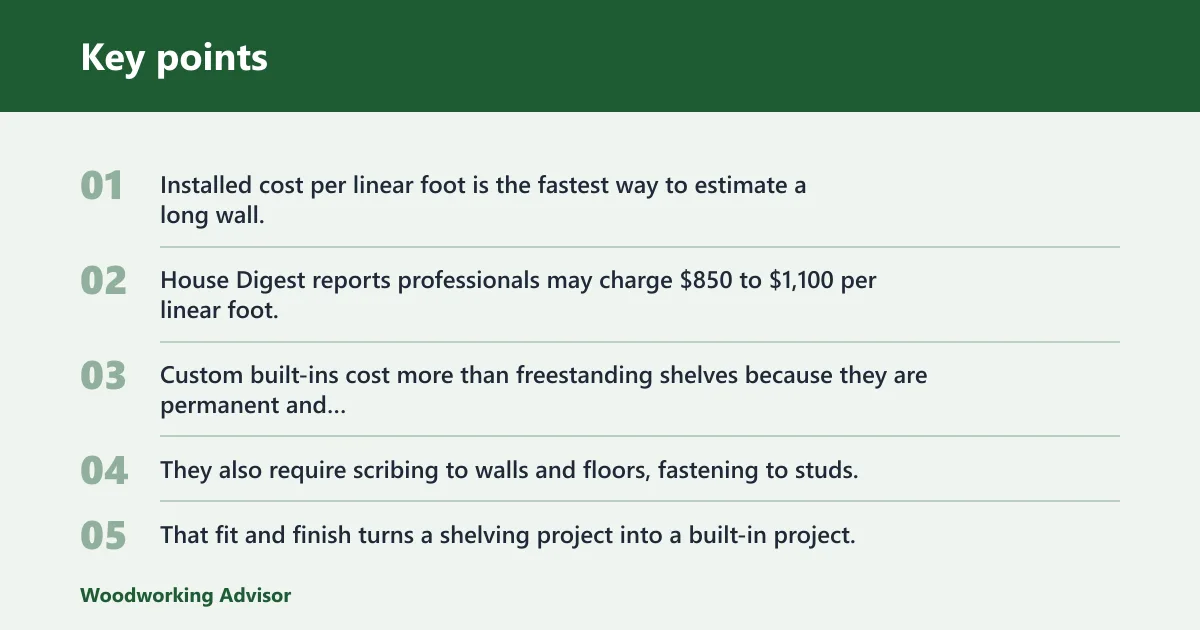
Installed cost per linear foot is the fastest way to estimate a long wall. House Digest reports professionals may charge $850 to $1,100 per linear foot, which is why an 8-foot wall with cabinetry, trim, and paint can jump far beyond a simple shelf run.
Custom built-ins cost more than freestanding shelves because they are permanent and cannot be moved when rearranging furniture. They also require scribing to walls and floors, fastening to studs, and finish work that matches the room. That fit and finish turns a shelving project into a built-in project.
How much does it cost to build built in bookshelves?
Built-in bookshelves usually cost less than a full wall unit with drawers and doors, but more than a simple open shelf. For a typical wall, a practical budget starts around a few hundred dollars for DIY materials and can move into the low thousands once you add labor, trim, and finish work. The final number depends on wall width and the shelf design.
How much does it cost to build a wall bookshelf?
A wall bookshelf usually means a full-height or near full-height run of open shelving across one wall. Cost rises with width, shelf count, and finish level. A modest 6-foot wall can stay near the lower end, while a full-wall unit for an 8-foot or 12-foot wall quickly adds base cabinets, crown molding, and more labor.
How much does it cost to build a wall of bookshelves?
A wall of bookshelves is usually the most expensive version because it covers more square footage and often includes a mix of open shelves, closed storage, and trim details. On longer walls, installed cost per linear foot is more useful than a single lump sum. A 12-foot run can cost several times more than a 6-foot niche once you add finish carpentry and electrical work.
What drives the price up?
Three things move the cost most: wall size, build complexity, and finish level. Bigger walls need more material and more labor. More complex layouts need more scribing, more cuts, and more finishing. Add doors, drawers, lighting, or custom trim, and the quote changes fast.
Wall size and layout
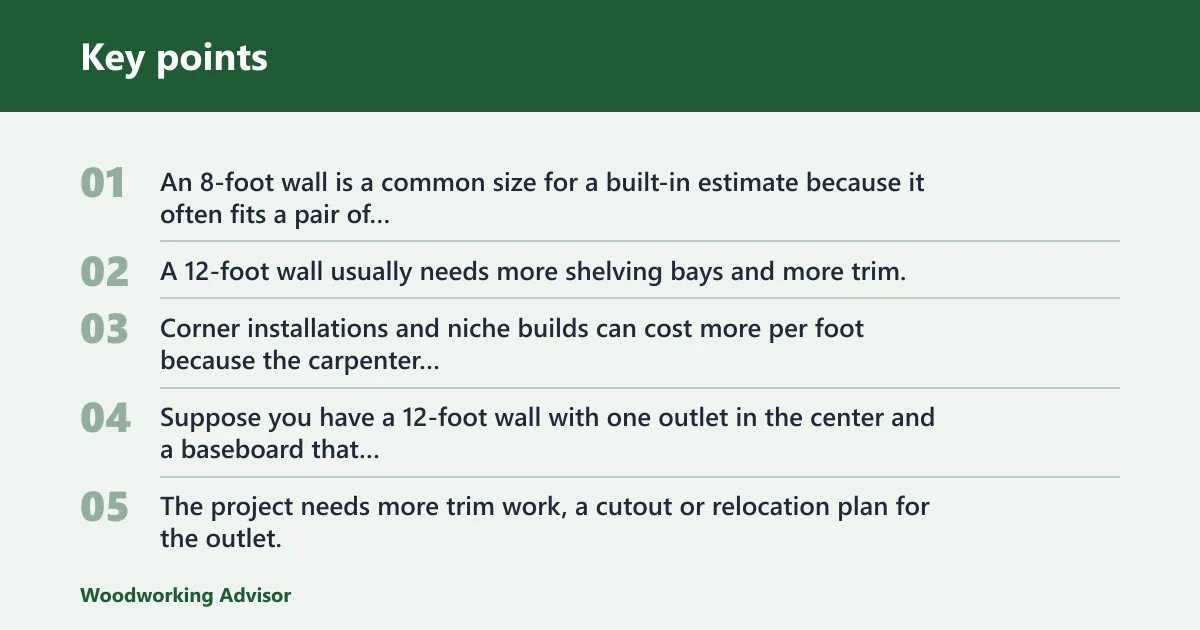
An 8-foot wall is a common size for a built-in estimate because it often fits a pair of bookcase towers, a center section, or a full wall unit. A 12-foot wall usually needs more shelving bays and more trim, so the price climbs faster than a simple width change would suggest. Corner installations and niche builds can cost more per foot because the carpenter spends extra time fitting odd angles.
Suppose you have a 12-foot wall with one outlet in the center and a baseboard that sticks out 3/4 inch. The project needs more trim work, a cutout or relocation plan for the outlet, and careful scribing at the floor. Those details can add time even if the shelf layout looks simple on paper.
Shelf depth, span, and thickness
Typical shelf depth for bookshelves is often about 10 to 12 inches for books and display items, though deeper shelves raise material cost and can crowd a room. Shelf span matters because longer spans sag more. A common rule of thumb is that thicker shelves and shorter spans resist sag better, especially with MDF or plywood.
For load, the shelf thickness often needs to increase as span grows. Longer open shelves may need a center divider, a front nosing, or another anti-sag detail. If you skip that reinforcement on a 6-foot or 8-foot run, the shelf may bow under books, and the fix costs more later than the support would have cost during the build.
Built-in features that add labor and material cost
Base cabinets, doors, drawers, crown molding, and lighting all add cost. Doors and drawers require hardware and alignment time. Crown molding adds cutting and finishing. Lighting adds electrical allowance and extra planning. Glass inserts and metal shelving pieces usually cost more than plain painted wood because the parts and the fit-up both rise.
A plain open shelf run is the cheapest version. Once you add lower cabinets, the project starts to look like cabinetry, not shelving. That is where cabinet maker labor, hinges, drawer slides, and door adjustment time begin to matter.
Materials and finish choices
MDF, plywood, solid wood, hardwood species, glass, and metal all change both the price and the finish look. Paint-grade builds usually start with MDF or paint-grade plywood. Stain-grade work often needs better plywood, solid wood faces, or hardwood species that take finish cleanly.
MDF versus plywood
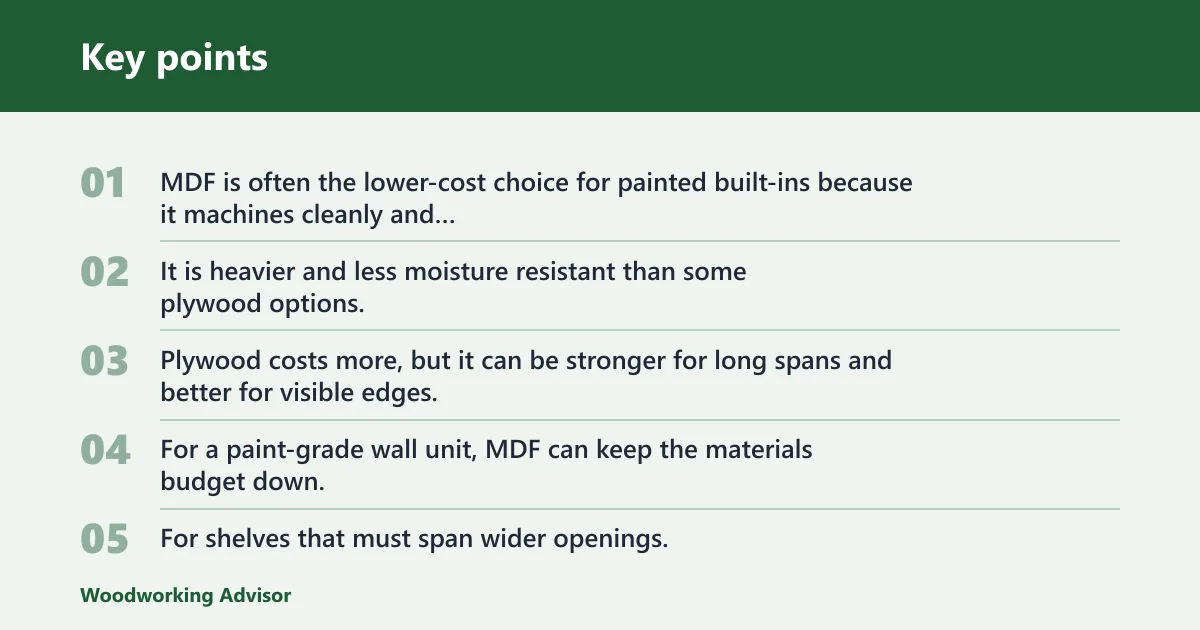
MDF is often the lower-cost choice for painted built-ins because it machines cleanly and has a smooth surface. It is heavier and less moisture resistant than some plywood options, so detailing and sealing matter. Plywood costs more, but it can be stronger for long spans and better for visible edges.
For a paint-grade wall unit, MDF can keep the materials budget down. For shelves that must span wider openings, plywood with thicker shelf stock can be a better value because it may need less anti-sag reinforcement.
Solid wood and hardwood species
Solid wood costs more than MDF or plywood, and hardwood species cost more again. Oak, maple, and cherry are common hardwood choices for stain-grade work because they take finish well and hold up under use. The cost increase comes from both lumber price and the extra time needed for careful joinery and finishing.
Hardwood also raises waste cost. Wider face frames, trim, and door fronts need matching grain and color. That adds labor before the first shelf is even installed.
Glass or metal options
Glass shelves or metal supports are usually specialty choices. Glass needs careful sizing and edge finishing. Metal adds fabrication or purchased hardware. Both can look clean in a modern room, but they often cost more than painted wood and are less forgiving if the wall is out of square.
Painted, stained, veneer, and custom trim finishes
Painted finish is usually the easiest to budget because minor filler work can disappear under paint. Stained finish costs more because the wood has to look right before finish goes on. Veneer can give a high-end look at lower material cost than solid hardwood, but the edge detail matters. Custom trim raises labor because every cut, return, and seam must line up.
Labor and installation costs
The same source says finish carpenters or cabinet makers typically charge $66 to $121 per hour. That rate matters because built-ins are labor-heavy: measuring, cutting, leveling, fastening, scribing, caulking, and finishing take time. The more the wall departs from square, the more labor you pay for.
Finish carpenter hourly rates
A finish carpenter usually handles the visible woodwork, fit-up, and final alignment. Their rate often covers precision work that generic framing labor does not. On a project with crown molding, doors, and cabinet fronts, the labor bill can rise quickly because fit and finish take longer than rough assembly.
Cabinet maker rates
A cabinet maker is often a better fit when the project includes drawers, door panels, custom boxes, or stain-grade detailing. That skill set is useful for built-ins that need furniture-level joinery. It usually costs more than simple shelving, but the finished product tends to look more refined.
DIY labor savings
DIY can save a large share of the labor cost if you can cut, assemble, and finish accurately. Builds and Buys lists DIY materials at $50 to $150 per linear foot, which shows how much of the installed price can be labor. The tradeoff is time, tool cost, and the risk of rework if the wall is uneven or the shelves are out of square.
Installation complexity and site conditions
Built-ins should fasten to studs. Drywall anchors alone are not the right support for a loaded shelf run, especially when books or cabinets add weight. Wall anchoring also gets harder when the wall hides plumbing, wiring, or ductwork. If you need to work around HVAC cutouts or outlet relocation, the quote should include that extra labor.
A common mistake is budgeting only for the shelf boards and overlooking costs like wall anchoring, paint, and trim. A shelf run that looks simple may still need baseboard removal, patching, shimming, and paint touch-up before it looks finished.
Can you save money with DIY?
Yes, DIY usually saves the most money on material-driven projects with simple walls and paint-grade finishes. It saves less when the design includes doors, drawers, lighting, or custom trim. If the wall is out of square, a pro may cost more up front but reduce waste and rework.
Where DIY saves the most
DIY savings are strongest on simple open shelving, straight walls, and paint-grade MDF or plywood. If you can keep the design simple and the finish basic, you avoid labor charges that can dwarf the material bill. That is why a basic 6-foot run can stay far below a pro-built unit.
When professional installation is the better fit
Professional installation makes more sense when the project includes a full wall unit, a 12-foot run, base cabinets, or a finish that must match existing millwork. It also makes sense when the wall is uneven, the floor slopes, or you need electrical work. Those details can be expensive to correct after the fact.
Say your room has a 12-foot wall, two outlets, and a heating register near one end. A modular approach may still work, but the moment you need cutouts, trim returns, and a clean tie-in around the register, the project starts to behave like custom carpentry.
When modular shelving plus trim is the cheaper option
For a plain wall, modular shelving plus trim can cost less than a fully custom built-in. This is especially true when you only need the look of built-ins, not a permanently fixed cabinet system. If the wall is flat and the baseboard is simple, you may get most of the visual effect for less money and less labor.
Built-ins can be overpriced when the design is thin on storage but heavy on custom trim and finish work. In those cases, you are paying for custom fit more than usable capacity. Modular units with a fitted filler, scribed side panels, and crown can solve the same layout at a lower total cost.
Frequently asked questions
How much does it cost to build built in shelves?
Most built-in shelves cost $1,500 to $6,000 for a typical wall once materials, labor, trim, and finish are included. The number changes fast with wall width, shelf depth, and whether you need cabinet fronts, lighting, or electrical work. DIY material-only budgets can be much lower.
How much do custom built in shelves cost?
Custom built-in shelves are usually priced above standard shelving because they are made to fit the room, not the other way around. The quote reflects design time, stud attachment, trim fitting, and finish work. Hardwood, drawers, and lighting push the total higher still.
Can I save money by DIYing built in shelves?
Yes, if the wall is simple and you can handle accurate measuring, cutting, and finishing. DIY saves the most on labor, which is a major share of the total. It saves less on complex walls, stain-grade finishes, or projects that need electrical work and precise trim details.
Sponsored / affiliate links. As an Amazon Associate I earn from qualifying purchases. I may earn additional commission from eligible campaigns.