How Much Does It Cost to Build a DIY Bookshelf?
A DIY bookshelf usually costs $60 to $400 for a freestanding unit, $250 to $900 for a larger custom bookcase, and $800 to $3,500+ for a built-in, with materials and finish driving most of the spread. Wrong dimensions, weak joinery, or a finish budget that leaves out primer and sandpaper can turn a low-cost build into a rebuild. This guide breaks down cost by size, lumber, hardware, tools, paint or stain, and build style so you can budget before you cut.
This guide is part of our Woodworking project ideas and plans series.
DIY bookshelf cost breakdown and estimates
For most DIY projects, size is the main cost driver. A simple freestanding bookshelf can stay near the low end if you use plywood or pine, while a deeper, taller, or built-in-style unit can multiply the total once sheet goods, trim, finish, and fit-up time are included.
Bookshelf cost table
| Scenario | Lumber / sheet goods | Back panel | Hardware | Finish | Consumables | Tool rental / ownership assumption | Low total | High total | Cost per linear foot |
|---|---|---|---|---|---|---|---|---|---|
| Budget freestanding bookcase, 3 ft wide | $25-$55 | $8-$18 | $8-$20 | $10-$35 | $10-$20 | Assumes basic tools already owned | $61 | $148 | $20-$49/ft |
| Standard 6-foot bookcase | $70-$170 | $15-$35 | $15-$35 | $20-$60 | $15-$30 | Assumes one saw or drill bought for the project | $135 | $330 | $23-$55/ft |
| Built-in-style unit, 8 ft run | $180-$450 | $25-$60 | $30-$80 | $35-$120 | $30-$70 | Assumes layout, fastening, and trim tools owned; specialty tools may be rented | $300 | $780 | $38-$98/ft |
These totals leave room for waste, edge banding, filler, sandpaper, and the extra paint or polyurethane that smaller estimates often skip. If your design needs a thicker top, vertical dividers, or a finished back, the material count jumps quickly.
Say your cabinet is 72 inches tall, 36 inches wide, and 12 inches deep. That budget will be very different from a 36-inch-wide shelf with the same height, because larger panels create more offcuts, need stronger shelves, and usually need better backing or thicker material to limit sag.
What drives the price
Height, width, depth, and shelf count set the cost. Bigger shelves need more material, but they also need better support; a long span often pushes you toward thicker plywood, hardwood edging, or a center divider, which raises cost faster than the footprint alone suggests.
A common first-timer mistake is pricing only the visible panels. A bookshelf also needs fasteners, glue, a back panel, sanding supplies, and finish. Built-in work adds leveling, anchoring, trim, and scribing, which can cost as much as a low-end freestanding bookcase by themselves.
Plywood, solid wood, and back panel choices
Plywood usually costs less than hardwood boards for the same usable surface, especially when you compare a full sheet to enough solid stock to build carcass parts and shelves. For DIY furniture, cabinet-grade plywood typically costs more than construction-grade plywood, but it gives you cleaner faces, more consistent thickness, and better paint or clear finish results.
Standard sheet size is usually 4 x 8 feet. Common thickness options are 1/4 inch for backs, 1/2 inch for lighter parts, and 3/4 inch for shelves and case sides. Thicker plywood resists sag better on wider spans and gives you a stiffer bookshelf, but it also raises the budget and creates more weight.
Solid wood boards are common for face frames, trim, doors, and exposed edges. Pine, poplar, oak, maple, and birch are common DIY furniture choices. Boards are priced by the board foot, so they often cost more than plywood for the same project area, and they move more with humidity, which makes them better for smaller exposed parts than for large shelf spans.
A back panel changes both price and performance. A thin hardboard or plywood back is cheaper than a full plywood carcass back, but a thicker or better-finished panel helps square the case and improves the finished look. On painted projects, a cabinet-grade back can be worth the extra cost because it hides fasteners and dents better.
Waste, edge banding, and yield
Waste allowance matters because a cut list never uses every inch of a sheet. A bookshelf with deep sides, several shelves, and a face frame can burn through more of a 4 x 8 sheet than expected once saw kerf, defects, and layout constraints are counted. A simple rule is to budget at least 10 percent extra material for waste, and more when the design uses wide parts or visible grain matching.
Edge banding is cheap per foot, but it adds up on every exposed plywood edge. Filler strips, scribing material, and trim also look small on paper, then become meaningful once you cover seams or hide uneven walls.
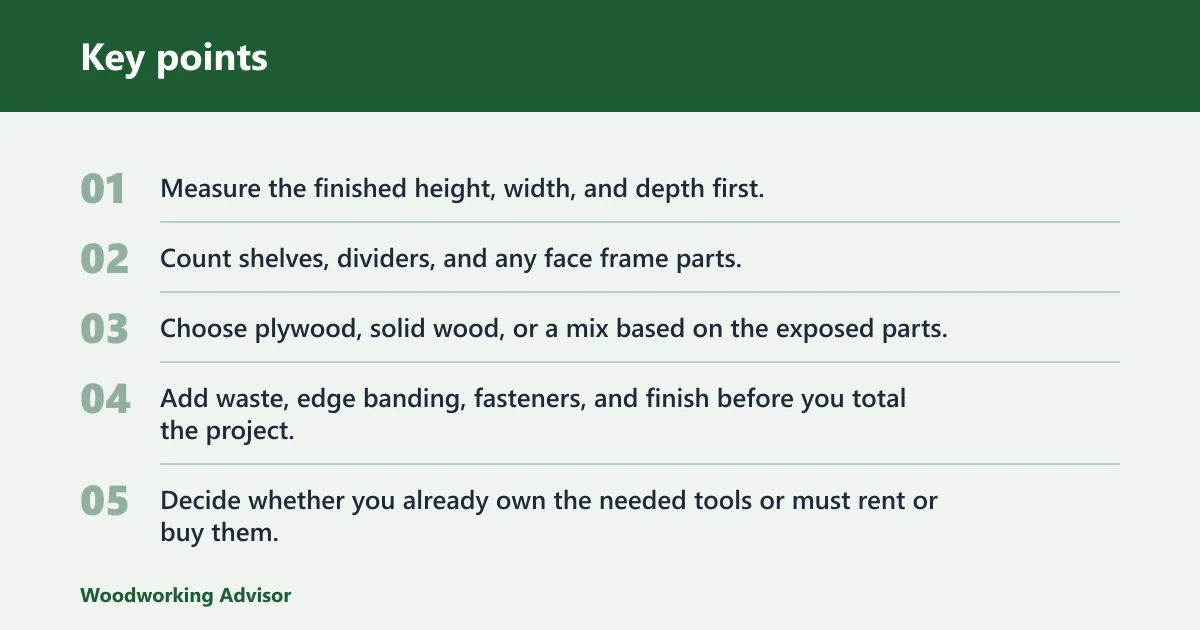
- Measure the finished height, width, and depth first.
- Count shelves, dividers, and any face frame parts.
- Choose plywood, solid wood, or a mix based on the exposed parts.
- Add waste, edge banding, fasteners, and finish before you total the project.
- Decide whether you already own the needed tools or must rent or buy them.
How much does wood cost for a bookshelf?
Wood cost depends on sheet size, thickness, and species. For most DIY bookshelves, plywood is the low-cost choice for carcasses and shelves, while solid boards cost more per usable area and are better reserved for face frames, trim, and visible details.
Plywood sheet size and thickness
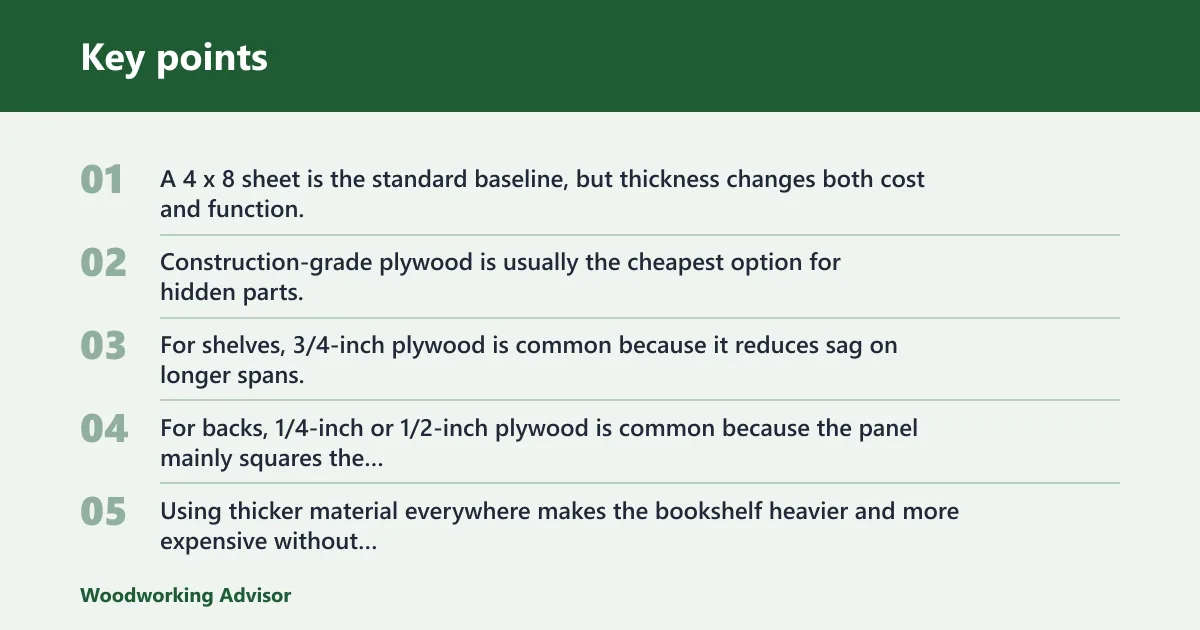
A 4 x 8 sheet is the standard baseline, but thickness changes both cost and function. Construction-grade plywood is usually the cheapest option for hidden parts, while cabinet-grade plywood costs more because the faces are better and the panel is better suited to paint or clear finish.
For shelves, 3/4-inch plywood is common because it reduces sag on longer spans. For backs, 1/4-inch or 1/2-inch plywood is common because the panel mainly squares the case and closes the back. Using thicker material everywhere makes the bookshelf heavier and more expensive without helping every part equally.
Cabinet-grade vs construction-grade plywood
Cabinet-grade plywood usually costs more than construction-grade plywood because it has cleaner faces, better veneer quality, and fewer visible defects. That matters for painted furniture too, since better faces need less filler and sanding before primer. If the shelf is hidden in a garage, construction-grade sheets can save money.
Solid wood boards and board-foot pricing
Solid wood boards are sold by board foot, so the price depends on thickness, width, and length. Pine is usually the cheapest common furniture species, with poplar often used for painted parts because it machines well and takes paint cleanly. Oak and maple cost more, but they are common when you want exposed grain and harder wear surfaces.
Solid wood moves with humidity more than plywood. That movement matters most on wide shelves and long panels, where seasonal change can cause twist or bow. Use solid stock where movement is less likely to create a fit problem, such as face frames, trim, and decorative edges.
How much do finishing materials add?
Finish can add a modest amount to a bookshelf or a large chunk of the budget, depending on the look you want. A paint-only project can stay relatively low-cost, while stain plus polyurethane usually needs more prep and a wider set of products.
Primer, paint, stain, and polyurethane
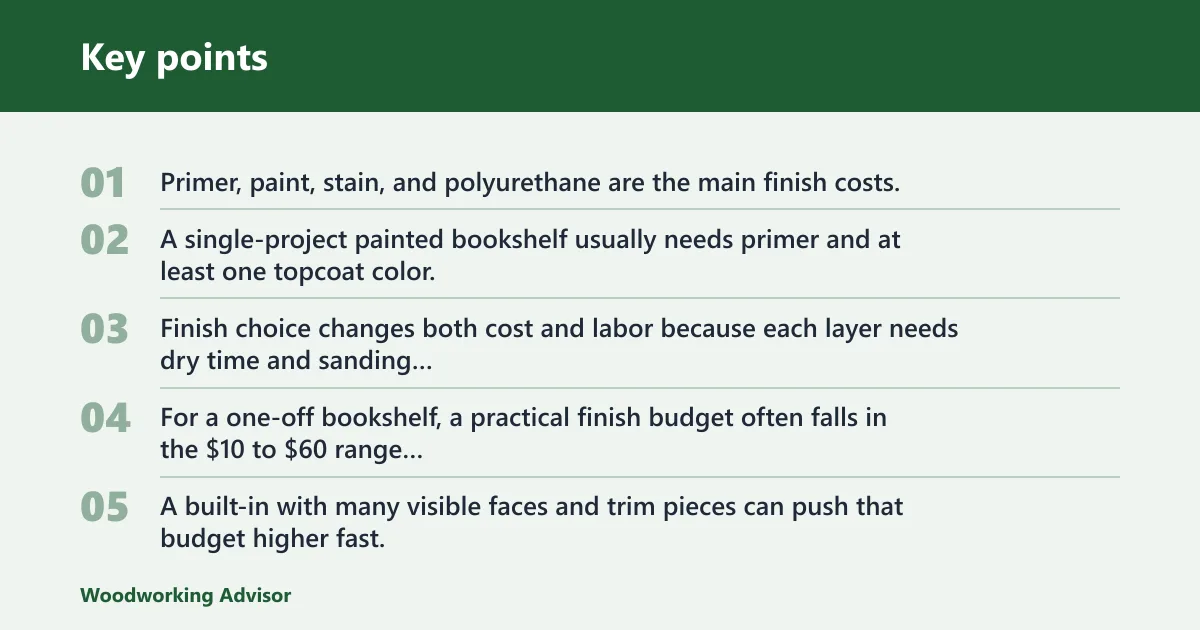
Primer, paint, stain, and polyurethane are the main finish costs. A single-project painted bookshelf usually needs primer and at least one topcoat color, while a clear-finished build may need stain, sealer, and one or more coats of polyurethane. Finish choice changes both cost and labor because each layer needs dry time and sanding between steps.
For a one-off bookshelf, a practical finish budget often falls in the $10 to $60 range for simple paint or stain jobs, and higher if you buy premium products or need extra coats on porous wood. A built-in with many visible faces and trim pieces can push that budget higher fast.
Sandpaper, filler, and prep supplies
Sandpaper, wood filler, tack cloths, and masking supplies are easy to overlook. These are small line items, but they add up when you sand every panel edge, fill fastener holes, and touch up seams. If the build uses plywood with exposed edges, you may also need edge banding supplies and a method to apply them.
Suppose you build a 6-foot painted bookcase from plywood and want clean edges. The frame may be inexpensive, but the extra primer, filler, sanding discs, and edge banding can add enough cost that a nicer plywood grade becomes the better value.
Finish budgets for painted and stained builds
Painted builds usually cost more in prep and less in material variation. Stained builds often require better wood selection because boards with knots, color variation, or mismatched grain show through more clearly. If the bookshelf will sit in a living room or office, budget for the finish you actually want to see, not only the cheapest one that covers the wood.
What tools do you need?
Tool ownership can materially change the real out-of-pocket cost. If you already own a saw, drill, square, and sander, the bookshelf may fit a modest materials budget. If you must buy or rent tools, the first build can cost much more than the lumber itself.
Ownership versus rental assumptions
For a basic freestanding bookshelf, many DIYers need only a circular saw or miter saw, a drill or driver, clamps, a measuring tape, and sanding tools. For a built-in, you may also need a level, stud finder, jigsaw, brad nailer, and tools for scribing trim. Renting specialty tools can make sense if this is a one-time project.
Cutting, clamping, drilling, and sanding tools
Cutting tools set the shape, clamping tools hold the case square, drilling tools handle fasteners, and sanding tools prepare the finish. A square and level matter more than many people expect because a slightly out-of-plumb case can create gaps that need extra filler, trim, or rework.
Fasteners, glue, and layout tools
Screws, wood glue, shelf pins or brackets, and layout tools are small line items but essential. Cheap hardware can save a few dollars, but it is poor economy if the shelf sags or the case racks. Measure twice and cut once is still the cheapest advice on the page, because it prevents waste and repeat cuts.
School Service notes that 99 percent of in-stock orders received before noon ship the same day, special printing can take 3-5 days to process and ship, and UPS delivery times are listed as 3 business days for the East Coast, 1-2 business days for the Midwest, and 4-5 business days for the West Coast. Those lead times do not affect bookshelf pricing directly, but they are a reminder that project timing changes when you need to wait on parts or custom materials.
Built-in bookshelf costs
Built-ins cost more than freestanding bookcases because they require wall anchoring, leveling, trim, filler strips, and often scribing to uneven walls. They may also need baseboard adjustments or electrical work. That is why a built-in budget should be treated as a separate project, not a larger version of the same shelf.
Wall anchoring and leveling
A built-in must fit the wall, floor, and ceiling conditions of the room. Leveling shims, cleats, and anchoring hardware are standard costs, and they matter because even a small slope can throw off door gaps or shelf alignment. If the unit spans a wall, the cost scales with the number of sections and the amount of finish carpentry needed.
Trim, filler strips, and scribing
Trim and filler strips hide the irregular gaps that show up at corners, ceilings, and baseboards. Scribing takes time, but it reduces the need for oversized gaps and heavy caulk lines. If you want the bookshelf to look built in rather than simply placed against a wall, budget for these finishing parts.
Baseboard and electrical adjustments
Baseboard removal or notch work is common when the bookshelf needs to sit tight to the wall. Electrical outlets can also affect layout, especially on full wall units. If the design crosses a receptacle or switch, the budget should include extra labor, safe rerouting by a qualified electrician where required, and more trim work to keep the fit clean.
The break-even point depends on what you compare it against. A simple DIY freestanding bookcase often beats buying a similar piece if you already own tools. A built-in may still cost less than a custom carpentry quote, but flat-pack furniture will usually stay cheaper than either on a pure cash basis.
Frequently asked questions
How much does it cost to build a bookshelf?
A simple DIY bookshelf often costs $60 to $400, depending on size, material, and finish. Freestanding units sit at the low end, while larger custom bookcases and wall-filling projects rise quickly once you add better plywood, hardware, waste, and paint or stain.
How much does it cost to build a custom bookshelf?
A custom bookshelf commonly lands in the $250 to $900 range, but the real number depends on dimensions, shelf span, and finish level. Taller cases, deeper shelves, and more visible solid wood parts all increase cost faster than a basic box design.
How much does it cost to build a built-in bookshelf?
A built-in bookshelf often costs $800 to $3,500+ because it adds trim, leveling, wall anchoring, and fit-up work. If the design needs scribing, baseboard changes, or electrical adjustments, the total climbs beyond the materials list alone.
How much does wood cost to build a bookshelf?
Wood cost can range from a few tens of dollars for a small pine or construction-grade plywood project to several hundred dollars for cabinet-grade plywood or solid hardwood. The key is to price the actual sheet count or board-foot total after the cut list is set.
What is the cheapest wood for a DIY bookshelf?
Pine and construction-grade plywood are usually the cheapest common choices. Pine works well for painted parts and simple frames, while plywood is often the better low-cost option for carcasses and shelves because it is stable and efficient to cut from sheets.
What tools do I need to build a bookshelf?
At minimum, you need a saw, drill or driver, clamps, measuring tape, square, and sanding tools. A built-in usually adds a level, stud finder, and often a brad nailer or trim tools. If you do not already own them, tool cost can rival the lumber budget.
Is it cheaper to build or buy a bookshelf?
Flat-pack furniture is usually cheaper upfront, especially for simple bookcases. DIY can win when you already own tools, want a specific size, or need a built-in look. Custom carpentry is usually the most expensive option, but it may be justified when fit and finish matter more than cash savings.
How much does it cost to build a bookshelf wall?
A bookshelf wall usually starts where built-in pricing starts: often several hundred dollars and sometimes several thousand, depending on width, height, trim detail, and electrical or baseboard changes. The larger the wall run, the more the budget depends on labor, finish work, and waste rather than only wood.
Sponsored / affiliate links. As an Amazon Associate I earn from qualifying purchases. I may earn additional commission from eligible campaigns.