Gorilla Glue Temperature Range
Gorilla Glue is not one temperature range. Temperature matters for Gorilla glue performance, especially for cold-shop work and heat-exposed joints. This guide compares Gorilla formulas so you can pick the right one for the job.
What temperature can Gorilla Glue handle?
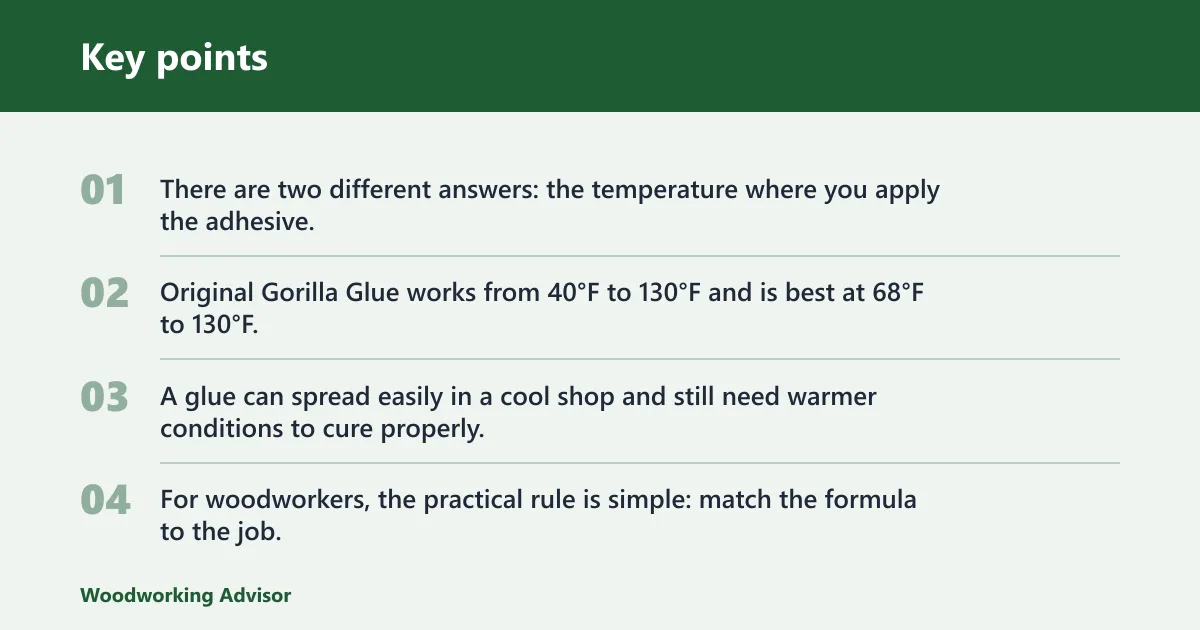


There are two different answers: the temperature where you apply the adhesive, and the temperature where the finished joint can live. Original Gorilla Glue works from 40°F to 130°F and is best at 68°F to 130°F, while Clear Gorilla Glue applies from 32°F to 100°F and is best at room temperature.
That split matters. A glue can spread easily in a cool shop and still need warmer conditions to cure properly. For woodworkers, the practical rule is simple: match the formula to the job, then check both application range and service temperature before loading the joint.
Gorilla Glue temperature table
This table separates the products that are often lumped together. Use it as a quick decision screen before you open the bottle or mix the epoxy.
| Product | Application temperature | Best working temperature | Clamp time | Full cure time | Service temperature |
|---|---|---|---|---|---|
| Original Gorilla Glue | 40 to 130° | 68° to 130° | 1-2 hours | 24 hours | Not listed here; check the specific label |
| Clear Gorilla Glue | 32° to 100° F | Room temperature | 2 hours | 24 hours | -20° to 180° F |
| Gorilla Super Glue Gel | Short working window; follow label | Room temperature | Seconds to minutes for a fast set | Varies by joint size and label | Heat resistance cited up to about 200° to 220°F |
| Gorilla Epoxy | Varies by formula | Room temperature | Varies by formula | Varies by formula | Check the specific epoxy label |
Why different Gorilla formulas behave differently
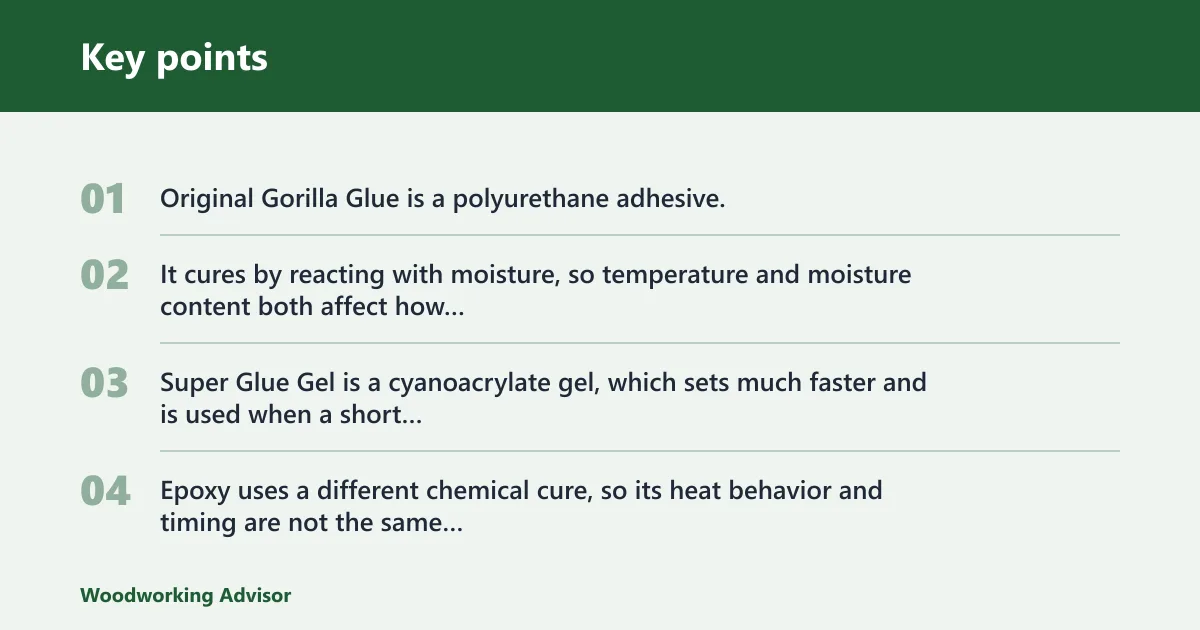
Original Gorilla Glue is a polyurethane adhesive. It cures by reacting with moisture, so temperature and moisture content both affect how fast the bond develops. Super Glue Gel is a cyanoacrylate gel, which sets much faster and is used when a short working window matters more than clamp time. Epoxy uses a different chemical cure, so its heat behavior and timing are not the same as polyurethane.
How cold affects polyurethane glue
Polyurethane Gorilla Glue is moisture-activated, and cold slows that reaction. That can stretch clamp time, delay cure, and leave a weak bond line if the parts never reach a suitable temperature.
Cold also changes the surface condition of wood. If the wood is too dry, the adhesive may not get enough moisture to foam and cure correctly.
Surface moisture targets for better results
For polyurethane glue, very dry stock is a problem. Below 10% moisture content, lightly dampen the non-glue surface so the adhesive has enough moisture to start curing. Do not soak the joint. A thin film is enough.
That matters because the foam you see is part of the cure process. If there is too little moisture, the glue may not expand properly. If there is too much water, the bond can weaken and the foam can become messy instead of useful.
Can you use Gorilla Glue in a cold workshop?
Yes, but cold workshop work needs more control. Original Gorilla Glue can work at 40°F, yet cure slows as temperature drops. If the shop stays below 50°F, expect longer clamp time, slower bond development, and a greater chance of a weak line if you rush the joint.
For small parts, warming the parts is often more practical than trying to heat the whole room. Bring the wood, glue, and clamps closer to the product’s best working range if you can do so safely and consistently.
What to do in a cold shop
- Check the label for the product you are using.
- Bring the wood and adhesive to the warmest practical indoor temperature.
- If the wood is below 10% moisture content, lightly dampen the non-glue surface.
- Apply the glue within the open working time.
- Clamp for the full recommended time before moving the part.
Say your garage is 45°F and you are gluing a 3/4-inch edge joint on pine. The glue may still bond, but it will cure slower than it would at room temperature. Keep the clamps on for the full 1-2 hours for Original Gorilla Glue, then leave the joint untouched until the 24-hour cure is done.
Does Gorilla Glue withstand heat?
Some Gorilla products handle heat after cure better than others. Clear Gorilla Glue lists service temperature from -20° to 180° F, and Gorilla Super Glue Gel is often described as heat resistant after cure. Original Gorilla Glue can survive normal indoor heat, but high heat can soften or weaken a bond if the joint is pushed past the formula’s limit.
Heat does not usually make a cured joint “melt” in a simple one-number way. Instead, performance drops as the adhesive softens, creeps, or loses bond strength. The symptom is often a joint that shifts under load, not a neat liquid failure.
Where Super Glue Gel fits better
Gorilla Super Glue Gel works better when you need a fast fix and the joint will face moderate heat later. Its working window is much shorter than polyurethane glue, so it is not the best choice for large assemblies or parts that need long alignment time. For a quick trim repair or a small interior fix, it can be the better tool.
When epoxy is the safer choice
Epoxy is often the better option when the joint may see higher heat, heavier stress, or a less forgiving fit. Because epoxy formulas vary, you should check the label for the specific product details instead of assuming it matches polyurethane or cyanoacrylate behavior.
A common first-timer mistake is using Original Gorilla Glue on a sunny window-seat repair because the bond looked cured the next day. If the joint later sees sustained heat, the glue line can soften or creep even though the clamp mark looked fine at 24 hours.
Clamp time and full cure time
Clamp time is not the same as full cure time. Original Gorilla Glue needs 1-2 hours of clamping and reaches 100% cure in 24 hours. Clear Gorilla Glue clamps for 2 hours and also reaches full cure in 24 hours. Do not load the joint just because it feels dry on the surface.
That extra waiting time matters on shelves, face frames, and edge-glued panels. If you move the part too soon, the bond line can shift before the adhesive finishes developing strength.
Before you load the joint
- Keep the joint clamped for the full recommended time.
- Leave the assembly undisturbed until the 24-hour cure is complete.
- Check for squeeze-out, starved areas, or a soft bond line before stressing the part.
- For hot-service locations, confirm the formula’s service temperature first.
Frequently asked questions
What temperature can Gorilla Glue withstand?
It depends on the formula and the job. Application temperature and service temperature are not the same, so check the specific product label before you use it.
Is Gorilla Glue high temp?
Some Gorilla products handle heat well after cure, but not all are “high temp” in the same way. The safest answer is to match the formula to the service conditions you expect.
What temperature does Gorilla Glue melt?
That is the wrong way to think about it. Cured adhesive usually softens, weakens, or creeps before any simple melt point matters. Heat can reduce bond strength long before the glue visibly fails, so the practical limit is the product’s service temperature and the load on the joint.
What is the temperature range for Gorilla Glue?
For Original Gorilla Glue, the application range is 40°F to 130°F, with best results at 68°F to 130°F. For Clear Gorilla Glue, the application range is 32°F to 100°F, with best results at room temperature. Those are application ranges, not the same as service temperature.
What is the application temperature for Clear Gorilla Glue?
Clear Gorilla Glue applies at 32°F to 100°F and is best at room temperature. It clamps for 2 hours and cures fully in 24 hours. If the shop is very cold, let the adhesive and workpieces warm up first so the bond develops on schedule.
How hot is too hot for Gorilla Glue?
That depends on which Gorilla formula you chose. For Clear Gorilla Glue, service temperature is listed up to 180°F. For Gorilla Super Glue Gel, the heat limit should be checked on the product label. Above the listed service range, expect softening, creep, or a weaker bond line.
Why does Gorilla Glue get hot?
Polyurethane glue can warm during cure because the chemical reaction is exothermic. That heat is usually modest in normal woodworking joints, but thicker applications and tighter conditions can make the reaction more noticeable. Temperature still matters because cold slows the reaction and can interfere with full bond development.
Sponsored / affiliate links. As an Amazon Associate I earn from qualifying purchases. I may earn additional commission from eligible campaigns.