Behr Deck Stain Temperature Range
Many deck stains call for temperatures between about 45°F and 95°F, with that range holding for about 8 to 12 hours after application. If a cold night or rain is due, wait. Bad timing can cause slow drying, poor adhesion, lap marks, and wash-off. This guide separates air temperature, board temperature, overnight lows, and rain forecasts so you can decide whether to stain today or hold off.
This guide is part of our Cold Weather Wood Finishing: What Works Below 50°F series.
Check the can, wood, and air temps
Behr deck stain can work well on exterior wood decks, but the label on the exact can in hand controls the decision. Product family matters. Water-based and oil-based formulas dry differently, and the minimum temperature on one Behr label may not match another.
The practical cutoff is usually about 45°F. That matters because most stains require a minimum air temperature of 45 degrees F, and below 45 degrees F, most stains will fail to adhere and cure. Keep the wood, the air, and the overnight forecast in view.
Read the label on the can
Start with the directions printed on the exact Behr container you will use. Manufacturer instructions override general temperature advice. If the can lists a higher minimum than the common 45°F threshold, use that higher number.
Also check recoat timing. The first coat may be dry enough to recoat sooner than it is ready for a cool night or rain. Dry to the touch is not the same as fully cured.
Separate air temperature from board temperature
Air temperature is only one part of the decision. Deck boards can run warmer than the forecast in direct sun, or cooler in shade and wind. That is why the site recommends using an infrared thermometer to check wood surface temperature before application.
If the boards are hotter than the air, stain can flash dry and fail to penetrate the wood. If the boards are colder than the air, the stain may sit on the surface too long and slow the bond.
Why 45°F is a practical cutoff
Forty-five degrees is the point where many stains start to become unreliable. The risk is not only slow drying. It is also poor adhesion and incomplete cure, especially if the temperature slides down again after sunset.
That is why a warm afternoon followed by a cold night is not automatically safe. The first 8 to 12 hours after application matter most.
What temperature should Behr deck stain be applied?
Use the Behr label on your can first, then judge the weather against it. For many deck stains, the minimum air temperature is 45°F, and the optimal application range is 45 to 95 degrees F. The key is staying in range long enough after application.
Minimum air temperature
Most stains require a minimum air temperature of 45 degrees F. If the forecast sits below that, or is likely to fall below it soon after application, wait for a better window.
That rule applies to Behr just as it does to other exterior deck stains, unless the label on the can says otherwise.
Minimum surface temperature
Do not assume the deck surface matches the weather app. In direct sunlight, boards can be hotter than the air. In shade or a windy exposure, they can be cooler. Check the board temperature with an infrared thermometer before you pour the stain.
Use the surface reading to decide whether the deck is ready, not just the forecast.
Hours the temperature must stay in range
The optimal temperature range for applying deck stain is 45 to 95 degrees F, and that temperature should be maintained for 8 to 12 hours after application. That post-application window is where many failures happen.
If the deck will drop out of range before that window closes, stain another day.
Can you stain if nights drop below 40°F?
Usually no, not if the deck will spend the first night below 40°F. Many deck stains will not completely cure below 40 degrees at night, and the first 8 to 12 hours after application are the critical window. A cold night can leave the film weak, tacky, or uneven.
Why the first 8 to 12 hours matter
Fresh stain needs time to soak in, set, and begin curing. If the temperature falls too quickly, the drying process slows or stalls. That risk is higher with cooler wood, high humidity, and low airflow.
Rain, dew, and condensation can create the same problem even without precipitation.
What happens during a cold night
A cool evening can leave the surface wet longer than expected. That can invite dust, pollen, and debris to stick to the finish. It can also leave the stain vulnerable to water spotting or wash-off if the film has not set.
Suppose you stain a north-facing deck at 4 p.m., the boards are 52°F, and the forecast drops to 38°F overnight. That is a wait-and-see setup, not a go-ahead.
When to wait for a warmer window
Wait if the overnight low is expected to fall below about 40°F during the first night after application. Also wait if the board temperature is only barely above the minimum and the deck will stay shaded through the evening.
A safer window is one where the boards remain in the label range through the full drying and early cure period.
How long does Behr deck stain dry before rain?
Dry time before rain depends on the product type, temperature, humidity, and whether the stain is still in the first cure window. Water-based stains typically dry to the touch in 2 hours, while oil-based stains usually dry to the touch in 12 hours. Full cure takes longer.
Dry to touch versus full cure
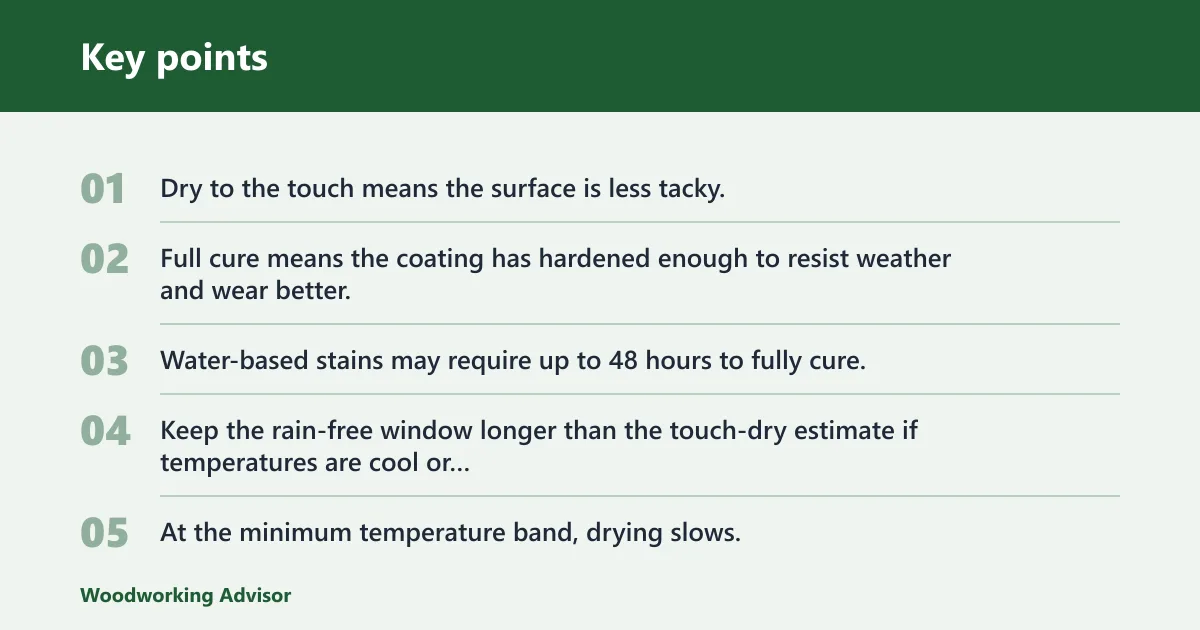
Dry to the touch means the surface is less tacky. Full cure means the coating has hardened enough to resist weather and wear better. Water-based stains may require up to 48 hours to fully cure, and oil-based stains may take 72 hours to cure completely.
Rain risk does not end at dry-to-touch time. Keep the rain-free window longer than the touch-dry estimate if temperatures are cool or humidity is high.
Rain-free window by temperature band
At the minimum temperature band, drying slows. That means the safe rain-free window should be treated more conservatively than a warm-day estimate. If the deck is just above 45°F and humidity is high, the finish may need the full overnight and more before it is weather-safe.
A hot, sunny afternoon is different. But direct sun can also cause stain to flash dry and fail to penetrate the wood, so hotter is not always better.
How humidity slows drying
High humidity lengthens the dry window and increases the chance that dew or evening moisture will interfere with curing. It can also keep the surface tacky longer, which raises the risk of dust pickup and lap marks.
If humidity is high and the forecast includes a cool night, treat that as a double warning.
Behr cold-weather application checklist
This table helps you separate product type, exposure, and weather risk before you start. Use the label on the can first, then compare the deck’s air, surface, and overnight conditions against the product family and the drying window.
| Product type | Exposure | Minimum air temperature | Minimum surface temperature | Safe overnight low | Rain-free window | Go / no-go |
|---|---|---|---|---|---|---|
| Water-based Behr deck stain | Sun | 45°F | At or above the label minimum; verify with infrared thermometer | Above 40°F for the first night | At least the dry-to-touch period, then longer if humidity is high | Go only if the deck stays in range for 8 to 12 hours after application |
| Water-based Behr deck stain | Shade | 45°F | Check carefully; shaded boards may stay cool | Above 40°F for the first night | Longer than the touch-dry estimate if the deck stays cool | No-go if boards are cool and night lows are dropping |
| Oil-based Behr deck stain | Wind | 45°F | At or above the label minimum; wind can cool boards fast | Above 40°F for the first night | Allow extra time beyond the 12-hour touch-dry estimate | Go only with a stable warm spell and low rain risk |
| Any Behr deck stain | Mixed exposure | Use the can in hand | Use the can in hand and an infrared thermometer | Do not start if the first night may fall below 40°F | Match the window to product type, temperature, and humidity | No-go if rain, dew, or cold night falls inside the first cure window |
How to use the checklist
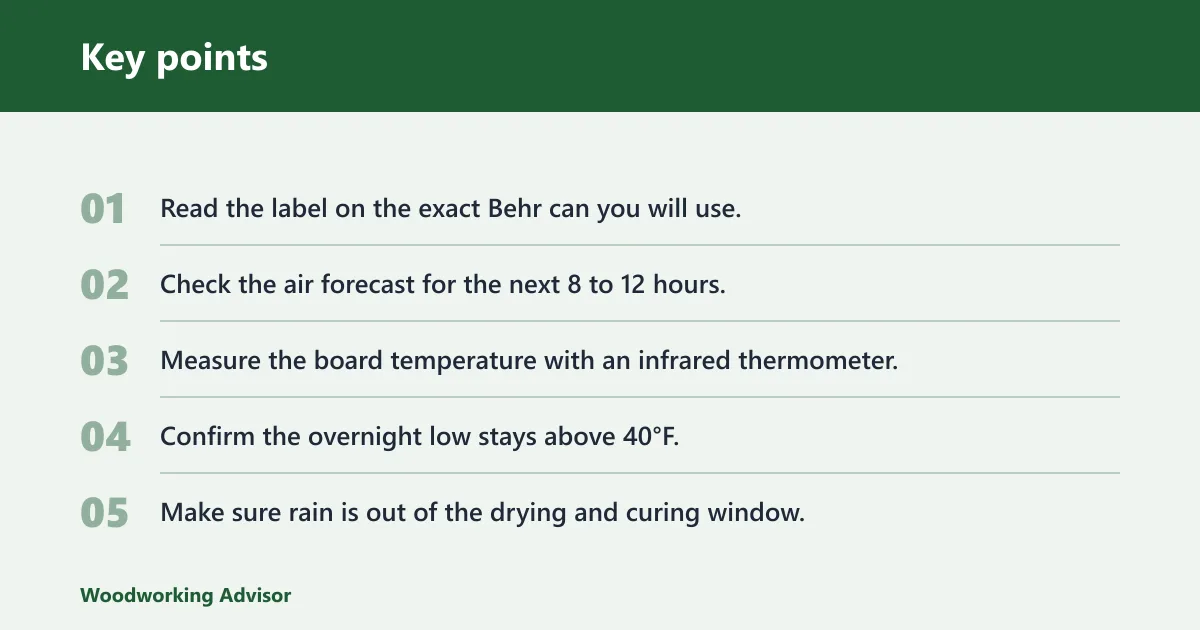
- Read the label on the exact Behr can you will use.
- Check the air forecast for the next 8 to 12 hours.
- Measure the board temperature with an infrared thermometer.
- Confirm the overnight low stays above 40°F.
- Make sure rain is out of the drying and curing window.
- Proceed only if all conditions stay in range.
Should you stain in the morning or afternoon?
Choose the time of day that gives you the best board temperature without pushing the surface into direct-sun flash drying. Morning can be safer on hot, sunny decks. Afternoon can work better on cool decks, but only if the boards are warm enough and the night will stay mild.
Direct sun can heat boards above air temperature
On a bright day, the deck surface may be much warmer than the air. That can speed drying too much and keep stain from soaking in. Direct sunlight can cause stain to flash dry and fail to penetrate the wood.
That is one reason early shade or late-day shade often gives more control.
Shade may stay too cool for too long
Shaded boards may never warm enough to support proper adhesion if the day is cool. That risk is highest in spring or fall, when the sun is lower and the evening cools fast.
A common first-timer mistake is choosing a shaded section because it looks calmer, then finding that the stain is still wet when the temperature drops.
Use an infrared thermometer before you start
Check the deck boards right before application. That gives you the real surface reading, not the forecast. It also helps you decide whether to move with the sun, wait for the shade, or stop for the day.
Picture a 120-square-foot deck with one half in sun and one half under an awning. The sunny side may be ready first, but the shaded side can lag enough to create lap marks if you move too fast.
Frequently asked questions
Is Behr stain good for decks?
Yes, Behr makes exterior deck stains for deck boards and other wood surfaces, but the right choice depends on the exact product and the label on the can in hand. Follow the manufacturer’s directions for minimum temperature, recoat timing, and cure time, especially if you are working in cool weather.
What is the best temperature for staining a deck?
The best temperature is usually the part of the day that stays within the product’s label range without strong direct sun or a cold night. In practical terms, aim for 45 to 95 degrees F, then confirm that the board temperature and overnight low stay favorable long enough for curing.
How long does Behr deck stain take to dry before rain?
Water-based stains typically dry to the touch in 2 hours, while oil-based stains usually dry to the touch in 12 hours. That is not the same as being safe from rain. Full cure can take up to 48 hours for water-based stains and 72 hours for oil-based stains.
Can I stain a deck if temperatures drop below 40°F at night?
Usually not during the first night after application. Many deck stains will not completely cure below 40 degrees at night, and the first 8 to 12 hours are the most important. If the forecast drops below that level, wait for a warmer window with a safer overnight low.
What happens if I stain in high humidity?
High humidity slows drying and extends the period when dust, pollen, dew, and rain can damage the finish. It can also leave the stain tacky longer, which raises the chance of lap marks or surface contamination. Build extra time into the rain-free window if humidity is high.
Sponsored / affiliate links. As an Amazon Associate I earn from qualifying purchases. I may earn additional commission from eligible campaigns.