Gorilla Glue in Cold Weather
Gorilla Glue in cold weather commonly works better when both the adhesive and the parts are above about 40°F (4°C); below that, curing can slow and bond quality may drop, so warming the materials or choosing a glue rated for colder use can help. Ignore that limit, and the joint can creep, fail, or waste a repair. This guide compares Gorilla adhesive options by application temperature, substrate temperature, clamp time, and whether the bond needs to hold indoors or outdoors.
How cold affects adhesive flow, cure, and bonding results
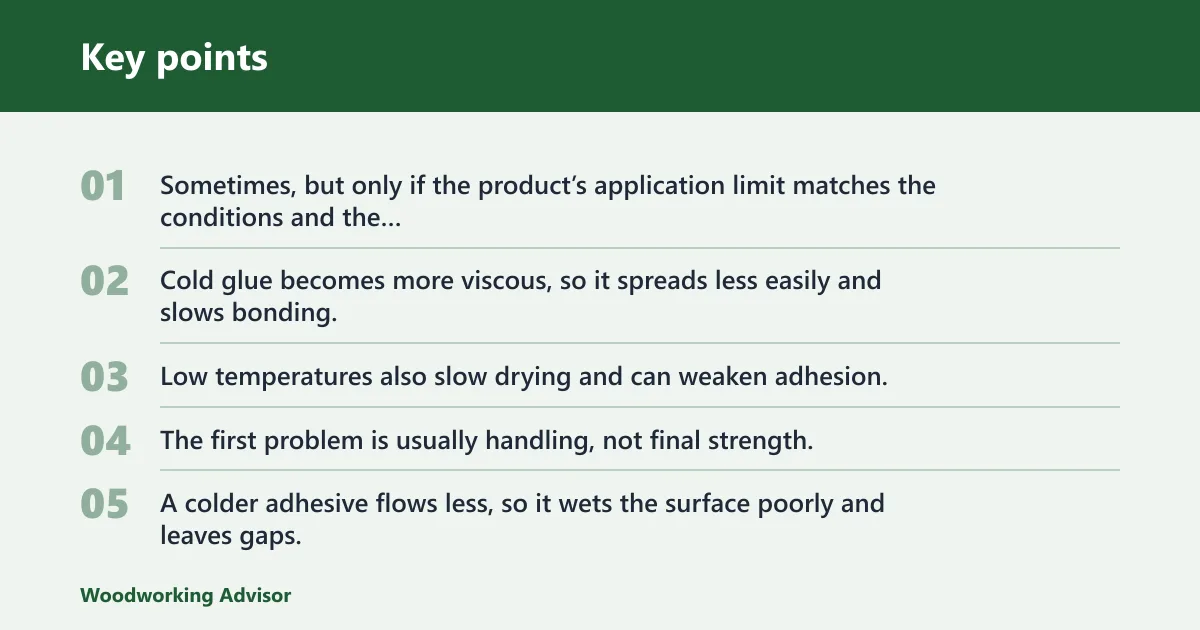


Sometimes, but only if the product’s application limit matches the conditions and the substrate is warm enough to wet out properly. Cold glue becomes more viscous, so it spreads less easily and slows bonding. Low temperatures also slow drying and can weaken adhesion, especially on cold or frosty wood, metal, or masonry.
What cold changes first
The first problem is usually handling, not final strength. A colder adhesive flows less, so it wets the surface poorly and leaves gaps. Then cure slows. On a cold board or bracket, the surface can pull heat out of the adhesive fast enough to delay set far longer than the air temperature alone suggests.
Why substrate temperature matters as much as air temperature
Air may be 45°F while the part you are bonding sits in a cold truck bed or unheated shop at 30°F. That part temperature controls wetting and cure more than the room reading does. Frost, condensation, and thermal mass all work against adhesion because the glue has to bond to the surface, not to the air.
The short answer for indoor, outdoor, and freezing conditions
For indoor repairs, a cold-rated product can work if the parts and adhesive are within spec. For outdoor repairs, choose a product meant for weather exposure, and do not apply over frost, ice, or visible condensation. In freezing conditions, some cured products can survive the service temperature, but that does not mean you can apply them at that temperature.
Application temperature vs service temperature
These are different limits. Application temperature is the temperature at which you can apply the product and expect it to wet the surface and cure correctly. Service temperature is the temperature the cured bond can survive after it has fully set. A product can be usable in storage or after cure without being usable at the moment of application.
What application temperature means
Application temperature is the working window. If the label says apply above 40°F, that means the adhesive, the substrate, and ideally the surrounding space should be above that point before you start. Cold materials can push the real bond line below the stated limit even when the room is warmer.
What service temperature means
Service temperature is the conditions the cured bond can tolerate later. This is the number to check for a finished outdoor repair, but it does not rescue a poor application. A cured bond rated for deep cold can still fail if it was applied to a frosty, damp, or overly cold substrate.
Why those two numbers are not interchangeable
Do not confuse “can survive” with “can be applied.” That mistake leads to weak bonds, brittle lines, or complete release after the first temperature swing. A glue that is fine on a winter fence once cured may still be a poor choice for a same-day repair in a cold shop.
Gorilla adhesive cold-weather decision table
Use this table to separate application temperature from service temperature before you choose a product. It also shows where each one fits best and what usually goes wrong if you use it below spec.
| Product | Minimum application temperature | Service temperature | Best use case | Likely failure mode below spec |
|---|---|---|---|---|
| Original Gorilla Glue | About 40°F for some Gorilla glues | 100% waterproof after cure | Outdoor planters and decor where a moisture-activated polyurethane and expanding fill are useful | Poor wetting, slow cure, foamed-out squeeze-out, weak bond on cold or dry parts |
| Gorilla Super Glue | Some Gorilla glues can be applied at 0 degrees | Not stated here as a universal cold rating | Fast cold-weather quick fixes on small, close-fitting parts | Chalky or brittle line, poor fit-up tolerance, instant grab before parts are aligned |
| Gorilla Epoxy Ultimate | 32°F to 90°F | -40°F to 300°F | Stronger structural repair where a 10-minute set and 4,250 PSI bond strength matter | Slow cure outside the application range, weak wetting on cold mass, brittle bond if mixed or applied cold |
| Gorilla Construction Adhesive Ultimate | Not listed here as a cold application product | 100% waterproof | Deck boards, railings, and exterior trim when you need working time and outdoor durability | Too-thick flow, delayed grab, or slip if the substrate is too cold for proper tack |
| Gorilla masonry construction adhesive | Made for damp surfaces | Cures in 2 to 7 days | Concrete, stone, granite, brick, pavers, and slate | Long cure, weak early hold, bond failure if frost or standing water is present |
| Permanent Gorilla Tape All-Weather | Above 40°F | 0°F to 200°F | Temporary or semi-permanent holds where a weather-resistant shell is enough | Poor initial adhesion if applied too cold, edge lift, peeling on dirty or icy surfaces |
How to read the table
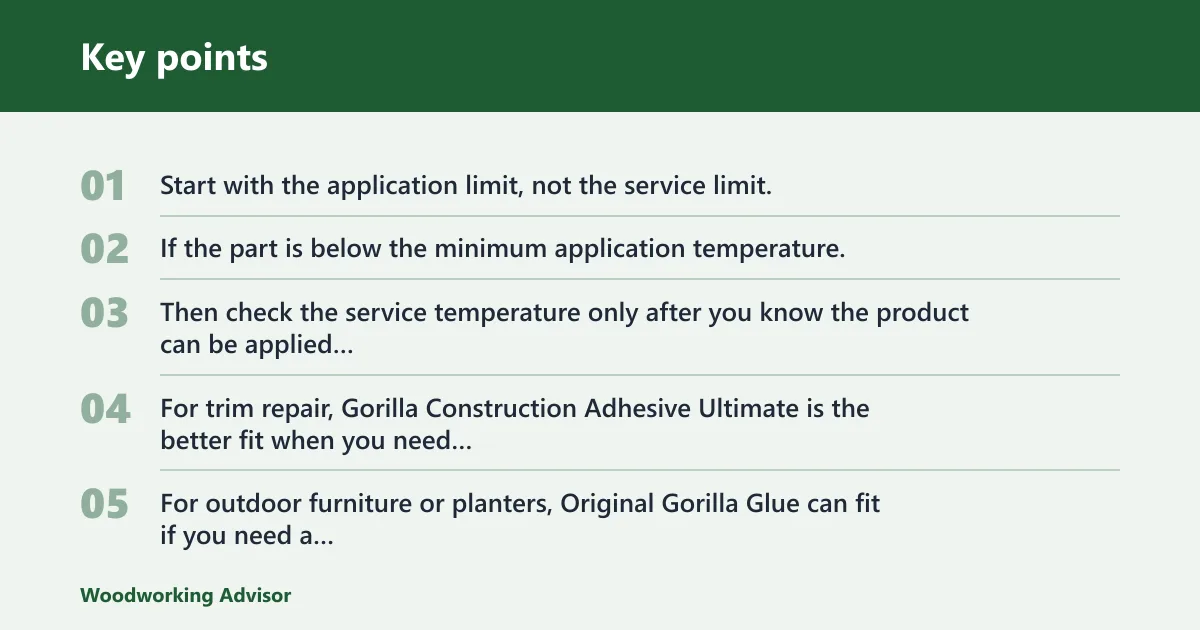
Start with the application limit, not the service limit. If the part is below the minimum application temperature, move to a warmer space or choose a different fastening method. Then check the service temperature only after you know the product can be applied correctly.
Which product fits trim repair, outdoor furniture, or masonry-adjacent work?
For trim repair, Gorilla Construction Adhesive Ultimate is the better fit when you need exterior durability and working time. For outdoor furniture or planters, Original Gorilla Glue can fit if you need a moisture-activated polyurethane and can control the temperature and surface condition. For stone, brick, or pavers, Gorilla Landscape Construction Adhesive is the relevant option because it is made for those materials and tolerates damp surfaces.
Which Gorilla product fits your project?
Pick by substrate first, then by temperature, then by required speed. A product that works on wood may not be the best choice for concrete or stone, and a fast fix is not the same as a structural repair. If you need a bond that must survive winter exposure, service temperature matters; if you need a bond today, application temperature matters more.
Outdoor wood repairs and weather exposure
For outdoor wood, choose between Original Gorilla Glue and Gorilla Construction Adhesive Ultimate based on the joint. Original Gorilla Glue works well for outdoor planters and decor when you can control moisture and clamping. Construction Adhesive Ultimate is the better fit for deck boards, railings, and exterior trim where a tougher building adhesive is more appropriate.
Quick fixes in a cold shop
Gorilla Super Glue is the cold-weather quick-fix product in this lineup. It sets faster than polyurethane and is useful for small, close-fitting parts where you need speed more than gap filling. It is not the right choice for large gaps, structural spans, or heavily stressed joints.
Concrete, stone, brick, and paver repairs
Use Gorilla Landscape Construction Adhesive when the repair is masonry-adjacent and the surface may be damp. It is made for concrete, stone, granite, brick, pavers, and slate. That said, damp is not the same as wet, icy, or frost-covered. Below-spec cold still risks a weak early bond and a long wait for full cure.
Cold-weather prep is simple and unforgiving: clean, dry, and frost-free surfaces first. Warming the glue helps, but it does not fix a cold substrate or contamination on the surface. For many winter repairs, prep quality matters more than brand choice.
- Remove dust, loose finish, oil, and old adhesive.
- Check for condensation, frost, or ice on both parts.
- Bring the adhesive and parts into the application range.
- Dry the surface fully unless the product specifically allows damp use.
- Apply a thin, even layer and clamp or hold the parts as directed.
- Leave the joint undisturbed for the full working and cure window.
Warming the glue before use
Warming the adhesive container to room temperature can improve flow and mixing. That helps, but it is only part of the solution. If the wood or masonry is still cold, the joint can still set slowly or poorly because the surface is pulling heat out of the bond line.
Why dampness helps one product and hurts another
Original Gorilla Glue uses moisture activation, but that is not the same as bonding to a wet or icy surface. Gorilla Landscape Construction Adhesive can be used on damp surfaces, which is why it is the better masonry choice. For other products, moisture can interfere with adhesion, especially if it shows up as condensation or frost.
Say your exterior trim is 36°F at the surface even though the garage air reads 48°F. That trim still behaves like a cold substrate, so a bead that looked fine in the tube can turn sluggish, slip, or skin over before it grabs.
How long does Gorilla Glue take to dry in cold weather?
Cold makes every stage slower: open time, clamp time, and full cure. Dry time is not the same as clamp time, and neither is the same as full cure. In cold weather, the practical answer is that you should expect longer waits than the label’s normal conditions imply, especially on cold or massive substrates.
Dry time vs clamp time vs full cure
Dry time is when the surface stops feeling wet. Clamp time is when the parts need to stay held together. Full cure is when the bond reaches its intended strength. People often stop too early because the surface looks set while the adhesive underneath is still developing strength.
Why cold extends every stage
Cold adhesive wets less well and cures more slowly. Cold wood, metal, or masonry adds more delay by cooling the bond line. If the part is also damp, the process becomes even less predictable because water can help one product and weaken another.
When you should stop waiting and change the repair method
If the substrate stays below the product’s application minimum, if frost returns, or if the joint must carry load before a long cure can finish, switch methods. Screws, nails, brackets, or indoor curing are safer than waiting on a marginal adhesive joint. A weak bond that needs repair twice costs more time than a mechanical fastener upfront.
When to switch from adhesive to fasteners
Switch to mechanical fasteners when the parts are too cold to stay within application limits, when the surfaces cannot be kept dry, or when the repair will be stressed before cure finishes. Adhesive is a good choice for the right joint. It is not the right answer for every winter repair.
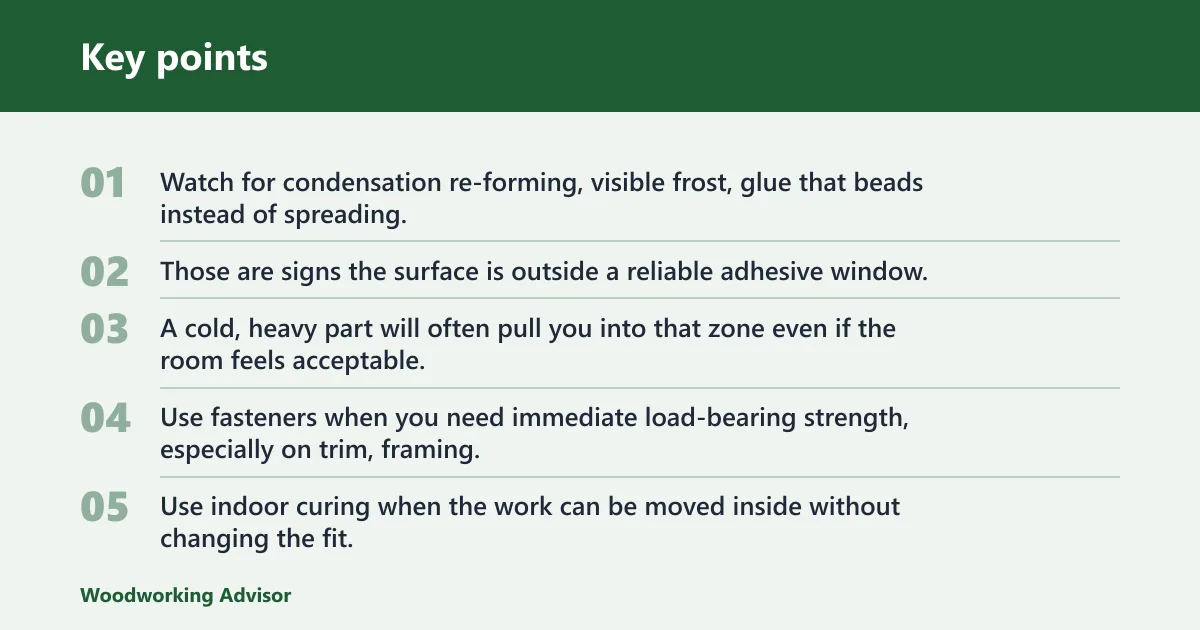
Signs the joint is too cold or too damp
Watch for condensation re-forming, visible frost, glue that beads instead of spreading, or a joint that slips under light pressure. Those are signs the surface is outside a reliable adhesive window. A cold, heavy part will often pull you into that zone even if the room feels acceptable.
Cases where screws, nails, or indoor curing are safer
Use fasteners when you need immediate load-bearing strength, especially on trim, framing, or temporary winter repairs. Use indoor curing when the work can be moved inside without changing the fit. A common first-timer mistake is trusting a quick grab on a cold joint and then discovering the bond never really developed.
How to avoid brittle or weak bonds
Do not apply a structural adhesive to frost-covered parts. Do not assume a cured bond rated for cold service can be created in freezing air. And do not rely on a tiny glue line where a mechanical joint or hybrid fastener-and-adhesive approach would better handle movement and temperature swing.
Frequently asked questions
Will Gorilla Glue dry in cold weather?
It can dry more slowly, but “dry” is the wrong target if the joint is below the product’s application range. Cold makes adhesive more viscous and slows cure, so a surface may look set while the bond is still weak. Warm the parts or choose a glue rated for colder use.
Will Gorilla Glue cure in cold weather?
Some Gorilla products can cure in colder conditions, but only within their stated application limits. Some Gorilla glues require 40 degrees at application, while some Gorilla glues can be applied at 0 degrees. The label matters because cure speed and bond quality both drop when temperature falls.
Can you use Gorilla Glue in cold weather?
Yes, if you match the product to the temperature and the substrate. Original Gorilla Glue, Gorilla Super Glue, Gorilla Epoxy Ultimate, Gorilla Construction Adhesive Ultimate, Gorilla Landscape Construction Adhesive, and Permanent Gorilla Tape All-Weather all have different limits. Cold weather itself is not the problem; using the wrong product at the wrong temperature is.
Does Gorilla Glue hold up in cold weather?
A cured bond may hold up in cold service if the product’s service temperature covers the use case. That is separate from application conditions. For example, Gorilla Epoxy Ultimate cures to handle -40°F to 300°F, while Permanent Gorilla Tape All-Weather has a 0°F to 200°F service temperature. Neither number fixes a poor cold application.
Does Gorilla Super Glue work in cold weather?
Gorilla Super Glue is the cold-weather quick-fix option among these products because it is a cyanoacrylate adhesive and sets faster than polyurethane. It is useful for small parts and tight joints, not for wide gaps or structural outdoor repairs. Cold still slows performance if the parts are below spec.
Does Gorilla Glue work in freezing temperatures?
Some cured Gorilla products can survive freezing temperatures, but that does not mean you can apply them there. Gorilla Epoxy Ultimate can be applied from 32°F to 90°F and cured bond handles -40°F to 300°F. That split between application and service is the key distinction to keep straight.
Sponsored / affiliate links. As an Amazon Associate I earn from qualifying purchases. I may earn additional commission from eligible campaigns.