Hammer Drill Vs Impact Driver Key Differences
Choosing the right tool can be tricky when you’re just starting out with DIY projects. You see a hammer drill and an impact driver, and they look pretty similar, right? Well, that’s where things can get a little confusing.
Lots of folks wonder about the Hammer Drill vs Impact Driver: Key Differences Explained because they both spin and make noise, but they do different jobs. Don’t worry, though! We’ll break it down super simply, step-by-step, so you’ll know exactly which one you need for your next task.
Let’s get started by looking at what makes them unique.
Hammer Drill Vs Impact Driver What’s The Difference
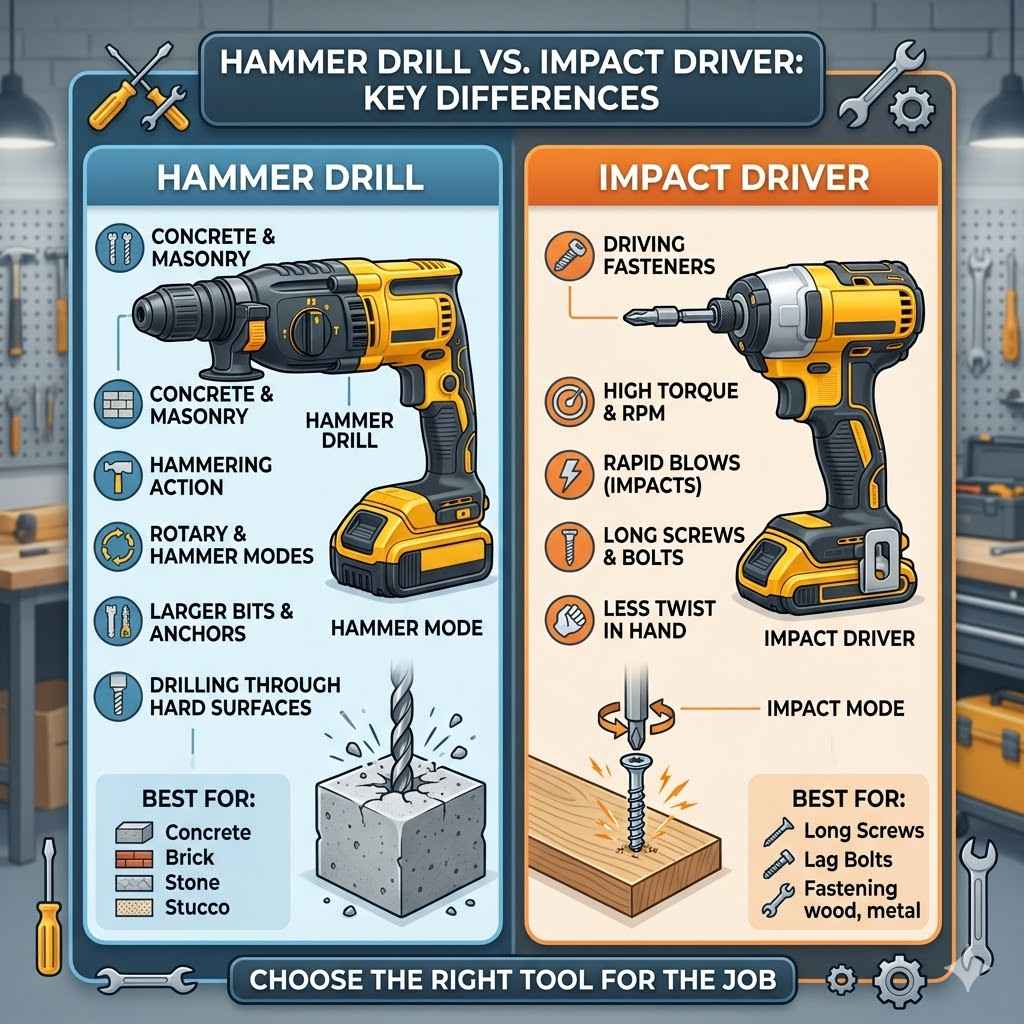
Understanding the core differences between a hammer drill and an impact driver is the first big step to picking the right tool for your job. Many DIYers get confused because both tools spin and can drive screws or drill holes. However, their mechanisms and intended uses are quite distinct.
A hammer drill is essentially a drill with an added hammering function, ideal for drilling into hard materials like concrete or brick. An impact driver, on the other hand, is designed for high-torque fastening, meaning it excels at driving long screws or bolts into tough materials with a powerful, percussive action.
This distinction in function means they handle different tasks with varying degrees of efficiency and effectiveness. For instance, trying to drill a large hole in concrete with an impact driver simply won’t work as intended, and using a hammer drill for repeatedly driving many screws might feel less powerful and more fatiguing than an impact driver. The goal of this section is to clearly define these two tools and set the stage for a deeper exploration of their unique capabilities.
What Is A Hammer Drill
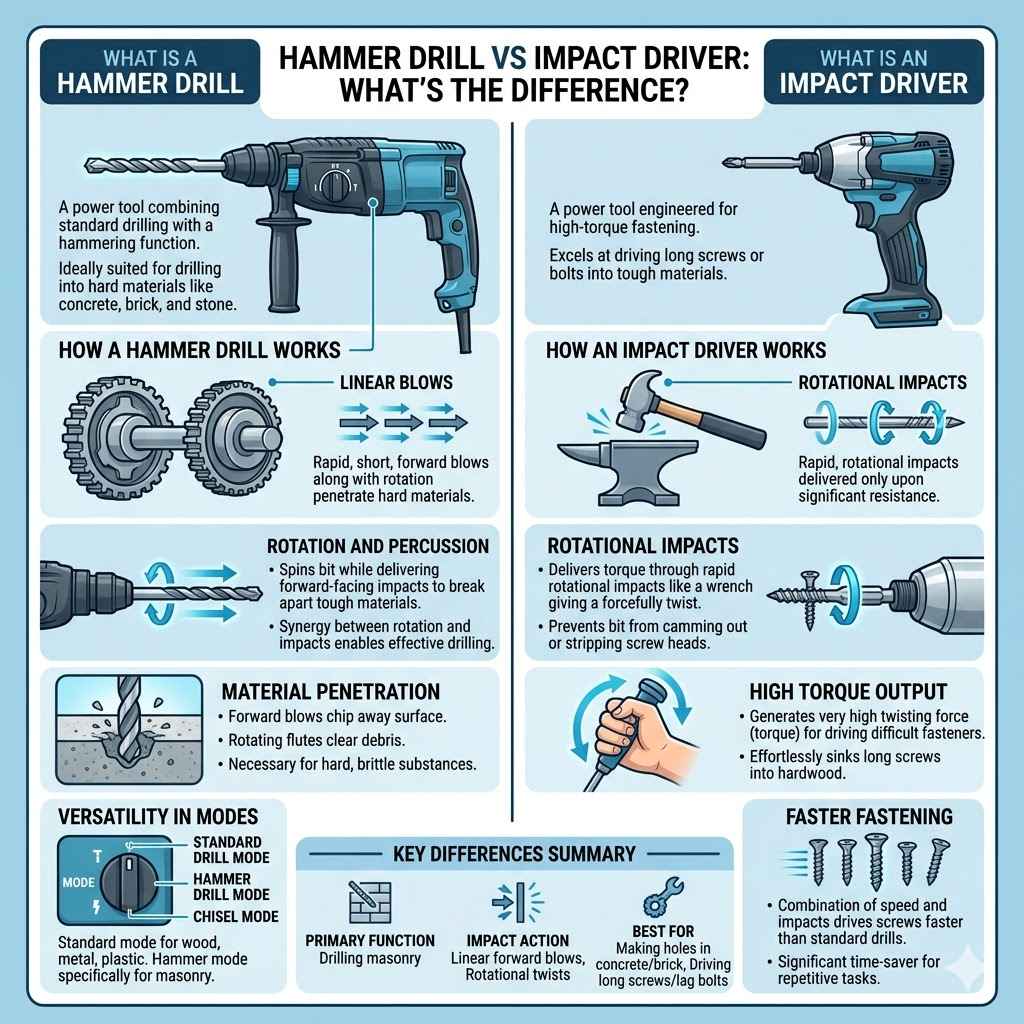
A hammer drill is a power tool that combines the functions of a standard drill with a hammering mechanism. When set to its hammer mode, it delivers rapid, short, forward blows along with the rotation of the drill bit. This hammering action is crucial for drilling into hard, brittle materials like concrete, brick, and stone.
The force of these blows helps to chip away at the material, allowing the drill bit to penetrate more effectively.
Hammer drills typically have a switch that allows you to toggle between standard drilling mode and hammer drilling mode. In standard drilling mode, it functions just like a regular drill. In hammer mode, the internal mechanism engages, creating the percussive effect.
This dual functionality makes it a versatile tool for a wide range of construction and renovation tasks. The size and power of hammer drills can vary significantly, from compact, lightweight models for light-duty tasks to heavy-duty, corded versions for professional applications.
How A Hammer Drill Works
The hammering action in a hammer drill is achieved through a mechanism called a cam or clutch system. Inside the drill, there are two toothed rings. When the hammer function is engaged, these rings rotate against each other.
As they turn, they push forward and then release rapidly, creating the percussive blows. This action is similar to a tiny jackhammer happening thousands of times per minute.
The speed and force of these blows depend on the drill’s motor and the internal mechanism. The rotation of the drill bit then works in conjunction with these blows to break up and remove material. It is important to note that this is a linear blow, meaning it pushes straight forward.
This is different from the rotational impact of an impact driver.
Rotation And Percussion
The hammer drill spins the drill bit while simultaneously delivering forward-facing impacts. This combination breaks apart tough materials like concrete or masonry. Without the rotation, the impacts would just push the bit back and forth.
Without the impacts, drilling into concrete would be extremely slow and difficult. The synergy between these two actions is what makes hammer drills effective for their specific purpose. The intensity of the hammering can often be adjusted by the user, allowing for more control when working with different materials or different types of bits.
Material Penetration
The forward blows created by the hammer drill chip away at the surface of hard materials. This chipping action creates small fragments of material that are then cleared away by the rotating flutes of the drill bit. This process is vital for making holes in substances that would resist or even break standard drill bits.
Imagine trying to hammer a nail into a wall versus just pushing it – the hammer provides the necessary force to overcome the material’s resistance. Similarly, the hammer action overcomes the resistance of dense materials like concrete.
Versatility In Modes
Most hammer drills offer at least two modes: standard drill mode and hammer drill mode. Some advanced models may even include a chisel mode. Standard drill mode is for drilling into wood, metal, or plastic.
Hammer drill mode is specifically for masonry. Chisel mode, if available, allows the tool to act more like a rotary hammer for chipping or light demolition work. This adaptability means one tool can serve multiple functions on a job site, reducing the need for specialized equipment for certain tasks.
What Is An Impact Driver
An impact driver is a power tool specifically engineered for driving fasteners like screws and bolts with significant force and torque. It achieves this through a unique mechanism that delivers rapid, rotational impacts. When the trigger is pulled, the tool spins the bit while also applying a powerful hammering force that is applied rotationally.
This means the impacts strike in a twisting motion, not a forward-and-back one like a hammer drill.
This design makes impact drivers incredibly efficient at driving long screws, lag bolts, or nuts into dense materials like hardwood or even metal studs. The additional torque provided by the impact mechanism allows it to overcome resistance that would stall a standard drill or require significant user effort. They are also designed to be more compact and lighter than many drills, making them easier to handle for extended periods.
How An Impact Driver Works
The core of an impact driver’s functionality lies in its striking mechanism, which is different from a hammer drill’s. When you squeeze the trigger, an internal motor spins a hammer. This hammer strikes an anvil, which is attached to the output shaft that holds the driver bit.
However, this striking action is not a constant forward beat. Instead, it’s a quick, powerful twist that happens only when there’s significant resistance.
This rotational impact is what gives the tool its immense fastening power. It’s like giving the screw a very strong, very fast twist. This percussive action helps to overcome the friction and resistance encountered when driving fasteners deep into materials, preventing the bit from camming out or stripping the screw head.
The driver also has a clutch system that can disengage the hammer when resistance is low, preventing overtightening.
Rotational Impacts
Unlike the linear blows of a hammer drill, an impact driver delivers torque through rapid rotational impacts. Imagine a powerful wrench giving a quick, forceful twist to a bolt. This twisting force is applied repeatedly and forcefully when the tool encounters resistance.
This action is key to its ability to sink screws quickly and deeply without requiring as much physical effort from the user. The speed at which these impacts occur is incredibly high, often thousands of times per minute.
High Torque Output
The primary advantage of an impact driver is its ability to generate very high torque. Torque is a twisting force. This high torque allows it to drive fasteners that would be nearly impossible for a standard drill.
For example, driving a 3-inch screw into hardwood can be done effortlessly with an impact driver. This makes them indispensable for tasks like building decks, framing, or assembling furniture that requires robust fastening.
- Faster Fastening
The combination of rotational speed and powerful impacts means impact drivers can drive screws much faster than standard drills. This is a significant time-saver on projects that involve a lot of fasteners. The tool practically drives the screw itself once it bites into the material.This efficiency is a major reason why many professionals prefer impact drivers for repetitive fastening tasks, as it reduces fatigue and speeds up the overall work.
Hammer Drill vs Impact Driver Key Differences Explained
Now that we’ve explored what each tool is and how it works, let’s directly compare the Hammer Drill vs Impact Driver: Key Differences Explained. The most fundamental distinction lies in their intended purpose and the way they deliver power. A hammer drill is designed for drilling holes, especially in hard materials, using a combination of rotation and forward-facing impacts.
An impact driver, conversely, is designed for fastening, using rotation combined with powerful rotational impacts to drive screws and bolts with exceptional force and speed.
Think of it this way: a hammer drill is like a powerful drill that can also pound, making it ideal for breaking through tough surfaces. An impact driver is like a super-powered screwdriver, designed to twist fasteners in with immense, rapid force. This fundamental difference dictates which tool is best suited for various applications.
Choosing the wrong tool can lead to frustration, inefficiency, and even damage to your materials or the tool itself. Understanding these core differences is essential for making informed decisions for your projects.
Drilling vs Fastening
The primary difference boils down to their core functions: drilling and fastening. A hammer drill excels at drilling holes. The percussive action helps break up material, allowing the drill bit to penetrate.
It can also drive screws, but it’s not its specialty, and the hammering can sometimes be too aggressive for delicate screws or materials.
An impact driver, however, is built for fastening. Its rotational impacts provide the torque needed to drive screws quickly and deeply into various materials, including hardwoods and metals. While some impact drivers can be used for drilling with specific bits, they are generally less precise for delicate drilling tasks compared to a dedicated drill or hammer drill.
The continuous impacts can be difficult to control for precise hole placement.
Hole Making Capability
Hammer drills are superior when the primary goal is to create holes, particularly in masonry. The hammer action makes short work of concrete, brick, and stone. While a standard drill can struggle, a hammer drill efficiently bores through these hard materials.
For general drilling into wood or metal, a hammer drill can still be used in its standard drill mode, making it a versatile choice for a variety of hole-making tasks.
Driving Screw Power
Impact drivers are the undisputed champions when it comes to driving screws. Their ability to deliver high torque with rapid rotational impacts means they can sink long screws into dense materials with ease. This power prevents cam-out (the bit slipping out of the screw head) and reduces the strain on the user.
For projects involving numerous screws, like deck building or framing, an impact driver is invaluable for both speed and efficiency.
Material Suitability
Hammer drills are best suited for drilling into masonry, concrete, and brick. They can also drill into wood and metal. Impact drivers are ideal for driving screws and bolts into wood, composite materials, and even light metal framing.
Using a hammer drill to drive many screws can lead to overtightening and stripping. Using an impact driver for extensive masonry drilling is generally ineffective and could damage the tool.
Power Delivery Mechanism
The way these tools deliver their power is a key differentiator. A hammer drill uses a cam or gear system to create forward, hammering blows that are independent of the rotation. This means the hammering action is a pulsating forward force.
An impact driver, on the other hand, uses a spring-loaded hammer that strikes an anvil in a rotational direction.
This means the power delivery is a series of rapid twists. This rotational impact is far more efficient for driving fasteners because it applies torque directly to the screw head. The hammer drill’s forward blows are more about breaking material, while the impact driver’s rotational blows are about turning and sinking.
Forward Hammering Action
The hammer drill’s mechanism creates a linear, forward thrust combined with rotation. This is achieved by two toothed plates that slide against each other, creating the “hammer” effect. This action is powerful for chipping away at hard materials.
It provides a direct force against the material being drilled, helping to break it down. The intensity of this action can often be adjusted based on the material.
Rotational Impact Delivery
The impact driver uses a hammer that spins and strikes an anvil. This anvil is connected to the drive shaft. When the tool encounters resistance, the hammer is released and strikes the anvil, delivering a powerful twisting force to the bit.
This happens thousands of times per minute, providing immense torque. This rotational nature is what makes it so effective for driving screws.
Torque vs Force
While both tools deliver power, the type of power differs. A hammer drill delivers significant forward force to break material. An impact driver delivers exceptionally high torque, which is rotational force, to turn fasteners.
For driving a screw, torque is critical. For drilling into concrete, forward force is crucial. This distinction is why they are not interchangeable for all tasks.
Control and Precision
When it comes to control and precision, there are notable differences. Hammer drills, especially in their standard drill mode, offer good control for drilling holes in a variety of materials. The variable speed trigger allows for careful speed adjustment.
However, in hammer mode, the percussive action can sometimes make precise placement of the very first bit contact difficult on very hard surfaces.
Impact drivers, with their high torque and rapid impacts, are designed for power, not delicate precision in drilling. They excel at driving screws straight and deep. However, their power can sometimes make it challenging to control the exact depth of a screw in softer materials, and they are not recommended for drilling holes where a clean, precise entrance is required, as the impacts can be less controlled than a standard drill’s rotation.
Variable Speed Triggers
Both tools typically feature variable speed triggers. This allows users to control the speed of rotation by how hard they squeeze the trigger. This is important for starting screws slowly or controlling the speed of a drill bit.
However, the impact action in both tools can sometimes override fine speed control when under load, especially in the case of an impact driver.
Precision Drilling
For precise drilling, especially into softer materials where you need to start a hole carefully without wandering, a standard drill or a hammer drill in its standard mode is generally preferred. The consistent rotation and controlled speed offer better accuracy for starting a hole exactly where you want it.
Driving Accuracy
Impact drivers are fantastic for driving screws accurately and consistently. The controlled bursts of torque help keep the bit engaged with the screw head, reducing stripping and ensuring the screw goes in straight. They are designed for efficiency and power in fastening, making them excellent for repetitive screw-driving tasks.
When To Use Which Tool
Deciding between a hammer drill and an impact driver comes down to the specific task at hand. If your main job involves creating holes, especially in tough materials like concrete or brick, the hammer drill is your go-to. Its ability to hammer and drill simultaneously makes it far more effective and efficient for these applications.
For general drilling in wood, metal, or plastic, a hammer drill can also serve admirably, especially if you have one already.
Conversely, if your project involves driving a lot of screws, lag bolts, or nuts, or if you’re working with dense materials like hardwoods, an impact driver will significantly outperform a standard drill or hammer drill. It saves time, reduces user fatigue, and provides superior fastening power. Understanding these scenarios will help you make the right choice and get the job done effectively and safely.
Ideal Hammer Drill Applications
Hammer drills shine when you need to penetrate hard materials. This includes tasks like mounting shelves on a brick wall, installing anchors for outdoor furniture on a concrete patio, or drilling holes for electrical conduits in a concrete block wall. They are also useful for general drilling tasks where you might encounter occasional harder spots in wood or other materials.
Some common projects where a hammer drill is essential include:
Masonry Drilling
Drilling into concrete, brick, stone, and other similar building materials. This is the hammer drill’s primary strength. It allows you to create pilot holes for anchors, create openings for pipes or wires, or install mounting hardware securely into these robust surfaces.
The rapid-fire hammering action breaks down the material, making the drilling process feasible and efficient.
Anchor Installation
When you need to install expansion anchors or concrete screws into walls or floors made of masonry. The hammer drill ensures the hole is deep and wide enough for the anchor to grip the material effectively, providing a secure hold for whatever you’re attaching.
General Purpose Drilling
For general construction or renovation tasks, a hammer drill can function as a standard drill. If you anticipate hitting harder spots in wood or need to drill through slightly tougher materials, the hammer drill’s versatility makes it a good all-around choice for many home improvement projects.
Ideal Impact Driver Applications
Impact drivers are indispensable for tasks requiring significant fastening power and speed. If you’re building a deck, framing a wall, assembling furniture with large screws, or working on automotive repairs where nuts and bolts need to be tightened with force, an impact driver is the tool you want.
Here are some scenarios where an impact driver excels:
Driving Long Screws
Sinking long screws (e.g., 3-inch deck screws) into dense hardwoods or pressure-treated lumber. The high torque of an impact driver makes this task quick and easy, preventing stripped screw heads and user fatigue. It drives the screw in smoothly and powerfully.
Woodworking and Framing
For building projects like decks, fences, or framing walls, where numerous screws need to be driven quickly and securely. The impact driver’s speed and power significantly speed up these repetitive tasks.
Automotive and Mechanical Work
Loosening or tightening bolts and nuts on vehicles or machinery. Impact drivers with appropriate sockets can be very effective for these applications, providing the necessary force to break loose stubborn fasteners or tighten them securely.
When Not To Use Each Tool
It’s just as important to know when not to use each tool. You wouldn’t use a hammer drill to drive hundreds of small screws into softwood, as the hammering action can be overkill and potentially damage the wood or strip the screws. Similarly, you shouldn’t use an impact driver for delicate drilling tasks, like starting a small pilot hole in thin metal or plastic, as the powerful impacts can cause the bit to wander or break.
It’s also not ideal for tasks requiring precise depth control without practice.
Here are some situations to avoid:
Using Hammer Drill for Delicate Fastening
When you need to drive many small screws into soft wood or particle board, the hammering action of a hammer drill can be too much. It can strip the screw heads, damage the material, or even break the screw. A standard drill or impact driver (on a low setting) is much better suited for these tasks.
Using Impact Driver for Precise Drilling
If you need to drill a very clean, precise hole in material like thin sheet metal or delicate plastic, an impact driver is not the best choice. The forceful, rotational impacts can cause the drill bit to slip, make the hole larger than intended, or even shatter brittle materials. A standard drill offers much finer control for such jobs.
Using Impact Driver for Masonry Drilling
Impact drivers are not designed to drill into concrete or brick effectively. They lack the forward-hammering action needed to break up these hard materials. Attempting to do so will likely result in frustration, slow progress, and potential damage to the tool or the material.
Impact Driver vs Hammer Drill Torque And Speed
When comparing a hammer drill and an impact driver, the concepts of torque and speed are crucial to understanding their performance. Torque refers to the rotational force applied by the tool. Speed refers to how fast the tool rotates or impacts.
These two factors, in combination with the tool’s mechanism, determine its effectiveness for different tasks.
Impact drivers generally boast higher torque ratings than hammer drills. This is their primary advantage for driving fasteners. While hammer drills have decent rotational speed, their torque output for pure fastening is often less than an impact driver.
The speed of hammer drills, especially in hammer mode, refers more to the rate of percussive blows. Understanding these differences will help you select the right tool for the job’s demands.
Torque Comparison
Torque is measured in inch-pounds (in-lbs) or foot-pounds (ft-lbs). Impact drivers typically have significantly higher torque ratings, often ranging from 1,000 to 2,000 in-lbs or even more. This high torque is generated by the striking mechanism, which amplifies the rotational force.
Hammer drills, while capable of driving screws, generally have lower torque ratings for fastening compared to impact drivers. Their torque figures might range from 300 to 600 in-lbs. However, their hammering action provides the force needed for drilling into hard materials, which is a different kind of power than fastening torque.
| Tool | Typical Torque Range (in-lbs) | Primary Use |
|---|---|---|
| Hammer Drill | 300 – 600 | Drilling (especially masonry) |
| Impact Driver | 1000 – 2000+ | Fastening (screws, bolts) |
Higher Torque For Fastening
The higher torque of an impact driver is its defining characteristic for fastening. This allows it to sink long screws, lag bolts, and tight nuts with minimal effort. The tool provides the power, so you don’t have to muscle the fastener into place.
This is invaluable for large construction projects or when working with tough materials.
Torque vs Hammering Force
It’s important to distinguish between the torque for rotation and the force of hammering. A hammer drill’s “force” comes from its percussive blows to break material. An impact driver’s “torque” comes from its rotational impacts to turn fasteners.
While both deliver power, they do so in different ways and for different purposes.
Impact Wrench Comparison
For even higher torque needs, especially in automotive or heavy-duty mechanical work, impact wrenches exist. These tools deliver even more torque than standard impact drivers and are designed specifically for loosening and tightening large nuts and bolts.
Speed Considerations
Speed is another factor that differentiates these tools. Impact drivers typically operate at higher rotational speeds (RPMs) when driving fasteners, but the actual effective speed is often moderated by the rapid impacts. The goal is to drive the fastener quickly while maintaining control.
Hammer drills have variable RPMs for drilling. In hammer mode, the speed often refers to the blows per minute (BPM), which can be quite high, indicating how rapidly the hammering action occurs. For general drilling, a hammer drill’s RPMs are usually sufficient.
For driving screws, an impact driver’s speed is optimized for efficiency.
Revolutions Per Minute (RPM)
RPM indicates how many times the drill bit or driver bit spins in one minute. Impact drivers often have RPMs in the range of 0-2,500 RPM, but the speed is dynamically controlled by the trigger and the resistance. Hammer drills also have similar RPM ranges, but their primary function isn’t based on maximizing pure rotational speed for fastening.
Blows Per Minute (BPM)
BPM is a measure specific to hammer drills and rotary hammers. It signifies the number of hammering impacts delivered per minute. A higher BPM generally means faster drilling into masonry.
For example, a hammer drill might have a BPM of 0-40,000.
Efficiency Through Speed
Both tools leverage speed to perform their intended tasks efficiently. Impact drivers use high rotational speeds combined with rapid impacts to drive screws fast. Hammer drills use rotational speed alongside a high BPM to bore through hard materials quickly.
The optimal speed for each task is crucial for performance and tool longevity.
Power Source And Battery Considerations
Both hammer drills and impact drivers are commonly available as cordless (battery-powered) or corded (plug-in) models. Cordless tools offer portability and convenience, making them popular for most DIYers and professionals alike. However, battery technology, charging times, and compatibility are important considerations for any cordless tool user.
The type of battery (e.g., lithium-ion) and its voltage will affect the tool’s power and runtime. Corded models offer consistent, unlimited power but tether you to an outlet. For most general applications, a good quality cordless hammer drill and impact driver combination is highly recommended for their flexibility and ease of use.
Understanding battery life and charging expectations is key to uninterrupted work.
Cordless vs Corded
Cordless tools offer unparalleled freedom of movement. You can take them anywhere on a job site or around your home without worrying about proximity to a power outlet. This makes them ideal for outdoor projects, working at heights, or in tight spaces.
However, battery life is a finite resource, and charging can take time.
Corded tools provide a continuous, uninterrupted power supply, meaning you don’t have to worry about batteries running out. They are often more powerful for heavy-duty, continuous tasks. The main drawback is the limitation of the power cord, which can be cumbersome and restrict movement.
Portability and Freedom
Cordless tools are king when it comes to portability. They let you move freely around your workspace without the hassle of a cord. This is especially important for large projects or when working in areas far from power sources.
Consistent Power
Corded tools offer the advantage of consistent, unlimited power. This is beneficial for demanding tasks that require sustained high performance, eliminating the need to swap batteries or wait for charging.
Battery Technology
The advancement in battery technology, particularly lithium-ion, has made cordless tools incredibly powerful and long-lasting. Most modern cordless drills and impact drivers use these efficient batteries.
Battery Voltage And Runtime
Battery voltage is a key indicator of a cordless tool’s power. Common voltages for hammer drills and impact drivers range from 12V for compact, lightweight tools to 18V or 20V for more powerful, standard-sized tools. Higher voltage generally means more power and torque.
Runtime, or how long a tool can operate on a single charge, depends on the battery’s amp-hour (Ah) rating and the tool’s power consumption. A higher Ah rating means longer runtime. For demanding jobs, having extra batteries is highly recommended to ensure continuous work without extended downtime for charging.
Voltage And Power
A 20V hammer drill or impact driver will typically offer more power and better performance than a 12V model. The higher voltage allows the motor to deliver more force, which is crucial for tough tasks. This is why many professionals opt for 18V or 20V systems.
Amp-Hours (Ah)
The Ah rating tells you how much energy the battery stores. A 4.0 Ah battery will last roughly twice as long as a 2.0 Ah battery under the same load. This is a critical factor for choosing a battery that matches your typical usage.
Fast Charging Technology
Many manufacturers offer fast-charging battery systems that can charge a depleted battery in under an hour, sometimes even in 30 minutes. This significantly reduces downtime on the job.
Frequently Asked Questions
Question: Can I use an impact driver as a hammer drill?
Answer: No, an impact driver cannot effectively function as a hammer drill. While it has a hammering action, it is rotational and designed for fastening, not for drilling into hard materials like concrete or brick.
Question: Can I use a hammer drill to drive screws?
Answer: Yes, you can use a hammer drill to drive screws in its standard drill mode. However, it is generally less efficient and powerful for this task than an impact driver, especially for long screws or dense materials.
Question: Which tool is better for building a deck?
Answer: An impact driver is generally better for building a deck. It excels at driving the numerous long screws required into wood quickly and with less effort.
Question: Do I need a hammer drill if I have an impact driver?
Answer: If you plan on drilling into masonry (concrete, brick, stone), then yes, a hammer drill is highly recommended. If your work is primarily with wood and screws, an impact driver might suffice on its own.
Question: What is the main difference in their sound?
Answer: An impact driver makes a distinct “ratcheting” or “chattering” sound as it delivers rapid rotational impacts. A hammer drill in hammer mode makes a more continuous “banging” or “drilling” sound as it hammers forward.
Summary
The hammer drill and impact driver are distinct tools with unique strengths. A hammer drill excels at drilling into tough materials like concrete thanks to its forward hammering action. An impact driver is built for power fastening, driving screws with incredible speed and torque via rotational impacts.
Understanding these differences ensures you choose the right tool for your project, saving time and effort.