How Long Does Polycrylic Take to Cure? What the Label Says
After your final coat of brush-on Minwax Polycrylic, allow 3 hours before light handling and 24 hours before normal use. The spray can is faster: handle it after 1 hour and wait 24 hours before heavy use. Those are the numbers on the label, and they assume a warm, dry, ventilated room. This guide sorts out why so many pages quote “30 minutes”, “24 hours” and “30 days” for the same product, and which one you should plan around.
Polycrylic Cure Times at a Glance
Best Clear Topcoat For This Timeline
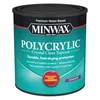 |
Minwax Polycrylic Protective Finish, Clear Satin, 1 Quart ($22.79) The brush-on water-based topcoat whose 2-hour recoat, 3-hour handling and 24-hour normal-use times this article explains.
|
Minwax publishes separate schedules for the brush-on liquid and the aerosol. This table combines the Minwax product page for the liquid with the Minwax technical data sheet for the spray.
| Milestone | Brush-on liquid | Aerosol spray |
|---|---|---|
| Dry to the touch | Not given on the label | 30 minutes |
| Recoat wait | At least 2 hours, then sand with 220 grit | 30 minutes, then sand with 220 grit |
| Light handling after final coat | 3 hours | 1 hour |
| Normal or heavy use after final coat | 24 hours | 24 hours (heavy use) |
| Recommended coats | 3 | At least 3 on bare wood, 2 over an existing finish |
| Coverage | About 125 sq ft per quart | About 20-25 sq ft per can |
The Minwax product page lists the liquid’s dry time as a range running from 3 hours to 24 hours. That range is simply the gap between light handling and normal use, which is exactly where the confusion below begins.
Four Different Clocks: Dry, Recoat, Handle, Use
Most articles treat “how long does Polycrylic take to cure” as one number. The label actually describes four separate moments, and mixing them up causes most finish damage.
- Dry to the touch. The surface no longer feels wet. Minwax gives 30 minutes for the aerosol; the liquid label does not state a touch-dry time.
- Ready to recoat. The film is hard enough to sand and take another coat: 2 hours for the liquid, 30 minutes for the spray. If you are working out timing between layers, our guide on how long to wait between coats of Polycrylic covers that stage in detail.
- Safe for light handling. You can move the piece carefully without leaving prints: 3 hours for the liquid, 1 hour for the spray.
- Ready for normal use. You can put it back in service: 24 hours after the final coat.
The trap is reading “dries in 30 minutes” from an aerosol page and applying it to a brushed tabletop, or reading “24 hours” and assuming a piece is ready to be loaded with books because you finished it yesterday morning. Each number answers a different question.
Is There a 30-Day Cure for Polycrylic?
Our earlier version of this page repeated a claim you will find on many finishing sites: that Polycrylic needs up to 30 days to fully cure. When we went back to the Minwax product page for the liquid and the technical data sheet for the aerosol, neither one states a 30-day figure. What Minwax does publish is 24 hours before normal use, and 24 hours before heavy use for the spray.
That does not mean a finish is at its final hardness the instant you use it. Water-based film finishes keep firming up after they feel dry, and many finishers give a new tabletop a few extra days of gentle treatment before hot mugs, sliding objects or heavy loads. Treat that as cautious practice, not as a Minwax rule. If you need a hard number for a job, use the label’s 24 hours and add margin for cold or humid conditions.
What Slows Polycrylic Down
Minwax states its aerosol dry times are based on good ventilation, 77°F and 50% relative humidity, and that lower temperature, higher humidity, lack of air movement or thick coats will extend them. The same factors are a sensible guide for the liquid. In practice that gives you four levers:
- Temperature. A cold garage or unheated basement means longer waits than the label. Move the piece indoors if you can.
- Humidity. A damp room slows a water-based finish. A dehumidifier or a dry day helps.
- Air movement. Fresh air moving through the room keeps water and solvents leaving the film. Minwax also asks for adequate ventilation for safety while you apply and let it dry.
- Coat thickness. Thick coats stay soft longer. Three thin coats reach use sooner than two heavy ones.
One more timing rule from the liquid label: if you stained the wood with Minwax Wood Finish stain first, wait at least 24 hours before applying Polycrylic over it. Skipping that wait is a common reason a fresh top coat stays tacky.
A Realistic Timeline for a Three-Coat Tabletop
Here is what the label times add up to for a three-coat job, ignoring the time you spend sanding and dusting between coats, which pushes every step later. The hours are our arithmetic from the Minwax numbers, not a table Minwax publishes.
| Milestone | Brush-on, earliest hour | Aerosol, earliest hour |
|---|---|---|
| Coat 1 applied | 0 | 0 |
| Coat 2 applied | 2 (plus sanding) | 0.5 (plus sanding) |
| Coat 3 applied | 4 (plus sanding) | 1 (plus sanding) |
| Light handling | 7 | 2 |
| Normal or heavy use | 28 | 25 |
The takeaway is that a piece finished in the morning is not ready for dinner that evening. Even the fastest route puts normal use a full day after the last coat. Plan the coats for the morning and early evening, then leave the piece alone overnight and through the next day.

How to Tell a Finish Is Ready for Use
Minwax says to test the surface for tackiness between coats, and the same habit works after the last one. These checks are our practical suggestions, not label instructions:
- Press a fingertip on an out-of-sight edge or the underside. If it feels tacky, drags or takes a print, it is not ready.
- Wait the full 24 hours before setting anything on the surface, and longer if the room stayed cold or humid.
- For the first few days, use a coaster under mugs and lift objects rather than sliding them.
- Save the piece’s first heavy job, such as a stack of books or a lamp base, for after that first full day.
If the finish is still soft after two days in a warm room, the usual causes are the ones on the label: a thick coat, cold air or high humidity. Give it more time with fresh air in the room. Do not add another coat on top of a soft one.
Jobs Where Polycrylic Is the Wrong Finish
Two cautions from the Minwax label matter more than any cure time. First, Minwax does not recommend Polycrylic for floors, because high-traffic areas need frequent recoating; it points floors to a Minwax polyurethane or its Ultimate Floor Finish. Second, it should not go over red mahogany stain; Minwax suggests its Fast-Drying Polyurethane or Water Based Oil-Modified Polyurethane there. If you are weighing options, see Polycrylic spray vs brush and how to apply Minwax Polycrylic. The spray version is covered in can you spray Minwax Polycrylic.
Frequently Asked Questions
How long does Polycrylic take to fully cure?
Minwax gives no day count for a full cure. It lists 3 hours before light handling and 24 hours before normal use for the brush-on liquid, and 1 hour before handling and 24 hours before heavy use for the aerosol. Give a new surface extra gentle treatment beyond that if you can.
Is Polycrylic really 30 days to cure?
The Minwax product page for the liquid and the aerosol data sheet do not state a 30-day figure. The commonly repeated 30 days is not a Minwax number. Plan around the label’s 24 hours before normal use.
How long before I can put things on a Polycrylic table?
Wait 24 hours after the final coat for normal use. Use coasters and avoid sliding objects for the first few days, and wait longer in a cold or humid room.
How long should I wait between coats of Polycrylic?
At least 2 hours for the brush-on liquid, then sand with 220-grit paper. The aerosol recoats after 30 minutes. Cool, humid or poorly ventilated rooms need longer.
Can I speed up Polycrylic curing?
Warm the room toward 77 degrees F, keep humidity down, keep fresh air moving through the space and apply thin coats. Minwax bases its aerosol dry times on those conditions. Avoid pointing direct heat at the surface.
Is cured Polycrylic waterproof?
Minwax describes it as protecting against scratches, spills and dirt, but it is a water-resistant clear topcoat, not a waterproof barrier. Wipe up spills promptly and use coasters.
Conclusion
Polycrylic has more than one clock: 2 hours to recoat the liquid, 3 hours to light handling, 24 hours to normal use, and faster spray times. The 30-day figure that circulates online is not on the Minwax product page or the aerosol data sheet. Apply thin coats in warm, dry, ventilated air, test for tackiness, and give the finished piece a full day before it goes back into service.
Sponsored / affiliate links. As an Amazon Associate I earn from qualifying purchases. I may earn additional commission from eligible campaigns.