Best Plywood for a Boat (2026): Based on Specs and Reviews
The best plywood for a boat depends on the panel: use BS 1088 or equivalent marine plywood for decks, transoms, and exterior parts, WBP-exterior plywood for protected interior panels, and match thickness to span and load, usually about 9 mm to 18 mm. Pick the wrong sheet, and rot, delamination, soft floors, or structural failure can follow. This guide breaks down plywood choice by boat part, exposure, and support spacing.
Best plywood for a boat
Marine plywood is the safest starting point for wet, structural boat parts because it uses waterproof or boil-proof glue and low-void construction. For boat decks and hull-adjacent parts, that matters more than a smooth face. A panel that stays bonded and stable in moisture is worth far more than one that only looks clean at the store.
What makes marine plywood different
Marine plywood is the “gold standard” for boat decks, but that label only matters when the panel meets a real marine specification. BS 1088 is commonly treated as a top marine plywood standard, and qualifying products are generally described as using all-veneer construction, no voids, and WBP phenolic glue. OHC says marine plywood must use WBP glue, and that the glue can withstand boiling for several hours.
That combination is why marine plywood is used for hulls, decks, transoms, and bulkheads. It is not maintenance-free. Bad sealing, edge exposure, or fastener leaks can still let moisture in and start rot or delamination.
What to look for at the lumberyard
Look for the construction details, not only the phrase “marine grade.” Ask for BS 1088 when available, or for another panel that clearly states WBP glue, low voids, and full veneer plies. Okoume is a common marine species, and better-made Okoume panels are described as virtually knot and void free.
Quick comparison
| Product | Badge | Best for | Price | ||
|---|---|---|---|---|---|
 |
OKOUME Marine Plywood 1/2 X 24 X 47WOODNSHOP | Our pick | 1/2" · BS-1088 · Okoume marine plywood | $66.35
Price as of 27 Oct 2026
|
View |
 |
RecPro 3/4" Marine Grade Plywood | 48" x 96" | 10 PackRecPro | Upgrade pick | 3/4" · 7-ply · marine grade plywood | $2,494.95
Price as of 27 Oct 2026
|
View |
 |
Woodcraft American Birch Plywood – 3/4" X 48" X 48"WOODCRAFT | Also great | 3/4" · birch · sanded plywood | $110.99
Price as of 27 Oct 2026
|
View |
Use this as the fast filter: structural parts get marine plywood first, protected interior panels can use sealed exterior plywood, and rough-service or cosmetic-only substitutes should stay out of decks and transoms. Exposure and support spacing decide more than brand names do.
How we chose
The comparison below follows five checks: exposure level, glue line and void quality, support spacing, sealing burden, and cost versus risk. That is the practical way to choose boat plywood.
It also separates true marine use from “good enough for dry furniture.” A plywood sheet can be fine in a cabinet and wrong in a bilge.
Boat plywood decision table
| Boat part | Exposure level | Support spacing | Safest plywood category | Buy / no-buy |
|---|---|---|---|---|
| Deck | High, weathered, foot traffic | Moderate to wide spans | BS 1088 marine plywood or Okoume marine panel, sealed with epoxy and often fiberglass cloth | Buy marine plywood |
| Floor | High, splash and trapped moisture | Depends on frame spacing; wider spacing needs thicker panel | Marine plywood first; sealed ACX only for lightly exposed, well-supported floors | Buy marine plywood or only-if sealed ACX |
| Transom | Very high, fastener holes and engine load | Structural load, minimal deflection allowed | BS 1088 marine plywood, often laminated and fully sealed | Buy marine plywood |
| Bulkhead | Moderate to high, depending on compartment moisture | Usually sheet-supported; still needs stiffness | Marine plywood or okoume; composite if the area stays wet | Buy marine plywood or only-if composite |
| Seat base | Moderate, repeated wetting from gear and spray | Short to moderate spans | Marine plywood for open boats; ACX only when well sealed and protected | Buy marine plywood or only-if sealed ACX |
| Interior panel | Low, protected from standing water | Usually close support | WBP-exterior plywood or ACX if finish matters | Buy ACX or exterior-grade sheet |
Thickness follows span, not habit
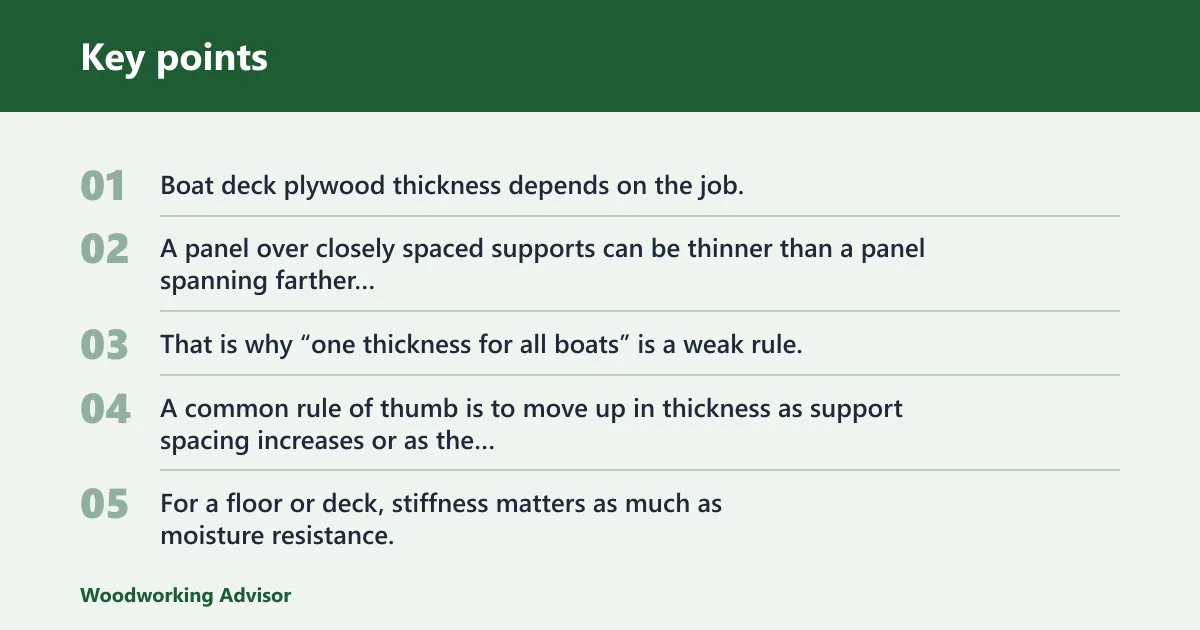
Boat deck plywood thickness depends on the job. A panel over closely spaced supports can be thinner than a panel spanning farther between stringers or frames. That is why “one thickness for all boats” is a weak rule.
A common rule of thumb is to move up in thickness as support spacing increases or as the panel carries more foot traffic and point loads. For a floor or deck, stiffness matters as much as moisture resistance.
What is the best plywood for a boat floor?
The best plywood for a boat floor is marine plywood when the floor sees splash, wet gear, or trapped moisture. If the floor is well supported and only lightly exposed, sealed ACX can be acceptable, but only after edge sealing, face coating, and careful fastener sealing. CDX is usually the weak choice for a floor.
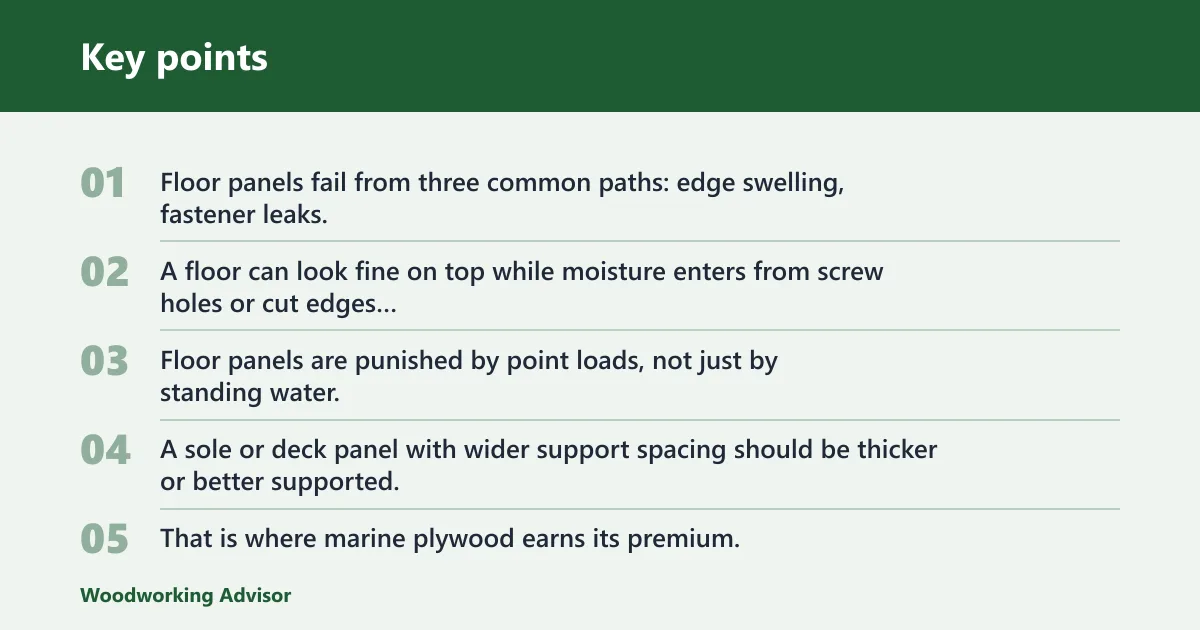
Floor panels fail from three common paths: edge swelling, fastener leaks, and delamination. A floor can look fine on top while moisture enters from screw holes or cut edges underneath.
Floor loading and support spacing
Floor panels are punished by point loads, not just by standing water. A sole or deck panel with wider support spacing should be thicker or better supported, because flexing opens joints and stresses the glue line. That is where marine plywood earns its premium.
Suppose a small skiff has a floor panel over wider framing and gets trailered outdoors. That panel sees vibration, humidity swings, and splash. Marine plywood or sealed marine-grade okoume is the safer call than an economy sheet with visible voids.
Marine plywood is worth the extra cost on floors that are hard to inspect, hard to dry, or hard to replace. It is also the better buy when fastener holes are unavoidable, because low-void construction reduces weak spots around hardware. That does not excuse poor sealing, though.
When sealed ACX is acceptable
ACX can work on a boat floor when the panel is protected from direct standing water, all edges are sealed, and the support spacing is close enough to limit flex. ACX has one smooth face and one C-grade face, so it is better than CDX for visible or finished surfaces. The drawback is that it is still not a true marine substitute.
Okoume plywood: best for lightweight panels
Okoume plywood fits best where weight matters and the panel still needs marine-grade durability. It is lightweight and rot resistant, and better-made panels are described as virtually knot and void free. The boatbuilding FAQ also describes it as lighter, stronger, and more dimensionably stable than softwood plywoods.
Builders often pair okoume with epoxy resin and fiberglass cloth. The epoxy seals faces, edges, and fastener penetrations, while the fiberglass adds abrasion resistance and helps on bottoms and other high-wear areas.
Where okoume fits best
Okoume is a strong choice for decks, light bulkheads, and panels where you want less weight without stepping down to a lower-spec sheet. It is commonly used in marine-grade panels and in hull construction. OHC also notes that marine-grade plywood is typically used for hull construction.
The drawback is cost. Okoume marine panels usually cost more than standard plywood, and they still need careful sealing to stay dry over time.
Why epoxy and fiberglass are common partners
Epoxy resin is used to seal plywood on boats, often inside and outside. That matters at cut edges, bolt holes, and corners where water sits first. Fiberglass cloth over epoxy is common on bottoms and wear areas because it improves surface toughness and helps resist abrasion.
Woodcraft American Birch: best for budget interior panels
This WOODCRAFT birch sheet is aimed at dry or lightly exposed interior work, not critical wet structure. Based on the listed specs and buyer feedback patterns common to sanded birch panels, it is useful where you want a cleaner face than rough construction plywood and do not need marine-grade certification.
The drawback is clear: it is not labeled marine grade, so it does not belong on decks, transoms, or any panel that gets repeated wetting. If you choose it for a protected interior panel, seal every edge and fastener penetration.
RecPro marine grade plywood: best for structural replacements
This RecPro 3/4-inch marine grade panel is the strongest fit when you need a thicker, load-bearing replacement for a floor, deck, or transom and want the security of waterproof glue and a near void-free core. Based on the manufacturer’s specs and published details, the 7-ply build points to better stiffness than low-ply economy sheets.
The drawback is price. At this level, it makes sense when the part is structural or hard to access later; it is overkill for a simple protected cabinet liner or light interior panel.
WOODNSHOP okoume marine plywood: best for lightweight marine panels
This WOODNSHOP Okoume panel is a good fit when you want BS-1088 marine specification, a lighter sheet, and sanding on both sides for easier finishing. It suits decks, cabin panels, and lighter boat parts where low weight matters and the builder plans to seal the panel carefully.
The drawback is that the 1/2-inch format may be too light for wider spans or high-load floors without solid support underneath. It is a better pick for weight-sensitive work than for a heavily loaded sole.
Which one should you buy?
Choose marine plywood first for decks, transoms, and any floor that sees wet service, wide spans, or hard-to-dry compartments. Choose okoume when weight matters and you still want marine-grade construction. Choose ACX only for protected, lightly exposed panels where you can seal every cut and hole. Avoid CDX for critical or visible boat parts unless it is a temporary, non-structural placeholder.
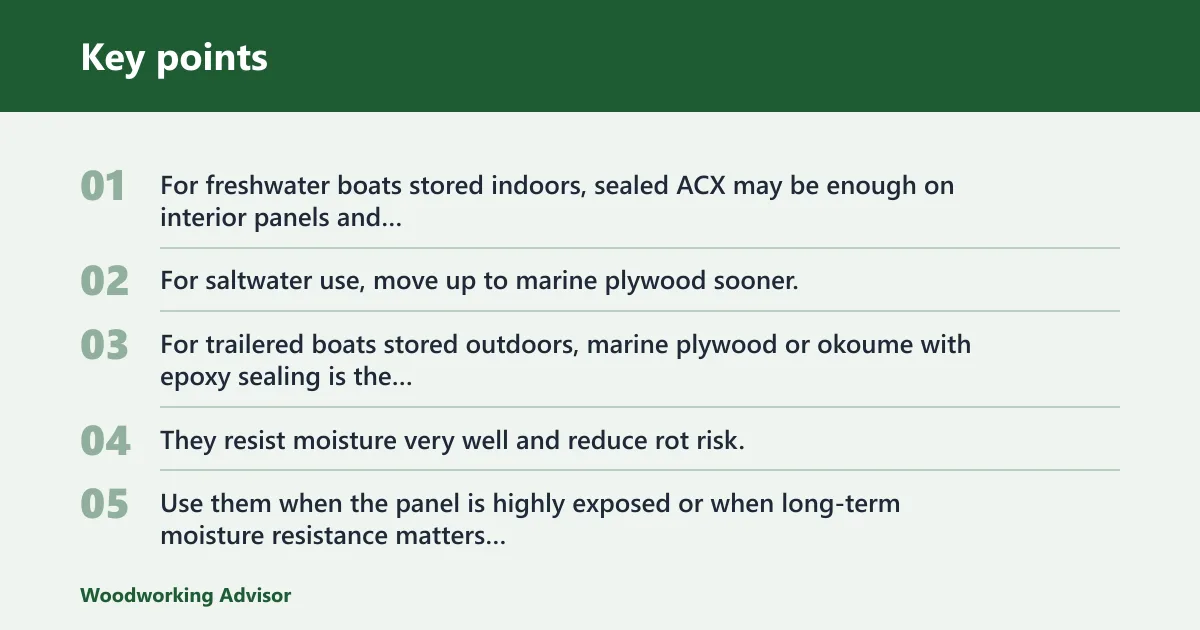
For freshwater boats stored indoors, sealed ACX may be enough on interior panels and lightly loaded parts. For saltwater use, move up to marine plywood sooner, because salt and repeated wetting punish edge treatment and fastener holes faster. For trailered boats stored outdoors, marine plywood or okoume with epoxy sealing is the safer choice, since weather cycles and standing water drive the failure rate.
What is better than marine plywood? For some jobs, composite panels are. They resist moisture very well and reduce rot risk, but they cost more and change how you fasten and repair the boat. Use them when the panel is highly exposed or when long-term moisture resistance matters more than easy woodworking.
Picture a 14-foot skiff with a plywood deck and a seat base under a cockpit cover. If the boat sits outside and the cover leaks at one corner, the first damage usually shows at cut edges and screw holes, not in the middle of the sheet. That is why sealing detail matters as much as sheet choice.
Installation and sealing that keep plywood alive
- Seal every cut edge before installation.
- Coat faces and backs with epoxy resin where the panel will see wet service.
- Pre-seal fastener holes, then install hardware with care to avoid crushing the coating.
- Add fiberglass cloth over wear areas, especially on bottoms and deck spots that see abrasion.
- Keep drainage paths open so water does not sit against the panel.
Marine plywood still fails when water gets past the coating. Rot, delamination, edge swelling, and fastener leaks are the main failure modes to watch. The material helps, but the sealing system keeps the panel alive.
Frequently asked questions
What is the best plywood for boat building?
For boat building, the best plywood depends on the part. Use marine plywood for structural parts such as decks, transoms, and hull-adjacent panels. Use okoume when low weight matters. Use ACX only for protected interior panels. Do not treat every panel as the same wet-service job.
What is the best plywood for boats?
The best plywood for boats is marine plywood with WBP glue, low voids, and a clear marine specification such as BS 1088. That said, protected interior pieces do not always need full marine grade. Match the panel to exposure, then seal the edges and penetrations.
What kind of plywood for a boat deck?
A boat deck should use marine plywood, usually okoume or another BS 1088-type panel, because decks see foot traffic, water, and repeated flex. Thickness should follow support spacing and load. Add epoxy sealing, and use fiberglass cloth where abrasion is likely.
What is better than marine plywood?
Composite panels can be better than marine plywood in very wet, hard-to-dry places because they resist rot well. They are not a universal replacement, though. They cost more and change fastening and repair methods, so they make the most sense where long-term moisture resistance is the top concern.
What is the best plywood to use for a boat floor?
The best plywood to use for a boat floor is marine plywood when the floor is structural or regularly wet. If you need a budget option, sealed ACX is the next step down for lightly exposed floors with close support. Avoid CDX on critical floors.
Sponsored / affiliate links. As an Amazon Associate I earn from qualifying purchases. I may earn additional commission from eligible campaigns.
 Baltic Birch Plywood 1/8'' x 12'' x 18'', 6 Pack, B/BB Grade, Void-Free Core, Laser Cutting Ready, Flat Sheets for CNC, Engraving, DIY Crafts, Art Painting, Wood Burning, Staining
 Baltic Birch Plywood Sheets Box of 45 - Laser Engraving Cutting, Scroll Saw Nature Veneer Color, Stronger Than Basswood, A/A Grade,12 x 12 x 1/8”, 3mm Thickness Perfect for Wood Burning