How Much Paint for a Garage Floor? (Gallons by Size + Cost)
Garage floor paint covers 200 to 400 square feet per gallon per coat — so a standard 2-car garage (480 sq ft) needs about 4 gallons for two coats. Buy too little and you are stuck with a mismatched second batch; buy too much and you have wasted $40-$150 on unused paint. This guide covers gallon math by garage size, coverage rates by coating type, and what each option costs.
Quick Answer
Measure your garage’s square footage, then divide the total (multiplied by 2 for two coats) by the paint’s coverage rate — usually 250 sq ft per gallon for two coats. A 1-car garage (240 sq ft) needs about 2 gallons; a 2-car garage (480 sq ft) needs about 4 gallons; a 3-car garage (720 sq ft) needs about 6 gallons. Round up and buy one extra gallon.
How Much Does Garage Floor Paint Cost? (By Type)
Best Garage Floor Paint Pick
Rust-Oleum EpoxyShield Gloss Gray Garage Floor Coating Kit
A true 2-part epoxy kit sized for a 1-car garage, sold with the base coat, color chips, and everything needed for one full application.
- Best for: 1-car garages that need a durable 2-part epoxy finish without hiring a pro
- Why we picked it: Manufacturer rates it 5x stronger-bonding than 1-part epoxy, and it is the kit most Home Depot stores stock, so matching topcoat is easy to find later
- Main drawback: Full cure takes about 3 days before you can drive on it, so time the project around a weekend you do not need the car inside
Compare more garage floor paint options
 Budget Pick KILZ 1-Part Epoxy Garage Floor Paint
|
 Large Garage Pick Rust-Oleum EpoxyShield 2.5 Car Kit
|
 Fastest Cure Rust-Oleum RockSolid Polycuramine
|
As an Amazon Associate we earn from qualifying purchases.
Price per gallon swings hard depending on which type of coating you buy, and that swing matters more than the coverage-rate math above once you are standing at the store shelf. Here is what each option actually costs as of 2026.
| Coating Type | Typical Price | Best For |
|---|---|---|
| Latex/Acrylic Floor Paint | ~$0.15-$0.30 per sq ft (roughly $25-$40/gallon) | Light-use garages on a tight budget |
| 1-Part Epoxy Paint | $48-$62 per gallon | DIYers who want epoxy durability without 2-part mixing |
| 2-Part / 100% Solids Epoxy Kit | $90-$160 per kit (covers 1 to 2.5 car garages) | Daily tire traffic, oil and chemical resistance |
| Professional Epoxy Installation | $5-$12 per sq ft installed ($1,600-$5,800 for a 2-car garage) | Cracked or heavily damaged concrete, no DIY time |
Durability tracks the price gap. Standard latex or acrylic garage floor paint typically starts peeling under tire traffic within about 6 months to a year. 1-part epoxy paint holds up longer, often 1 to 2 years, before it needs a fresh coat. A true 2-part or 100% solids epoxy system bonds chemically to the concrete instead of just sitting on top of it, so it commonly lasts 5 years or more under daily vehicle use — which is why the higher sticker price still works out cheaper per year of durability for most 2-car garages.
How to Calculate How Much Paint You Need
Getting the paint quantity right means you will not run back to the store mid-project or end up with gallons of leftover paint you never use again. Here is how to figure it out precisely.
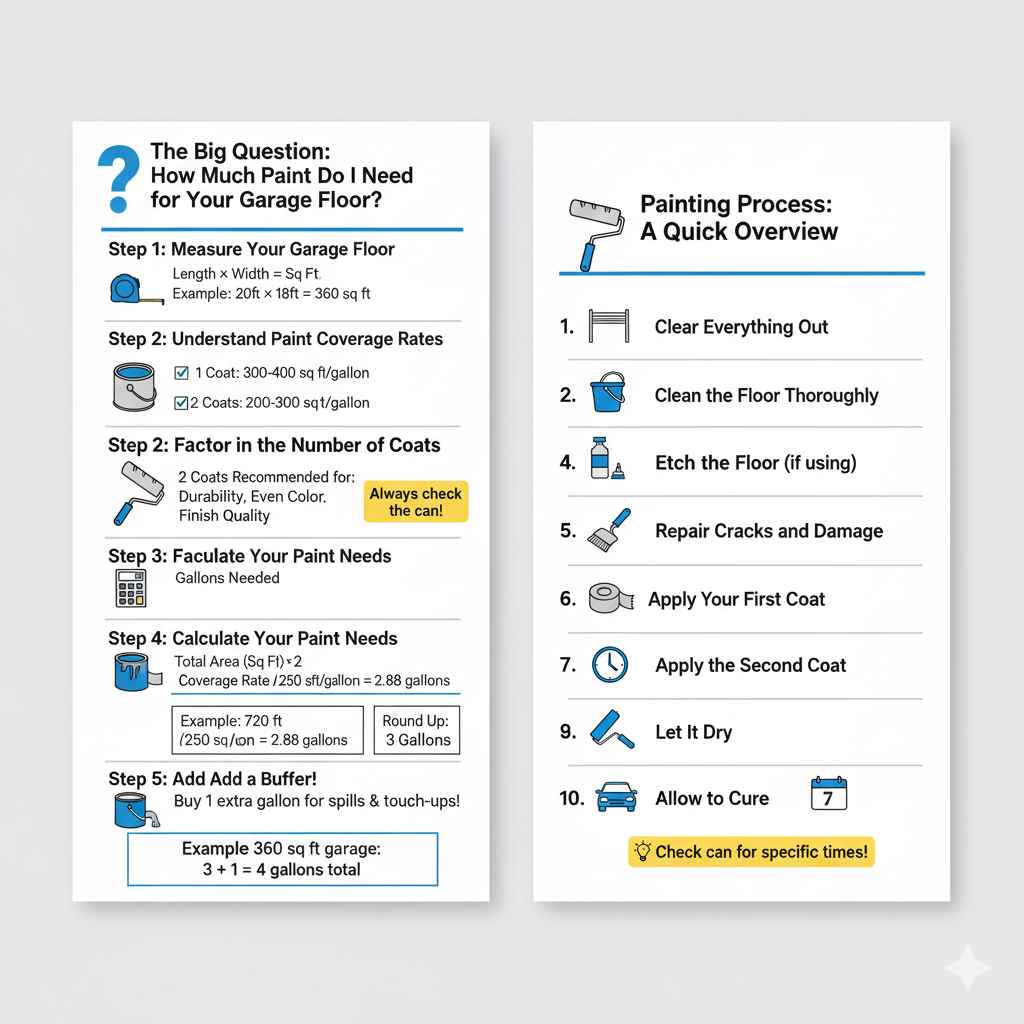
Step 1: Measure Your Garage Floor
You need the exact size of your garage floor in square feet. Most garages are rectangular, so this is usually straightforward.
- Get your tools: A measuring tape at least 50 feet long, plus a notepad or your phone for recording measurements.
- Measure length and width: Stand at one end of your garage and measure the longest wall, then measure the width from one side wall to the other.
- Calculate square footage: Length × Width = Square Footage. Example: A 20 ft by 18 ft garage is 20 × 18 = 360 sq ft.
- For irregular shapes: Break the floor into smaller rectangles or triangles (a bump-out for storage, a workshop nook), measure each section, then add the totals together.
Step 2: Understand Paint Coverage Rates
Every paint can lists its coverage rate as square feet per gallon. For garage floor paints, this varies quite a bit.
Generally speaking, a gallon of good quality garage floor paint covers:
- 1 coat: 300 to 400 square feet.
- 2 coats: Typically 200 to 300 square feet.
Coverage varies with paint quality, paint type (epoxy covers differently than latex), how porous the concrete floor is, and application method (rolling typically uses slightly more paint than spraying, though rolling is usually more practical for a garage floor). Always check the specific coverage rate printed on the can you plan to buy — do not rely on generic numbers alone.
Step 3: Factor in the Number of Coats
For a garage floor, two coats are almost always recommended. Two coats create a thicker, more resilient finish that stands up better to foot traffic, car tires, oil drips, and cleaning. They also give a more even color, especially over a dark or stained existing floor, and a second coat usually improves the sheen and overall finish.
So when calculating, plan to cover your total square footage twice. If your garage is 360 sq ft, you are covering 720 sq ft for two coats.
Step 4: Calculate Your Paint Needs
Using our example garage (360 sq ft) and a paint with an average coverage of 250 sq ft per gallon for two coats:
- Total area to cover: Garage square footage × 2 coats
- Paint needed (gallons): Total area to cover ÷ coverage rate per gallon
Example calculation: Garage size 360 sq ft, 2 coats, 250 sq ft per gallon coverage. Total area to cover = 360 sq ft × 2 = 720 sq ft. Paint needed = 720 ÷ 250 = 2.88 gallons. Since you cannot buy 0.88 of a gallon, plan on at least 3 gallons.
Step 5: Add a Buffer (Buy One Extra Gallon)
It is always worth buying a little extra paint, for the same reason you buy extra fasteners for a woodworking project — better to have some left over than to be stuck mid-coat without it. A buffer covers spills and drips, gives you matching paint for future touch-ups near shelves or corners, and accounts for uneven application or extra-porous patches of concrete that soak up more than expected.
Recommendation: For most standard garage floor projects, buy one extra gallon beyond your calculated need. If your garage is on the larger side (over 600 sq ft) or you are using a less common paint, add 10-15% extra instead. For our 360 sq ft example — just under 3 gallons calculated — buying 4 gallons is the smart move, giving you two good coats plus a bit for future touch-ups.
Factors That Affect How Much Paint You Need
Beyond basic square footage, a few other things influence your paint purchase.
1. The Condition of Your Concrete
Concrete can behave like a sponge. Unsealed, older concrete is often very porous after decades of weather, car fluids, and dust opening up its pores.
- Porous concrete: Absorbs paint more readily, so you will use more.
- Sealed or smooth concrete: Less common for bare garage floors, but absorbs less, so paint goes further.
This is why floor preparation matters. Cleaning and etching the floor (with a concrete etcher) helps adhesion but can also slightly open pores. A primer, if your paint manufacturer recommends one, can help seal the concrete and improve top-coat coverage.
2. Type of Garage Floor Coating
Different coating types have different coverage rates. Here is how the common options compare.
| Paint/Coating Type | Typical Coverage (per gallon, 2 coats) | Notes |
|---|---|---|
| Latex/Acrylic Floor Paint | 200-300 sq ft | Most budget-friendly, easiest cleanup. Good for light use. |
| Water-Based Epoxy Kit | 200-300 sq ft | A popular DIY choice with good durability and chemical resistance. Often sold in kits sized for specific garages. |
| 100% Solids Epoxy System | 100-150 sq ft (per mixed gallon/unit) | Professional-grade, extremely durable and resistant. Trickier to apply and more expensive; coverage is lower per unit because the product is thicker. |
| Concrete Stain | 300-500 sq ft | Penetrates the concrete instead of forming a film. Acid-based or water-based, usually needs a sealant on top. Looks more natural. |
100% solids epoxy covers less per gallon because it is a thicker, more concentrated product built for maximum performance. Always check the manufacturer’s specifications for your chosen product.
3. Color Choice
Darker colors generally provide better coverage than lighter ones, especially over a dark or unevenly colored concrete floor. Pale pastels might need an extra coat for a uniform look.
4. Application Method
Most DIYers use rollers. Spraying can achieve a thinner, more even coat that uses less paint overall, but it also requires more masking, safety gear, and carries a risk of overspray. For a garage floor, rolling is almost always the more practical approach.
Calculating Paint Needs for Common Garage Sizes
Here are estimations for common garage sizes, assuming a mid-range paint such as a water-based epoxy or good quality latex floor paint, two coats, at an average coverage of 250 sq ft per gallon for those two coats.
| Garage Size (Length x Width) | Square Footage | Total Area to Cover (2 Coats) | Calculated Gallons Needed (approx.) | Recommended Purchase |
|---|---|---|---|---|
| 10 ft x 20 ft | 200 sq ft | 400 sq ft | 1.6 gallons | 2 gallons |
| 12 ft x 20 ft | 240 sq ft | 480 sq ft | 1.92 gallons | 2 gallons |
| 14 ft x 22 ft | 308 sq ft | 616 sq ft | 2.46 gallons | 3 gallons |
| 20 ft x 20 ft | 400 sq ft | 800 sq ft | 3.2 gallons | 4 gallons |
| 20 ft x 24 ft (2-car) | 480 sq ft | 960 sq ft | 3.84 gallons | 4 gallons |
| 24 ft x 24 ft (2-car) | 576 sq ft | 1152 sq ft | 4.6 gallons | 5 gallons |
Note: These are estimates. Always check the specific coverage details of your chosen product and factor in floor condition.
Essential Tools and Materials for Painting Your Garage Floor
Beyond the paint itself, having the right supplies makes the job smoother and the results better.
For Preparation:
- Safety gear: Chemical-resistant gloves, eye protection, and a respirator mask (especially for cleaning or strong-smelling paints/epoxies). See OSHA’s guidelines on personal protective equipment for concrete work.
- Stiff broom or leaf blower: To clear loose debris.
- Heavy-duty degreaser/cleaner: For removing oil, grease, and grime.
- Stiff brush or floor scrubber: To work the cleaner into the concrete.
- Wet/dry vacuum: To pick up dirty water and dry dust.
- Concrete etcher (optional but recommended): A mild acid solution that opens concrete pores for better adhesion.
- Hose and water source: For rinsing.
- Painter’s tape: To seal off walls, doors, or areas you do not want painted.
- Drop cloths or plastic sheeting: To protect anything you cannot move.
For Painting:
- Your chosen garage floor paint/coating: Calculated using the steps above.
- Paint rollers: A dense nap roller (3/8″ to 1/2″) suitable for concrete/epoxy. Avoid fuzzy rollers.
- Roller frame: A sturdy one that can handle the weight and pressure.
- Extension pole: For reaching longer distances comfortably.
- Paint tray or 5-gallon bucket with liner: For holding paint.
- Paint brushes: For cutting in edges along walls and corners.
- Stir sticks: To thoroughly mix the paint, especially important for two-part epoxies.
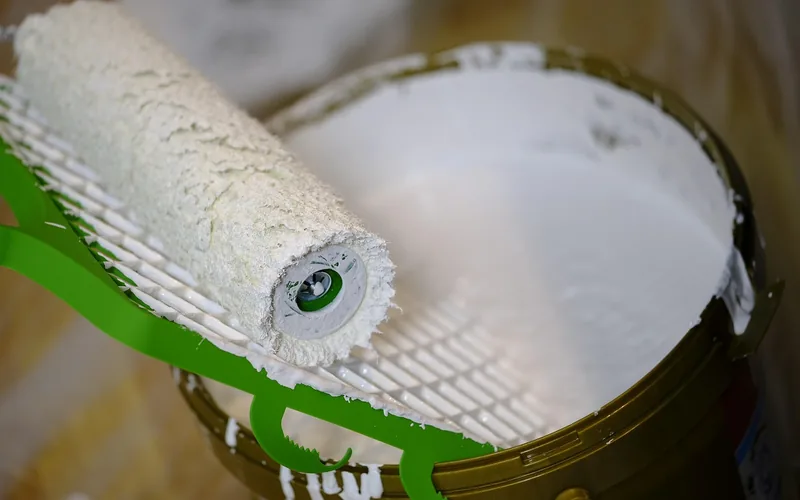
Painting Process: A Quick Overview
This guide focuses on how much paint you need, but knowing the basic steps helps you visualize where it all goes.
- Clear everything out: The more you remove from the garage, the better.
- Clean the floor thoroughly: Degrease, scrub, rinse, and vacuum until the floor is spotless and dry.
- Etch the floor (if using): Follow the product instructions, then rinse and dry completely.
- Repair cracks and damage: Use a concrete patching compound if needed and let it cure fully.
- Tape off edges: Seal any areas you want to protect.
- Mix your paint: Stir thoroughly, especially for two-part systems.
- Apply the first coat: Start at the back of the garage and work toward the door. Brush the edges, roll the main floor.
- Let it dry: Follow the manufacturer’s recoat time — critical for adhesion.
- Apply the second coat: Repeat the process.
- Allow to cure: Curing is different from drying — it is when the paint reaches full hardness. Check the can; it can be anywhere from 24 hours to 7 days before you can drive on it.
For detailed application tips, reputable paint manufacturers such as Sherwin-Williams or Benjamin Moore publish specific product application instructions on their websites.
Related Garage Floor Coating Guides
If you are still deciding on a coating type, these guides from our Paints category cover the questions that come up most: whether exterior paint works in a garage, how to seal a painted concrete floor once it is done, and what actually happens if you try to use garage floor epoxy over a wood substrate instead of concrete.
Frequently Asked Questions About Garage Floor Paint
How do I prepare my garage floor before painting?
Clear the space, clean the floor meticulously to remove all dirt, grease, and oil, and etch the concrete with an acid solution or cleaner. This creates a clean, porous surface for the paint to adhere to. Make sure the floor is completely dry afterward before you apply any coating.
Can I paint over an old, peeling garage floor coating?
Generally, no. You need to remove as much of the old, peeling coating as possible first, through scraping, sanding, or a chemical stripper. If the old coating is still well-adhered, you may be able to paint over it after thorough cleaning and light sanding or etching.
How many coats of paint does a garage floor need?
Two coats, almost without exception. A single coat leaves thin spots that wear through fast under tire traffic, while two coats build a thicker, more even film that holds color and resists oil, foot traffic, and cleaning much longer.
Is epoxy or regular paint better for a garage floor?
Epoxy is more durable. Standard latex or acrylic floor paint sits on top of the concrete and typically starts peeling under tire traffic within 6 months to a year. Epoxy — especially a 2-part or 100% solids system — bonds chemically to the concrete and commonly lasts 5 years or more under daily vehicle use, which is why it costs more per gallon but less per year of durability.
How long does garage floor paint last before it needs to be redone?
It depends on the coating type and how much vehicle traffic the floor sees. Standard paint typically needs a fresh coat within 1-2 years under regular car traffic; 1-part epoxy usually lasts 1-2 years as well before showing wear; a true 2-part or 100% solids epoxy system can last 5 years or more before it needs redoing.
Measure your square footage, double it for two coats, and divide by your paint’s coverage rate — that single calculation, plus one extra gallon as a buffer, is what keeps a garage floor project from turning into a second trip to the store. From there, the coating type you choose (latex, 1-part epoxy, or a full 2-part epoxy system) will decide both how far each gallon stretches and how many years you get before you are painting again.
Sponsored / affiliate links. As an Amazon Associate I earn from qualifying purchases. I may earn additional commission from eligible campaigns.