How to Make a Right Triangle Out of Wood (3-4-5 Method)
To make a right triangle out of wood, mark and cut one leg 3 units long and the adjacent leg 4 units long, meeting at a square corner – if the diagonal (hypotenuse) measures exactly 5 units, the corner is a true 90-degree angle. This is the 3-4-5 method, the same layout trick carpenters use to square deck frames and large panels, and it works because 3 squared plus 4 squared equals 5 squared (9 + 16 = 25), the Pythagorean theorem in its simplest whole-number form.
Most guides to the 3-4-5 rule stop at “squaring a corner” – checking that a deck frame or a cabinet box is square before you fasten it. This guide covers that, but it also covers something most of those pages skip: actually cutting a standalone right-triangle piece of wood, the kind used as a shelf bracket, a roof gusset, a gable brace, or a decorative accent. The math is identical, but building a physical triangle piece adds steps – choosing material, cutting the hypotenuse cleanly, and joining or finishing the piece – that a simple squaring check does not.
Tools And Materials You Need
Best Square For Marking Accurate Right Angles
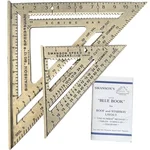 |
Swanson Speed Square Value Pack (7" + Big 12") – $16.50 Marks the 90-degree corner of your triangle directly, and its printed scales let you double-check the 3-4-5 diagonal without a separate protractor.
|
Beyond the square, the material list is short. Plywood (1/2 inch or 3/4 inch) is the most forgiving choice for a first triangle – it will not split along the hypotenuse cut the way solid pine can. Pine or poplar boards work well for a lighter decorative triangle, and oak or maple are worth the extra effort only if the piece needs to carry real structural load, like a shelf bracket.
For tools, you need a tape measure accurate to at least 1/16 inch, a pencil, a straightedge for the long hypotenuse line, and a saw – a circular saw or miter saw for straight cuts, or a jigsaw if the hypotenuse needs a slight curve softened at the corner. Wood glue, screws or brackets are optional, needed only if you are joining the triangle to something else rather than cutting it as one solid piece. Add safety glasses and hearing protection any time a power saw is running.
Why The 3-4-5 Method Works
The 3-4-5 triangle is a special case of the Pythagorean theorem, which states that in any right triangle, the square of the hypotenuse equals the sum of the squares of the two legs (a² + b² = c²). Plug in 3 and 4: 3² is 9, 4² is 16, and 9 + 16 equals 25, which is 5². Because 3, 4, and 5 are all whole numbers, this is the easiest right-triangle ratio to measure with an ordinary tape measure – no trigonometry or decimals required.
The ratio scales freely. Doubling it gives 6-8-10, tripling gives 9-12-15, and for a large layout like a deck frame or a shed floor, many carpenters use 6-8-10 or even 9-12-15 because a longer hypotenuse measurement is easier to read precisely than a short one – a small error in a 5-foot diagonal is a much bigger angle error than the same error in a 15-foot diagonal. Whatever multiple you choose, the ratio between the three numbers has to stay exactly 3:4:5 or the angle will not be a true 90 degrees. If you would rather skip the mental math, this site’s wood triangle calculator will scale the ratio and give you exact leg and diagonal lengths for any size triangle.
This is also the real answer to a question that trips up a lot of woodworkers: a speed square or combination square is accurate for marking a right angle at a single point, but its blade is usually only 7 to 12 inches long. Span that same square across a 4-foot panel or an 8-foot deck frame and any tiny gap between the square’s edge and the wood gets magnified into a real angle error by the time you reach the far end. The 3-4-5 method does not have that limitation, because you are checking the actual diagonal across the full width of the piece – it is the correct tool for large layouts, while a speed square is the correct tool for marking and cutting a single corner once you already know where it goes.
Step-By-Step: Marking And Cutting Your Wood Triangle
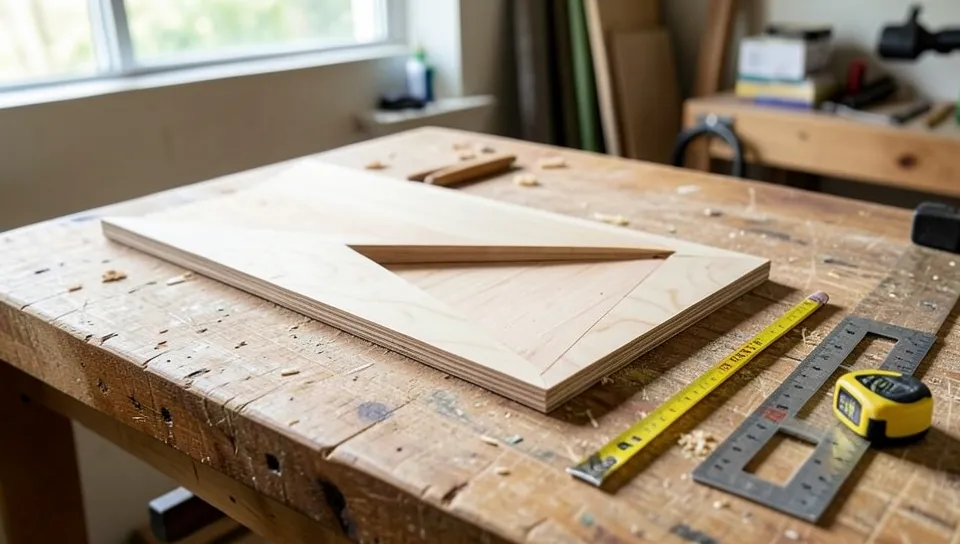
Start by deciding the size of the triangle and pick a 3-4-5 multiple that fits it. A small shelf bracket might use 6-8-10 inches; a gable brace might use 18-24-30 inches. Then follow these steps:
- Mark the corner point. Choose a starting corner on your board and mark it with a pencil dot. This is the 90-degree vertex of the triangle.
- Draw the first leg. Using your straightedge, draw a line from the corner point equal to your first measurement (for example, 12 inches if you are using the 12-16-20 multiple). Keep this line square to the edge of the board if you are using the board’s factory edge as a reference.
- Draw the second leg at a right angle. From the same corner point, use your speed square or a combination square to draw a second line at exactly 90 degrees to the first, equal to your second measurement (16 inches in this example).
- Check the diagonal. Measure the straight-line distance between the two far ends of your legs. It should equal your third measurement (20 inches). If it is off by more than about 1/16 inch on a cut this size, nudge the angle of the second leg slightly and re-measure until the diagonal is correct – this is the actual verification step, not the square alone.
- Connect the hypotenuse. Draw a straight line between the two endpoints using your straightedge. This completes the triangle outline.
- Cut the legs first, then the hypotenuse. Cut the two shorter legs with a circular saw or miter saw guided by your straightedge, then cut the hypotenuse last, supporting both sides of the cut to prevent the corner from breaking off as the blade exits.
- Test-fit the corner. Hold your square against the cut 90-degree corner. If light shows under the blade at any point, the corner needs a light pass with a sanding block before you move on.
Scaling The 3-4-5 Ratio For Larger Projects
If you are squaring something bigger than a single cut piece, like a deck frame, a shed floor, or a large panel glue-up, scale the ratio up so the diagonal measurement is long enough to catch small errors. Common multiples carpenters use on-site:
| Multiple | Leg A | Leg B | Diagonal (Hypotenuse) | Typical Use |
|---|---|---|---|---|
| 1x | 3 ft | 4 ft | 5 ft | Small shed or garden box corner |
| 2x | 6 ft | 8 ft | 10 ft | Standard deck frame corner |
| 3x | 9 ft | 12 ft | 15 ft | Large deck or foundation layout |
On a job this size, two people and a long tape measure work faster than one – one person holds the tape at the corner while the other reads the diagonal at the far mark. If the frame is close but not exact, the fix is to pivot one board slightly at the corner (not re-measure the legs) until the diagonal reading matches, then re-check both legs are still at the intended length before fastening anything permanently.
Common Mistakes To Avoid
The most frequent error is measuring the legs correctly but reading the diagonal from the wrong two points – always measure between the two outer endpoints of the legs, not from the corner. Another common mistake is trusting a warped or bowed board without checking it first; sight down the edge of any board before you use it as a straightedge reference, since a bowed board will throw off every measurement taken against it. Cutting the hypotenuse before the legs is also a common misstep – it removes the reference edges you need for an accurate final check, so always cut the two legs first. The same 3-4-5 check is also useful any time you need to cut wood to size accurately for a project that is not a triangle at all, like squaring a panel before glue-up.
If your finished triangle rocks or does not sit flat, the most likely cause is a saw blade that was not perfectly perpendicular to the base during the cut, producing a slight bevel on one edge. A few passes with a sanding block on a flat surface, checked periodically with the square, will true it back up without redoing the whole piece.
Finishing Your Wooden Triangle
Once the corner tests true, sand the edges – medium-grit first to knock down saw marks, then fine-grit to smooth the surface, sanding with the wood grain to avoid visible scratches. Wipe the piece with a barely damp cloth to remove dust and let it dry fully before finishing. A penetrating oil or wipe-on poly works well for a triangle that will be handled often, like a shelf bracket, while an exterior spar varnish or exterior paint is the right call if the piece will be exposed to weather, such as a gable brace or an outdoor decorative accent.
If you are joining the triangle to another piece – as a corner brace under a shelf, for example – pre-drill your screw holes near the edges to avoid splitting the plywood or solid wood, and add wood glue at the joint for extra holding strength before driving fasteners.
Frequently Asked Questions
How do you measure for a right triangle in wood using the 3-4-5 method?
Mark a corner point, measure 3 units along one leg and 4 units along a second leg set at roughly a right angle to the first, then measure the diagonal between the two leg endpoints. If that diagonal measures exactly 5 units (using the same unit as the legs), the corner is a true 90-degree angle. Scale all three numbers up equally, such as 6-8-10 or 9-12-15, for a larger triangle.
What tools do I need to build a wood right triangle?
You need a tape measure, a pencil, a straightedge for marking the hypotenuse, a speed square or combination square for the initial right angle, and a saw – a circular saw or miter saw for most cuts. Safety glasses and hearing protection are recommended any time a power saw is in use.
Can I use plywood to make a right triangle?
Yes, plywood is one of the best materials for a first wood triangle because its cross-laminated layers resist splitting along the hypotenuse cut, which solid wood is more prone to. Use 1/2 inch plywood for lighter decorative pieces and 3/4 inch for anything load-bearing, like a shelf bracket.
Why does the 3-4-5 method work for checking a right angle?
It is a direct application of the Pythagorean theorem: 3 squared (9) plus 4 squared (16) equals 25, which is exactly 5 squared. Because all three numbers are whole numbers, the ratio can be measured accurately with a standard tape measure, which is why it has been the standard on-site squaring check in carpentry for centuries, long before laser levels or digital angle finders existed.
Should I use a speed square or the 3-4-5 method?
Use a speed square for marking or verifying a right angle at a single, small corner – its blade is only 7 to 12 inches long, which is plenty of accuracy for that. Use the 3-4-5 method (scaled up if needed) any time the right angle spans a distance longer than your square’s blade, such as a deck frame, a large panel, or a shed floor, because the longer diagonal measurement catches small errors a short square blade cannot.
Conclusion
Making an accurate right triangle out of wood comes down to one reliable check: legs of 3 and 4 units meeting at a diagonal of exactly 5 units. That ratio, scaled to whatever size you need, is more dependable than eyeballing a square alone on anything larger than a small corner, and it is the same technique professional carpenters use to square decks, sheds, and foundations. Mark it carefully, cut the legs before the hypotenuse, and test the corner with a square before you call the piece finished.
Sponsored / affiliate links. As an Amazon Associate I earn from qualifying purchases. I may earn additional commission from eligible campaigns.