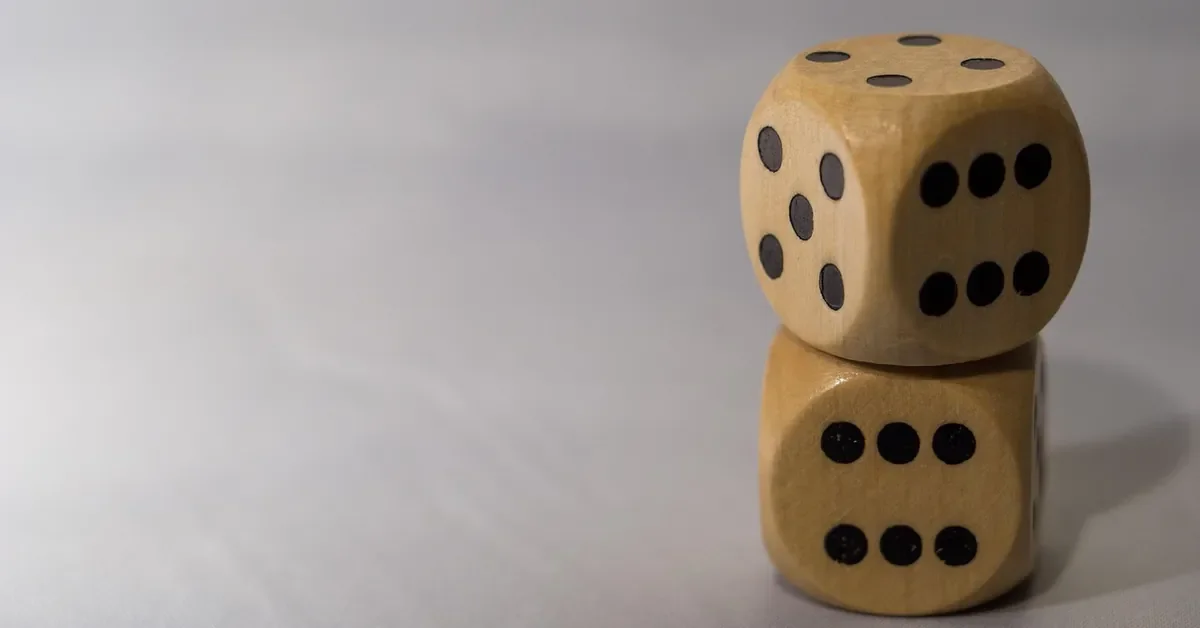
How to Make Wooden Dice: Cut, Drill and Roll-Test Fair Pips
Wooden dice start as a hardwood cube, typically 16 mm (5/8 inch) per side, with 1 to 6 pips drilled so opposite faces add up to 7. The catch: every drilled pip removes wood, so uneven pip depth nudges rolls toward the 6. This guide covers cutting square cubes, laying out and drilling pips, finishing, and a 300-roll test to check fairness.
Tools and Materials for Wooden Dice
|
Best Caliper For Checking Dice  |
NEIKO 01401A 6-Inch Electronic Digital Caliper, $31.99 Reads in millimeters or inches, so you can confirm every cube face matches within a fraction of a millimeter and every pip is drilled to the same depth, the two checks this guide says decide whether a die rolls fair.
|
As an Amazon Associate we earn from qualifying purchases.
You need very little to make a set of wooden dice. The list below covers everything for a set of five 16 mm dice. Browse more small builds in our woodworking projects category.
| Item | Spec | Why it matters |
|---|---|---|
| Hardwood stick | 5/8 x 5/8 inch, about 12 inches long | One long stick is safer to cut than tiny loose blocks |
| Saw with stop block | Miter saw, miter-gauge table saw, or fine-tooth hand saw with a guide | Repeat cuts land at the same length |
| Drill press or drill guide | 1/8 inch brad point or twist bit, depth stop | Same pip depth on all 21 pips |
| Sandpaper | 220 and 320 grit on a flat surface | Keeps faces flat and corners even |
| Measuring | Digital caliper or accurate rule | Confirms cube size and pip depth |
| Pip color | Black paint, ink, or a wood-burner | Contrast so pips can be read at a glance |
Choosing the Best Wood for Dice
Dice are handled, rolled, and knocked around, so density and fine grain matter more than color. Hard maple and beech are the standard choices because they keep sharp corners and take small holes cleanly. Walnut and cherry look richer but are softer, so corners round off sooner. The Janka hardness values below are the commonly published figures for each species.
| Wood | Janka hardness (lbf) | Best for | Watch out for |
|---|---|---|---|
| Hard maple | 1,450 | Crisp corners, high-contrast pips | Burns if the bit dulls |
| Beech | 1,300 | Budget option, fine even grain | Moves with humidity |
| Red oak | 1,290 | Rustic look | Open pores show inside pips |
| Black walnut | 1,010 | Dark, rich color | Pips vanish unless you use white paint |
| Black cherry | 950 | Warm color that deepens with age | Softer corners dent sooner |
If you want a second small project that uses the same milling steps, try our guide to cutting a pyramid out of wood.
Cutting Square Cubes
A die is only as fair as its cube is square. Size is a choice, but consistency is the rule: every face on a single die should match. For scale, casino dice are held to a tolerance of 0.0005 inch on each dimension, far beyond what a workshop can match, so aim for a practical target of under 0.1 mm (about 0.004 inch) between the largest and smallest face.
| Dice size | Metric | Typical use |
|---|---|---|
| 5/8 inch | 16 mm | Standard board-game dice |
| 3/4 inch | 19 mm | Casino-style dice |
| 1 inch | 25 mm | Large lawn-game and beginner-friendly dice |
- Mill the stick square: plane or sand a 12-inch stick until both faces measure exactly the same, checking with the caliper at three points along its length.
- Set a stop block: clamp a block to your saw fence so each cut removes a piece exactly the same length as the stick is wide.
- Cut cubes from the long stick: never cut a loose cube by hand, since the offcut is too small to hold safely near a blade.
- Check every cube: measure across all three axes and set aside any cube more than 0.1 mm off.
- Flatten the faces: rub each face on 220-grit paper taped to a flat surface, then 320 grit, so faces stay dead flat instead of rocking.
Pip Layout: The Rule Opposite Faces Follow
On a standard die, 1 is opposite 6, 2 is opposite 5, and 3 is opposite 4, so every opposite pair adds to 7. Use the pattern below when marking the cube. Divide each face into a 3 by 3 grid; on a 16 mm face each grid cell is about 5.3 mm wide, so pip centers sit about 2.7 mm, 8 mm, and 13.3 mm from a face edge.
| Face | Pips | Placement on the 3 x 3 grid | Opposite face |
|---|---|---|---|
| 1 | 1 | Center | 6 |
| 2 | 2 | Two opposite corners | 5 |
| 3 | 3 | Diagonal line: corner, center, opposite corner | 4 |
| 4 | 4 | All four corners | 3 |
| 5 | 5 | Four corners plus center | 2 |
| 6 | 6 | Two columns of three, edge cells | 1 |
Notice that three pips sit on a diagonal line, not in a triangle. A triangle is a common mistake that makes the 3 face look wrong next to a shop-bought die.
Drilling the Pips Without Making the Die Biased
Here is the angle most guides skip. Every pip is a hole, and a 6 face has six of them while the opposite 1 face has one. That leaves the 6 side lighter, so the die tends to settle with the heavier 1 side down and the 6 up. The effect is small, but you can calculate it.
Assume a 16 mm hard maple cube at roughly 0.65 g per cubic centimeter and pips 3.2 mm (1/8 inch) wide. Deeper pips remove more wood and shift the balance further. These figures are computed from those assumptions, not measured on a real die:
| Pip depth | Wood removed (21 pips) | Share of cube weight | Balance shift toward the 1 face |
|---|---|---|---|
| 1.6 mm (1/16 inch) | about 0.18 g | about 6.6% | about 0.12 mm |
| 0.8 mm (1/32 inch) | about 0.09 g | about 3.3% | about 0.06 mm |
Halving the depth roughly halves the shift, which is why shallow pips are better than deep ones. Whatever depth you choose, use a depth stop so all 21 pips match. Some makers avoid the problem completely by burning the pips with a wood-burner, which removes almost no material. Casino dice solve it the other way: the drilled holes are filled with a paint of the same density as the material removed, and the spots sit flush with the surface.

- Mark the pip centers: use an awl or a paper template glued to the face to press a small dimple at each center.
- Hold the cube safely: clamp it in a hand-screw clamp or a scrap block with a square pocket, never with bare fingers near the bit.
- Set the depth stop: test on a scrap cube and measure the hole with the caliper before you drill the real one.
- Drill slowly: a sharp brad point bit gives a clean entry, and backing the bit out clears chips so the hole stays round.
- Check the hole depth: measure a few pips per face; aim for less than 0.1 mm difference between them.
If you like building small game accessories, our dungeon master screen plans pair well with a handmade dice set.
Finishing Wooden Dice
Finish comes last because the pips need to be filled and the surface sealed evenly. Fill each pip with black paint or ink, then let it dry and lightly sand the face flush. Skip thick film finishes: a heavy build of varnish rounds corners and adds thickness unevenly. Two thin coats of wipe-on oil or shellac protect the wood and leave the dimensions almost unchanged.
- Break the sharp corners lightly with 320-grit paper so they do not chip.
- Apply the finish to all six faces in one session so no face gets more coats than another.
- Let the finish cure fully before rolling the dice on a game table.
For a related build with a different shape, see our wooden printer’s tray plans.
How to Test Whether Your Dice Are Fair
You can test a die with a simple chi-square check. Roll it 300 times and tally each face. A fair die should land on each number 50 times. For each face, square the gap between your count and 50, divide by 50, and add all six results together. With 5 degrees of freedom, a total above 11.07 suggests bias at the 5% significance level, so it is worth reshaping or re-drilling that die.
| Face | Expected rolls | Example count | Calculation |
|---|---|---|---|
| 1 | 50 | 44 | (44-50)^2 / 50 = 0.72 |
| 2 | 50 | 52 | (52-50)^2 / 50 = 0.08 |
| 3 | 50 | 47 | (47-50)^2 / 50 = 0.18 |
| 4 | 50 | 49 | (49-50)^2 / 50 = 0.02 |
| 5 | 50 | 51 | (51-50)^2 / 50 = 0.02 |
| 6 | 50 | 57 | (57-50)^2 / 50 = 0.98 |
These example counts add up to a chi-square of 2.00, well under 11.07, so this sample would pass. They are illustrative numbers for the method, not results from a die tested by the author.
Safety Note on Small Parts
Dice are small parts. The U.S. Consumer Product Safety Commission defines a small part as anything that fits inside a cylinder 1.25 inches wide and 2.25 inches long, roughly the size of a young child’s throat, and even a 1-inch die fits. Keep handmade dice away from children under three.
Frequently Asked Questions
How big should wooden dice be?
Standard game dice are usually 16 mm (5/8 inch) per side, and most casinos use 3/4-inch dice. Pick one size and keep every face within about 0.1 mm of it. Larger dice, such as 25 mm (1 inch), are easier to drill and handle for beginners.
What is the best wood for making dice?
Dense, fine-grained hardwoods such as hard maple, beech, or walnut hold crisp corners and small pips. Avoid soft pine, which dents and dulls quickly. Open-grained woods like red oak work but show pores inside the pips.
Why do opposite sides of a die add up to 7?
By convention, 1 sits opposite 6, 2 opposite 5, and 3 opposite 4, so every pair totals 7. Keeping this pairing also balances the pip count, which matters for fairness on drilled wooden dice.
Are homemade wooden dice fair?
They can be, if the cube is square and every pip is the same depth. Drilled pips remove wood, which can shift the balance slightly toward the 6. Shallow pips of equal depth and a 300-roll chi-square test will show whether your die is acceptably fair.
Conclusion
A fair wooden die comes down to three things: a cube that is square to within 0.1 mm, pips laid out with opposite faces adding to 7, and pips drilled to the same shallow depth. Get those right, roll-test the result, and you have a set that plays as well as it looks.
Sponsored / affiliate links. As an Amazon Associate I earn from qualifying purchases. I may earn additional commission from eligible campaigns.