What Should Inside Humidity Be in Winter?
Keep winter indoor humidity around 30% to 40% RH for most heated wood shops and homes; if windows or cold walls regularly show condensation, humidity is generally kept near 25% to 30% RH, and the dew point of those surfaces should not be exceeded. Too much humidity brings condensation, rust, swollen stock, and glue failure; too little dries skin, irritates the throat, increases static, and can crack skin or nasal passages. This guide gives a surface-based target so you can set winter humidity for wood, tools, and windows without guessing.
What should indoor humidity be in winter?
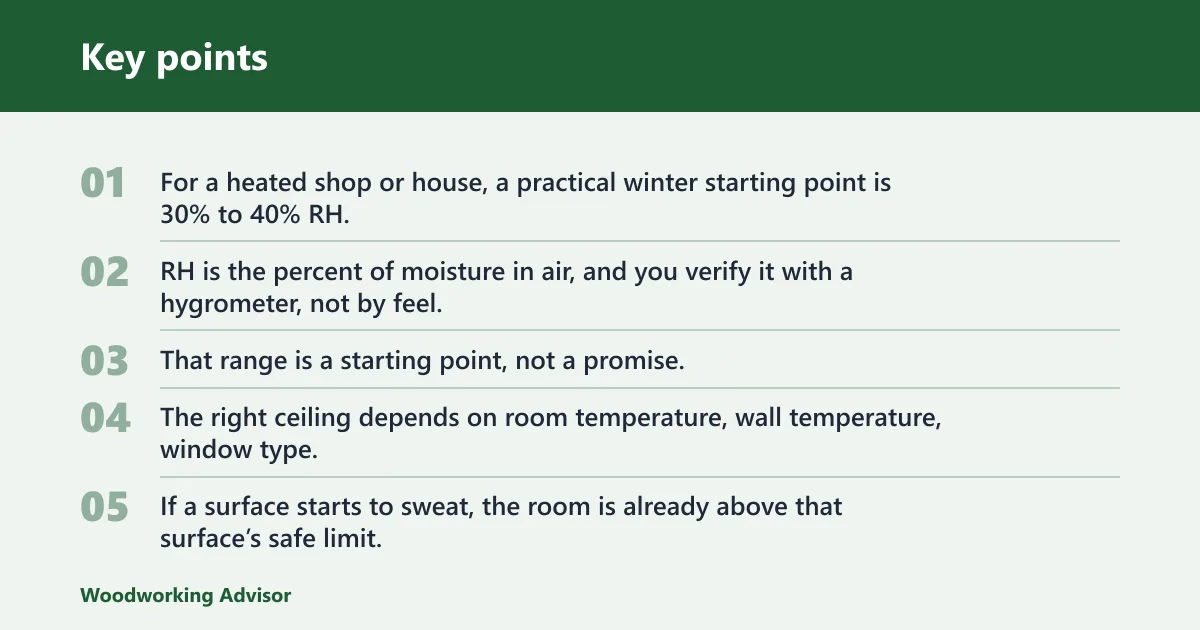

For a heated shop or house, a practical winter starting point is 30% to 40% RH, with the lower end used when windows, exterior walls, or tools show moisture on cold days. RH is the percent of moisture in air, and you verify it with a hygrometer, not by feel.
That range is a starting point, not a promise. The right ceiling depends on room temperature, wall temperature, window type, and how much outside air leaks in. If a surface starts to sweat, the room is already above that surface’s safe limit.
The winter starting range for heated spaces
In a heated wood shop, 30% to 40% RH is the most useful first target because it usually balances dry-air complaints against condensation risk. It also gives glue, finishes, and stored lumber a more stable environment than a room that swings widely from day to day.
EPA indoor humidity guidance keeps indoor humidity below 60%, with 30% to 50% RH as the usual safe band. NDSU recommends 30% to 40% RH during winter months, and that narrower target is often the better fit for spaces with tools, sheet goods, and windows.
Why 30% to 40% RH is the practical target
Dry winter air makes wood shrink. Boards can cup, joints can loosen, and a finish that was applied in one moisture condition may not behave the same after the room dries out further. A moderate winter target helps reduce those swings without pushing surfaces into condensation.
Too little humidity also dries skin, irritates the throat, increases static, and can crack skin or nasal passages. The same source notes that below about 30% RH these complaints become more likely, so the lower edge of the winter range should be used carefully and only when colder surfaces demand it.
When comfort gives way to condensation risk
Once RH climbs above about 40%, condensation risk rises on cold glass and other chill surfaces. The same source says condensation forms when heated indoor air hits cold window air, and the problem appears sooner with weaker windows because their interior glass surface runs colder.
That is why the best number is not fixed. A room with newer windows may tolerate a bit more RH than a room with single-pane glass or a cold slab wall. The surface temperature decides the ceiling.
How does humidity affect wood and tools?

Winter humidity matters in a shop because wood, glue, finishes, and metal all respond to it. A room that stays too dry can pull moisture from lumber and stress joints; a room that stays too damp can fog windows and rust cast iron, blades, and fasteners.
Board movement, cupping, and seasonal change
Wood moves across the grain as moisture changes. If shop air drops too dry, boards can shrink, edges can shift, and a flat panel can cup or twist as one face dries faster than the other. Keeping winter RH in a controlled band reduces that movement.
Suppose a 12-inch-wide face frame panel is acclimated in a 25% RH room and then moved into a 40% RH basement for assembly. The moisture change can be enough to alter fit, open seams, or change clamp pressure on a glued joint.
Glue joints, finishes, and drying conditions
Glue joints depend on stable moisture conditions. If stock is too dry, it can move after assembly and place stress on the bond line. If the room is too damp, drying slows and surface moisture can interfere with some finishing schedules.
Finishes also respond to the room, especially on cold surfaces. A finish room that runs humid enough to fog windows can create poor drying conditions and tacky surfaces. Keep the shop within the winter range, then watch the surfaces as you work.
Rust on cast iron, blades, and fasteners
Metal tools need moisture control for a different reason. Once RH and surface temperature combine to produce condensation, cast iron tops, saw blades, drill bits, and stored fasteners can rust. Rust often starts where air circulation is poor and temperature stays low.
That means corners, tool drawers, and machines parked beside exterior walls deserve special attention. Humidity control helps, but so does air movement and keeping the coldest metal off a damp floor or uninsulated wall.
What does the EPA guidance mean here?
EPA guidance gives a ceiling, not a woodworking setpoint. Keep indoor humidity below 60%, and treat 30% to 50% RH as the usual safe band. For winter woodworking, that band is often too broad, so many heated spaces do better closer to 30% to 40% RH.
Below 60% RH as a ceiling
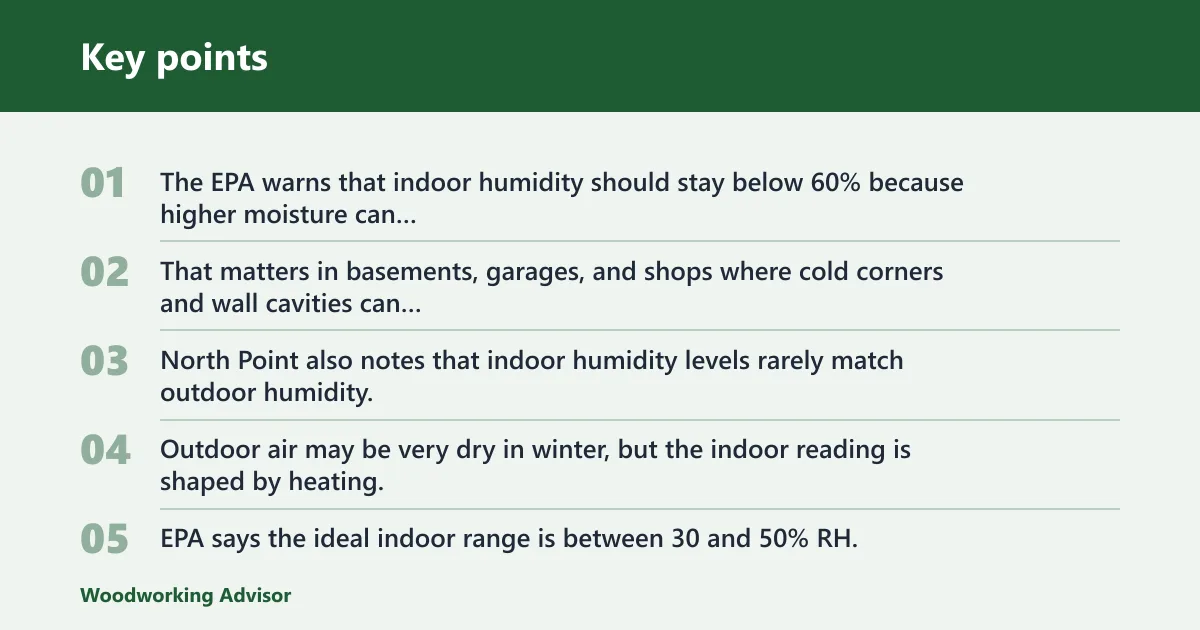
The EPA warns that indoor humidity should stay below 60% because higher moisture can support mold and other biological growth. That matters in basements, garages, and shops where cold corners and wall cavities can stay damp even when the center of the room feels fine.
North Point also notes that indoor humidity levels rarely match outdoor humidity. Outdoor air may be very dry in winter, but the indoor reading is shaped by heating, infiltration, cooking, bathing, and the moisture added by breathing.
Why 30% to 50% is the common indoor band
EPA says the ideal indoor range is between 30 and 50% RH, while EPA warns humidifier users not to exceed 50% RH. For most homes, that band is reasonable; for workshops with cold glass and metal tools, the lower half of the band is usually safer.
North Point says too much humidity should not cross 65% RH, but a wood shop should not wait that long to act. Condensation, rust, and swelling can begin well before 65% if the surfaces are cold enough.
Why higher RH can support biological growth
Higher RH does not only affect wood. It can also support mold and other biological growth when moisture persists on surfaces, in corners, or on windowsills. Mold often starts where air is still and surfaces stay cold, then spreads if the moisture source remains.
That is why a humidifier should be treated as a control tool, not a set-and-forget appliance. It can help dry rooms, but it can also push the room past the safe point if you do not monitor RH.
How do you check the right humidity?
Use a hygrometer room by room and trust the reading, not your skin or the feel of the air. Relative humidity is measured on a percent scale, and it is different from absolute humidity, which is the total moisture content in the air.
Using a hygrometer room by room
An indoor reading tool can be analog or digital. Place it where the room condition matters most: near the bench in the shop, near the coldest window in the house, or near the wall where stored lumber sits. One reading in the warmest corner is not enough.
Check the basement, garage, and main shop as separate spaces. A heated garage may sit drier or colder than an insulated shop, and an unheated storage area should not be treated like a conditioned workspace.
Reading RH instead of guessing by feel
You cannot judge humidity accurately by feel alone. Static, dry skin, and a scratchy throat point to dryness, but they do not tell you whether the room is at 28% RH or 38% RH. Only the hygrometer gives the number you can act on.
One common first-timer mistake is to run a humidifier until the air feels comfortable, then discover the windows fogged overnight. The air may feel better while the glass surface is already too cold for that moisture level.
Watching surface conditions, not only the number
Surface condition is the final check. Window fog, wet sills, cold-surface condensation, rust, and persistent damp corners all tell you the room is too wet for the current temperature. If those signs appear, lower the humidifier setting even if the hygrometer still looks moderate.
Dew point helps here. It is the temperature where moisture condenses, and it changes with room temperature and RH. Near windows, exterior walls, and uninsulated surfaces, the dew point can be reached even when the room itself seems comfortably dry.
What does condensation tell you?
Condensation tells you that the indoor air is holding more moisture than the surface temperature can accept. If glass, metal, or an exterior wall gets wet, the indoor RH is too high for that spot, even if the room feels dry elsewhere.
Window fog and wet sills
Window fog is one of the clearest warnings. The same source says above about 40% RH increases window condensation risk, and double-pane windows may show condensation below zero at 40% RH. Triple-glaze windows may resist condensation until closer to minus 40 F.
That spread shows why the same RH number can be safe in one shop and too high in another. A weak window system reaches the dew point sooner, so the usable indoor target drops when the glass gets colder.
Cold corners, exterior walls, and uninsulated surfaces
Cold corners and exterior walls often show the first moisture because they cool faster than the room air. In a basement or garage, the cold slab edge, unfinished wall, or uninsulated door can pull surface temperature down enough to collect moisture before the windows do.
Mold risk grows in those spots. Windowsills, corner trim, and hidden wall edges are common starting points because they hold moisture longer than open air does. The safest response is to lower RH and improve air movement.
How dew point changes the usable setpoint
Think of dew point as the point where water stops staying in the air. If a surface falls below that point, moisture condenses there first. A colder room temperature can make dew point issues appear sooner because the inside surface of a window or wall stays nearer to the condensation line.
That is why a heated shop can still need a low RH setpoint during a cold snap. The room may feel warm, but the glass and metal may not be warm enough to stay dry.
Winter humidity decision table
Use this one-page guide as a ceiling, not a comfort target. Start with the outside temperature band, then choose the indoor RH ceiling for the room type, and finally check the warning signs before turning the humidifier up or down.
| Outside temperature band | Recommended indoor RH ceiling | Visible warning signs |
|---|---|---|
| Above 20 F / -7 C | 30% to 40% in a heated garage or insulated shop; keep below 50% indoors | Fog on windows, damp sills, static easing as RH rises, no rust on exposed metal |
| 0 F to 20 F / -18 C to -7 C | 25% to 35% in a heated garage; 30% or less near weak windows or cold walls | First fog on colder panes, light rust on cast iron, static on clothing or sanded stock |
| Below 0 F / -18 C | 25% to 30% in an insulated shop; lower if single-pane windows sweat | Window condensation, cold-surface wetting, rust spots, static discharge, dry skin symptoms if too low |
| Heated garage | 30% to 35% unless windows fog; then back off toward 25% to 30% | Roll-up door sweating, corner condensation, rust on tools stored near exterior walls |
| Insulated shop | 30% to 40% as the normal starting range | Fogged panes, wet sills, tacky finishes, or static if the air is too dry |
| Unheated storage area | Do not add moisture unless the space is sealed and monitored closely | Condensation on tools, rust on fasteners, damp packaging, mold on cardboard or wood scraps |
How should you adjust a shop humidifier?
Use a humidifier only to lift a room out of dry-air trouble, then stop at the surface limit. Pair the humidifier with RH monitoring, because adding moisture without checking windows and cold metal can create condensation faster than it solves dryness.
When to add moisture
Add moisture when RH sits below about 30% and you see dry skin, static, scratchy throat, or cracked nasal passages. In a heated shop, that is the point where lumber and glue conditions may start to drift too far toward dryness.
Keep the target modest. For most heated spaces, 30% to 40% RH is the winter starting range, not a goal to exceed. Raise humidity slowly and watch the coldest surfaces first.
When to back off
Back off as soon as windows fog, sills dampen, or metal begins to show dew. The same source says above about 40% RH increases window condensation risk, so the ceiling should fall when the weather turns colder or when the room has weaker windows.
A common rule of thumb is simple: if the hygrometer rises and the window surface still sweats, the room is too humid for that surface temperature. Lower the humidifier output before mold or rust has a chance to start.
How to avoid pushing surfaces into condensation
Use short humidifier cycles, then recheck the room after the air has mixed. Keep air moving across cold glass and along exterior walls. If a room has a basement corner, an uninsulated garage wall, or old windows, treat those surfaces as the limiting factor.
Say your insulated shop holds 34% RH at 38 F indoors, but the single-pane entry window beads water every morning. The humidity number is not the only issue; the window surface is colder than the rest of the room, so the target must come down.
Frequently asked questions
What should indoor humidity be in winter: for most heated homes?
For most heated homes and wood shops, start around 30% to 40% RH in winter. Keep indoor humidity below 60% at all times, and lower the target if windows, walls, or tools show condensation. Surface condition matters more than a comfort-only range.
What should home humidity be in winter?
A home can usually stay in the 30% to 50% RH band that EPA considers ideal, but winter woodworking spaces often do better near 30% to 40% RH. If windows sweat, lower the setpoint. If the air feels harsh and static rises, move upward slowly.
What should indoor relative humidity be in winter?
Indoor relative humidity in winter should usually sit around 30% to 40% RH in heated spaces. That range helps limit dry-air symptoms while reducing the chance of condensation on colder surfaces. Measure it with a hygrometer, and let the coldest surface in the room set the ceiling.
What should inside humidity be in winter?
Inside humidity in winter should not be judged by comfort alone. Aim for 30% to 40% RH in a heated shop or house, then watch windows, corners, and metal surfaces. If fog, wet sills, or rust appear, the room is too humid for those surfaces.
What should indoor humidity be in winter in wisconsin?
In a cold state like Wisconsin, the usable winter target often needs to stay near the low end of the normal band. Start around 30% RH in heated spaces and lower it if single-pane or weaker windows sweat. Very cold outdoor air makes surface limits tighter.
What should indoor humidity be at in winter?
Indoor humidity in winter should usually be set by the room’s coldest surface, not by a single comfort number. For most heated rooms, 30% to 40% RH is a practical target. If condensation appears, reduce RH until the glass and walls stay dry.
Sponsored / affiliate links. As an Amazon Associate I earn from qualifying purchases. I may earn additional commission from eligible campaigns.