Will a Dehumidifier Work in a Shed?
Yes, but only if the shed stays warm enough for the unit to run properly: compressor dehumidifiers usually work best above about 60°F, and many stop removing water or frost up below about 41°F. In a cold, leaky shed, a poor setup can leave tools rusting, wood moving, and stored goods getting musty. This guide breaks down which dehumidifier type works in each temperature band, what fails in winter, and how to size and place one in a shed or woodshop.
Cold sheds and condensation cycles
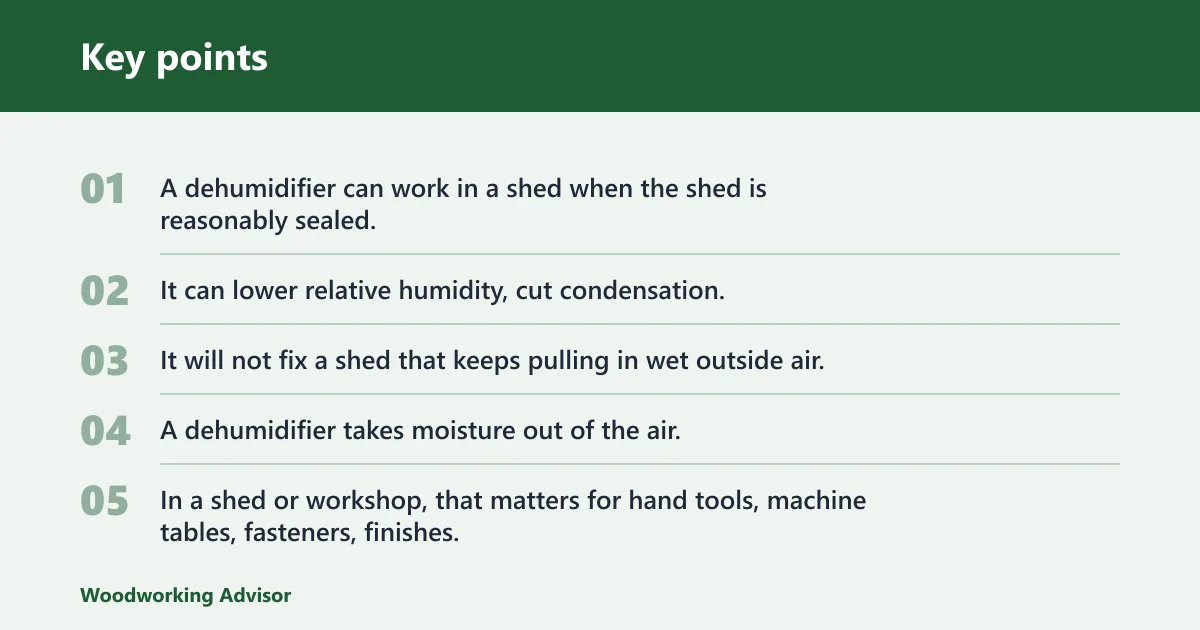


A dehumidifier can work in a shed when the shed is reasonably sealed, the temperature suits the machine, and the unit is sized for the space. It can lower relative humidity, cut condensation, and reduce damp conditions that lead to rust and mould. It will not fix a shed that keeps pulling in wet outside air.
What moisture control can fix
A dehumidifier takes moisture out of the air, which helps keep relative humidity in a healthy range and cuts damp, mould, and condensation. In a shed or workshop, that matters for hand tools, machine tables, fasteners, finishes, and stored timber. A practical shed target is around 55-60% RH.
What a dehumidifier cannot fix
It cannot make up for major air leaks, standing water, roof leaks, or a shed that is too cold for the compressor to keep extracting water. Heating alone also does not remove moisture; it only changes how much water the air can hold. If the shed is leaky, the unit may run but collect very little water.
Why sheds stay damp in cold weather
Warm, moist air cools overnight and reaches the dew point, so water condenses on cold metal, tools, walls, and windows. That is why a dry-looking shed can still develop rust and mould. A cold shed with repeated door opening often gets damp again faster than a small unit can recover.
Picture a 10 m² garden shed used for lawn tools. The owner closes the door at dusk, the temperature drops overnight, and the mower deck and spanners are wet by morning. A dehumidifier can help, but only if the shed is reasonably sealed and the unit matches the temperature range.
Shed humidity decision table
| Shedded condition | Best dehumidifier type | Expected performance | Main failure mode |
|---|---|---|---|
| Sealed heated shed | Refrigerant dehumidifier | Good water removal; compressor units work most efficiently above 12-15°C | Tank fills slowly if humidity is already moderate |
| Sealed unheated shed above 12-15°C | Refrigerant dehumidifier | Usually works well; auto defrost can help in cooler spells | Performance drops as the shed cools toward the lower limit |
| Unheated shed below 10°C | Desiccant dehumidifier | Works well even near freezing and adds gentle warmth of 5-10°C | Uses more power than a compressor unit in warm conditions |
| Leaky shed | Fix leaks first; desiccant only if needed | Poor control unless air infiltration is reduced | Outside damp air keeps replacing the dried air |
Which dehumidifier type fits your shed?
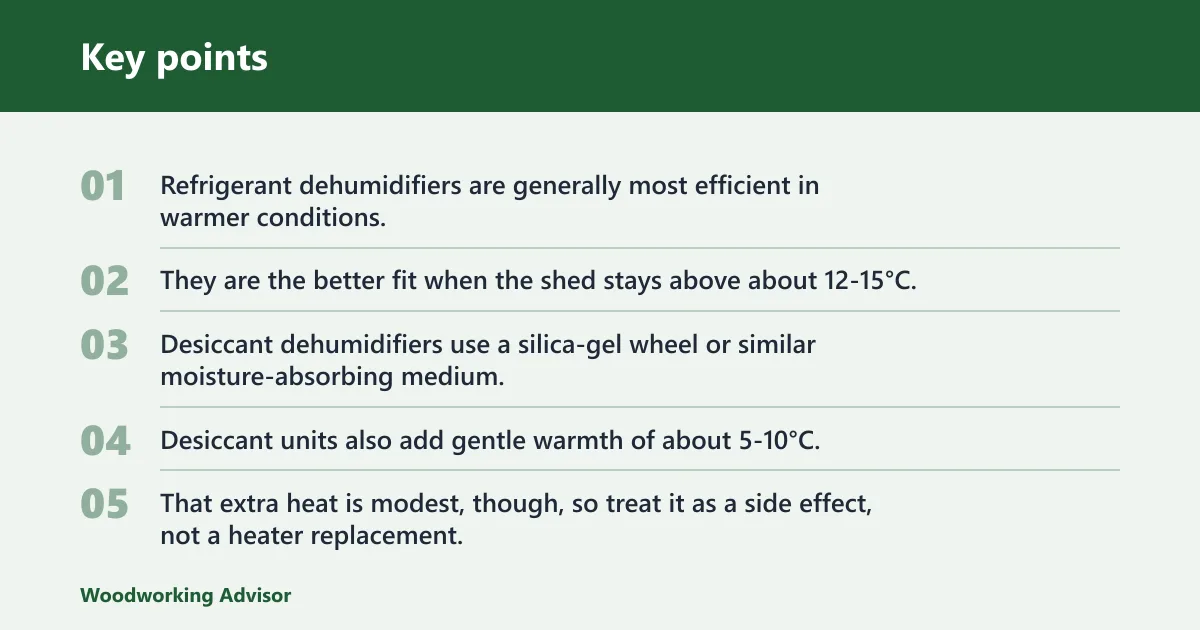
Refrigerant dehumidifiers are generally most efficient in warmer conditions, often above about 12–15°C, where their coils can condense moisture more effectively. They are the better fit when the shed stays above about 12-15°C, especially in a heated or insulated workshop. Desiccant dehumidifiers use a silica-gel wheel or similar moisture-absorbing medium, so they work well in cold spaces and winter use.
Desiccant units also add gentle warmth of about 5-10°C, which can help a small shed stay above the frost line. That extra heat is modest, though, so treat it as a side effect, not a heater replacement. In a cold, unheated shed, that extra warmth can make the difference between usable and useless.
A hybrid or small unit can make sense in a tight, well-sealed tool shed, but size still matters. A small dehumidifier can work in a compact space with limited moisture and few air leaks. It usually struggles in a large garden shed, a workshop with frequent door opening, or any building that breathes damp outdoor air.
Do dehumidifiers actually work? Yes, when the unit type matches the temperature and the shed is sealed well enough for the dried air to stay inside. They fail most often when the shed is too cold, too leaky, or too large for the unit’s capacity.
Will a dehumidifier work in cold weather?
Yes, but the type matters. Refrigerant dehumidifiers lose effectiveness in cold air because their coils cannot condense moisture as well, while desiccant units keep working near freezing. If the shed is below about 10°C, a compressor model may appear to run normally but remove very little water.
The low-temperature operating threshold
Compressor models often need warmer conditions, and the low-temperature operating threshold is the key limit. Compressor dehumidifiers work most efficiently above 12-15°C. Some consumer units list a low-end operating point of 41°F, but that is still close to the edge for winter use.
Auto defrost and its limits
Auto defrost protects compressor units from frost buildup and helps them keep running in cooler weather. It does not turn a warm-weather machine into a true cold-room unit. If the shed is consistently too cold, the machine may spend too much time defrosting and too little time removing water.
Why water collection drops in cold air
Cold air holds less moisture, and the evaporator coil on a refrigerant dehumidifier can frost over or stop condensing efficiently. That means the tank may collect less water even though the unit is on. This is a common false failure: the machine is working, but the conditions are wrong.
Suppose a timber workshop sits at 8°C all week and the dehumidifier tank barely fills. The unit is not necessarily broken. It may simply be the wrong type for that temperature band, especially if the room also has a loose door seal and a dusty filter.
How should you set up a shed dehumidifier?
Set the humidistat, drain the water continuously if possible, and place the unit where air can move around it. A dehumidifier works best in a reasonably airtight shed, with the door kept closed and obvious leaks sealed first. Dust, chips, and sawdust should stay out of the intake.
Use a humidistat at the right setpoint
A humidistat gives automatic humidity control, so the unit stops and starts at a chosen RH level. For most sheds, a practical target is around 55-60% RH, and a common setpoint is about 60% RH. Many consumer units allow adjustment across ranges such as 35% to 85% RH or 35% to 90% RH.
Choose continuous drain if possible
A continuous drain hose lets the unit remove water nonstop and send it to a drain or sink. That reduces tank-emptying hassle and helps a unit run for longer periods without interruption. The guide advice is simple: use the drain hose rather than the tank if possible.
Place it where air can circulate
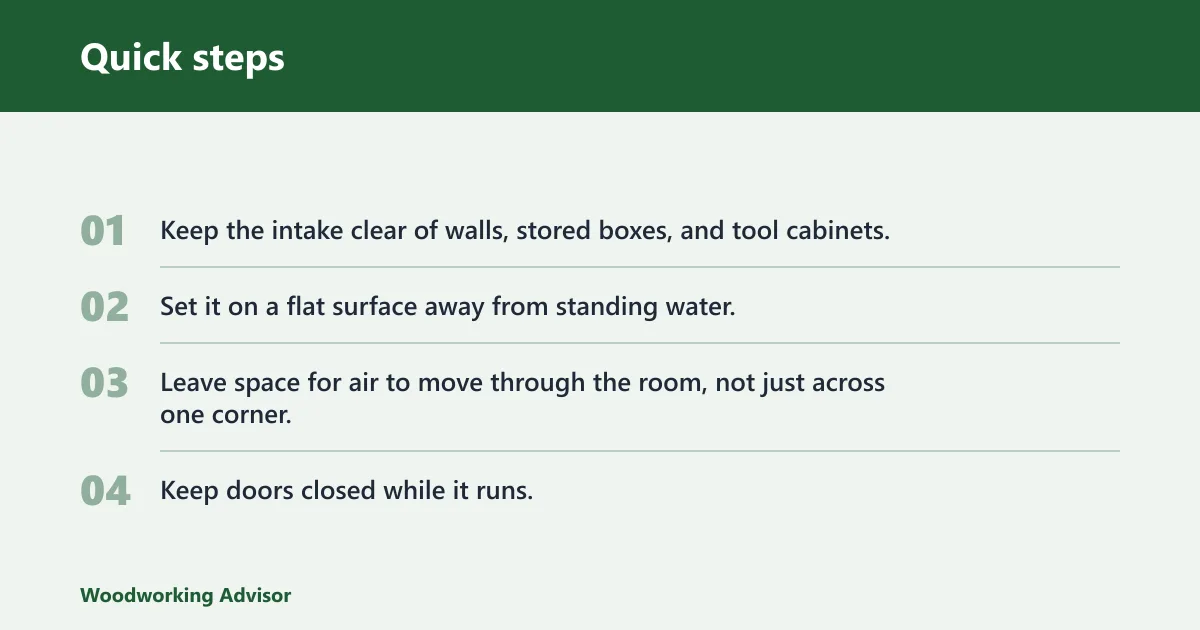
- Keep the intake clear of walls, stored boxes, and tool cabinets.
- Set it on a flat surface away from standing water.
- Leave space for air to move through the room, not just across one corner.
- Keep doors closed while it runs.
Keep filters clear of dust and chips
Woodshops load filters faster than ordinary storage sheds. Sawdust reduces airflow and can cut performance, especially on small units. Check the filter regularly, and keep the machine away from direct chip streams from planers, sanders, and saw stations.
A common first-timer mistake is putting a dehumidifier beside a workbench full of open finish cans and lumber stickers, then expecting perfect control in a leaky shed. The unit may dry one corner while the rest of the room stays damp. Seal, drain, and circulate first.
What humidity level should I aim for?
For most sheds and workshops, aim around 55-60% RH. That is low enough to reduce condensation and rust without pushing the air unnaturally dry. Very low RH is usually unnecessary unless you are protecting sensitive machinery, paper goods, or finish storage.
Practical RH targets for sheds and workshops
If the shed stores hand tools, bench machines, and general supplies, 55-60% RH is a sensible target. Lower may be useful for long-term tool storage, but it costs more energy and can dry wood more than needed. Consumer units often let you set a range from 35% upward, so there is room to tune the setting.
When lower RH is worth the energy cost
Lower RH makes sense if the shed contains precision tools, bare cast iron, or finishes that must stay dry. It may also help after a wet season or a leak repair, when the air and stored materials are carrying extra moisture. In a large shed, the extra runtime can be significant.
Why very low RH can be unnecessary
Timber storage does not need desert-dry air. Very low RH can add cost without much benefit and may dry out wood more than the work requires. For most winter sheds, a steady mid-range target is the practical choice.
How do you dehumidify a shed without a dehumidifier?
Start by reducing the moisture load. Seal air leaks, improve ventilation where outside air is drier than the indoor air, and keep wet materials out of the shed. Heat can help a little by raising air temperature, but it does not remove moisture by itself.
Seal air leaks first
If the shed leaks, outside damp air replaces the air you just dried. Seal gaps around doors, windows, corners, roof lines, and floor edges before sizing any machine. Shed airtightness is the first thing to fix because every other method works better after that.
Improve passive ventilation where it helps
Ventilation can help in dry weather, but it can also make a damp shed worse in wet or humid conditions. In an unheated shed, the tradeoff matters: extra air exchange may lower moisture on a dry, cold day and raise it on a wet one. Use vents only with a clear reason.
Use heat only as part of the plan
Heat can make a compressor dehumidifier more effective, and it can reduce condensation on cold surfaces. It should not be treated as a substitute for moisture removal. If you heat the shed without controlling humidity, the same water is still in the air.
Store timber and tools to limit moisture damage
Keep lumber off the floor, away from outside walls, and out of direct drips. Wipe tools after use, especially after wet cutting or sanding sessions. If finishes are stored in the shed, keep lids tight and avoid placing them near cold walls where condensation forms first.
Frequently asked questions
Will a dehumidifier work in a shed?
Yes, if the shed is reasonably sealed and the unit matches the temperature. A dehumidifier can reduce damp, mould, and condensation, but it will struggle if the shed is very leaky or the air is too cold for the chosen model.
Do small dehumidifiers work in a shed?
Small dehumidifiers can work in a compact, fairly airtight shed with limited moisture loads. They usually fall short in larger sheds, timber workshops, or spaces that open often. Size the unit to the space and the leak level, not just the floor area.
Should a dehumidifier run all the time?
Not usually. A humidistat lets the unit cycle on and off around a set RH, which saves energy and avoids over-drying. Continuous running can make sense after a leak, during a very wet spell, or when a continuous drain is available and the shed stays occupied.
How effective are dehumidifiers in a garden shed?
They can be effective in a garden shed if the structure is sealed well enough and the temperature stays in range for the unit. In a leaky, unheated garden shed, performance drops fast because the machine keeps drying air that is immediately replaced by damp outside air.
What type of dehumidifier works best in an unheated shed?
A desiccant dehumidifier is usually the better fit for an unheated shed, especially below 10°C. It works well near freezing and adds gentle warmth of 5-10°C. A refrigerant unit is better only if the shed stays above about 12-15°C.
Do dehumidifiers give off heat?
Yes. Compressor units give off some heat as part of operation, and desiccant units add gentle warmth of about 5-10°C. That extra heat can help in a cold shed, but it is modest and should not be relied on as the only source of temperature control.
Sponsored / affiliate links. As an Amazon Associate I earn from qualifying purchases. I may earn additional commission from eligible campaigns.