Is Wood Glue Stronger Than Screws? Joint Strength Guide
In a well-fitted wood-to-wood joint, glue is often stronger than screws in shear, while screws provide immediate hold, clamping, and a way to take the joint apart later. Miss that difference, and the joint can creep, split, strip, or fail at the wrong moment. The right choice depends on the project, the joint shape, load direction, and how soon the part must be held before the adhesive cures.
Is wood glue stronger than screws?


What the comparison is really measuring
“Stronger” can mean different things. Bond strength is how much force the adhesive layer takes across the mating surface. Pull-out resistance is how well a fastener stays put when loaded along its length. Joint strength is the whole assembly, including the wood around the fastener, the fit, and the direction of the force.
Wood glue bonds wood fibers and spreads stress across the full bond line. Screws give immediate mechanical fastening at specific points. That is why glue can create a bond stronger than the wood itself in the right joint, while screws still matter when a part must be held right away or taken apart later.
How wood glue and screws actually hold a joint
Glue works best on clean, smooth, tightly fitted surfaces. A good glue line turns two pieces of wood into one broad load path, which is why large surface area matters so much. Screws do a different job: they pull parts together locally, resist movement immediately, and can add support while the glue dries.
That difference explains a lot of real-world failures. Glue spreads stresses evenly across the bond line. Screws concentrate stress at specific points, so their holding power depends on location, wood species, edge distance, and whether the stock splits or crushes.
| Joint type | Typical load direction | Need for clamping | Need for disassembly | Best choice |
|---|---|---|---|---|
| Butt joint | Often tension or racking; weak in shear | Yes, if glue is used | Sometimes | Screws-only or both |
| Box joint | Shear across many interlocking faces | Yes | Rarely | Glue-only |
| Pocket hole joint | Pulling and light structural load | Usually no separate clamp after screw drive | Sometimes | Screws-only or both |
| Edge-glued panel | In-plane shear and seasonal movement control | Yes | No | Glue-only |
| Frame corner with dados or mortises | Mixed load, including racking | Yes | Usually no | Glue-only or both |
| Temporary assembly or test fit | Handling load only | No | Yes | Screws-only |
When is wood glue enough without screws?
Wood glue is enough when the joint fits tightly, the surface area is large, and the parts can stay clamped until cure is complete. In those cases, glue-only joinery is often the cleanest and strongest option for wood-to-wood contact. That is especially true for joints loaded mostly in shear rather than prying or racking.
Best cases for glue-only joinery
PVA glue is often the go-to indoor wood glue for many furniture and shop builds because it is predictable, easy to spread, and strong enough for common joinery when the fit is good. Box joints are a classic example. They create substantially more glue surface area than a simple butt joint, and that extra area is a big reason they hold well.
Edge-glued panels, dowel joints, mortise-and-tenon joints, and well-cut box joints are all good candidates when the parts fit closely. Clamping matters here. It keeps the faces aligned while the glue dries and the cure time runs out, but the clamp force should be firm, not excessive.
When glue-only is a bad bet
Glue alone would not be enough with a butt joint unless the design adds another means of support. The glue area is small, and that small area limits how much load the joint can spread. A butt joint that sees racking, twisting, or impact usually needs screws, joinery with more interlock, or both.
Starved glue joints are another failure point. Too little glue, over-tight clamping, or dusty surfaces can leave the bond line weak. Over-clamping can squeeze too much adhesive out of the joint. The goal is a thin, continuous film, not a dry seam.
- Dry-fit the parts before adding glue.
- Check that the faces meet cleanly across the full area.
- Apply enough glue to wet both surfaces.
- Clamp until the joint stays aligned without drift.
- Leave the joint alone until the adhesive has cured.
When do screws still make sense?
Screws still make sense when the joint needs immediate holding power, when the parts are awkward to clamp, or when the assembly may need to come apart later. They are also useful when the screw is part of the structure, such as in pocket-hole joinery or as temporary mechanical help during glue-up.
Immediate hold and serviceability
Screws are fast. They hold before the adhesive cures, which makes them useful for casework, site-built furniture, and repairs where the parts want to move. They also help with disassembly. If a joint may need service later, screws are often the more practical choice because glue can make teardown destructive.
That said, screw strength is location-specific. A screw driven too close to an edge, into thin stock, or across weak grain can split the part or strip the hole. In those situations, the screw may add less value than a better joint shape or a wider glue surface.
Where screws help structural performance
Screws can add support in load-bearing joints, especially where the joint needs immediate resistance to movement before the adhesive reaches full strength. Pocket hole joints usually rely on screws, and they can also be glued for extra holding power. But pocket holes are not automatically superior to glued joinery; they are a different solution for a different geometry.
For thin stock and small parts, the risk of screw splitting goes up. Pre-drilling, correct screw length, and proper grain orientation matter. A screw that causes a split has not strengthened the joint at all.
Choose wood glue if… / choose screws if…
Choose wood glue if the fit is tight, the surface area is large, and the joint can stay clamped through cure. Choose screws if you need instant handling strength, future removal, or help with a weak joint shape. In many furniture builds, the right answer is both, but the reason should be structural rather than habitual.
Choose wood glue if…
- The joint has a large, clean mating surface.
- The load is mainly shear, not prying or racking.
- You can clamp the parts until the glue cures.
- The piece will not need easy disassembly later.
Choose screws if…
- You need immediate hold for assembly or handling.
- The joint geometry has little glue area, like a butt joint.
- The part may need to be removed for service or repair.
- The screw is part of the design, as in many pocket-hole joints.
What glue type should you use for the job?
PVA glue is the default for most indoor furniture because it is simple, reliable, and strong on wood-to-wood joints with a good fit. Epoxy is the better pick in some high-stress, high-moisture, or gap-prone situations, and it can be stronger than wood glue in those contexts. Polyurethane glue expands into the joint and can fill gaps, which helps when cuts are not as precise as they should be.
PVA, epoxy, polyurethane, hide glue, and construction adhesive
Hide glue is reversible, which can matter in antique restoration and repairs where later release is useful. It also allows adjustment during assembly. Epoxy can make screw removal difficult once it cures around hardware, so use it when permanence is the point. Polyurethane glue is useful when there are small gaps, but it is not the first choice for every joint because fit still matters.
Liquid Nails is a construction adhesive, not a replacement for standard wood glue in every woodworking case. It is stronger than wood glue in some applications, especially on non-porous materials, but it is not the same tool for fine joinery. For furniture that depends on accurate wood-to-wood fit, PVA or epoxy is usually the more appropriate choice.
For indoor casework, Titebond III is ANSI/HPVA Type I water-resistant, and Gorilla Wood Glue has a 20-30 minute clamp time. Those are useful details when the workflow depends on open time and clamping schedule, but joint geometry still matters more than label claims.
Is wood glue better than screws
Wood glue is better than screws when the question is bond strength across a well-fit wood-to-wood surface. It is not better when the joint needs immediate handling, easy disassembly, or a fast temporary hold. In practice, “better” depends on whether the joint is built for shear area or for mechanical fastening.
For a box joint or well-made edge glue-up, glue is usually the better structural choice. For a quick cabinet face frame, a pocket-hole assembly, or a butt joint that has little surface area, screws may be the practical first step.
What wood glue is the strongest
There is not one wood glue that is the strongest choice for every joint. Epoxy is often a strong choice in high-stress, moisture-prone, or gap-filling situations, while PVA is commonly used for clean indoor joinery with a tight fit. The strongest adhesive is the one that matches the joint, the load, and the environment.
Hide glue, polyurethane glue, and PVA all have places where they are the right answer. The wrong glue, even a strong one, can underperform if the surfaces are dusty, the fit is poor, or the clamp schedule is rushed.
Is glue stronger than screws
Glue is often stronger than screws in a properly made wood-to-wood joint because it spreads load over the whole bond line. Screws are point fasteners, so their strength depends on where they sit and how the wood behaves around them. That does not make screws weak; it makes them different.
The better comparison is glue strength versus screw pull-out and joint geometry. A glue line in shear can outperform a screw in a clean assembly, while a screw can still hold a part instantly when glue would need time to cure.
Is glue stronger than wood
Yes, wood glue can create a bond stronger than the wood itself when the joint fit is good and the adhesive is applied correctly. That statement is about the bond line, not about every possible failure mode in a real project. The wood around the joint can still split, crush, or tear before the glue line does.
That is why surface area, clamping, and cure time matter so much. The glue may be very strong, but the surrounding fibers and the joint shape still decide how the assembly fails.
Should I use wood glue and screws together?
Use wood glue and screws together when you need instant holding plus a final adhesive bond, or when the joint geometry is weak and you want both mechanical and bonded support. This is common in butt joints, pocket-hole assemblies, and some casework where clamping is awkward. The combination can help, but it should not be a substitute for a poor fit.
Glue-plus-screws also adds workflow cost. You pay in setup time, drilling, and cleanup. In exchange, you get faster handling and a more forgiving assembly process. For beginners, that trade can be worth it on a first cabinet or shop fixture.
What joint types need screws instead of glue?
Joints that have very little glue area, that must be assembled and handled immediately, or that need later removal often need screws instead of glue. Butt joints are the most obvious example. Pocket hole joints also depend on screws by design, although glue can be added when the joint will stay permanent.
Some temporary builds, jigs, and site assemblies are also better suited to screws. If the joint must be taken apart later, the screw may be the whole point.
Can wood glue replace screws in furniture assembly?
Sometimes, yes. In furniture with good joinery, wood glue can replace screws because the joint design carries the load and the adhesive only has to keep the parts locked together. That works best in mortise-and-tenon, box, dado, and well-fit edge joints. It does not work as well in simple butt joints or in parts that need immediate use.
Where seasonal movement or racking is part of the load, glue alone may not be enough unless the joint design already addresses those forces. The furniture should be designed around the joint, not the other way around.
Is wood glue really not stronger than wood?
Wood glue can be stronger than the wood itself, but only when the joint fit, clamping, and cure are right. That does not mean a glued project is indestructible. It means the bond line can exceed the surrounding fibers, so failure may move into the wood rather than the adhesive.
If the fit is poor, the glue is starved, or the clamp pressure is wrong, the adhesive will not reach that level. A strong glue cannot rescue a sloppy joint.
Hacker News
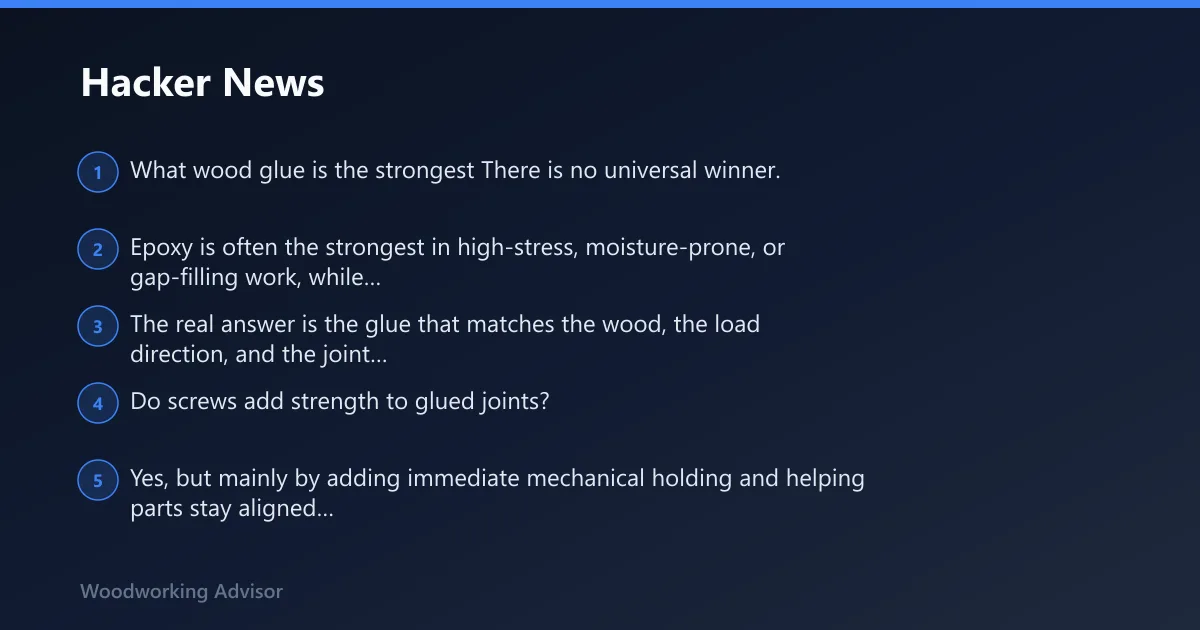
What wood glue is the strongest
There is no universal winner. Epoxy is often the strongest in high-stress, moisture-prone, or gap-filling work, while PVA is the standard for clean indoor joints with a tight fit. The real answer is the glue that matches the wood, the load direction, and the joint geometry.
Do screws add strength to glued joints?
Yes, but mainly by adding immediate mechanical holding and helping parts stay aligned while the glue cures. Screws can also contribute structural resistance in some joints, especially pocket-hole assemblies. They do not replace good fit, and they can split thin stock or concentrate stress if placed badly.
What joint types need screws instead of glue?
Butt joints are the clearest case, because the glue area is small and the joint has little inherent resistance to movement. Pocket-hole joints also rely on screws. Temporary assemblies and parts that must be removed later are often better served by screws than by a permanent adhesive bond.
Can wood glue replace screws in furniture assembly?
Yes, when the furniture uses joinery that provides enough surface area and mechanical interlock. Box joints, mortises, dados, and well-fitted edge joints can often be assembled with glue alone. If the piece needs quick handling, disassembly, or extra resistance to racking, screws may still be the better fit.
Is glue stronger than wood
Often, yes. A correctly made glue joint can exceed the strength of the wood fibers around it, which is why the wood may fail before the bond line does. But that only applies when the surfaces are clean, the fit is tight, and the adhesive is allowed to cure properly.
Should I use wood glue and screws together?
Use both when the joint needs immediate hold and a final adhesive bond, or when the geometry is weak and you want more than one load path. This is common for butt joints and some pocket-hole builds. For well-made high-area joinery, glue alone is often the cleaner answer.
Sponsored / affiliate links. As an Amazon Associate I earn from qualifying purchases. I may earn additional commission from eligible campaigns.