Hot Glue vs Wood Glue for Quick Fixes That Hold Better
Use hot glue for quick positioning, tack-ups, and non-structural fixes; use wood glue for any joint that must hold weight, resist heat, or last. Pick the wrong adhesive and a repair can creep, pop loose, or fail again after the first warm day or hard use. This guide shows where hot glue works, where wood glue wins, and the fastest safe choice for common small repairs.
Hot glue vs wood glue: the quick answer


Hot glue is the speed tool. Wood glue is the repair adhesive. For a loose trim piece, a temporary fixture point, or a light part that needs to stay put long enough for the next step, hot glue is often the faster choice. For any wood joint that must hold weight, take clamping, and keep going for years, wood glue is the safer pick.
When speed matters more than bond life
Hot glue sets fast and works well for temporary fixes and crafts. I use it when the goal is to hold a piece in place, not to build a joint that will carry load. That makes it a good fit for quick alignment, fixture points, and mixed-material tacks.
When wood glue is the safer pick
Wood glue gives a strong, durable bond made for wood-to-wood connections. If the repair will see stress, heat, or moisture, wood glue is the better choice because it forms a tougher bond after it dries. PVA wood glue is a common interior repair option for furniture and similar work.
| Decision factor | Hot Glue | Wood Glue for Quick Fixes | Winner |
|---|---|---|---|
| Set and handling speed | Grabs fast and solidifies as it cools | Needs clamping and longer drying time | Hot Glue |
| Strength on wood-to-wood joints | Weak structural bond on wood | Strong, durable bond for wood joints | Wood Glue for Quick Fixes |
| Heat and moisture resistance | Limited heat resistance; not water-resistant | Can be water-resistant; better for long-term use | Wood Glue for Quick Fixes |
| Mixed materials and temporary positioning | Bonds wood, fabric, paper, plastics, ceramics, and certain metals | Best on wood-to-wood connections | Hot Glue |
| Cleanup and reversibility | Easier to remove when a tack point is wrong | Cleaner final bond, but less forgiving after cure | Hot Glue |
Set and handling speed
Hot glue is the faster tool because it is a quick-drying adhesive applied in a molten state and solidifies as it cools. Wood glue needs more time to dry, and the part usually needs clamping while the bond forms. For a true quick fix, that gap matters more than anything else.
Strength on wood-to-wood joints
Wood glue wins here. Hot glue can hold a light part in place, but it is not a structural wood adhesive, and the bond can fail when a joint sees pull, racking, or repeated stress. For a chair part, rail, or edge joint, wood glue is the proper choice.
Heat and moisture resistance
Hot glue is not water-resistant, and heat can soften it enough to let a repair creep or release. Wood glue can be water-resistant depending on the formula, which makes it a better choice for repairs that may see damp air, spills, or a warm room. A sunny window or parked car is a bad place for hot glue on a stressed repair.
Mixed materials and temporary positioning
Hot glue bonds wood, fabric, paper, plastics, ceramics, and certain metals, so it is useful when wood meets another material. That makes it handy for tack points, layout aids, and temporary assembly. Wood glue is less useful when the repair includes plastic, fabric, or metal because it is made for wood-to-wood connections.
How each adhesive behaves on wood
Hot glue and wood glue fail for different reasons. Hot glue grabs quickly, but it does not soak into wood fibers the way a wood adhesive does. Wood glue bonds into the wood structure and needs time to dry and cure before it reaches full strength.
What hot glue does when it cools
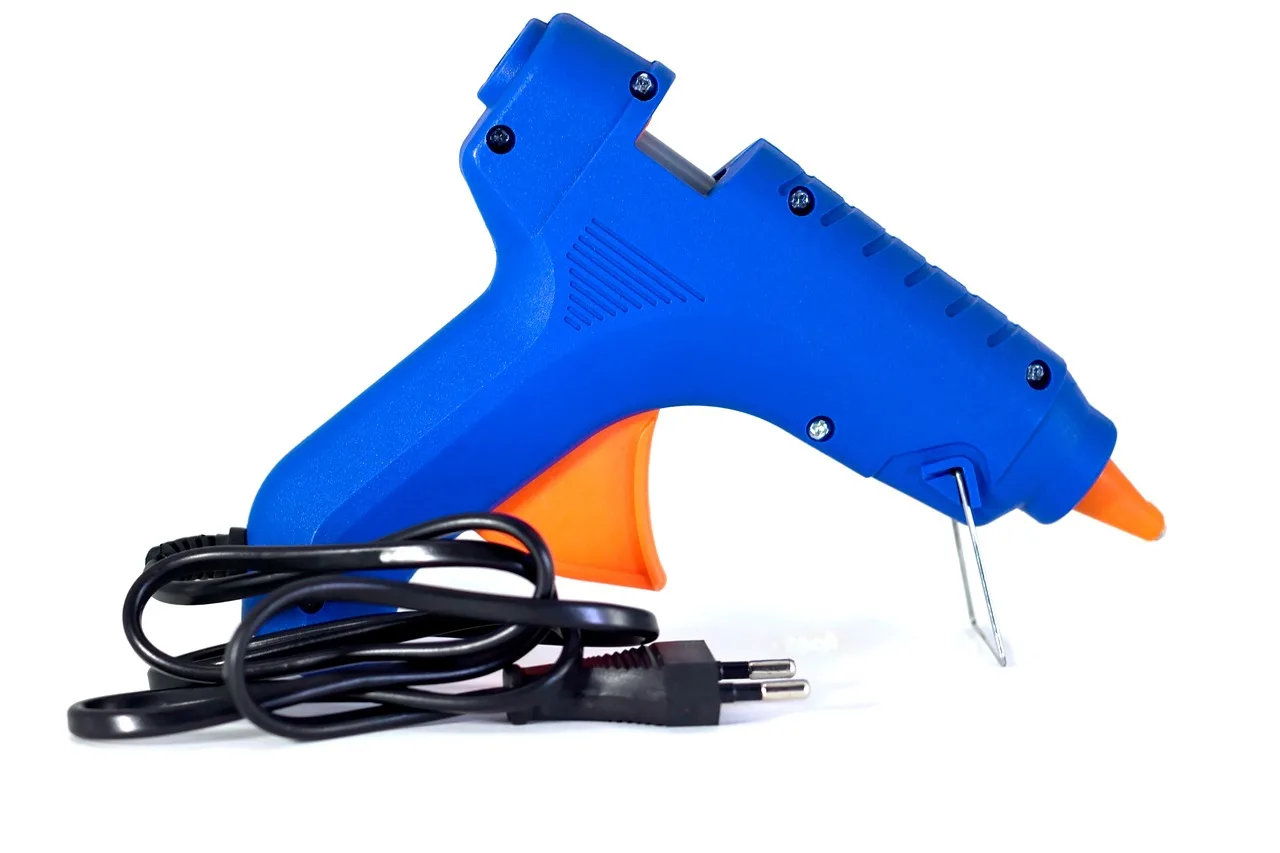
Hot glue is a hot-melt adhesive from a glue gun. It flows while hot, fills small gaps, and hardens as it cools, which makes it useful for quick positioning. On wood, that fast grab helps only when the part is light and the joint is not expected to carry real load. (en.wikipedia.org)
How PVA wood glue bonds wood fibers
PVA wood glue is the common carpenter’s glue for interior work. It is typically water-based, cleans up while wet, and forms a strong bond once dried. Because it is made for wood, it is the standard choice for furniture repair, edge joints, and other wood-to-wood fixes.
Why high-temp guns outperform low-temp guns on wood
A low-temp glue gun is usually in a lower-temperature range and is often better for foam, fabric, and paper. A high-temp glue gun is typically in the higher-temperature range and is often better for wood repairs because the glue stays fluid long enough to wet the surface and grab the joint properly. Wattage matters too, because better heat recovery keeps the glue hot while you work.
Side-by-side comparison for quick fixes
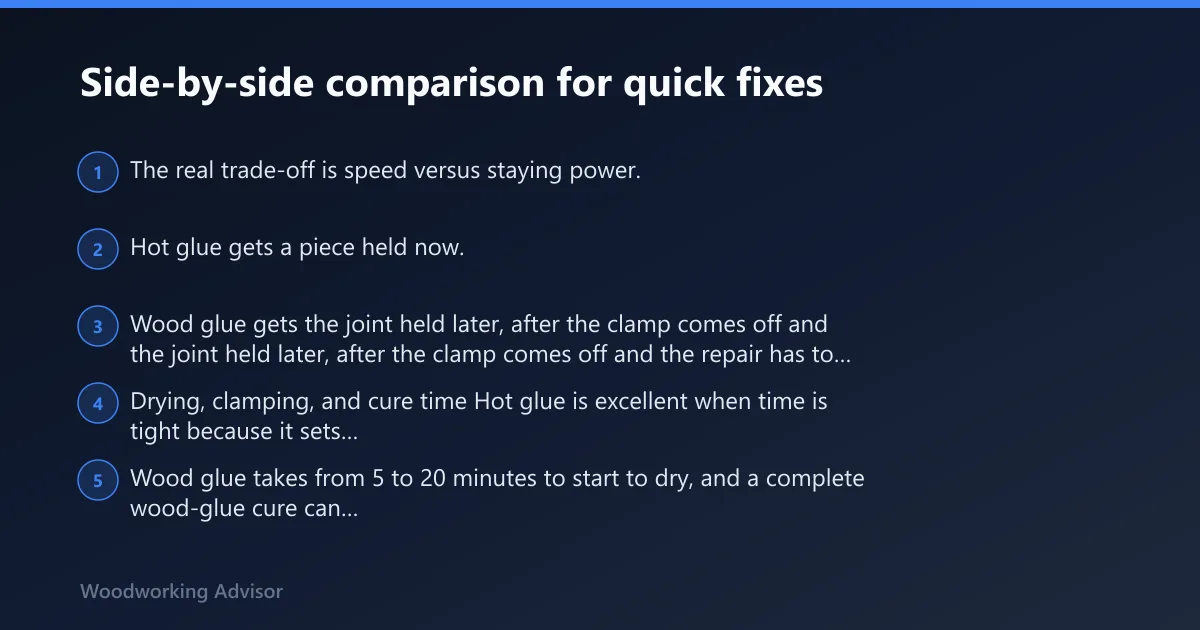
The real trade-off is speed versus staying power. Hot glue gets a piece held now. Wood glue gets the joint held later, after the clamp comes off and the repair has to survive use.
Drying, clamping, and cure time
Hot glue is excellent when time is tight because it sets fast. Wood glue takes from 5 to 20 minutes to start to dry, and a complete wood-glue cure can take around an entire day. That means wood glue may feel secure before it is truly ready for load-bearing use.
Strength and durability
Hot glue is ideal for temporary fixes and crafts, but it is a weak structural bond on wood. Wood glue provides a strong, durable bond made for wood-to-wood connections. If the joint must stay closed through use, the table turns in wood glue’s favor quickly.
Cleanup and rework
Hot glue is forgiving when the first placement is wrong. It can often be reheated or peeled away with less cleanup than a failed wood-glue repair. Wood glue gives a better final bond, but rework costs more time because the pieces may need scraping, sanding, or a full reset.
Mixed materials and positioning
Hot glue has the edge when the repair includes two different surfaces that wood glue will not grab well. For a quick tack point on trim, props, craft parts, or a small shop jig, hot glue can hold parts in place while another fastening method does the real work. That is positioning, not structural repair.
When is hot glue actually the better choice?
Hot glue is the better choice when the repair is temporary, light, and non-structural. It is the faster option for positioning parts, holding small pieces during assembly, and making short-term tack points where the goal is to keep pieces aligned rather than make the final bond.
Temporary alignment and fixturing
When two parts need to stay still while another step happens, hot glue is often the fastest helper. A few dots can hold a part long enough to clamp, screw, or pin it later. That is why it works well in the shop for jigs, spacers, and layout aids.
Light trim, picture frames, and craft parts
Loose trim, picture frame corners, craft components, and similar light parts often fit hot glue’s strengths better than wood glue’s. The bond is quick, and the part usually does not need full structural strength. If the trim is decorative and not load-bearing, hot glue can be the practical choice.
Mixed-material tack points where wood glue cannot grab
Hot glue is useful when wood meets fabric, plastic, paper, ceramic, or certain metals. In those cases, wood glue is often the wrong adhesive because it is meant for wood-to-wood joints. Hot glue gives a fast tack without waiting on a clamp setup that may not help anyway.
When is wood glue the better choice?
Wood glue is the better choice when the repair must survive use, stress, heat, or time. If the joint can flex, pull apart, or sit in a warm or damp place, wood glue is the safer adhesive. Hot glue may hold at first, then fail when conditions change.
Furniture repairs and stressed joints
Loose rails, chair parts, edge glue lines, and similar furniture repairs need a bond that behaves like part of the wood. PVA wood glue is the common interior wood adhesive for that job. Hot glue may hide the problem for a while, but it does not solve a stressed joint.
Loose blocks and small wood-to-wood repairs
Small wood repairs can still need real bond strength. If a loose block, cleat, or edge piece must stay attached after the clamp comes off, wood glue is the right pick. It takes longer, but the repair is more likely to remain stable.
Any repair that must survive heat or moisture
Warm rooms, sunny windows, garages, cars, and damp areas are hard on hot glue. Moisture and heat resistance are common failure points for quick hot-glue repairs on wood. If the part may see either condition, choose a wood glue formula with the needed water resistance instead.
Decision checklist: choose the safer adhesive
Use this checklist before reaching for the gun or bottle. Score each item, then pick the adhesive that best fits the repair, not the one that feels fastest in the moment.
- Load: If the part will carry weight, resist pull, or see repeated use, score it toward wood glue.
- Heat exposure: If the repair sits near a window, in a car, or in a warm room, score it toward wood glue.
- Surface porosity: Porous wood favors wood glue for a lasting joint; mixed materials favor hot glue for a quick tack.
- Need for reversibility: If the repair is temporary or may need to come apart, score it toward hot glue.
How to read the score
If load and heat both point to wood glue, use wood glue even if hot glue would be faster. If the part is light, temporary, and mixed-material, hot glue is usually the safer quick fix because it can hold without pretending to be a structural repair. The right answer is the one that cuts failure risk, not the one that finishes first.
Choose hot glue if… / Choose wood glue for quick fixes if…
Choose hot glue if the part is temporary, light, non-structural, or needs fast positioning across mixed materials. Choose wood glue if the joint must hold weight, survive heat or moisture, or stay intact after full cure and long use. That split keeps the repair honest.
Choose hot glue if…
- The part only needs a temporary hold.
- You are aligning trim, craft parts, or a shop jig.
- The surfaces include fabric, paper, plastic, or other mixed materials.
- You need a quick tack and can accept later rework.
Choose wood glue for quick fixes if…
- The joint is wood-to-wood and must stay strong.
- The repair will see heat, moisture, or repeated stress.
- You can clamp the pieces while the glue dries and cures.
- You want the repair to last instead of acting as a temporary hold.
Frequently asked questions
Can I use hot glue instead of wood glue on a quick wood repair?
Only when the repair is light, temporary, and non-structural. Hot glue is useful for quick positioning and tack-ups, but it is a poor substitute for wood glue on any joint that must carry load or stay fixed over time. If the joint matters, use wood glue.
Is hot glue strong enough for wood joints?
Not for joints that need real strength. Hot glue can hold a small piece in place, but it is a weak structural bond on wood and can soften under heat. For rails, furniture parts, or any joint under stress, wood glue is the safer choice.
When is wood glue better than hot glue for a quick fix?
Wood glue is better whenever the repair must last, even if the fix is small. That includes loose blocks, furniture parts, edge joints, and anything that may see moisture or heat. The extra clamp and cure time are worth it when failure would be a problem.
How long does wood glue need to clamp before handling?
It varies by formula, but wood glue generally needs enough clamp time for the joint to stop shifting before handling. It may start to dry in 5 to 20 minutes, yet full cure can take around an entire day. For load-bearing use, wait for full cure, not just initial grab.
Does hot glue hold up in heat or moisture?
Not well compared with wood glue. Hot glue is not water-resistant, and heat can soften it enough to let the bond creep or fail. A warm room, sunny window, car interior, or damp area can turn a quick hot-glue repair into a repeat job.
Can hot glue bond wood to plastic or fabric better than wood glue?
Yes, for a quick tack point. Hot glue bonds wood, fabric, paper, plastics, ceramics, and certain metals, so it handles mixed materials better than wood glue. That said, the bond is usually best treated as temporary positioning unless the joint is very light.
What kind of glue should I use for a temporary wood repair?
Use hot glue if the repair is only meant to hold a piece in place for now. It sets fast and is easy to revise when the fit is wrong. If the temporary repair must still carry load or survive heat, use wood glue instead and clamp it properly.
Why does hot glue fail on wood repairs so quickly?
Hot glue fails when the repair asks for more than a tack bond can give. It has limited heat resistance, no water resistance, and weak structural performance on stressed wood joints. Once the joint flexes, warms up, or gets damp, the bond can let go fast.
Sponsored / affiliate links. As an Amazon Associate I earn from qualifying purchases. I may earn additional commission from eligible campaigns.