Jointer vs Joiner: What’s the Real Difference?
Many folks getting into woodworking get a bit mixed up when they hear the words “jointer” and “joiner.” It’s pretty common because they sound so similar! This confusion can make it tricky to know which tool you need for your projects. Don’t worry, though.
We’re going to break it down super simply, step by step, so you’ll know exactly what each one does. We’ll clear up the Jointer vs Joiner: What’s the Real Difference? so you can confidently pick the right tool.
Understanding the Jointer and Joiner Tools
This section will get you started with the basics of what woodworking jointers and joiners are. We’ll look at how they work and why knowing the difference is important for anyone working with wood. Understanding these tools is a key first step in using them effectively for your projects.
What is a Woodworking Jointer
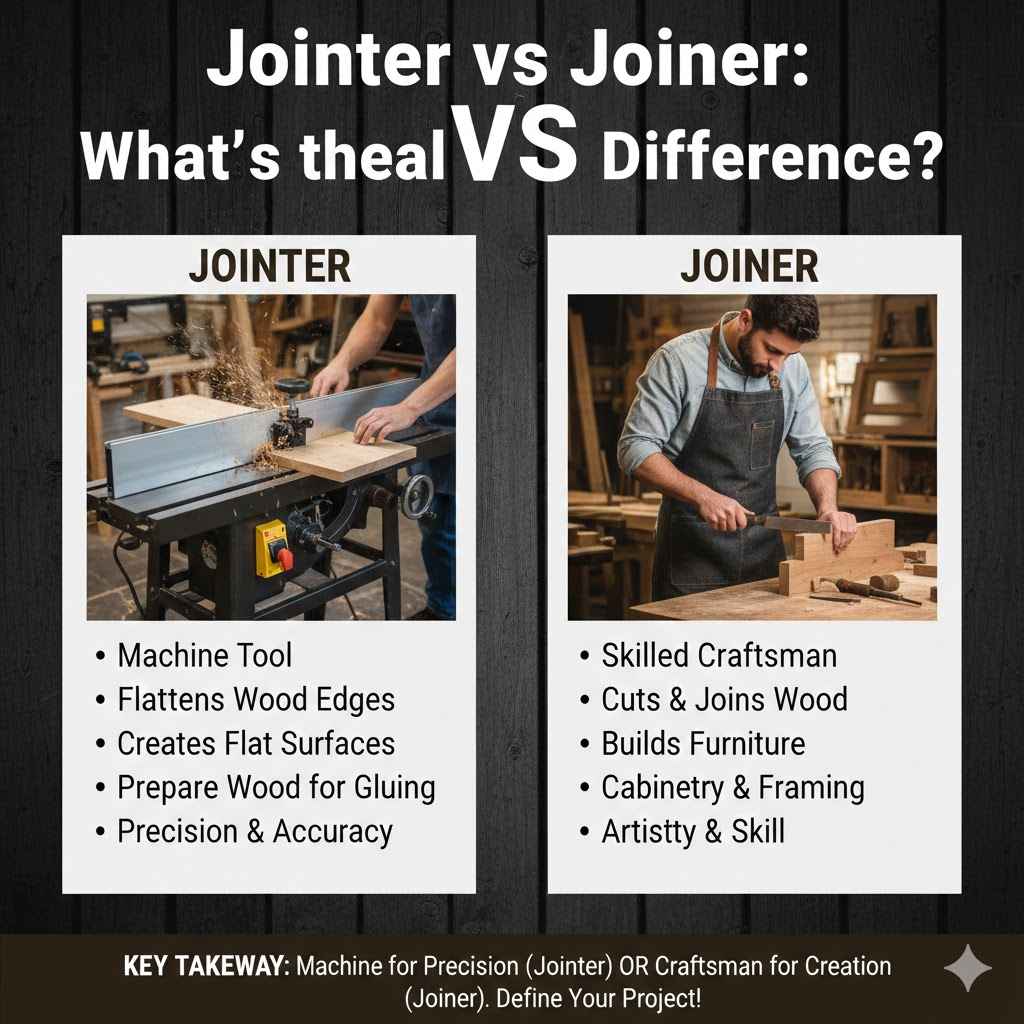
A woodworking jointer is a stationary machine used to flatten and square up rough lumber. Its main job is to create a perfectly flat face and a perfectly square edge on a piece of wood. This is crucial because most lumber you buy from the store isn’t perfectly flat or square.
You need these perfect surfaces to make precise joints and assemblies. Without a jointer, creating tight-fitting pieces would be very difficult.
The jointer works by having a set of rotating knives that shave off thin layers of wood. The wood is passed over these knives on a flat table. One side of the wood rests against a fence, which is set at a precise 90-degree angle to the cutterhead.
This ensures that one face of the board becomes perfectly flat and parallel to the bottom of the machine. Then, the board is flipped and passed over the knives again, with the flattened face against the fence. This creates a second face that is perfectly flat and parallel to the first.
Finally, the edge is dressed against the fence to make it perfectly square to the faces. This process prepares wood for subsequent operations like planing or cutting.
- Flattening Surfaces: The jointer’s primary function is to create a perfectly flat face on a board. This is essential for many woodworking tasks. A flat face ensures that subsequent operations, like using a thickness planer, produce consistent results. Without a flat reference surface, the planer can create uneven thicknesses.
- Squaring Edges: After a face is flattened, the jointer squares the edge of the board. This means the edge is precisely 90 degrees to the flattened face. This creates a reference surface that is essential for accurate cuts and joinery.
- Preparing for Planing: A common workflow is to use the jointer first to flatten one face and square one edge of a rough board. Then, this flattened face is placed against the fence of a thickness planer. The planer then makes the opposite face parallel and at the desired thickness.
The accuracy of a jointer is measured in how flat and square it can make surfaces. High-quality jointers have adjustable fences and tables that allow for very fine adjustments. The sharpness and alignment of the knives are also critical.
Dull or misaligned knives will result in tear-out or uneven cuts, compromising the flatness and squareness of the wood.
Imagine you have a piece of wood that looks like a gentle wave. You can’t just put it through a planer, or the planer will just follow the curve, and you’ll end up with wood that’s thinner in some spots and thicker in others. The jointer flattens out that wave so you have a nice, straight surface to start with.
It’s like ironing out a wrinkled shirt before you fold it.
What is a Woodworking Joiner
The term “joiner” in woodworking usually refers to the person who performs joinery, or it can refer to a specific type of machine called a “mortiser” or a “tenoner” which are used to cut specific types of joints. However, in the context of a “jointer vs joiner” discussion, people are often mistakenly using “joiner” when they mean “jointer.” Sometimes, people might refer to a bench jointer or a specialized bench tool that helps hold workpieces together for gluing, which could be considered a type of joiner tool. But generally, the main confusion arises from the spelling and the fact that a jointer is used to make pieces ready for joining.
If the term “joiner” is used for a machine, it typically refers to tools that create the actual connections between pieces of wood, rather than preparing the surfaces. For example, a mortiser cuts rectangular holes (mortises) for mortise and tenon joints, while a tenoner cuts the projecting parts (tenons). These machines are designed to create specific components of a joint.
They don’t typically focus on achieving perfect flatness or squareness of raw lumber like a jointer does. Instead, their precision lies in the accuracy of the shapes they cut for fitting pieces together.
- Creating Specific Joints: Machines called “joiners” in a broader sense are designed to create precise parts of joints, such as mortises or tenons. These are specialized machines for specific tasks within the joinery process.
- The Woodworker as Joiner: Often, “joiner” refers to the craftsperson skilled in creating joints and assembling furniture or structures. This person uses various tools, including a jointer, to achieve their final pieces.
- Distinction from Jointer: The key difference is that a jointer prepares the wood for joining, making surfaces flat and edges square. A machine joiner, or the act of joining, is about the assembly process and creating the interlocking parts.
Let’s clarify. When someone says “joiner” for a machine, they are usually talking about a tool that cuts the actual joint. Think of a mortise and tenon joint.
The mortise is the hole, and the tenon is the peg that fits into it. A mortiser machine cuts the hole, and a tenoner machine cuts the peg. These are different from a jointer, which makes the wood perfectly flat and square so these parts can fit together snugly.
Why the Confusion Between Jointer and Joiner
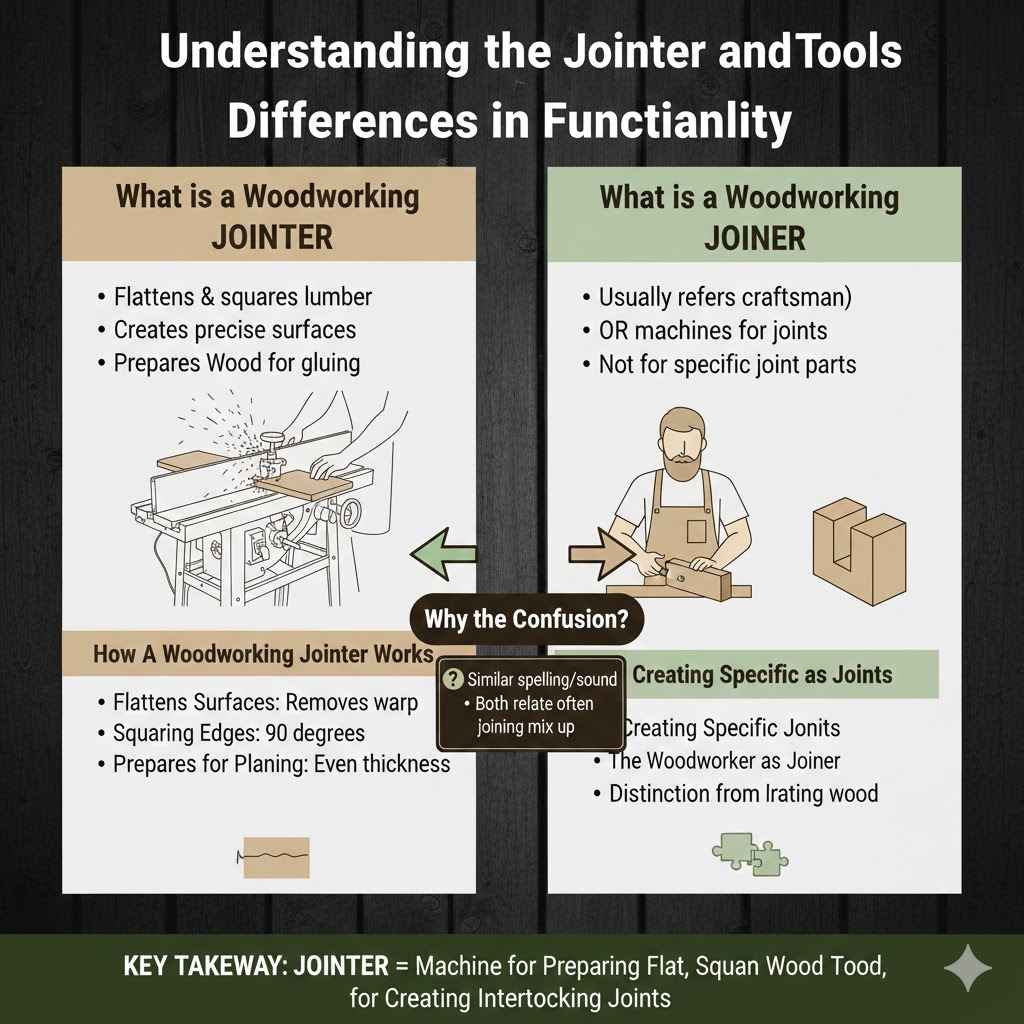
The main reason for the confusion between “jointer” and “joiner” is their very similar spelling and pronunciation. Both words relate to the process of bringing pieces of wood together. However, their functions in woodworking are distinct.
A jointer is a machine that prepares lumber for joining, while a joiner can refer to the person performing the joinery or specialized machines that cut specific joint components.
Beginners often encounter these terms in woodworking books, online forums, or when talking to experienced woodworkers. Hearing the terms used interchangeably or in contexts where the distinction isn’t immediately obvious can lead to misunderstandings. For instance, someone might say they need a “joiner” to make their tabletop flat, when they actually need a “jointer.” This leads to questions about the Jointer vs Joiner: What’s the Real Difference?, especially when looking to buy or understand woodworking equipment.
- Phonetic Similarity: The words sound almost identical, making it easy to mix them up in conversation or when reading. The slight difference in pronunciation is often overlooked.
- Related Concepts: Both terms are deeply connected to the process of woodworking and creating finished pieces. A jointer’s output is directly used for joinery, creating a strong link in concept.
- Ambiguity in Machine Names: While “jointer” is a specific machine, “joiner” can refer to a person or a class of machines (like mortisers or tenoners). This broadness adds to the confusion.
This confusion isn’t about being new to woodworking; it’s a common linguistic hurdle. The goal is to make the distinction clear so you can correctly identify the tools and their roles. We will now look at the jointer in more detail to solidify its purpose before moving on to the nuances of the “joiner” concept.
The Jointer’s Role in Woodworking
This part will explore the jointer as a specific tool. We will detail its core functions, how it achieves them, and why it’s considered an indispensable piece of equipment for serious woodworkers. Understanding the jointer’s purpose is vital for appreciating its contribution to creating high-quality wooden items.
How a Jointer Works Mechanically
A typical jointer consists of a cast-iron body housing a rotating cutterhead fitted with sharp knives. Two tables, an infeed and an outfeed, are positioned above the cutterhead. The infeed table is adjustable, while the outfeed table is usually set at the same height as the cutterhead’s highest point.
A fence, adjustable for angle, runs along the outfeed side of the machine.
When a board is placed on the jointer, one face is presented to the cutterhead. This face is then made flat as the knives shave off wood. After this face is flattened, the board is flipped.
The now-flat face is placed against the outfeed table and the fence. The infeed table is then adjusted down slightly. As the board passes over the cutterhead, the edge is made perfectly square to the flattened face.
This two-step process ensures that the board has at least one perfectly flat face and one perfectly square edge.
- Cutterhead Mechanism: The cutterhead spins at high speed, usually with two or three sharp knives. As the wood is pushed across, the knives quickly remove slivers of material, creating a smooth surface. The speed of rotation and the sharpness of the knives are crucial for a clean cut without tear-out.
- Infeed and Outfeed Tables: The infeed table supports the wood as it enters the cutting zone, and its height is adjusted to control the depth of cut. The outfeed table supports the wood after it has passed the cutterhead and is set to be perfectly level with the knives’ highest point. This provides continuous support and ensures the wood remains flat as it exits.
- The Fence: The fence acts as a guide, ensuring the edge being dressed is kept at a precise 90-degree angle to the flattened face. It can also be set at other angles for chamfering or beveling edges, although its primary role in flattening and squaring is critical.
The power of the motor determines how quickly the jointer can remove material and how well it handles denser woods. A more powerful motor allows for deeper cuts or faster feeding of the wood. The overall mass and rigidity of the machine are also important.
A heavy, stable jointer will vibrate less and produce more accurate results, especially when working with larger or harder pieces of wood.
Consider the precision needed. If a jointer’s knives are slightly out of alignment, or if the tables are not perfectly parallel, the resulting wood will not be flat or square. This means that the next steps in woodworking, like joining the pieces together or applying finishes, will be compromised.
The jointer is the foundation for accuracy in many woodworking projects.
Common Uses of a Jointer
The jointer is used extensively in furniture making, cabinetry, and any craft where precise wood joinery is required. Its primary role is to prepare rough lumber into a usable state. This includes taking boards that are bowed, twisted, or cupped and making them flat and square.
It is also used to create perfectly square edges that will be glued together. When you are making a tabletop from several boards, for instance, you need the edges of those boards to be perfectly straight and at a 90-degree angle to the faces so they fit together seamlessly. A jointer accomplishes this task.
- Dimensioning Rough Lumber: Before any other milling operation, rough lumber often needs its faces flattened and edges squared. The jointer is the first machine used in this process.
- Edge Gluing Preparation: To create wide panels, such as tabletops or cabinet sides, individual boards are glued edge to edge. The jointer ensures these edges are perfectly straight and square, creating a tight glue line that is strong and visually appealing.
- Creating Square Stock: While a thickness planer can make two faces parallel, it relies on one face being flat first. The jointer provides this essential flat face. It also squares up an edge, producing a piece of wood that has a reference face and a reference edge, making subsequent cuts more accurate.
The jointer is also useful for creating chamfers and bevels on edges when the fence is set to an angle other than 90 degrees. This can be for aesthetic purposes or to prepare an edge for a specific type of joint. However, its main job remains providing flat and square surfaces.
Think about building a wooden box. You need four sides that fit together at the corners. If the edges of the wood aren’t perfectly straight and square, you’ll end up with gaps at the corners.
The jointer makes those edges perfectly straight and square, so your box comes together beautifully and is strong.
One example is in professional cabinet shops. When they receive a large shipment of hardwood, it’s rarely perfectly dimensioned. They’ll run every board through a jointer first to ensure flatness and squareness.
This guarantees that all subsequent cuts for drawers, doors, and cabinet carcasses will be accurate. Many shops report that using a jointer upfront saves significant time and reduces material waste by preventing assembly errors.
Jointer vs. Thickness Planer A Common Pairing
The jointer and the thickness planer are often used in sequence and are considered complementary tools. A jointer is used to flatten one face of a board and square one edge. The thickness planer is then used to bring the opposite face parallel to the first, achieving the desired thickness.
If you were to use a thickness planer on a warped board without first jointing it, the planer would simply follow the warp. The resulting board would have two parallel but still warped faces. The jointer is essential for establishing a reference plane.
After jointing one face and one edge, the jointed face is placed against the planer’s table for the thicknessing operation.
| Tool | Primary Function | Key Outcome |
|---|---|---|
| Jointer | Flattens one face and squares one edge of lumber. | Creates a reference flat surface and a square edge. |
| Thickness Planer | Makes the opposite face parallel to the jointed face and achieves desired thickness. | Produces lumber of uniform thickness with parallel faces. |
- Establishing the Reference Surface: The jointer’s primary role is to create the initial flat face and square edge. This is the crucial first step in dimensioning lumber accurately.
- Achieving Parallelism: The thickness planer takes the flat face created by the jointer and creates a parallel face on the opposite side. This process yields wood with a consistent thickness.
- Preventing Warped Lumber: Without a jointer, using a thickness planer on warped or twisted boards will result in boards that are still warped but thinner. The jointer corrects the initial warp.
Many woodworkers start with a jointer and then invest in a thickness planer. This duo allows them to take rough-sawn lumber and mill it to precise dimensions and perfect flatness. For example, a woodworker might buy a rough board of maple.
They would first run it through the jointer to flatten one face and square one edge. Then, they would set the thickness planer to remove material from the opposite face until it’s parallel to the first and the board reaches its final thickness. This process ensures the board is perfectly flat, square, and ready for any woodworking task.
Consider a scenario where you need to make a cabinet door. The panels for the door must be perfectly flat and square to fit into the frame snugly. If you used a thickness planer alone on uneven wood, the panel might not fit correctly, leaving gaps or making the door difficult to assemble.
The jointer ensures that the panel starts flat, and the planer then makes it the correct thickness, resulting in a perfect fit.
The Concept of a Joiner
This section addresses the term “joiner” beyond just the confusion. We will explore what it can refer to, including the skilled craftsperson and specialized machines that create joints. This will help clarify that while “jointer” is a specific tool, “joiner” has broader meanings.
The Woodworker as a Joiner
In woodworking, a “joiner” is often used to describe a skilled craftsperson who specializes in creating joints and assembling wooden components. This person has a deep understanding of wood movement, joinery techniques, and the precision required to build furniture, structures, or other wooden items. They are experts in fitting pieces together seamlessly and creating strong, durable, and aesthetically pleasing connections.
A joiner uses a variety of tools, including hand tools and power tools, to execute their craft. While they certainly use a jointer to prepare their lumber, their skill set extends far beyond the operation of that single machine. They are masters of joinery methods like mortise and tenon, dovetails, lap joints, and more.
The term “joiner” in this sense highlights the artistry and technical expertise involved in assembling wood.
- Skilled Craftsperson: A joiner is recognized for their ability to make complex and precise connections between pieces of wood. This often involves intricate hand-cut joints or highly accurate machine-cut joints.
- Assembly Expert: Their primary role is to assemble wooden parts into functional and beautiful objects. This requires a deep knowledge of how wood behaves and how to counteract its natural tendencies to move.
- Tool Proficiency: A joiner is proficient with a wide array of woodworking tools, from hand planes and chisels to table saws and specialized joinery machines. The jointer is just one tool in their arsenal.
When you hear about a fine piece of antique furniture, the craftsman who made it would have been called a joiner. They were not just operating machines; they were applying years of skill and knowledge to create something lasting. This skill is what elevates woodworking from simply cutting and assembling to a true craft.
For example, a skilled joiner might be tasked with restoring a historic wooden door. They would need to understand the original joinery, carefully disassemble the door without damage, mill replacement parts using techniques that match the original, and reassemble it so it’s both strong and aesthetically faithful to its history. This requires not just machinery but a deep understanding of wood and joinery principles.
Specialized Joinery Machines
Beyond the general jointer, there are specialized machines that could be broadly referred to as “joiner” machines because they are designed to create specific types of joints. These machines are dedicated to producing particular parts of a joint with high accuracy and efficiency, often for repetitive tasks.
Examples include mortisers, which create rectangular holes (mortises) often used in mortise and tenon joints, and tenoners, which cut the projecting parts (tenons) that fit into mortises. Dovetail machines are used to cut dovetail joints, common in drawer construction. These machines are distinct from a jointer because their primary function is not to flatten or square lumber but to cut precise shapes for interjoining pieces.
| Machine Type | Primary Function | Type of Joint Involved |
|---|---|---|
| Mortiser | Cuts rectangular holes (mortises). | Mortise and Tenon |
| Tenoner | Cuts projecting parts (tenons). | Mortise and Tenon |
| Dovetail Machine | Cuts interlocking “tail” shapes. | Dovetail Joint |
- Mortisers: These machines use a hollow chisel or a router bit within a guide to create clean, square mortises. They are incredibly efficient for making many mortise and tenon joints quickly and accurately.
- Tenoners: Tenoners can be used to cut the corresponding tenons. Some are very specialized, while others might be part of a larger table saw setup or a dedicated machine that shapes the end of a board to fit into a mortise.
- Dovetail Machines: These machines use templates and router bits to cut the distinctive interlocking pins and tails of a dovetail joint, known for its strength and beauty. They allow for rapid production of strong, decorative joints.
While a jointer prepares the wood, these “joiner” machines create the actual connection points. They are essential for mass production or for achieving perfect consistency in joinery. A woodworker might use a jointer to get their wood flat and square, then use a mortiser to cut all the holes for their project, and then a tenoner to cut the corresponding pegs.
This division of labor highlights the different purposes of these tools.
Imagine you’re building 50 identical drawers for a large dresser. Using a mortiser and a dovetail machine would allow you to create all the necessary joinery with incredible speed and uniformity. A skilled craftsperson would still set up and operate these machines, ensuring each joint is perfect for a strong and well-made drawer.
These are distinct from the basic surface preparation done by a jointer.
Distinguishing Jointer from “Joiner” Machines
The fundamental difference is purpose. A jointer’s primary goal is to make lumber flat and square. It creates a reference surface.
Specialized “joiner” machines create the actual interlocking parts that hold pieces of wood together. They are about cutting shapes for assembly, not about surface preparation of raw material.
Think of it this way: a jointer is like preparing a canvas for a painting by stretching it perfectly and ensuring it’s smooth. The specialized “joiner” machines are like the artist’s brushes and paints, used to create the image and connect different elements on the canvas. Without the prepared canvas (from the jointer), the painting (the joined piece of wood) might not turn out as well.
- Surface Preparation vs. Joint Creation: A jointer prepares the wood surfaces. Joinery machines create the slots, pegs, or interlocking shapes that form the actual joint.
- Reference Surfaces: A jointer creates true planes and right angles, which are essential for any subsequent precise work. Joinery machines rely on these true surfaces to make accurate cuts for assembly.
- Scope of Work: A jointer works on the overall shape and flatness of a board. Joinery machines work on the specific edges or ends of boards to make them fit together.
The confusion often arises because the word “join” is inherent in both concepts. You “join” pieces of wood together. A jointer helps you prepare the pieces so they can be “joined” well.
A joiner machine helps you cut the specific elements needed to “join” them. The context usually clarifies which is meant.
A common example is furniture assembly. You might use a jointer to flatten the sides of a bookshelf and square their edges. Then, you might use a specialized machine or hand tools to cut mortises and tenons for the shelves.
The jointer makes the wood ready for these cuts, and the joinery itself is what holds the bookshelf together. The jointer’s work enables the effectiveness of the joinery.
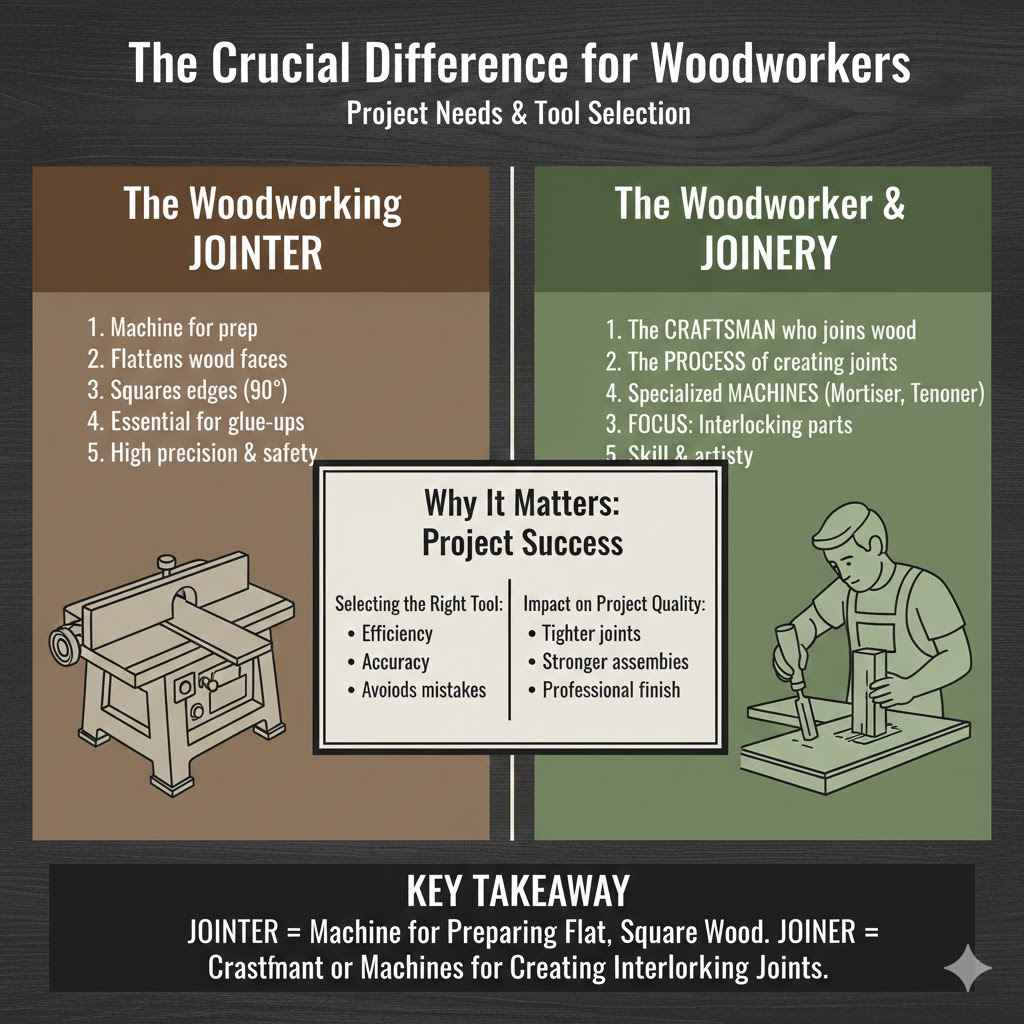
The Crucial Difference for Woodworkers
This part will summarize why knowing the difference between a jointer and a “joiner” is so important for anyone working with wood. It affects tool selection, project planning, and the quality of the finished work. Understanding this distinction is key to avoiding mistakes and achieving professional results.
Selecting the Right Tool for the Job
The most important reason to understand the difference is to select the correct tool for your woodworking needs. If you have rough lumber and need to flatten its faces and square its edges, you need a jointer. Trying to achieve this with a machine designed for cutting joint components will not work.
Conversely, if you need to create precise mortise and tenon joints for a table leg and frame, a jointer alone cannot do this. You would need a mortiser, a tenoner, or the skills and tools for hand-cutting these joints. Using a jointer for this task would be like trying to hammer a nail with a screwdriver – it’s the wrong tool for the job.
- Project Requirements Dictate Tool Choice: Assess what you need to achieve. Is it surface preparation or joint creation? This will determine if you need a jointer or a different specialized machine.
- Efficiency and Accuracy: Using the correct tool ensures your work is done efficiently and accurately. A jointer excels at flattening, while specialized joinery machines excel at cutting precise joint components.
- Avoiding Costly Mistakes: Purchasing the wrong equipment due to confusion can be a costly error. Understanding the roles of each tool prevents buying something that won’t perform the task you need.
For example, if you’re building a small wooden shelf and you buy a board that’s a bit cupped, you’ll need a jointer to flatten it. If you then need to attach the shelf to a bracket, you might need to drill holes. A drill is the right tool for holes.
Trying to make a flat surface with a drill, or trying to drill a precise mortise with a jointer, would lead to frustration and poor results.
A woodworker planning to build a dovetailed chest of drawers needs to understand that they will require a jointer to prepare the wood for the drawer sides and bottoms. They will then also need a method for cutting the dovetails – perhaps a dovetail jig or a dedicated dovetail machine. The jointer provides the perfectly flat and square stock, and the dovetail cutting method provides the strong interlocking joints.
Impact on Project Quality
The correct use of a jointer significantly impacts the quality and precision of your finished woodworking projects. Lumber that is flat and square makes all subsequent operations easier and more accurate. This results in tighter-fitting joints, cleaner assemblies, and a more professional-looking final product.
When pieces fit together perfectly, glue lines are minimal and strong, and the overall structure is more stable. This is especially critical in furniture making, where both structural integrity and aesthetic appeal are paramount. A well-jointed piece of wood forms the foundation for a successful and beautiful creation.
- Precision in Assembly: Flat, square stock from a jointer allows for perfectly aligned glue joints and tight-fitting joinery, enhancing the overall structural integrity.
- Aesthetic Appeal: Consistent flatness and squareness contribute to a clean, professional look. Gaps and misalignments are avoided, leading to a more pleasing visual outcome.
- Durability and Longevity: Projects built with accurately dimensioned and well-joined components are inherently stronger and will last longer. Poorly fitted joints can lead to stress points and eventual failure.
Consider building a musical instrument. The precise dimensions and flatness of the wood are crucial for sound quality. A jointer ensures that the pieces used for the body or neck are perfectly dimensioned and true, allowing for optimal resonance and playability.
Any imperfections in flatness can negatively affect the instrument’s tone.
A boat builder, for example, relies heavily on perfectly flat and square lumber. When constructing the hull, each plank must fit precisely against the next. A jointer ensures that the edges are perfectly straight, allowing for a watertight seal when the planks are fastened together.
Without this preparation, the boat would likely leak and be structurally unsound.
Frequently Asked Questions
Question: What is the main difference between a jointer and a joiner
Answer: A jointer is a machine that flattens one face and squares one edge of a piece of wood. A joiner can refer to a skilled woodworker who creates joints, or to specialized machines that cut the actual joint components like mortises or tenons.
Question: Do I need a jointer to make good furniture
Answer: For high-quality furniture, a jointer is highly recommended. It ensures that your lumber is flat and square, which is essential for strong and precise joinery.
Question: Can a joiner machine cut wood flat
Answer: Specialized joiner machines like mortisers or tenoners are designed to cut specific shapes for joints, not to flatten surfaces of lumber. That is the job of a jointer.
Question: Is the term “joiner” ever used for a hand tool
Answer: While “joiner” primarily refers to a person or a machine, some smaller bench tools that assist in holding workpieces for gluing might be informally called joiner’s helpers or similar, but this is less common than the other meanings.
Question: What is the first step when milling rough lumber
Answer: Typically, the first step is to use a jointer to flatten one face and square one edge of the rough lumber. This establishes a reference surface for all subsequent milling operations.
Summary
Understanding the Jointer vs Joiner: What’s the Real Difference? is key for woodworking success. A jointer prepares wood by flattening faces and squaring edges, crucial for accuracy. A joiner is either the skilled craftsperson creating joints or specialized machines that cut joint components.
Using the right tool for surface preparation versus joint creation ensures quality projects.