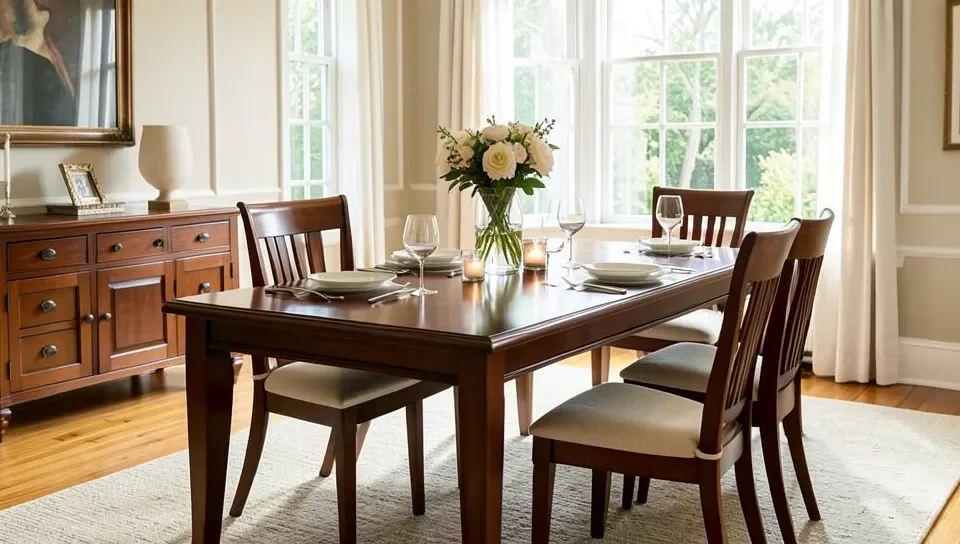
Mahogany Wood Table: Why Most ‘Mahogany’ Tables Aren’t Actually Mahogany
Most tables sold as “mahogany” are actually rubberwood, cherry, or another budget wood with a mahogany-colored finish, not genuine mahogany — checking a real dining table listing for this piece confirmed a “Mahogany” color option built on a rubberwood frame, a pattern that shows up across most budget mahogany-labeled furniture. The Material or Frame Material field on the listing, not the product name or the finish color name, tells you which one you’re actually buying.
How to Confirm a Table Is Actually Mahogany
Actually Solid Mahogany
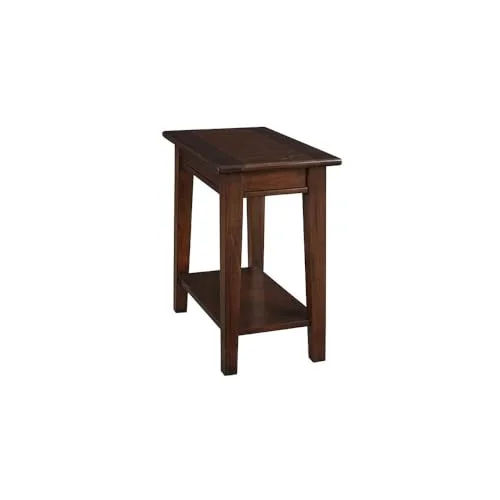 |
Starlight Canyon Solid Mahogany Side Table – $213.77 Listed Frame Material is solid plantation-grown mahogany, not a mahogany-colored finish on a cheaper wood.
|
Check the listing’s technical details for “Frame Material” or “Material” specifically — a table described as having a “mahogany finish,” “mahogany tabletop” with a different wood listed as the frame material, or just a reddish-brown photo with “mahogany” in the title is describing color, not species. Genuine solid mahogany or mahogany veneer construction should say so directly in that field, the same distinction that applies to mahogany mirror frames and other mahogany-labeled furniture across the board.
Why a Solid Mahogany Tabletop Needs Room to Move
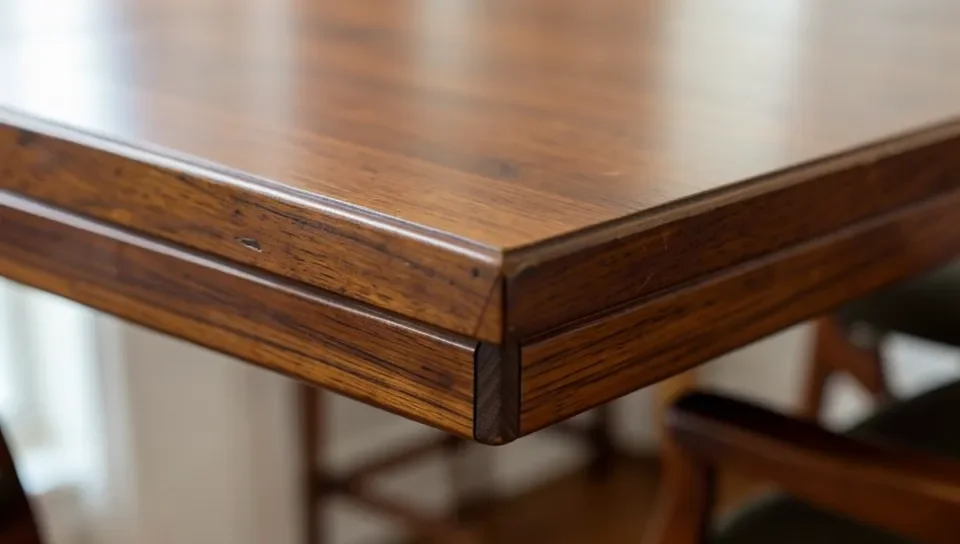
A genuine solid mahogany tabletop expands and contracts across its width with seasonal humidity changes — a wide dining table top can move a measurable fraction of an inch across the grain between dry winter heating season and humid summer months. This is exactly why well-built solid mahogany (or any solid hardwood) tables use breadboard ends (a perpendicular strip capping the end grain, attached with slotted screw holes or a sliding dovetail that allows the main panel to move underneath) or a floating-top attachment method with elongated screw holes, rather than gluing or rigidly screwing the top down all the way across. A table with the top rigidly fastened at every point is a real warning sign of poor construction, since it gives the wood nowhere to move and will eventually crack.
Real Care Differences for a Table vs. Other Mahogany Furniture
A tabletop takes more direct wear than a mirror frame or decorative piece — heat rings from hot dishes, water rings from sweating glasses, and everyday scuffs are the realistic damage sources to plan for. A table pad or placemats under hot dishes prevents the most common damage; a coaster habit for cold or wet glasses prevents the cloudy white ring that forms when moisture gets trapped under a finish. Unlike a purely decorative mahogany piece, a table’s finish is worth choosing for durability (a hard-curing polyurethane or catalyzed lacquer) over a purely traditional oil finish that looks better but wears faster under actual daily table use.
Historic Mahogany Table Styles and Why They Look the Way They Do
Mahogany’s dimensional stability and workability made it the standard for the pedestal dining table with a tilt-top mechanism common in the Chippendale and Federal periods — a design that would be riskier in a wood more prone to warping, since a large round or oval top balanced on a single central pedestal has more unsupported overhang than a four-leg design. The tilt-top mechanism itself, a locking hinge under the top, existed specifically so a pedestal table could stand upright against a wall when not in use, freeing floor space in the smaller rooms typical of the period. Drop-leaf and gate-leg mahogany tables from the same era relied on the wood’s strength-to-weight ratio to let a hinged leaf support real weight without an oversized, clunky hinge rail underneath. These aren’t just stylistic choices from the period — they’re design decisions that specifically leaned on mahogany’s particular mechanical properties, which is part of why reproduction mahogany furniture still gravitates toward these same forms today.
Leaf Extension Mechanisms: What to Check Before Buying
A butterfly leaf (stored folded underneath the table, unfolded into place) is more convenient day-to-day than a separate drop-in leaf that needs its own storage space, but it adds mechanical complexity that’s worth inspecting before buying — a loose or poorly-fitted butterfly mechanism will develop play and misalignment faster than a simple drop-in leaf with no moving parts. For a genuine solid mahogany top specifically, an extension mechanism also needs to accommodate the wood movement discussed above; a well-built extending table accounts for this in the slide rail tolerances, while a cheaply made one can bind or gap seasonally as the wood expands and contracts.
Sizing a Mahogany Dining Table to Your Room
Allow roughly 24 inches of table width per seated person and at least 36 inches of clearance between the table edge and the nearest wall or furniture for chairs to pull out and people to walk behind seated guests comfortably. A rectangular mahogany table with a mahogany-appropriate visual weight (see the sizing note on frame density below) generally suits a room at least a few feet wider than the table itself on each side; a round or oval pedestal-base table, which needs no leg clearance at the corners, can work in a slightly tighter room than a four-leg rectangular design of the same seating capacity.
Real Cost Difference: Solid Mahogany vs. Veneer Tabletop
A genuine solid mahogany tabletop costs meaningfully more than a mahogany veneer over an MDF or plywood core, largely because solid stock wide enough for a full tabletop (often requiring multiple boards edge-glued together) uses more raw lumber and more labor than laying a thin veneer sheet. Veneer construction isn’t inherently inferior for a tabletop the way it might be perceived to be — a well-made veneer top is more dimensionally stable than solid wood (less wood movement to engineer around) and can actually resist warping better across a very wide table, though it’s less repairable if the surface is deeply gouged since sanding through a veneer exposes the substrate underneath.
Frequently Asked Questions
How can I tell if a table is real mahogany or just mahogany-colored?
Check the listing’s Material or Frame Material field specifically, not the product name or photo. Many tables use rubberwood or cherry with a mahogany-colored finish rather than actual mahogany.
Why do solid mahogany tabletops have breadboard ends?
Breadboard ends let a solid wood tabletop expand and contract across its width with seasonal humidity changes without cracking. A rigidly fastened solid top has nowhere to move and can split over time.
What actually damages a mahogany table the most?
Heat rings from hot dishes and water rings from sweating glasses are the most common real damage. A table pad and a coaster habit prevent most of it.
Conclusion
The real question for a “mahogany” table isn’t style, it’s the Material field — most budget listings are a different wood with a mahogany-colored finish. A genuine solid mahogany top also needs construction that respects wood movement (breadboard ends or a floating attachment), and day-to-day care that accounts for real table use, not just decorative display. For mahogany’s use in mirror frames specifically, see our mahogany mirror guide, or for a matching dining room piece, our mahogany hutch guide.
Sponsored / affiliate links. As an Amazon Associate I earn from qualifying purchases. I may earn additional commission from eligible campaigns.