MDF Baseboard vs Wood Baseboard: Essential Choice
Choosing between MDF and wood baseboard? MDF is budget-friendly and paints smoothly, great for simple designs and dry areas. Solid wood is durable, repairable, and adds natural warmth, ideal for longevity and higher-end finishes. Your project’s location, budget, and desired look will guide the best choice.
Hey there, DIYers and homeowners! Picking the right baseboard can feel like a puzzle, especially when you’re faced with two popular choices: MDF and wood. It’s a common question I get in my workshop, and I’m here to tell you it doesn’t have to be overwhelming. You want that finishing touch to look fantastic, last a long time, and fit your budget, right? We’ll break down MDF and wood baseboards, looking at what makes each one tick, so you can make a choice you’ll be happy with for years to come. Get ready to feel confident about your decision!
As a woodworker, I’ve seen firsthand how the small details, like baseboards, can completely transform a room. They’re more than just a decorative trim; they protect your walls from scuffs and provide a clean transition between the floor and the wall. When it comes to choosing between Medium-Density Fiberboard (MDF) and solid wood baseboards, each has its own set of advantages and disadvantages. Understanding these differences will help you select the perfect material for your home improvement project, whether you’re renovating, building new, or just tackling a small update.
This guide is designed to be your go-to resource. We’ll explore what MDF and wood baseboards are, dive into their pros and cons, discuss where each material shines, and even touch on installation tips. By the end of this article, you’ll have a clear picture of which option is the best fit for your specific needs and budget, making this essential home choice much simpler.
What Exactly Are MDF and Wood Baseboards?
Before we compare them, let’s get acquainted with each material:
Medium-Density Fiberboard (MDF) Baseboards
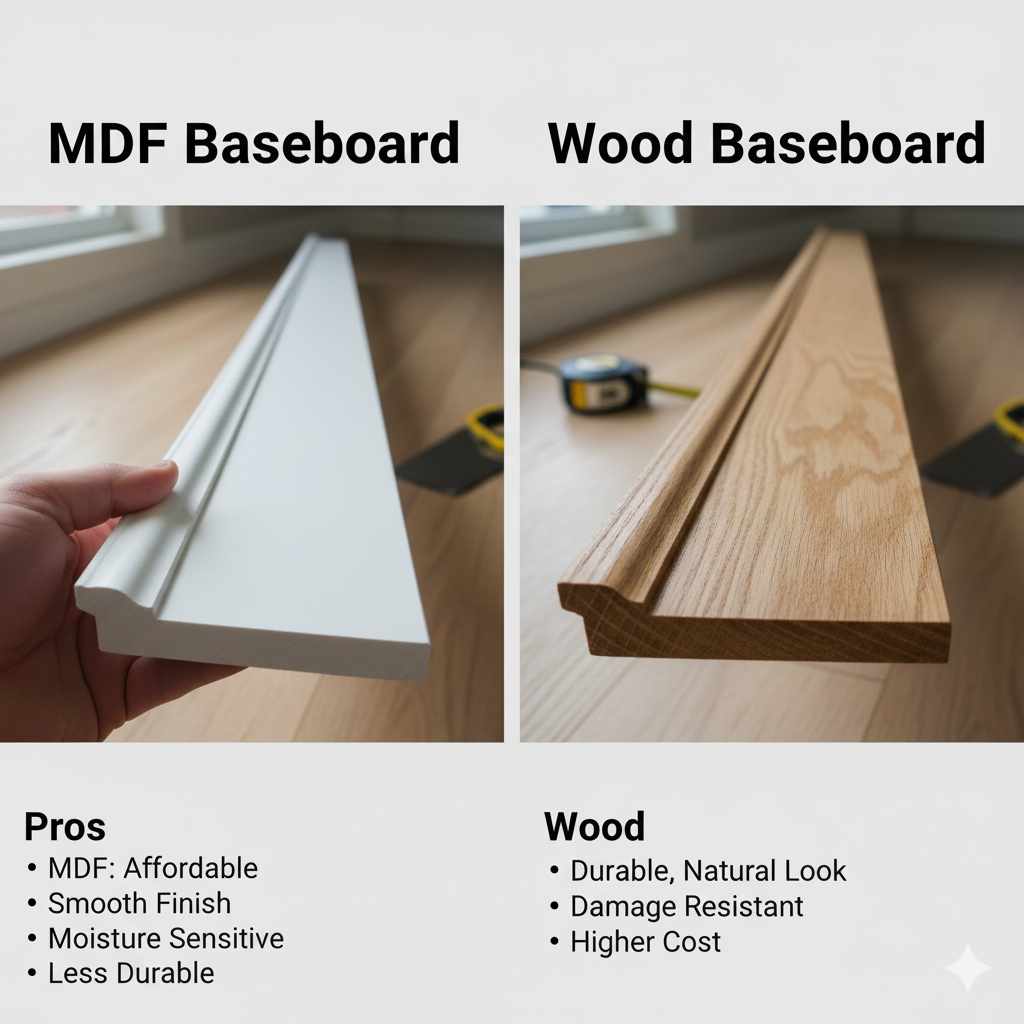
MDF is an engineered wood product. It’s made by breaking down hardwood and softwood into wood fibers, then combining them with wax and a resin binder. This mixture is then pressed into panels under high temperature and pressure. The result is a dense, stable, and smooth material. MDF baseboards are a popular choice because they are generally more affordable and offer a uniform surface that is excellent for painting.
Because MDF is an engineered product, it doesn’t have the natural grain patterns you’d find in solid wood. This uniformity can be a big plus if you’re aiming for a flawless painted finish. However, it also means it lacks the inherent character and warmth that natural wood provides. MDF is sensitive to moisture, so it’s typically best suited for dry interior spaces.
Wood Baseboards
Wood baseboards, often referred to as solid wood or simply “wood” baseboards, are made from actual timber. Common woods used for baseboards include pine, oak, poplar, maple, and finger-jointed pine. Each type of wood has its own characteristics, such as hardness, grain pattern, color, and cost. Solid wood offers a natural beauty, durability, and can be stained to reveal its rich grain or painted.
Solid wood is a traditional and often premium choice. It’s a living material that can expand and contract slightly with changes in humidity, but it’s generally more resistant to impact damage than MDF. It can also be repaired more easily if nicked or scratched, and it adds a timeless appeal to any home. The natural variations in wood grain can be a sought-after aesthetic for many homeowners.
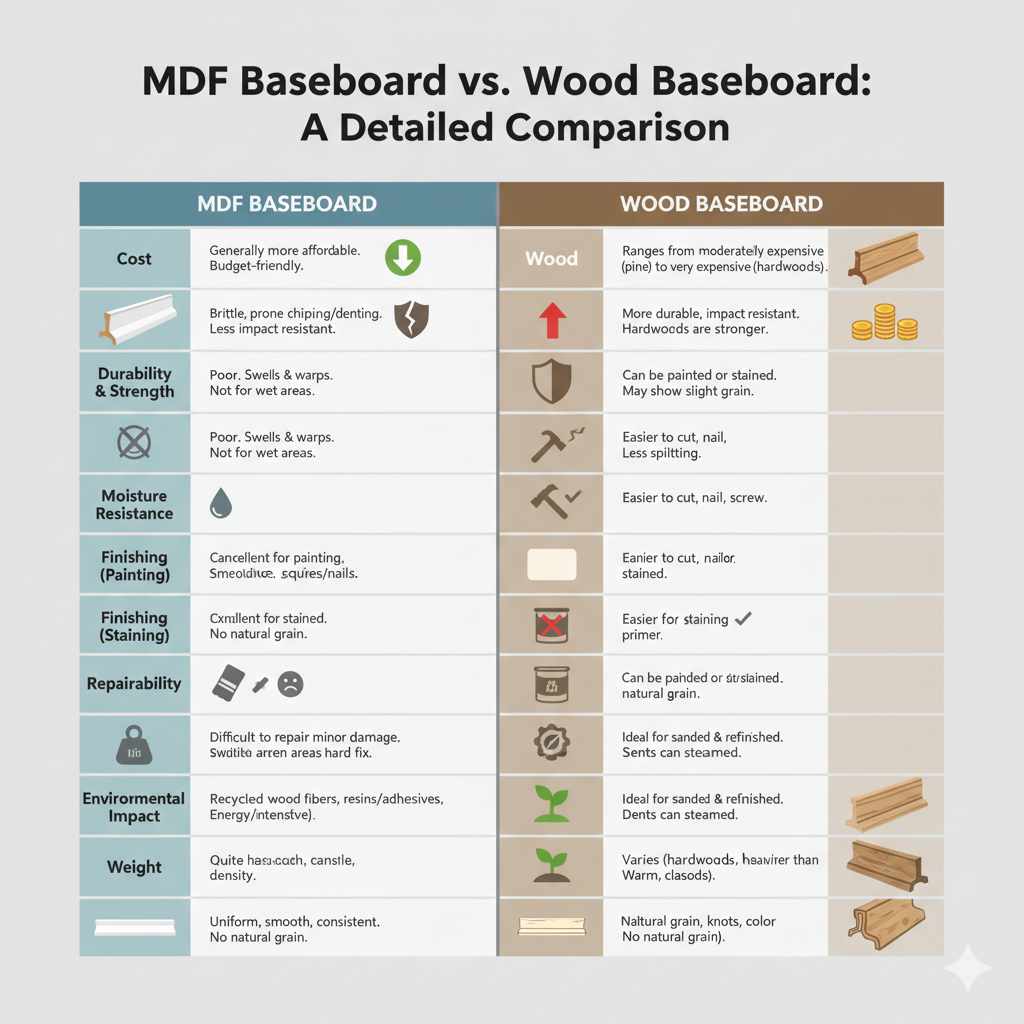
MDF Baseboard vs. Wood Baseboard: A Detailed Comparison
Let’s break down the key differences between these two popular baseboard materials across several important factors:
| Feature | MDF Baseboard | Wood Baseboard |
|---|---|---|
| Cost | Generally more affordable, making it a budget-friendly option. | Can range from moderately expensive (pine) to very expensive (hardwoods like oak or maple), depending on the wood species. |
| Durability & Strength | Can be brittle and prone to chipping or denting, especially on corners. Less resistant to impact. | More durable and resistant to impacts. Hardwoods are significantly stronger than softwoods. |
| Moisture Resistance | Poor. Swells and warps significantly when exposed to moisture. Not suitable for bathrooms, kitchens, or basements without special sealing. | Varies by wood species. Generally better than MDF but can still be affected by prolonged high humidity. Proper sealing is recommended for moisture-prone areas. |
| Ease of Installation | Can be drilled and cut, but screws and nails can cause it to split if not handled carefully. | Easier to work with for cutting, nailing, and screwing. Less prone to splitting. |
| Finishing (Painting) | Excellent for painting due to its smooth, uniform surface. Requires primer to seal. | Can be painted or stained. Staining highlights natural grain, while painting offers a smooth finish (though may show slight grain texture). |
| Finishing (Staining) | Cannot be stained as there is no natural wood grain. | Ideal for staining to showcase natural wood beauty. |
| Repairability | Difficult to repair minor damage. Swollen areas are hard to fix. | Can be sanded and refinished. Dents can often be steamed out of hardwoods. |
| Environmental Impact | Made from recycled wood fibers, but contains resins and adhesives. Manufacturing process can be energy-intensive. | Renewable resource if sourced sustainably. Untreated wood is biodegradable. |
| Weight | Can be quite heavy due to its density. | Weight varies depending on the wood species; hardwoods are generally heavier than softwoods. |
| Appearance | Uniform, smooth, consistent. No natural grain. | Natural grain patterns, knots (depending on grade), and color variations. Offers a warm, classic look. |
Pros and Cons at a Glance
To help you quickly weigh your options, here’s a simplified rundown:
MDF Baseboard: The Pros and Cons
Pros:
- Budget-Friendly: Often significantly cheaper than solid wood.
- Smooth Finish: Provides a perfect, uniform surface for painting.
- Uniformity: No knots or natural imperfections to work around; consistent quality.
- Easy to Cut (initially): For straight cuts, it’s easy to machine.
- Stable: Less prone to warping with humidity changes compared to some woods (though very susceptible to swelling if wet).
Cons:
- Moisture Sensitive: Extremely vulnerable to water damage, leading to swelling and disintegration.
- Brittle: Can chip or break easily, especially corners and edges.
- Difficult to Repair: Damaged sections are hard to fix seamlessly.
- Heavy: Its density makes it heavy to handle.
- Dust: Cutting MDF produces very fine dust that can be a respiratory irritant, requiring good dust collection and personal protective equipment (PPE).
- Not for Staining: Lacks natural wood grain, so staining isn’t an option.
Wood Baseboard: The Pros and Cons
Pros:
- Durability: Generally more robust and resistant to dents and impacts.
- Natural Beauty: Offers unique grain patterns and warmth.
- Stainable: Can be stained to match existing wood tones or desired finishes.
- Repairable: Can often be sanded, filled, or refinished to fix minor damages.
- Long-Lasting: With proper care, it can last for generations.
- Variety: Available in many wood species with different characteristics and price points.
Cons:
- Higher Cost: Generally more expensive than MDF, especially for hardwood species.
- Can Warp/Move: Susceptible to expanding or contracting with humidity changes.
- Requires Finishing: Needs paint, stain, or a clear coat to protect it, which adds time and cost.
- Knots/Imperfections: Lower-grades can have knots and imperfections that might need filling or be undesirable for some looks.
- Harder to Work With (for beginners): Can split if nails are driven too close to edges without pre-drilling.
When to Choose MDF Baseboard
MDF baseboard is an excellent choice in several scenarios:
- Budget is Paramount: If you’re on a tight budget and need to cover a large area, MDF is often the most economical option.
- Perfect Painted Finish is the Goal: For walls painted in a single, solid color, MDF’s smooth, featureless surface is ideal. It accepts primer and paint beautifully, creating a flawless, professional look.
- Low-Traffic or Dry Areas: MDF is best suited for living rooms, bedrooms, or hallways where it won’t be exposed to splashes, high humidity, or excessive wear and tear.
- Creating Specific Profiles: MDF can be machined into intricate profiles and decorative shapes more easily and affordably than some softer woods, offering stylish designs at a lower cost.
When installing MDF, especially in a DIY project, be mindful of its density and potential for chipping. Using a fine-tooth blade when cutting will result in cleaner edges. Always prime MDF thoroughly, applying multiple coats if necessary, to ensure an even paint finish and to offer a slight barrier against minor moisture. For guidance on best practices for working with engineered woods, resources like the Forest Stewardship Council (FSC) provide information on responsible sourcing and material properties, which can indirectly inform material choices, although MDF is not typically FSC-certified as it’s an engineered composite.
When to Choose Wood Baseboard
Solid wood baseboards are a fantastic choice for:
- Long-Term Durability and Value: If you’re looking for a solution that will last for decades, is resistant to damage, and can add value to your home, solid wood is the way to go.
- Natural Beauty and Warmth: For homes where you want to highlight natural materials, wood’s inherent grain, color, and texture are unmatched. It’s perfect for a traditional, rustic, or high-end contemporary look.
- Areas Requiring Staining: If you want to stain your baseboards to match hardwood floors, other trim, or furniture, solid wood is the only option that allows for this.
- Moisture-Prone Areas (with precautions): While not completely waterproof, hardwoods like oak or poplar are more dimensionally stable and less prone to immediate swelling than MDF. With good sealing and ventilation, they can be used in kitchens or powder rooms, though bathrooms and basements are still risky.
- Restoration Projects: In older homes, solid wood baseboards often match the original materials and can be repaired to blend in seamlessly.
When choosing wood, consider the species. Pine is softer and less expensive, making it easier to work with but also more prone to dents. Oak and maple are harder, more durable, and more expensive. This wood calculator from Woodbin is a handy tool for estimating material needs, which can help in budgeting for your project. Pre-drilling pilot holes for nails or screws is often a good practice with solid wood to prevent splitting, especially near the ends of the boards.
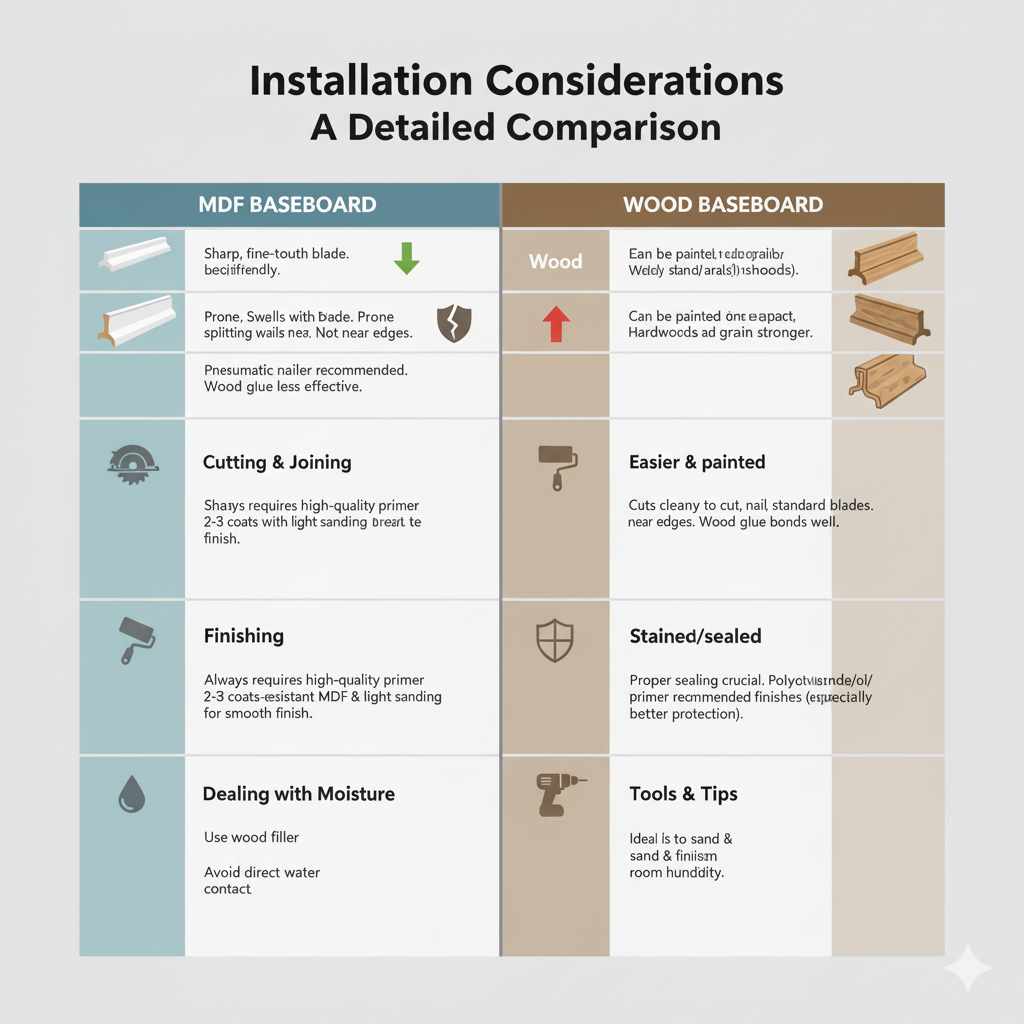
Installation Considerations: MDF vs. Wood
Both MDF and wood baseboards can be installed using similar methods, but there are a few differences to keep in mind:
Cutting and Joining
- MDF: Requires a sharp, fine-tooth blade for clean cuts. Saw blades specifically designed for MDF will produce less tear-out. Because it’s dense and brittle, fasteners like nails can cause it to split if driven too close to the edge. Using a pneumatic nailer with the correct pressure is often recommended to minimize damage. Wood glue can be used, but it doesn’t penetrate MDF as well as it does wood.
- Wood: Generally cuts cleanly with standard woodworking blades. Different wood species will behave differently; hardwoods might require a more powerful saw. Nails and screws can be used easily. Pre-drilling is advisable for screws, especially in hardwoods, and for nails near edges to prevent splitting. Wood glue bonds well with solid wood for joints.
Finishing
- MDF: Always requires a good quality primer before painting. You might need two or even three coats, with light sanding in between, to achieve a smooth, pore-free surface.
- Wood: Can be stained and sealed. If painting, a primer is still recommended, especially if dealing with wood knots that could bleed through paint.
Dealing with Moisture
- MDF: If moisture is a concern, consider MDF specifically treated for moisture resistance, though it’s still not ideal for truly wet environments. Thorough sealing with a moisture-barrier primer and multiple coats of paint are essential.
- Wood: Proper sealing and finishing are crucial for all wood, but especially if it might encounter some humidity. Using a polyurethane or oil-based finish will offer better protection.
Frequently Asked Questions (FAQ) about Baseboards
Q1: Can I use MDF baseboards in a bathroom?
A1: It’s generally not recommended. MDF swells and disintegrates when exposed to moisture. If you absolutely must, use a moisture-resistant MDF product and seal it with multiple coats of a high-quality, moisture-resistant primer and paint, but be aware it’s still a risk.
Q2: Which is better for painting, MDF or wood?
A2: MDF is often considered better for achieving a perfectly smooth, uniform painted finish because it has no grain or imperfections. However, wood can also be painted beautifully after proper priming.
Q3: How long do wood baseboards typically last?
A3: Solid wood baseboards, when properly installed and finished, can last for many decades, often outlasting the life homeowners expect to live in a house. They are a very durable choice.
Q4: Is MDF cheaper than wood baseboards?
A4: Yes, MDF is almost always less expensive than solid wood baseboards, making it a popular choice for budget-conscious projects.
Q5: Can I stain MDF baseboards?
A5: No. MDF is an engineered product made from wood fibers, wax, and resin; it does not have the natural grain of wood, so it cannot be stained to achieve a wood-like finish.
Q6: Which type of baseboard is more eco-friendly?
A6: Sustainably harvested solid wood is considered more eco-friendly as it’s a natural, renewable resource. MDF uses wood byproducts but also relies on synthetic resins and adhesives. While some MDF is made with recycled content, its end-of-life disposal can be more challenging.
Q7: How do I choose the right size and profile for my baseboards?
A7: The size and profile should complement your room’s ceiling height and architectural style. Taller ceilings can accommodate taller and more ornate baseboards. For modern or minimalist styles, simpler, flatter profiles are often preferred. For beginners, sticking to common, simpler profiles in either MDF or wood will be easier to work with and install.
Making the Final Decision
As you can see, both MDF and wood baseboards have their place in home improvement projects. The “essential choice” truly depends on your specific project’s needs, your budget, and the aesthetic you’re aiming to achieve.
If you’re prioritizing affordability and a flawless painted finish in a dry area, MDF is a strong contender. It offers a clean look without breaking the bank. Remember its limitations, especially regarding moisture, and plan your finishing steps accordingly.
If you’re looking for natural beauty, long-term durability, the ability to stain, and a material that can withstand a bit more wear and tear, solid wood is likely your best bet. While it comes at a higher initial cost, its longevity and aesthetic appeal are often well worth the investment.
Consider the room where the baseboards will be installed. A high-traffic hallway might benefit from the durability of wood, while a guest bedroom with minimal wear might be perfectly fine with MDF.