MDF vs OSB Board: Which Should You Actually Use?
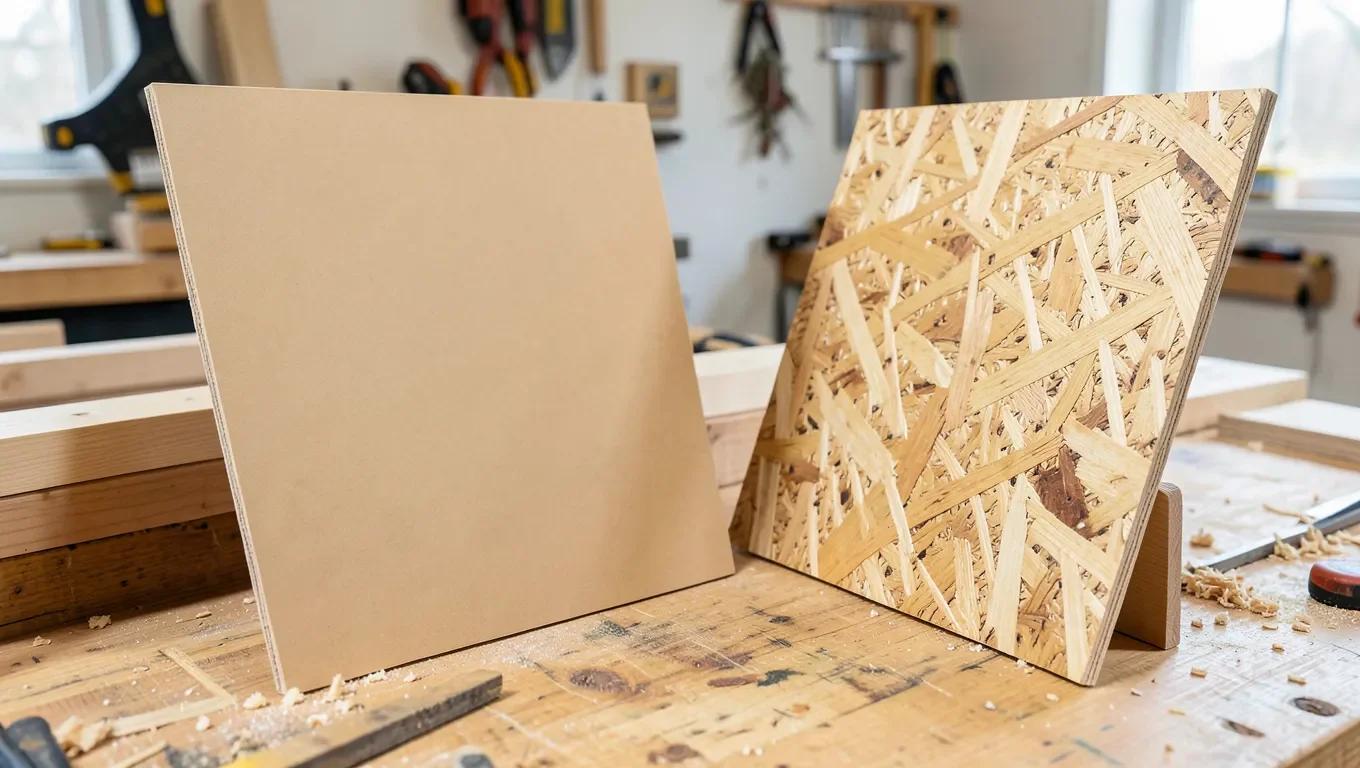
MDF and OSB are both engineered wood panels, but they are not interchangeable. MDF is a dense, fiber-based sheet with a glass-smooth face built for painted furniture and cabinetry, while OSB is a strand-based structural panel rated for load-bearing work like subfloors, roof decking, and wall sheathing. Pick the wrong one and you either end up with a sagging, unrated “structural” panel or a rough-surfaced cabinet door that won’t take paint cleanly. Here’s how the two actually compare, with the real numbers behind the claims.
MDF vs OSB: The Quick Answer
If you need a smooth, paintable surface for furniture, cabinet doors, trim, or shelving that stays indoors, use MDF. If you need a panel rated to carry structural loads – subfloors, wall sheathing, roof decking – use OSB. MDF has zero shear strength for framing, and OSB has no APA rating or approval for fine furniture work. Before you pick a sheet, here’s a real product worth having on hand if you’re going the MDF route: raw MDF edges soak up moisture fast, and a dedicated sealer stops that before it becomes a swelling problem.
Best MDF Edge Moisture Sealer
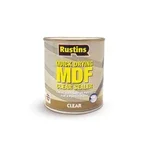 |
Rustins Quick Drying MDF Clear Sealer – $17.50 Seals raw MDF edges and faces against moisture before it can swell, crumble, or telegraph through paint.
|
What Is MDF?
Medium-Density Fiberboard is made by breaking hardwood and softwood down into fine wood fibers, combining them with wax and a synthetic resin binder (usually urea-formaldehyde), then hot-pressing the mat under heat and pressure. There’s no grain, no knots, and no strand pattern – just a uniform fiber structure from face to face. That’s why it machines and routs so cleanly: there’s nothing for a blade or bit to catch on.
Density typically runs 700 to 850 kg/m³ (roughly 44 to 53 lb/ft³), which is why a sheet of MDF feels noticeably heavier than a same-size sheet of plywood or OSB. That density is also what gives MDF its glass-smooth, paint-ready surface – but it comes at a cost: MDF has essentially no structural rating. It isn’t tested or approved for shear or bending loads the way OSB and plywood are, so it should never be used as sheathing, subflooring, or anything load-bearing.
MDF’s real strength is in cabinetry, furniture doors, drawer fronts, decorative molding, and wall paneling – anywhere a flawless painted or laminated finish matters more than structural capacity. For a deeper look at exactly how the fiber mat is built and pressed, see our guide on how MDF board is made.
What Is OSB?
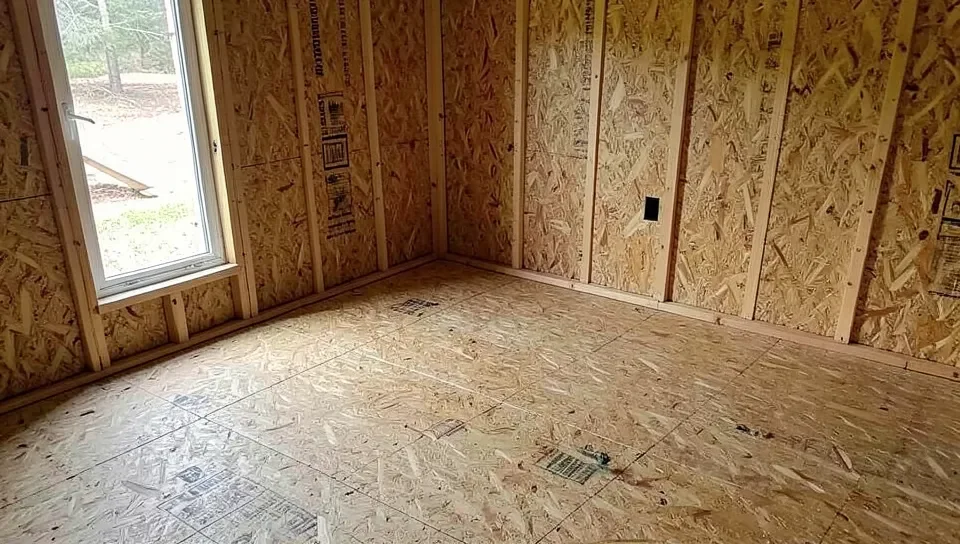
Oriented Strand Board is made from large, thin wood strands – usually aspen, pine, or other fast-growing species – that are cross-layered so the strands in each layer run perpendicular to the layers next to it, then bonded under heat and pressure with a resin binder. That cross-orientation is the entire point: it’s the same principle that makes plywood strong, and it’s why OSB can carry real structural loads instead of just looking like a solid panel.
Because of that engineered strength, OSB is manufactured and tested to APA (formerly the American Plywood Association) performance standards under the voluntary PS 2 product standard, and it carries a span rating stamped right on the panel – a number that tells a builder the maximum support spacing the sheet can safely handle for roof, wall, or floor use. MDF has no equivalent rating system, because it was never engineered or tested for that job. OSB density runs lower than MDF, typically around 600 to 700 kg/m³, but density isn’t the whole story here – it’s the cross-strand layering, not raw mass, that gives OSB its shear strength.
Structural Strength: Why the Difference Matters
This is the single biggest reason these two materials get confused for interchangeable “engineered wood” – and the single biggest reason they’re not. OSB’s cross-oriented strands act like the criss-crossed layers in plywood, resisting bending and shear forces from multiple directions at once. MDF’s fibers run in no particular direction at all, which gives it uniform machinability but almost no resistance to shear loading.
| Property | MDF | OSB |
|---|---|---|
| Structural / span rating | None | APA PS 2 rated, span-stamped |
| Shear strength | Very low | High |
| Typical density | 700-850 kg/m³ | 600-700 kg/m³ |
| Surface for paint/finish | Excellent | Poor without heavy prep |
| Typical use | Furniture, cabinetry, trim | Subfloors, wall sheathing, roof decking |
In practical terms: never substitute MDF for OSB in a wall, floor, or roof assembly, even temporarily. A building inspector will fail it, and more importantly, it will actually sag and fail under load in a way rated OSB won’t.
Moisture and Swelling: What Actually Happens
Here’s a detail most comparisons skip entirely: OSB is not moisture-proof just because it’s “structural.” Standard OSB soaked for 24 hours (the standard ASTM D1037 test) typically swells 10 to 15% in thickness, and lab testing has shown that surface layers can swell even more than that because compaction stress built up during hot-pressing releases once the panel gets wet. That’s the part competitors usually leave out: a lot of that swelling doesn’t fully reverse when the board dries out, because the release of that internal pressing stress is permanent, not just temporary water absorption. That’s why a flooded subfloor often stays slightly swollen and bumpy even after it dries.
MDF handles water worse in a different way. Because it’s made of loose fibers held together by resin rather than interlocked wood strands, water doesn’t just swell MDF – it can break down the fiber-to-fiber bond entirely, causing the edges to puff up, crumble, and lose structural cohesion in a way OSB generally doesn’t. Moisture-resistant “green” MDF grades exist and perform better, but they’re still not a substitute for a sealed edge or a genuinely waterproof material in a wet location.
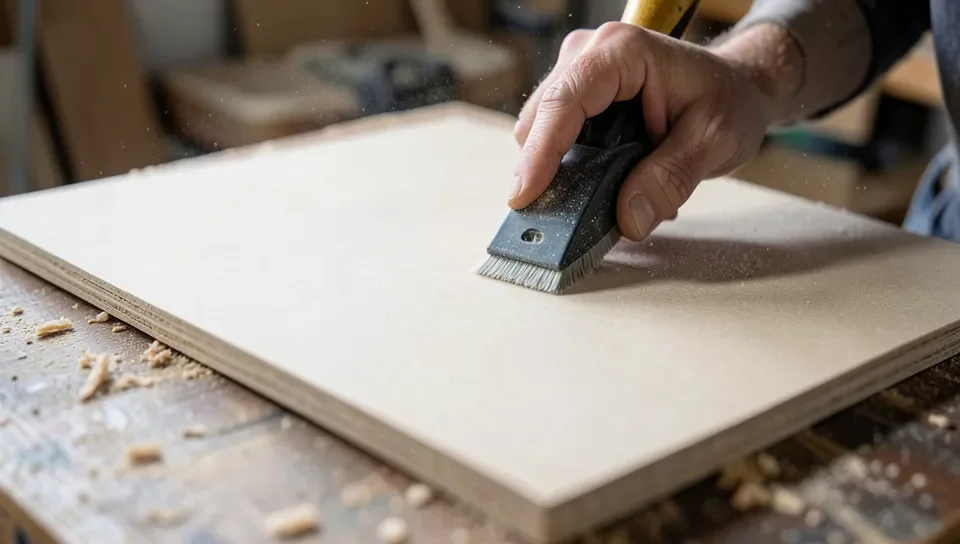
The practical takeaway: if MDF is going anywhere near moisture – a kitchen toe-kick, a bathroom shelf, a garage – seal every cut edge before installation, since factory-sealed faces don’t protect the exposed core where you cut it. For OSB, always use exterior-rated panels for any sheathing application exposed to weather during construction, and don’t assume standard interior OSB will bounce back to its original thickness after a soaking.
Cost and Weight Compared
OSB is consistently the cheaper structural option – in North American lumber pricing, OSB typically runs 15 to 25% less than CDX plywood at an equivalent thickness and span rating, and it’s generally cheaper than MDF per sheet as well, since MDF’s finer fiber processing and resin content cost more to produce. MDF’s higher price is offset by lower finishing costs if you need a painted result: a primed MDF door needs far less prep and fewer coats than trying to get a smooth painted finish out of OSB’s rough, waffled surface. For the full breakdown of MDF against plywood specifically (not OSB) on strength, cost, and moisture resistance, see our MDF vs plywood guide.
Weight follows density: a 3/4-inch MDF sheet is noticeably heavier to carry and mount than a same-thickness OSB sheet, which matters if you’re hanging large cabinet panels or working solo.
Which Should You Use? Scenario by Scenario
Cabinetry, Furniture, and Trim
MDF wins here without much debate. Its uniform, grain-free surface routs cleanly for decorative edges and takes primer and paint far better than OSB’s strand-textured face. If you’re specifically comparing these two materials for kitchen cabinet boxes and doors, our dedicated MDF vs plywood for kitchen cabinets guide covers the cabinetry-specific tradeoffs in more depth, including how MDF stacks up against plywood rather than OSB.
Subfloors, Wall Sheathing, and Roof Decking
OSB is the correct material, full stop. It’s span-rated, code-recognized, and priced for large structural jobs. Never substitute MDF here – it isn’t rated for the loads and will sag or fail over a span.
DIY Shelving and Craft Projects
For a garage shelf or workshop project where looks don’t matter and cost does, OSB can work if the spans are reasonably short and well-supported. For anything visible – a display shelf, a sign, a craft piece that’ll be painted – MDF’s finish quality makes it the better pick. If you’re not sure how many sheets a given project needs, our MDF board calculator guide walks through sizing it out.
Frequently Asked Questions
Is MDF stronger than OSB?
No, not for structural use. OSB’s cross-oriented strand layers give it real shear and load-bearing strength that MDF’s randomly oriented fibers simply don’t have. MDF is denser and smoother, but it has no structural or span rating.
Can I use OSB instead of MDF for cabinets?
You can, but you shouldn’t for anything visible. OSB’s rough, waffled surface doesn’t rout or paint cleanly the way MDF does, so it’s a poor substitute anywhere a smooth painted or laminated finish is the goal.
Does OSB fully dry out after getting wet?
Not completely. A soaked OSB panel typically swells 10 to 15% in thickness, and because some of that swelling comes from internal pressing stress releasing rather than just water absorption, the panel often stays slightly thicker than its original dimension even after it dries.
Is MDF or OSB cheaper?
OSB is generally the cheaper sheet per square foot, and it’s also typically 15 to 25% less expensive than comparable CDX plywood. MDF costs more upfront due to its fiber processing and resin content, though it can save money on finishing since it needs less paint prep.
How do you protect MDF from moisture?
Seal every cut edge, not just the factory faces – the exposed core at a cut edge is where MDF absorbs water fastest and starts to swell or crumble. A dedicated MDF sealer applied before installation is the most reliable protection for edges in kitchens, bathrooms, or garages.
Wrap Up
MDF and OSB solve different problems. MDF gives you a dense, glass-smooth panel built for paint and fine finishing; OSB gives you a span-rated structural panel built to carry real loads. Match the material to the job – smooth and paintable versus strong and load-bearing – and seal MDF’s edges any time moisture is a possibility.
Sponsored / affiliate links. As an Amazon Associate I earn from qualifying purchases. I may earn additional commission from eligible campaigns.