Miter Saw Stands at Lowe’s: Folding vs Heavy-Duty Options
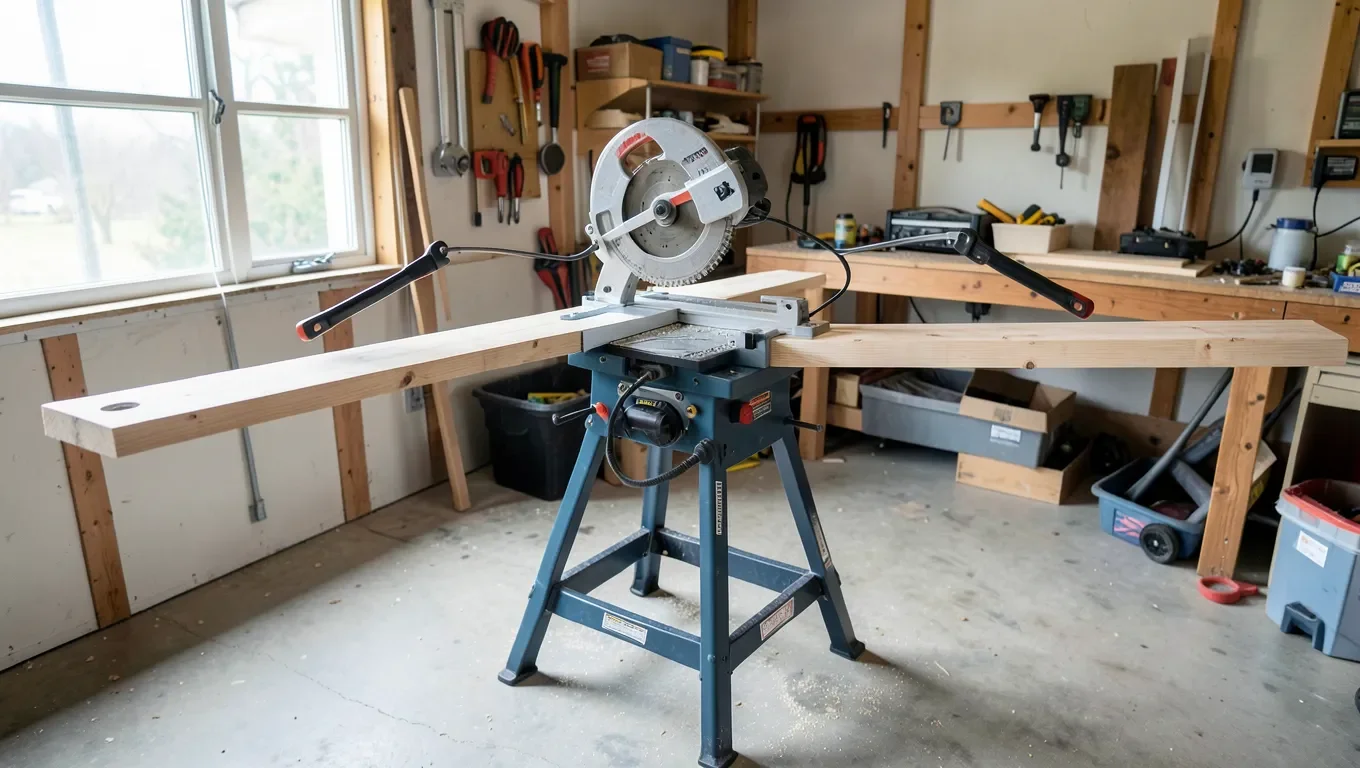
Lowe’s carries miter saw stands ranging from $60 folding legs you can toss in a truck bed to $475 wheeled shop stands rated for 16 feet of material. The right one for you depends on three things most shoppers never check before buying: how far the extension arms actually reach, whether the stand folds fast enough to be worth hauling to a jobsite, and whether its saw mount will fit the saw you already own. Here’s what actually separates the good stands from the frustrating ones.
Our Pick: The Best Universal-Mount Miter Saw Stand for Long Boards
If you cut long trim, baseboard, or dimensional lumber by yourself and want a stand you won’t outgrow if you switch saw brands later, this is the one we’d point you to.
BEST LONG-BOARD SUPPORT PICK
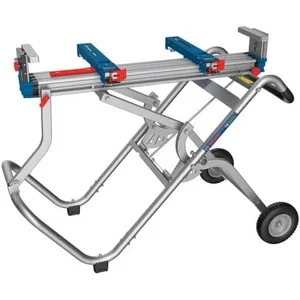 |
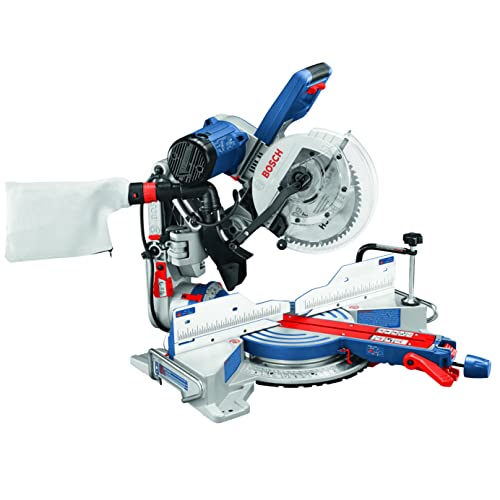
Bosch T4B Gravity-Rise Miter Saw Stand – $475 The extension-arm reach and true universal mount this guide recommends checking for, in one stand.
|
What Lowe’s Actually Sells: Folding, Rolling, and Heavy-Duty Stands
Lowe’s house brand, Kobalt, covers most of the budget and mid-range shelf space. The Kobalt Steel Adjustable Rolling Miter Saw Stand (KMS-S16) folds down for storage, telescopes out to about 8 feet of total work support, and rolls on 8-inch wheels. A lighter Kobalt folding model weighs about 34 pounds, supports workpieces up to 118 inches, and holds up to 330 pounds, with quick-release mounting brackets sized for 7-1/4-inch, 10-inch, and 12-inch saws.
Above that tier, Lowe’s also stocks name-brand stands like the DEWALT DWX726, a foldable rolling stand with about 8 feet of material support and universal mounting rails, and premium options like the Bosch T4B below, which roughly doubles that support length. None of these are Lowe’s exclusives except the Kobalt line, so the same stand you see on the shelf is usually the one you’ll find priced and reviewed on Amazon.
| Stand | Material Support | Weight | Mount Type |
|---|---|---|---|
| Kobalt folding stand | Up to 118 in. | ~34 lbs | Quick-release, 7-1/4″/10″/12″ saws |
| DEWALT DWX726 | ~8 ft. | Rolling, foldable | Universal mounting rails |
| Bosch T4B (our pick) | Up to 16 ft. | 76.7 lbs | Universal rapid-release, 2 mounts |
Buying in-store versus online at Lowe’s matters too if you want to test the fold mechanism before you own it. A stand that feels smooth in the aisle with no load on it can still bind once a 40-plus-pound saw is clamped to the mount, so if you’re buying in person, ask to unfold and refold the floor model with a comparable saw before you check out. Buying online, Lowe’s and Amazon both give you a standard return window, typically 30 to 90 days depending on the item, which is enough time to actually mount your saw and test the extension arms under a real cut rather than just unboxing it and setting it aside.
Extension-Arm Reach: Why Support Length Matters More Than Price
The number that actually predicts whether a stand will frustrate you isn’t the price tag, it’s the combined extension-arm reach. Cut an 8-foot piece of baseboard on a stand with only 4 feet of support on each side and the offcut end will droop the moment it clears the fence, throwing off your angle right at the end of the cut. That’s the single biggest reason solo trim carpenters complain about “cheap” stands that are really just too short for the work.
Most folding stands at Lowe’s, including the Kobalt and DEWALT models above, top out around 8 feet of total support. That’s enough for most interior trim and shelving. If you regularly cut longer stock, deck boards, fascia, or full sheets ripped into strips, the extra reach on something like the Bosch T4B (up to 16 feet) removes the need for a helper or a stack of sawhorses on either side.
Portability: Folding for the Jobsite vs. a Stationary Shop Setup
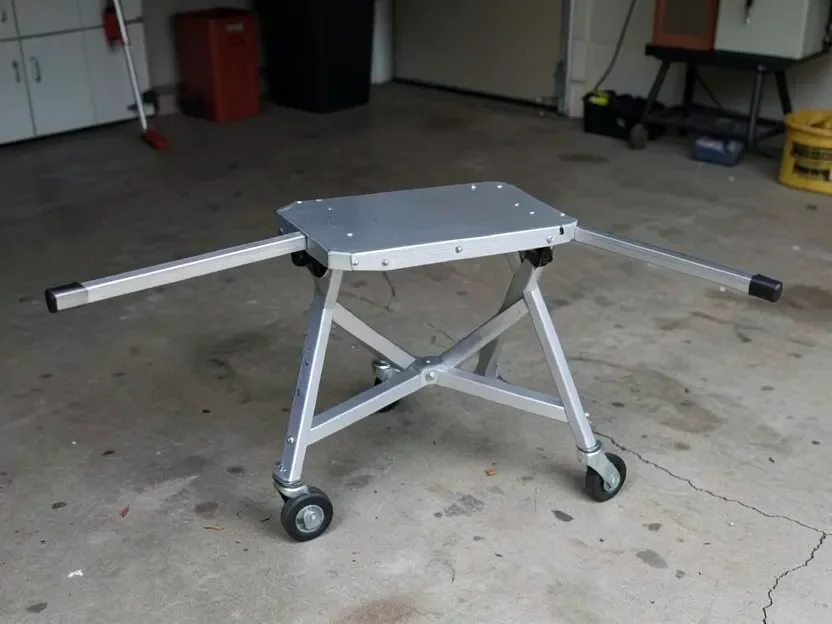
If the stand is living in one spot in a garage or shop, weight and fold speed barely matter, buy for support length and stability instead. If it’s riding in a truck bed every day, the folding mechanism is what you’ll actually notice. Kobalt’s lighter folding stand, at roughly 34 pounds with quick-release fold levers, is easy for one person to sling into a truck bed. The Bosch T4B uses a “gravity-rise” mechanism, its own weight pulls the frame into the folded position when you release a lever, which is a genuinely faster one-person fold than a stand that needs each leg locked individually, but at 76.7 pounds it’s built more for wheeling around a jobsite than lifting in and out of a vehicle all day.
Wheels matter more than most buyers expect here too. A stand with real pneumatic or rubber wheels can be rolled fully assembled, saw still mounted, across a driveway or gravel jobsite. A stand without wheels has to be broken down, carried, and reassembled every time you move it, which adds up over a workday.
Universal Mount vs. Saw-Specific Mount: The Compatibility Issue Buyers Miss
Almost every stand Lowe’s sells advertises a “universal” mount, but that word is doing more work than it should. In practice, “universal” mounting rails clamp onto the saw’s own base plate using a quick-release bracket, and that bracket has to match the width and shape of your saw’s base, not just its blade diameter. A stand rated for saws up to 12 inches can still be a poor physical fit for a specific model’s base footprint even though the blade size checks out.
This is the compatibility issue that trips people up when they buy a stand separately from the saw, which is common since Lowe’s sells stands and saws as separate purchases rather than bundles. If you’re pairing a stand with a saw you already own, like a Ryobi 10-inch sliding compound miter saw, check the saw’s base width against the stand’s bracket spread before you buy rather than after, since sliding compound saws often have a longer base footprint than a basic non-sliding miter saw of the same blade size. Both the DEWALT DWX726 and the Bosch T4B publish their mounting rail specs for exactly this reason, and it’s worth a two-minute check against your saw’s manual.
Setting Up and Maintaining Your Stand
Before first use, unfold the stand on level ground and lock every leg latch before mounting the saw, an unlocked leg is the most common cause of a stand collapsing mid-cut. Attach the saw with the quick-release mount fully seated and tightened, then extend the support arms and check that they’re level with the saw’s table before making any cuts. Wear eye and hearing protection, and clear the area around the stand of cords, offcuts, and clutter before you start.
For upkeep, wipe sawdust off the rails and folding joints after each use since packed dust is what makes fold mechanisms start to stick. Check that leg latches and mount clamps still lock firmly every few months, and lubricate wheel axles and folding pivots if they start to squeak or bind. Store the stand folded in a dry space; a damp garage floor is the most common cause of rust on the steel-frame models.
Also check the stand’s rated weight capacity against your actual saw, not just its blade size. A 12-inch sliding compound miter saw can weigh 15 to 20 pounds more than a basic 10-inch non-sliding saw of similar power, and a stand rated for lighter saws will flex or wobble under that extra weight even if the mount physically clamps on fine. The capacity number listed on the box, not the saw-size range, is the one that actually protects your cuts and your fingers.
Frequently Asked Questions
How much extension-arm reach do I actually need?
For most interior trim and shelving work, 8 feet of combined support (the amount most folding stands at Lowe’s offer) is enough. If you regularly cut 8-foot or longer stock like deck boards or fascia, look for a stand rated closer to 16 feet so the far end doesn’t droop as you finish the cut.
Are folding miter saw stands sturdy enough for a jobsite?
Yes, as long as every leg latch is fully locked before you mount the saw. Wheeled folding stands like the Bosch T4B are built specifically for jobsite use, with gravity-rise folding and pneumatic wheels so the saw can be rolled between cutting stations without breaking the stand down.
Will a universal-mount stand fit any miter saw?
Not automatically. “Universal” mounts clamp to a saw’s base plate width, so a stand rated for saws up to 12 inches can still be a bad physical fit for a specific model’s base footprint. Check your saw’s base dimensions against the stand’s mounting rail spec before buying them separately.
Should I buy a folding stand or a heavy-duty rolling stand?
Buy a lightweight folding stand if it’s leaving the shop with you regularly, weight and fold speed matter more than raw capacity there. Buy a heavier rolling stand if it’s staying in one shop or jobsite trailer, since the extra material support and stability outweigh the added weight when you’re not lifting it in and out of a truck every day.
Conclusion
Don’t shop a miter saw stand on price alone. Check the extension-arm reach against the longest stock you actually cut, decide honestly whether it needs to fold and travel or just sit in one spot, and confirm the mount will actually fit your saw’s base before you buy it separately. Get those three right and any of the stands Lowe’s carries, from the budget Kobalt folding model to the Bosch T4B above, will hold up to real use.
Sponsored / affiliate links. As an Amazon Associate I earn from qualifying purchases. I may earn additional commission from eligible campaigns.