Polyurethane Foam Mattress Health Risks: CertiPUR-US Facts
Polyurethane foam mattresses release volatile organic compounds (VOCs) that peak in the first 72 hours and taper off over about 30 days — but CertiPUR-US® certified foam caps those emissions at 0.5 parts per million, a threshold a 2024 peer-reviewed risk assessment found does not pose undue health risk to healthy adults. Uncertified foam has no such cap, and people with asthma, chemical sensitivity, or infants sleeping nearby carry more risk than that baseline. This guide covers what’s actually in the foam, what CPSC flammability rules require, and how to cut real exposure.
Quick Answer
A CertiPUR-US® certified polyurethane foam mattress has passed independent testing for VOC emissions (under 0.5 ppm), formaldehyde, heavy metals, and regulated phthalates — and current evidence does not show it raises cancer risk for a healthy adult sleeping on it. An uncertified mattress has none of those guarantees. Air out any new foam mattress in a ventilated room for 48–72 hours before regular use, longer if you’re pregnant, have asthma, or are furnishing a nursery.
What’s Actually in a Polyurethane Foam Mattress
Best Air Purifier Pick For VOC Off-Gassing
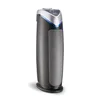
GermGuardian AC4825E HEPA Air Purifier
A budget-friendly HEPA + activated-carbon tower purifier sized for a bedroom — the carbon stage is what actually adsorbs VOCs, not the HEPA filter alone.
- Best for: speeding up off-gassing decline in a bedroom during the first month with a new mattress
- Why we picked it: combines a true HEPA filter with an activated-carbon layer, the combination that targets both particles and VOCs
- Main drawback: carbon filter needs replacing every few months for VOC adsorption to stay effective
Compare more air purifier options
 Option 1 DREO HEPA Air Purifier (AHAM Verified)
|
 Option 2 MOOKA True HEPA Air Purifier
|
 Option 3 KNKA Dual-Intake Air Purifier
|
As an Amazon Associate we earn from qualifying purchases.
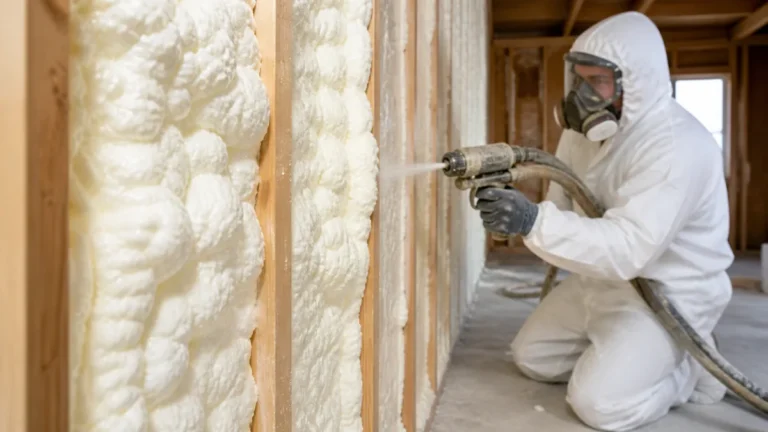
Polyurethane foam is made by reacting polyols with diisocyanates (usually TDI or MDI) along with blowing agents, catalysts, and additives that set the foam’s density and firmness. Memory foam is the same base chemistry with additional viscoelastic additives. During manufacturing and for a period after, unreacted or residual chemicals off-gas as VOCs — this is normal chemistry, not a manufacturing defect, and it’s why a brand-new mattress or car seat has a distinct smell.
The specific VOCs identified in foam mattress emissions studies include formaldehyde, toluene, and trace amounts of benzene and naphthalene, alongside flame-retardant byproducts in some products. Cured polyurethane itself is chemically inert once fully off-gassed — the health question is about the emission window, not the finished solid foam.
VOC Off-Gassing: How Much, How Long, and What CertiPUR-US Actually Caps
CertiPUR-US® is an independent, third-party certification program for flexible polyurethane foam. To carry the label, foam must be made without ozone depleters, PBDE flame retardants, formaldehyde, phthalates regulated by the Consumer Product Safety Improvement Act, or mercury, lead, and other heavy metals — and it must emit less than 0.5 parts per million of VOCs, tested after the foam has had time to off-gas in a controlled chamber.
A 2024 peer-reviewed risk assessment published in a toxicology journal specifically verified the CertiPUR-US limit values for toluene diamine and methylene dianiline in flexible foam and concluded that foam meeting the certification’s thresholds does not pose an unreasonable health risk to consumers under normal use. That’s a meaningfully different finding than “polyurethane foam is safe” as a blanket claim — it applies to certified foam tested against a defined limit, not to foam in general.
- Emissions are typically highest in the first 72 hours after unboxing and decline by roughly half within the first week.
- Lower-level off-gassing can continue for several weeks to a month, which is why “new mattress smell” can linger.
- Uncertified foam has no published VOC ceiling — manufacturers aren’t required to test or disclose emission levels unless the product carries a voluntary certification.
Health Risks: Respiratory Symptoms, Sensitization, and the Cancer Question
The best-documented short-term effects of VOC exposure are eye, nose, and throat irritation and headaches — the American Lung Association lists these as the primary concern for VOC sources generally, including new furniture and foam. People with asthma or existing chemical sensitivity are more likely to notice symptoms from a freshly unboxed mattress than a healthy adult without those conditions.
On cancer specifically: some individual VOCs that have shown up in mattress emissions testing (including formaldehyde and, in some lab studies, trace benzene) are classified by IARC or the National Toxicology Program as known or probable human carcinogens — but that classification is based mostly on sustained occupational exposure, not the trace, declining exposure from sleeping near a finished consumer mattress. The U.S. Occupational Safety and Health Administration has not set a carcinogenicity exposure limit specific to polyurethane foam end-use products, in large part because there isn’t enough consumer-exposure data to set one. That’s a gap in the evidence, not proof of harm — treat “mattresses cause cancer” as an overstatement of what the research currently shows, and treat “there’s zero risk” the same way.
The most consistent, well-supported recommendation across CPSC guidance and academic VOC studies is exposure reduction, not elimination: buy CertiPUR-US certified foam when possible, air out a new mattress before sleeping on it nightly, and prioritize ventilation in the room for the first month.
Flame Retardants and the CPSC 16 CFR 1633 Standard (What Most Guides Get Wrong)
Every mattress sold in the U.S. must meet the Consumer Product Safety Commission’s federal open-flame standard, 16 CFR Part 1633, which took effect in 2007 and requires a finished mattress to resist ignition and limit heat release when exposed to an open flame for a sustained period. This is a system-level test on the whole assembled mattress — foam, springs, adhesive, and cover together — not a chemical-additive mandate.
This is the part most articles on this topic skip: compliance does not require adding chemical flame retardants to the foam itself. Most modern mattress manufacturers meet 16 CFR 1633 with a fire barrier — a layer of inherently flame-resistant fiber (commonly a treated rayon/viscose or fiberglass-blend fabric) wrapped around the foam core, rather than chemically treating the foam. If you want to confirm a specific mattress’s approach, the manufacturer’s spec sheet or CertiPUR-US listing will usually state “fire barrier” rather than “chemical flame retardant” — and CertiPUR-US certification already excludes PBDE flame retardants specifically.

How to Actually Reduce Exposure (Ranked by Effectiveness)
- Buy CertiPUR-US certified. This is the single biggest lever — it caps VOCs at 0.5 ppm and rules out formaldehyde, PBDE retardants, and regulated heavy metals before the mattress ever ships.
- Unbox and air out before sleeping on it. Open windows or run a fan in the room for 48–72 hours, since this is when emissions are highest. Bag-compressed mattresses (bed-in-a-box) tend to off-gas faster once unboxed because of the vacuum-seal process, so give them the full window.
- Ventilate the bedroom for the first month. Lower-level off-gassing continues for weeks; a cracked window or an air purifier with an activated-carbon stage (carbon adsorbs VOCs; a standard HEPA filter alone does not) noticeably speeds the decline.
- Use a breathable, washable mattress protector. It won’t stop off-gassing, but it reduces direct skin contact with the foam surface and cuts down on trapped moisture and dust mites over time.
- Extra caution for higher-risk groups. Pregnant people, infants, and anyone with diagnosed asthma or chemical sensitivity should extend the airing-out period and consider a natural-latex or innerspring alternative if symptoms appear.
Certified vs. Uncertified Foam: What You’re Actually Getting
| Factor | CertiPUR-US® Certified | Uncertified Foam |
|---|---|---|
| VOC emissions | Tested, capped under 0.5 ppm | Untested, no published limit |
| Formaldehyde | None added | Not disclosed |
| PBDE flame retardants | Excluded by certification | Possible, brand-dependent |
| Heavy metals (lead, mercury) | Excluded by certification | Not disclosed |
| Independent third-party testing | Yes, annual | None required |
CertiPUR-US is a voluntary program, not a legal requirement, so a mattress without the label isn’t automatically unsafe — it just means those specific claims haven’t been independently verified. If you already own an uncertified mattress and can’t easily replace it, the ventilation and air-purifier steps above still meaningfully reduce ongoing exposure. For a broader look at polyurethane’s other health questions, see our guide on whether polyurethane is toxic (wet vs. cured), and if you’re deciding between foam types for a bed, our comparison of whether polyurethane foam is safe to sleep on covers the flammability and allergy angle in more depth.
Lower-VOC Alternatives Worth Considering
If off-gassing is a dealbreaker rather than a manageable inconvenience, natural latex (Global Organic Latex Standard certified) and innerspring mattresses with organic cotton or wool covers generally emit fewer VOCs than polyurethane foam, since they don’t rely on the same polyol/diisocyanate reaction. They typically cost more and sleep firmer or bouncier than memory foam, which is a real trade-off for people who specifically want foam’s contouring feel — there’s no single “healthiest” mattress that’s also the best fit for every sleeper.
Frequently Asked Questions
Is polyurethane foam mattress off-gassing dangerous?
For a healthy adult, CertiPUR-US certified foam’s off-gassing is below the exposure thresholds studied in current risk assessments, and the strongest emissions fade within the first 72 hours. It’s more of a concern for infants, pregnant people, and anyone with asthma or chemical sensitivity, who should extend the airing-out period.
Do polyurethane foam mattresses cause cancer?
There’s no direct evidence that sleeping on a finished, off-gassed polyurethane foam mattress causes cancer. Some VOCs detected in emissions testing, like formaldehyde, are classified as carcinogens at sustained occupational exposure levels, but that’s a different exposure scenario than trace, declining household off-gassing. Choosing CertiPUR-US certified foam removes formaldehyde from the equation entirely.
How long does it take polyurethane foam to stop off-gassing?
Emissions are highest in the first 72 hours and drop by roughly half within a week, but low-level off-gassing can continue for several weeks to about a month. Airing the mattress in a ventilated room before regular use shortens the period you’re exposed to peak concentrations.
Does every mattress contain chemical flame retardants?
No. Federal flammability rule 16 CFR 1633 requires mattresses to resist open-flame ignition, but most manufacturers meet it with a fire-barrier fabric layer wrapped around the foam rather than adding chemical flame retardants to the foam itself. CertiPUR-US certification also specifically excludes PBDE flame retardants.
Is CertiPUR-US the same as organic or non-toxic?
No. CertiPUR-US only certifies the foam against a specific list of substances (VOCs, formaldehyde, certain phthalates, heavy metals, ozone depleters and PBDE flame retardants) — it doesn’t mean the mattress is organic, biodegradable, or free of all synthetic materials. For an organic claim, look for GOLS (latex) or GOTS (cotton/wool) certification instead.
Conclusion
Polyurethane foam mattresses aren’t the health hazard some headlines suggest, but they aren’t risk-free either — the real answer depends on whether the foam is CertiPUR-US certified, how well the room is ventilated in the first month, and whether you’re in a higher-risk group like pregnancy or asthma. Certified foam, a 48-72 hour airing-out period, and ongoing bedroom ventilation address the large majority of the documented risk without requiring you to replace a mattress you already own.
Sponsored / affiliate links. As an Amazon Associate I earn from qualifying purchases. I may earn additional commission from eligible campaigns.
 Mattress Comfort, Box Spring Bed Base Queen Size, 8-Inch Wood Mattress Foundation – Amish Made in USA – Quiet Noise Free, 2-Pieces Under Mattress-Support BoxSpring, Fully Assembled, Gray
 Mattress Comfort, Box Spring Bed Base King Size, 4-Inch Wood Mattress Foundation – Amish Made in USA – Quiet Noise Free, 4-Pieces Under Mattress-Support BoxSpring, Fully Assembled, Gray