Pocket Screws vs Mortise and Tenon: Which Joint Lasts Longer?
Mortise and tenon usually lasts longer in furniture and frames that face racking, movement, or repairs. Pocket screws are usable for hidden, lower-load assemblies, but they are the weaker long-term choice when stiffness matters. Poor joint choice leads to wobble, loose parts, and repairs that cost more than the original build. This guide compares service life, failure modes, and where each joint fits best.
| Decision factor | Pocket Screws | Mortise and Tenon | Winner |
|---|---|---|---|
| Assembly speed | Fast. A pocket-hole jig, drill, and special screws make quick work of face frames and cabinet boxes. | Slower. Layout, chopping or routing the mortise, and fitting the tenon take more steps. | Pocket Screws |
| Racking resistance | Fair for low-stress panels and hidden frames, but the joint can start visibly opening at about 50 pounds. | High. Long-grain bearing surfaces and a mechanical lock make it better for side load. | Mortise and Tenon |
| Expected service life under stress | Best when the joint is hidden and load is modest. | Better when the part will see repeated stress, seasonal movement, or repair work. | Mortise and Tenon |
| Repair and rework risk | Higher if the screw path strips, the joint loosens, or a mistake leaves a weak face-grain edge. | Lower when the fit is right, because a damaged joint can often be cleaned up and refit. | Mortise and Tenon |
| Tooling and skill | Lower barrier. A pocket-hole jig is a low-cost setup tool, and Kreg is a common brand name in this category. | More setup and fitting skill are needed. | Pocket Screws |
What sets mortise and tenon apart over time
Mortise and tenon usually lasts longer when the joint has to stay stiff over years of side load, repeated use, and seasonal wood movement. Pocket screws can last a long time in hidden, lightly loaded work, but they are a shorter-life choice in chairs, tables, and door frames that rack or flex.
The real trade-off
The key difference is not raw strength alone. It is how the joint behaves after months and years of use, especially when a frame gets pushed sideways, lifted by one corner, or exposed to humidity swings. Pocket-hole joinery is drilled at about 15 degrees, uses special screws, and is fast to assemble with minimal clamp time.
Mortise and tenon is the traditional structural answer: a rectangular mortise paired with a matching tenon. That geometry gives a larger long-grain glue surface and a mechanical lock that resists movement better than an end-grain-heavy connection.
What “lasts longer” means here
Longer service life usually means less wobble, fewer loose fasteners, less glue-line creep, and fewer repairs. It also means the joint keeps its alignment when the furniture is moved, sat on, opened, closed, or cleaned for years. A joint can feel strong on day one and still be a poor long-term choice.
How each joint works
Pocket-hole joinery and its angled screw path
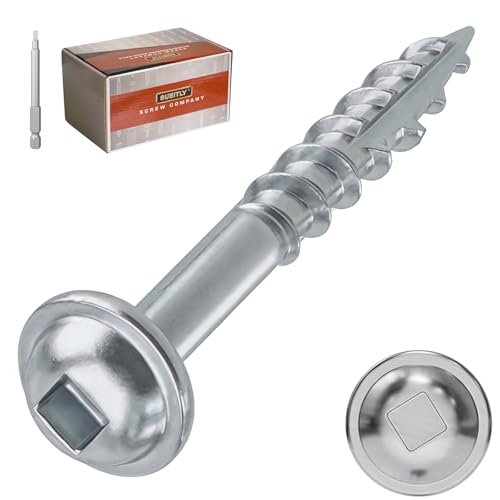
Pocket-hole joinery uses an angled pocket hole drilled at about 15 degrees, plus a drill, a jig, and self-tapping pocket screws. The screw pulls one part tight to another quickly, which is why it is popular for face frames, cabinet boxes, shelving, and hidden fasteners.
That speed has limits. The screw head, the screw threads, and the wood around the pocket do much of the work, so the connection depends on good pilot placement, correct screw length, and enough material thickness around the hole.
Mortise and tenon and its long-grain bearing surfaces
Mortise and tenon is the standard structural choice for traditional furniture joinery in load-bearing work. The tenon fits into the mortise, so the joint resists pull, twist, and racking with more long-grain contact than a screw-driven corner joint.
That long-grain glue surface matters because glue bonds more reliably to long grain than to end grain. The fit must also be accurate; clamp pressure should bring the shoulders home, not force a bad fit to look acceptable.
Which joint handles racking better?
Mortise and tenon handles racking better. Racking force is sideways stress that tries to turn a square frame into a parallelogram, and that is the load case that breaks weak chair legs, table aprons, and door frames first. Pocket screws can hold parts together, but they are not the better answer for repeated side load.
Why racking force matters
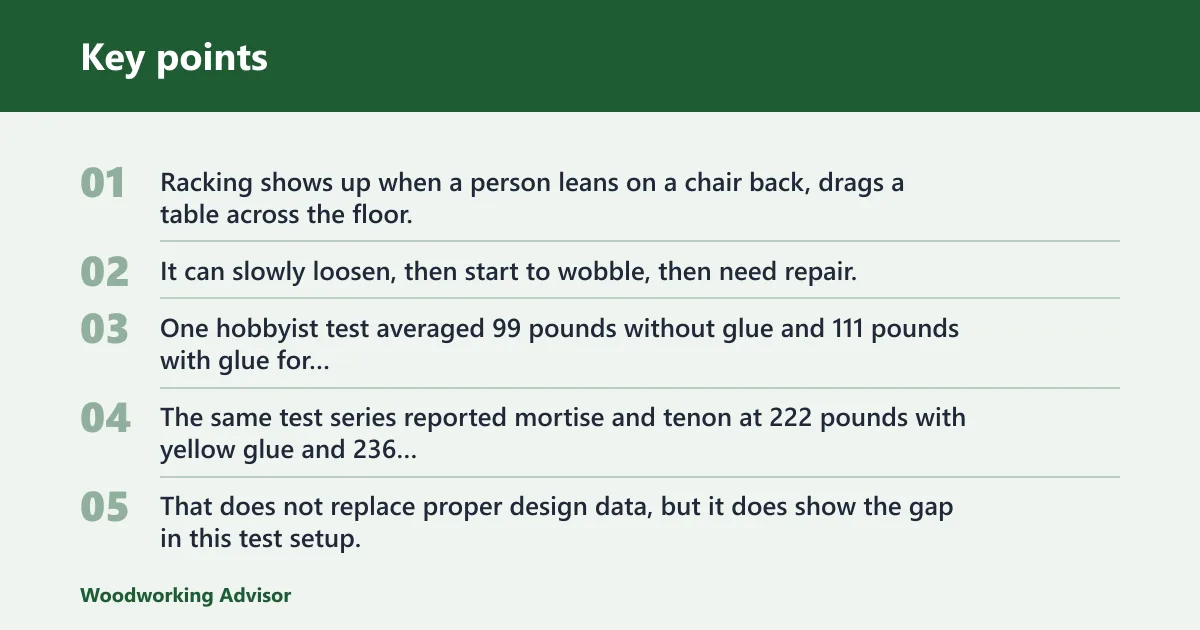
Racking shows up when a person leans on a chair back, drags a table across the floor, or opens and closes a door over time. The joint may not fail in a dramatic snap. It can slowly loosen, then start to wobble, then need repair.
Where pocket screws reach their limit
One hobbyist test averaged 99 pounds without glue and 111 pounds with glue for pocket-hole joints. The same test series reported mortise and tenon at 222 pounds with yellow glue and 236 pounds with epoxy, and the tester concluded mortise and tenons were twice as strong as pocket hole joints. That does not replace proper design data, but it does show the gap in this test setup.
A common first-timer mistake is to use pocket screws for a chair frame because the first assembly feels tight. Then the joints begin opening at stress points, often before the rest of the chair shows wear.
Why mortise and tenon resists side load better
The tenon shoulders and cheeks spread load across more wood, so the force does not concentrate at one screw shank or one small glue line. That gives mortise and tenon a real advantage in chairs, tables, and doors where the frame is always being worked from the side.
Which joint lasts longer?
Mortise and tenon usually lasts longer in furniture that sees repeated stress, movement, or repair. Pocket screws are usable for hidden work with lower loads, but long-term stiffness is where mortise and tenon pulls away. The difference shows up first as looseness, then as visible gaps, then as wobble.
Service life in chairs, tables, and doors
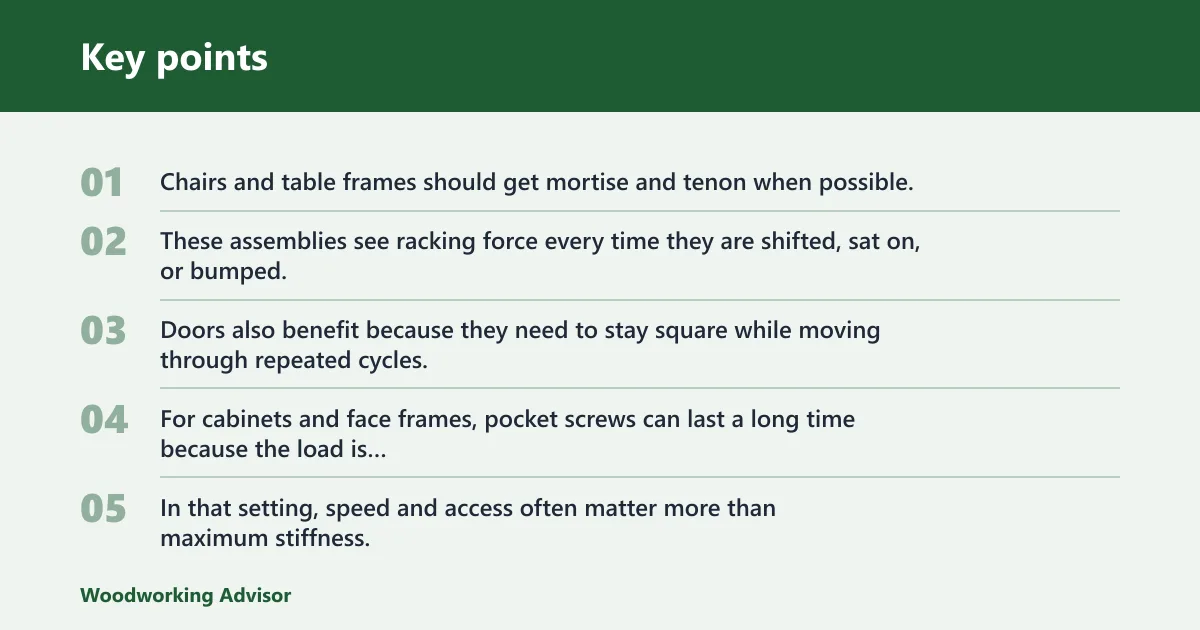
Chairs and table frames should get mortise and tenon when possible. These assemblies see racking force every time they are shifted, sat on, or bumped. Doors also benefit because they need to stay square while moving through repeated cycles.
For cabinets and face frames, pocket screws can last a long time because the load is more static and the parts are usually hidden. In that setting, speed and access often matter more than maximum stiffness.
Wood movement, loosening, and maintenance over time
Wood moves with humidity. Seasonal expansion and contraction can open gaps, bruise screw holes, or relax a joint that was only barely adequate at the start. That is one reason long-grain bearing and a well-fitted tenon tend to age better than a corner held mainly by screws.
Do pocket screw joints loosen over time? Yes, they can, especially when the joint carries side load or when the material around the screw threads is thin. Glue helps, but glue type matters too. PVA, or yellow glue, is common for indoor furniture, while epoxy and polyurethane sometimes appear in comparative testing and can change measured results.
Repairability when a joint starts to fail
Pocket screws are easier to assemble, but a failed pocket-hole corner can be awkward to repair cleanly if the hole has stripped or the joint has crept out of square. Mortise and tenon takes more work upfront, but it usually gives you more options for cleanup, refit, and re-glue if the part is still sound.
Picture a small dining chair with about a 1-inch front stretcher that can start to wiggle after a while. If the joint was a pocket screw corner, the fix may require rebuilding the connection. If it was a well-fitted mortise and tenon, a reset or re-glue may be enough.
Tools, setup, and fit
Pocket-hole jig setup, screws, and clamp needs
Pocket screws win on setup speed. The jig controls the angle, the drill creates the pocket, and the special screw pulls the parts together with little clamp time. That makes the method useful when you need a quick build and the holes can stay hidden.
Even here, fit matters more than brute clamp force. Over-clamping often means the joint surfaces do not fit correctly, or the screws are pulling too hard against misaligned stock. The clamp should hold the parts, not compensate for a bad layout.
Mortise and tenon layout, fit, and clamp pressure
Mortise and tenon asks for better layout, more careful fitting, and more time. The mortise walls must be true, the tenon thickness must match, and the shoulders should seat without forcing the piece out of square.
Clamp pressure matters, but it is not a cure for poor fit. If you have to crush the parts together, the joint is already wrong. The correct goal is full contact on the shoulders and even glue squeeze-out, not visible force.
What projects are they best for?
Pocket screws are best for cabinet boxes, face frames, shelving, and shop fixtures where hidden fastening and speed matter more than maximum racking resistance. Mortise and tenon is often preferred for chairs, table frames, and doors where stiffness, repeated stress, and repairability matter more than build speed.
Pocket screws for cabinet boxes, face frames, and shop fixtures
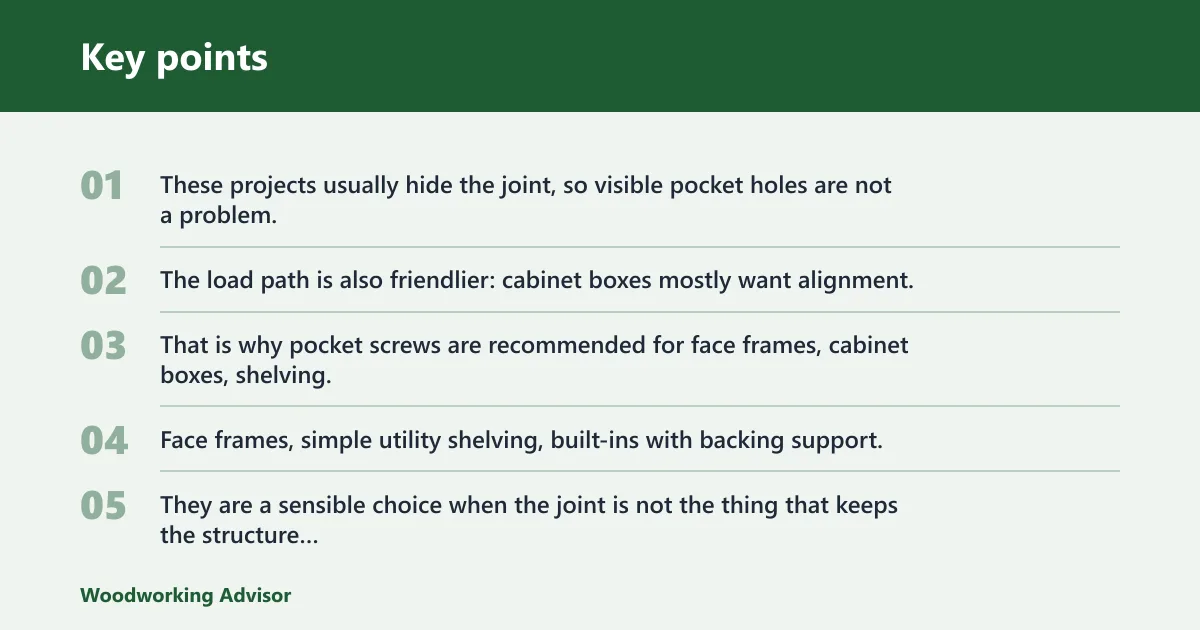
These projects usually hide the joint, so visible pocket holes are not a problem. The load path is also friendlier: cabinet boxes mostly want alignment, not heavy side-load resistance. That is why pocket screws are recommended for face frames, cabinet boxes, shelving, and hidden fasteners.
What projects are pocket screws best for? Face frames, simple utility shelving, built-ins with backing support, and fixtures that may be adjusted or replaced later. They are a sensible choice when the joint is not the thing that keeps the structure square.
Mortise and tenon for chairs, table frames, and doors
These projects need a joint that keeps working after years of movement. Mortise and tenon is recommended for chair and table legs and other load-bearing joints because it handles racking better and keeps more long-grain glue surface in play.
What projects need mortise and tenon joints? Chairs, dining tables, benches, door frames, and any frame that must stay stiff under repeated use. If the part supports body weight or moving hardware, this is usually the safer choice.
Appearance matters because pocket holes can be visible unless they are hidden with plugs, placed on the inside face, or buried in a cabinet carcass. In visible furniture, that can be a real trade-off. In hidden structure, it is often a nonissue.
| Project type | Load and racking risk | Expected service life | Recommended joint |
|---|---|---|---|
| Face frames | Low to moderate, mostly alignment load | Medium to long | Pocket Screws |
| Cabinet boxes | Low, mainly static load | Long | Pocket Screws |
| Shelving and shop fixtures | Low to moderate, usually hidden | Medium | Pocket Screws |
| Chair legs and stretchers | High racking risk, repeated stress | Long | Mortise and Tenon |
| Table frames | High racking risk, seasonal movement | Long | Mortise and Tenon |
| Doors | High racking risk, repeated cycles | Long | Mortise and Tenon |
Likely failure modes by joint
| Failure mode | Pocket Screws | Mortise and Tenon | When it becomes limiting |
|---|---|---|---|
| Loosening | More likely when side load or seasonal movement works the screw connection loose. | Less likely if the fit is right, though poor fit can still open the joint. | When wobble appears before visible damage. |
| Screw breakout | Possible if the screw strips thin stock or the pocket is too close to an edge. | Not a normal mode of the joint. | When the screw no longer clamps the parts together. |
| Glue-line failure | Can happen, but the screw often becomes the weak link first. | Can happen if the fit is poor or the adhesive choice is wrong. | When the glue surface is small or contamination weakens bond quality. |
| Wood movement gaps | More visible in wider parts or where seasonal change shifts alignment. | Still possible, but better geometry gives it more tolerance. | When humidity change opens a visible seam or changes squareness. |
Choose Pocket Screws if… / Choose Mortise and Tenon if…
Choose Pocket Screws if you need a fast build, the joint will be hidden, the load is mostly static, and the project is a face frame, cabinet box, shelf, or shop fixture. Choose Mortise and Tenon if the frame must resist racking, stay stiff for years, or survive repeated stress in a chair, table, or door.
- Choose Pocket Screws if the joint will not be the main structural defense against side load.
- Choose Pocket Screws if setup speed and low clamp time matter more than maximum stiffness.
- Choose Mortise and Tenon if the part must stay square under repeated use.
- Choose Mortise and Tenon if repairability and long-term tightness matter more than build speed.

Frequently asked questions
Is pocket screw joinery strong enough for furniture?
Yes, for the right furniture. Pocket screw joinery is strong enough for many hidden cabinet parts, face frames, and utility pieces, especially when the load is modest and the joint is well supported. It is not the better choice for furniture that will see heavy racking or repeated stress.
Is mortise and tenon stronger than pocket screws?
In furniture that has to stay stiff, yes. Mortise and tenon is the standard for traditional furniture joinery because it gives more long-grain glue surface and better racking resistance.
Which joint lasts longer in a table or chair frame?
Mortise and tenon usually lasts longer in a table or chair frame because those parts see side load, repeated movement, and seasonal wood changes. Pocket screws can work in some frames, but they are more likely to loosen or show movement over time when the frame is asked to stay square under stress.
When should I use pocket screws instead of mortise and tenon?
Use pocket screws when speed, hidden fasteners, and easy assembly matter more than top-tier structural performance. That fits face frames, cabinet boxes, shelving, and many shop fixtures. If the joint is not carrying major racking force, pocket screws can be a practical choice.
Do pocket screw joints loosen over time?
They can. Loosening is more likely when the joint sees racking force, when wood movement changes the fit, or when the screws are working close to thin edges. The joint may still hold for years in low-stress work, but it is less forgiving than a well-made mortise and tenon.
How much strength does a mortise and tenon joint have compared with pocket screws?
Specific numbers depend on wood species, glue, sample size, and test setup, so one test should not be treated as universal truth.
Sponsored / affiliate links. As an Amazon Associate I earn from qualifying purchases. I may earn additional commission from eligible campaigns.