Best Redwood Grade for Outdoor Furniture: Top Picks
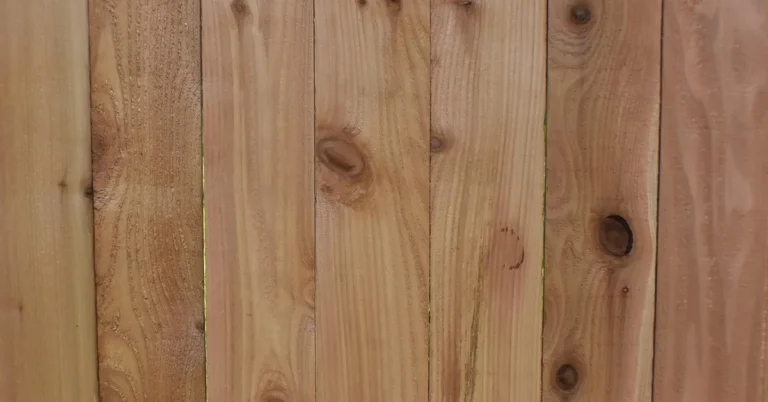
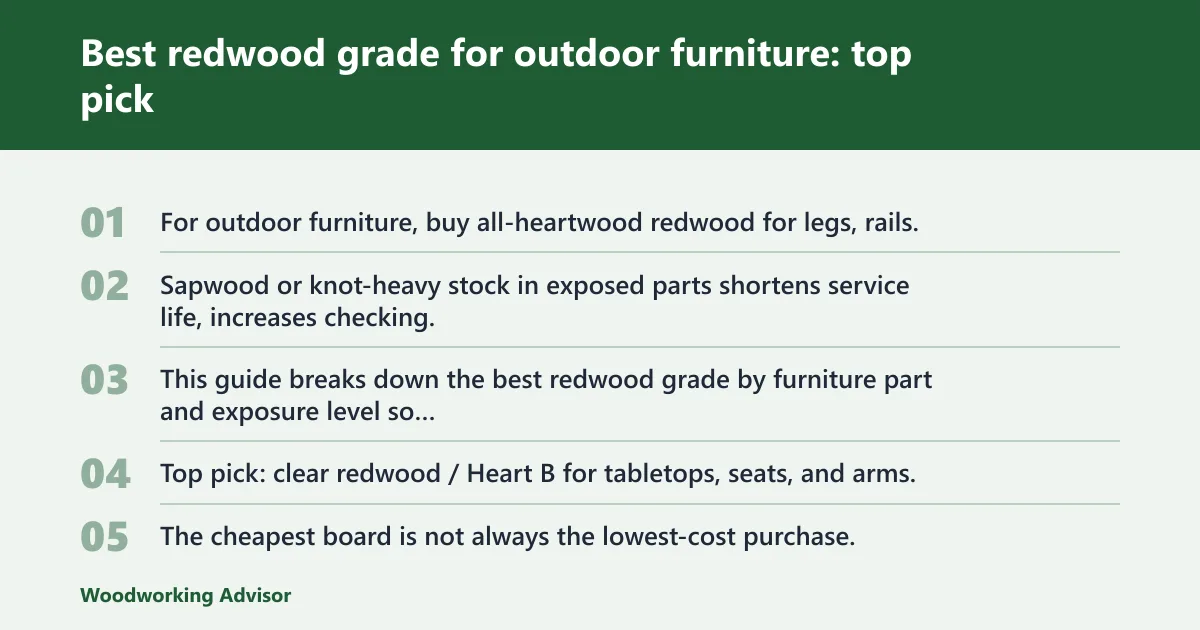
For outdoor furniture, buy all-heartwood redwood for legs, rails, and any part that stays exposed; use construction heart or a lower visible grade only for hidden braces and undersides. Sapwood or knot-heavy stock in exposed parts shortens service life, increases checking, and pushes you toward early replacement. This guide breaks down the best redwood grade by furniture part and exposure level so you can spend more only where failure starts.
This guide is part of our Redwood Grade Chart: Clear, B Grade, Construction Common Explained series.
Top pick: clear redwood / Heart B for tabletops, seats, and arms; construction heart redwood for legs, stretchers, and hidden members.
Best redwood grade for outdoor furniture: top pick


What this guide helps you buy and why part-by-part selection saves money
The cheapest board is not always the lowest-cost purchase. Outdoor furniture fails first at thin edges, exposed end grain, and members that stay wet or take load. Redwood’s natural decay resistance belongs in the heartwood, and its dimensional stability matters when boards must stay flat across seasons. That means you can save money on parts that stay hidden, but not on the parts you see, sit on, or depend on structurally.
Redwood is a lightweight softwood with natural decay resistance, and its heartwood is the durable part of the board. It also has a Janka hardness of 450 lbf, specific gravity of 0.35 to 0.40, and volumetric shrinkage of 6.9%. Those numbers do not make it hardwood-tough, but they do support the common buying rule: choose heartwood content first, then choose appearance grade by exposure.
📊 Redwood has a Janka hardness of 450 lbf. Source: Sentientfurniture.
Quick picks by project and budget

For most DIY outdoor furniture, the best value is clear redwood / Heart B on visible surfaces and construction heart redwood on hidden structure. If the project is mostly benches, tables, or loungers, that split keeps the decay-resistant heartwood where weather and wear are highest while trimming cost on concealed members. Avoid sapwood-heavy boards anywhere rain or sun will reach them.
- Best for tabletops and bench seats: clear redwood / Heart B, because fewer knots and blemishes reduce checking on visible, thin edges.
- Best for legs, rails, and hidden stretchers: construction heart redwood, provided the board is all-heartwood or nearly all-heartwood.
- Best budget choice for second-growth stock: second-growth construction heart or clear stock with strong heartwood coverage, if the supplier can sort out sapwood.
Best for tabletops and bench seats
Choose clear redwood / Heart B here. Tabletops and bench seats show every knot, patch, and sapwood streak, and they are also the parts most likely to develop edge checking if the grain is interrupted. Clear stock gives you cleaner finish results and flatter-looking broad surfaces.
Construction heart redwood is usually the better spend in these parts. It is all-heartwood stock with limited sapwood and is commonly used for decking and furniture-adjacent exterior work. If the member is hidden, partly shaded, or backed by joinery, small knots matter less than heartwood coverage and consistent milling.
Best budget choice for second-growth stock
Second-growth redwood is more common, lower cost, and usually the right way to control budget if the board is sorted carefully. It offers moderate resistance, not the highest durability class, so inspect for heartwood dominance and reject pieces with large sapwood areas or face checks on load-bearing parts.
Is construction heart redwood good enough for patio furniture?
Yes, construction heart redwood is good enough for many patio furniture parts, especially legs, aprons, rails, and other components that are hidden or receive only partial exposure. It is all-heartwood stock with limited sapwood preferred, so it works well when strength, outdoor durability, and cost matter more than a flawless face.
Where construction heart works well
Use it for bases, inner rails, back supports behind slats, table aprons, and underside framing. These pieces need decay resistance and dimensional stability more than a perfect surface. Braundera lists construction heart as the grade it stocks for decking, which fits the same logic for exterior furniture structure.
Where clearer stock is worth the upgrade
Pay more for clear redwood / Heart B when the part is touched, seen, or spans a wide opening. Bench seats, tabletops, arm caps, and exposed back slats are common upgrade points because knots can create weak spots, trap moisture, and make sanding and finishing less predictable.
What to inspect for sapwood, knots, and edge defects
Look for white or pale yellow sapwood and keep it out of exposed surfaces. Braundera describes sapwood as white in color and says it will rot as quickly as untreated pine. Also check edges for splits, wane, and broken corners. Thin furniture parts do not hide defects well, and edge damage often turns into checking after the first wet-dry cycle.
When is clear redwood worth the extra cost?
Clear redwood is worth the extra cost on parts that stay visible, get handled often, or have thin edges that can check or split. It is the right upgrade when knots would distract from the design or create weak points at seat fronts, arm tops, and tabletop edges. Use cheaper stock where the board disappears into the frame.
Visible parts that benefit most from fewer knots
Tabletops, bench seats, arm rails, back slats, and front aprons are the main candidates. Braundera’s Heart B is described as a clear grade with limited knots or blemishes, which makes it a better fit for finish-facing parts than construction heart. Cleaner stock also sands more evenly and tends to finish more predictably.
Thin parts that can check or split
Thin boards move faster with humidity swings. Redwood is notably stable, and Braundera says it is the most stable of all softwoods and will not warp, cup, or split like other woods with moisture, but no wood is immune to poor grain or hidden defects. Clear stock lowers the chance that knots concentrate stress at an edge.
Picture a 3/4-inch-thick bench seat with a knot right near the front edge. That area takes body weight, dries fast in sun, and sees repeated movement. A clear board costs more at checkout, but it is often cheaper than replacing a split seat later.
Choose clear stock when you plan to leave the redwood unfinished or use only a light oil. Any blemish will show as the board grays. If the member is underneath the frame or inside a boxed base, the premium buys little. Spend where the surface is visible or where a defect would actually fail the part.
How do old-growth and second-growth redwood compare?
Old-growth redwood usually offers higher durability and higher decay resistance, but it is rarer and more expensive. Second-growth material is more common and generally lower cost, yet it can still work well for outdoor furniture if you choose all-heartwood boards. The label matters less than the amount of heartwood in the actual board.
Durability and decay resistance
Old-growth heartwood carries high durability. Second-growth material offers moderate resistance. That difference matters most in wet climates, on furniture that sits directly on damp ground, and on parts with end grain exposure. For a patio set under cover, second-growth heartwood can be a sensible buy if the board is clean and well milled.
Availability and price
Old-growth redwood is historically harvested lumber and is now much less common in normal retail supply. That scarcity makes it expensive. Second-growth lumber is what most buyers will see in current stock, especially for larger boards. If the project is simple, second-growth clear or construction heart often gives the best value.
How to judge second-growth boards by heartwood content, not by the label alone
Do not assume second-growth equals lower performance. Inspect the board face and edges. More heartwood means better outdoor service, regardless of age class. If the pale sapwood band is wide, keep looking. If the board is mostly heartwood with only a small outer strip, it may be a good candidate for hidden or sheltered parts.
Grade-by-component table for outdoor furniture
This is the simplest way to buy redwood without overspending. Start with the part’s exposure, then choose the lowest grade that still protects the failure-prone surface. Keep sapwood off exposed faces whenever possible, and reserve clear grades for visible parts that are thin, wide, or heavily handled.
| Furniture part | Lowest grade that still makes sense | Why this grade fits | What to avoid |
|---|---|---|---|
| Tabletops | Clear redwood / Heart B | Visible surface, wide boards, and thin edges benefit from fewer knots and better appearance | Sapwood streaks, open knots near edges, face checks |
| Bench seats | Clear redwood / Heart B | Weight-bearing, visible, and prone to checking at the front edge | Knot clusters, pale sapwood, cupped stock |
| Seat slats and back slats | Clear redwood / Heart B, or very clean construction heart on hidden backs | Thin parts need stable grain and clean edges; back slats can tolerate slightly less cosmetic grade if they are partly sheltered | Large knots, wane, edge splits |
| Arms | Clear redwood / Heart B | Frequent contact and exposed edges justify cleaner stock | Sapwood on top edges, short grain around knots |
| Legs and aprons | Construction heart redwood | Strong outdoor performance with less need for appearance-grade stock | Wide sapwood bands, rot-prone defects at joints |
| Hidden stretchers, cleats, and support rails | Construction heart redwood or lower visible grade with strong heartwood content | These parts are less seen but must stay durable; heartwood matters more than appearance | Boards with major sapwood exposure or loose knots at joinery points |
How to choose the right grade for your space
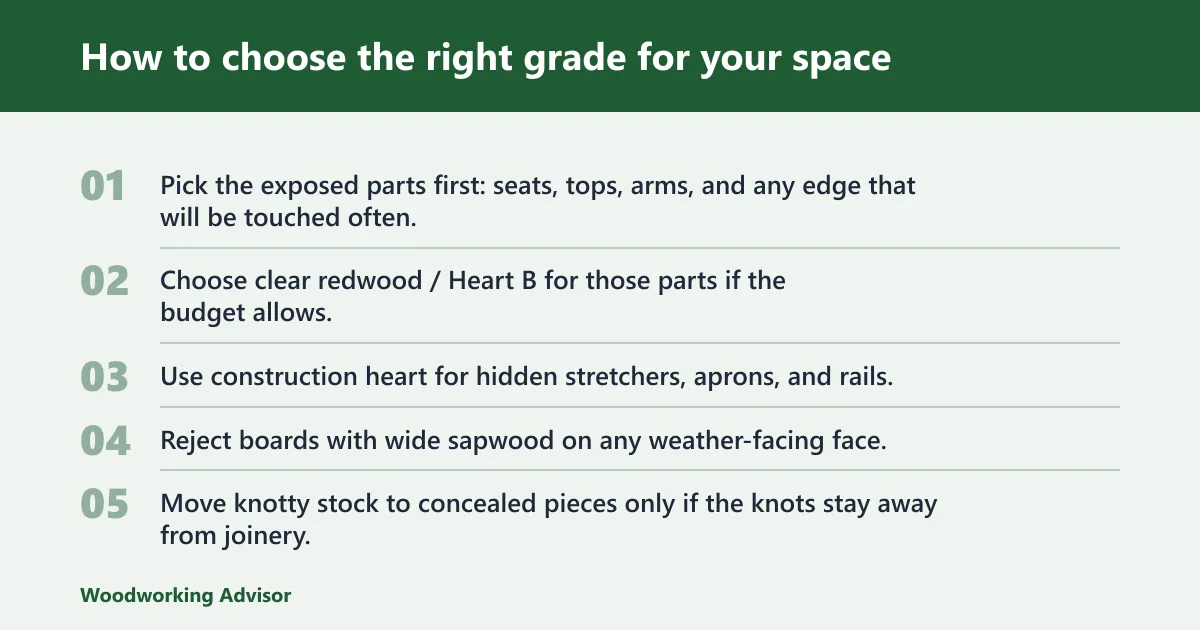
Match the grade to moisture, sun, and visibility. A covered, shaded patio can accept more economical heartwood stock than a deck with full sun and sideways rain. In every setting, the cheapest safe choice is the one that keeps heartwood where weather hits and hides lower grade where it will not matter.
Full-sun, shaded, and coastal placements
Full sun drives faster graying and more movement, so pay up for clear stock on visible parts and use construction heart on hidden structure. Shaded locations stay damp longer, which makes sapwood even less acceptable. Coastal air raises the value of all-heartwood boards because wetting cycles are more frequent and more persistent.
Pay more only where it shows or fails
That rule is the buying shortcut. Pay for clear grade on tabletops, seats, and arms. Save with construction heart on legs, aprons, and concealed stretchers. Do not pay for clear stock on parts that disappear under the frame. Do not save money by sliding sapwood into exposed faces.
Suppose you are building a bench of about 6 feet for a shaded porch with a slatted back. The seat and arm tops should be clear redwood, while the back’s hidden support rails can be construction heart. That split cuts cost without putting the weak material in the most visible or most stressed spots.
Finish choices: exterior stain versus UV-protective oil
Exterior stain helps preserve color and adds protection based on exposure, but it is not required for decay resistance. UV-protective oil slows graying and usually needs periodic reapplication, which suits owners who want the original color longer. If you want natural weathering, a penetrating oil-based water sealer is a common choice for the initial finish.
Finish is a maintenance choice, not a substitute for proper grade selection. Braundera notes that stain is the only way to prevent fading to silvery gray. That means color control is separate from outdoor durability. Keep the best heartwood in the highest-exposure parts, then choose a finish based on how often you want to renew it.
How to avoid knots and blemishes in redwood furniture pieces
Buy longer and wider than you need so you can cut around small defects. Lay out cut lists before purchase, then inspect faces, edges, and ends for knots near joinery, sapwood on exposed faces, and wane on thin parts. For tabletops and seats, choose the cleanest boards first and use less perfect material only where it will be hidden.
- Pick the exposed parts first: seats, tops, arms, and any edge that will be touched often.
- Choose clear redwood / Heart B for those parts if the budget allows.
- Use construction heart for hidden stretchers, aprons, and rails.
- Reject boards with wide sapwood on any weather-facing face.
- Move knotty stock to concealed pieces only if the knots stay away from joinery.
- Choose a finish based on color goals, not as a fix for weak stock.
Frequently asked questions
What redwood grade is best for outdoor furniture?
Clear redwood / Heart B is the best all-around choice for visible outdoor furniture parts because it combines all-heartwood stock with fewer knots and blemishes. Construction heart redwood is the better value for hidden structure. The right answer depends on exposure: buy the cleanest grade where people sit, touch, and see the board.
What is the difference between clear redwood and heart redwood?
Clear redwood, often called Heart B, is all-heartwood stock with limited knots or blemishes and is better for finish-facing parts. Construction heart redwood is also all-heartwood stock, but it can be less cosmetic and is commonly used where appearance matters less. Both rely on heartwood, but clear stock looks cleaner.
Does sapwood in redwood furniture rot outside?
Yes. Sapwood is the pale white to yellow outer portion of the board, and it has low durability outdoors. Braundera says it will rot as quickly as untreated pine. For exposed furniture parts, sapwood should be minimized or excluded, especially on surfaces that stay wet, get direct sun, or face repeated rain.
Should outdoor redwood furniture be stained or left to weather?
Either approach can work, but the finish choice changes appearance more than core durability. Exterior stain helps preserve color and adds protection, while UV-protective oil slows graying and needs regular reapplication. If you want the board to weather naturally, a penetrating oil-based water sealer is a common maintenance choice.
How does second-growth redwood compare to old-growth for outdoor use?
Old-growth redwood has higher durability and higher decay resistance, but it is rarer and more expensive. Second-growth is more common and offers moderate resistance. For outdoor furniture, second-growth can still be a smart buy when the board is mostly heartwood and the exposed parts are chosen carefully.
What grade of redwood should I buy for benches and tables?
Buy clear redwood / Heart B for the bench seat and tabletop, then use construction heart for legs, aprons, and hidden braces. Benches and tables fail first at wide, thin, visible parts, where knots and sapwood create the most trouble. The best grade is the one matched to exposure, not the whole project.
Sponsored / affiliate links. As an Amazon Associate I earn from qualifying purchases. I may earn additional commission from eligible campaigns.