Cedar Shakes Curling: Why It Happens and How to Prevent It
Cedar shake edges curl when the exposed face dries faster than the underside, and replacement is usually the right call once curling affects more than about 20% of the roof or the shakes are split, brittle, or leaking. If left alone, water can reach the deck and underlayment, decay can spread, and repair costs can rise quickly. This guide explains the moisture physics behind curling, what you can stabilize, and the signs that mean it is time for repair or replacement.
What curling usually means
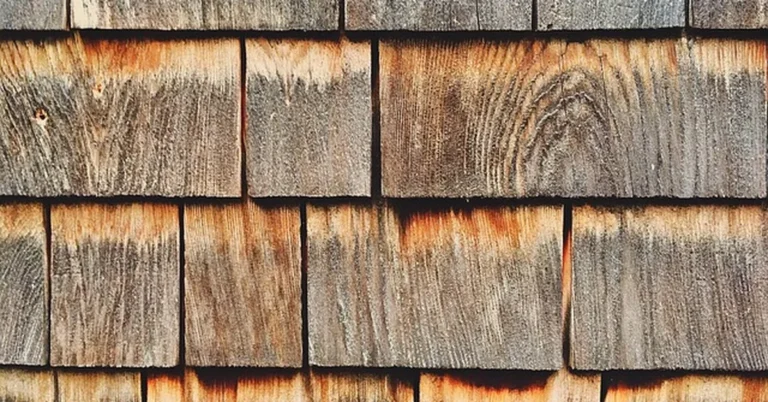
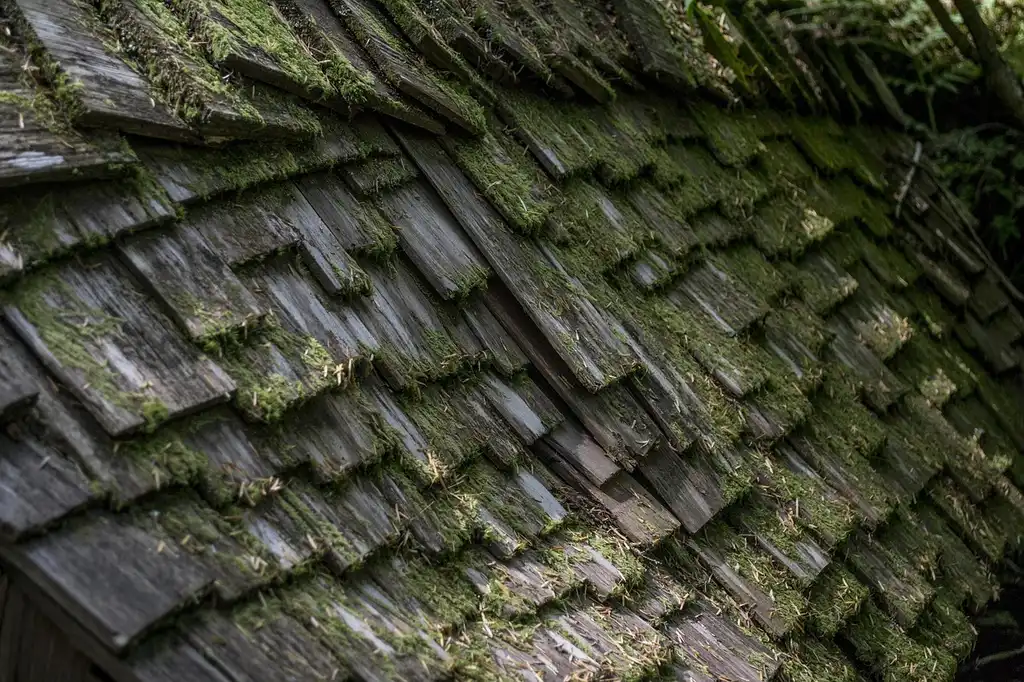
Curling is the edge of a shake lifting and bending away from the roof surface. It is different from cupping, where the board curves across its width, and different again from edge lift caused by loose fasteners. Separate those symptoms first, and the cause is easier to trace.
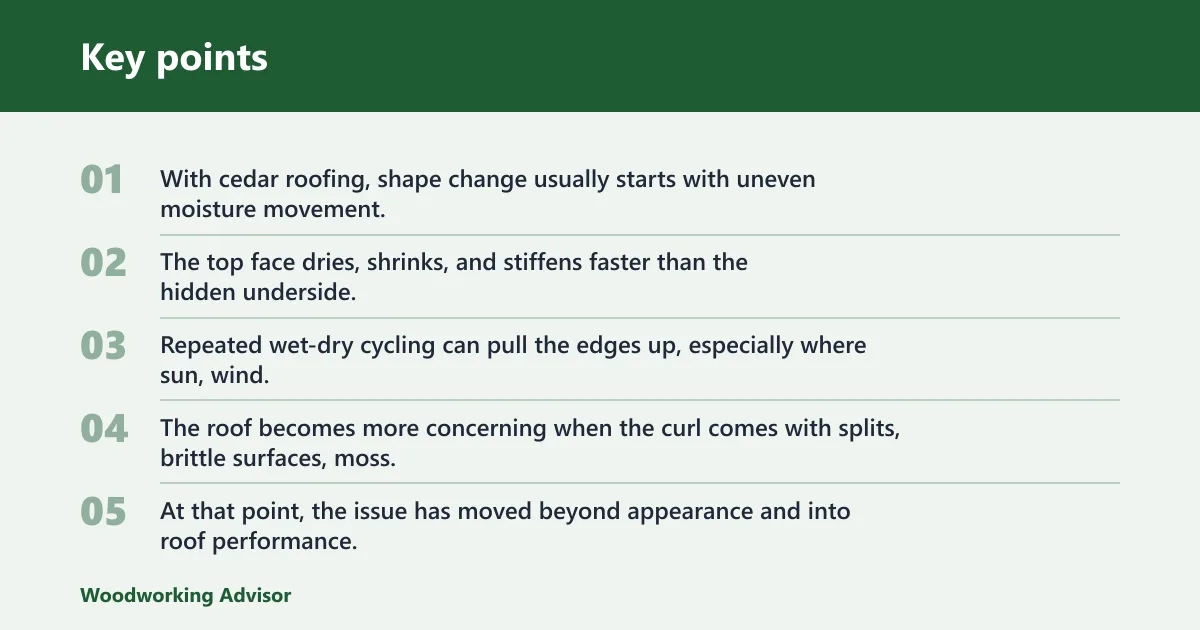
With cedar roofing, shape change usually starts with uneven moisture movement. The top face dries, shrinks, and stiffens faster than the hidden underside. Repeated wet-dry cycling can pull the edges up, especially where sun, wind, and coating breakdown leave one side more exposed than the other.
Curling is sometimes only cosmetic at first. The roof becomes more concerning when the curl comes with splits, brittle surfaces, moss, loose nails, or visible water entry. At that point, the issue has moved beyond appearance and into roof performance.
Curling versus cupping versus edge lift
Curling usually shows up at the sides or corners of a shake. Cupping bows the piece across its face, often because one side gains or loses moisture faster than the other. Edge lift is often tied to fasteners or movement at the butt end, not only to wood movement.
That distinction matters because each symptom points to a different repair path. A shake that has curled from drying imbalance may still be usable for a time. A shake that has cupped badly, split, or lifted because of fastener failure usually needs replacement.
Cedar shakes and cedar shingles
Cedar shakes and cedar shingles are not interchangeable on a roof. Shingles are sawn on both sides, so they have a more uniform appearance and more precise thickness and taper. Shakes have a rougher profile and are commonly used on roofs where the thicker, split look is part of the design.
That difference affects fitting, exposure, and repair matching. A replacement piece has to match the existing roof in thickness, reveal, and texture. Mixing a shingle into a shake field often looks mismatched and can create uneven courses.
Why roof products are not interchangeable
Shake lengths are commonly 18 inch and 24 inch products, while cedar shingles are available in 16 inch, 18 inch, and 24 inch lengths. Length affects installation spacing, repair matching, and how easy it is to replace a damaged section without disturbing nearby courses.
Thickness matters too. Cedar shake butt thickness ranges from 3/8 inch to 1 inch plus, while tapersawn shakes range from 5/8 inch to 1½ inches. Thicker pieces usually resist distortion better, but they also need correct fastening and exposure so the roof stays even.
Which wood and grain hold up best?
Western Red Cedar and Alaskan Yellow Cedar are the main wood species used in cedar shakes and shingles. Alaskan Yellow Cedar is often used in higher-quality roof products, while better roofing stock is commonly selected for grain quality, tight structure, and fewer defects.
For longevity, grain orientation matters as much as species. Edge grain is the preferred orientation because it moves less across thickness changes and tends to stay flatter. Flat grain is less stable and is more likely to cup, twist, or curl under weather cycling.
Edge grain versus flat grain
Premium Grade shakes allow no flat grain. That is a strong quality marker because it sets a higher stability bar before the product ever reaches the roof. Lower-quality products can include flat grain, sapwood, and knots, all of which increase the chance of movement and early wear.
Number 1 Grade shakes are often used as a top reference in grading guidance, and they can include up to 20% flat grain per bundle. That does not make them poor roof products, but it does mean they are not the same as premium shake stock built around edge grain only.
Premium grade and Number 1 grade
Higher quality cedar roofing is 100% edge grain and free of knots and sapwood. Products are certified using a grading system developed by CSSB. That grading matters because the installed quality of the shakes or shingles largely determines longevity, especially on exposed roofs with strong sun and repeated wetting.
Say your south-facing slope curls first while the shaded slope still looks flat. That pattern points to exposure and moisture cycling, not simply old age. If the curled side also has flat-grain pieces or visible knots, the material choice likely made the problem worse.
Curling cedar shakes triage table
Use this table to sort the roof into stabilize, repair, or replace. If the symptom is widespread, or if several problems appear together, the roof usually needs more than a cosmetic fix.
| Symptom | Likely cause | Urgency | DIY-safe action | Pro action |
|---|---|---|---|---|
| Edge curl at the exposed ends | Uneven drying, coating breakdown, sun exposure | Moderate | Inspect for splits, loose nails, and missing coating | Evaluate whether the affected course can be patched or must be replaced |
| Cup across the face | Moisture imbalance, flat grain, repeated wet-dry cycling | Moderate to high | Check attic ventilation and roof drainage | Replace damaged pieces and review material quality |
| Split shake | Drying stress, age, fastener movement | High | Mark the location and watch for leaks | Replace the shake and inspect nearby courses |
| Lifted butts | Fastener failure, shrinkage, warped stock | High | Avoid prying unless you are clearing debris | Check nail placement, underlayment, and surrounding pieces |
| Moss on the surface | Long moisture retention, shade, poor drainage | Moderate | Gently remove debris from valleys and gutters | Inspect for trapped moisture and hidden decay |
| Brittle shakes | Age, sun exposure, coating loss, repeated drying | High | Limit foot traffic | Plan for broader replacement, not spot repair only |
| Nail back-out | Wood shrinkage, movement, poor fastening | High | Note the pattern and keep water out of the area | Reset or replace fasteners and inspect the course below |
| Localized curling | One slope, ridge zone, or trouble spot with stronger exposure | Moderate | Compare the area to neighboring slopes | Test for a local repair instead of whole-roof replacement |
| Widespread curling | Systemic aging, coating failure, ventilation problems | High | Document the affected area | Plan a full roof evaluation for repair or replacement |
| Exposure-related curling | South or west slope, ridge, and wind-driven weather | Moderate to high | Check whether the same exposure pattern repeats each season | Adjust repair scope to the exposure zone and underlying cause |
Why do cedar shakes curl?
Cedar shakes curl when moisture leaves the wood unevenly. Sun-facing slopes dry faster than shaded slopes, ridge zones see stronger airflow, and repeated wet-dry cycling creates stress that pulls the exposed edge upward. If the roof coating has broken down, the drying imbalance becomes stronger.
Poor attic ventilation can make the problem worse by trapping heat and moisture under the roof deck. That hidden moisture can keep the underside of a shake wetter for longer, so the top and bottom faces move at different rates. The result is shape change, then curling, then cracking.
Fastener problems also matter. If nails back out or are placed poorly, the shake can move every time the roof heats, cools, wets, or dries. That movement adds stress and can turn a minor curl into a split or lifted butt.
A common first-timer mistake is assuming every curled piece is the same problem. A 24 inch shake on a west-facing slope that curls after coating failure is not the same failure pattern as a single loose piece near the ridge with a backed-out nail.
Sun-facing slopes and wet-dry cycling
Exposure is one of the clearest predictors of where curling starts. South- and west-facing slopes usually see more sun load and faster surface drying, while shaded areas may stay damp longer. Those different moisture patterns can pull the roof out of shape in patches rather than all at once.
Poor attic ventilation and trapped moisture
If the attic stays hot and humid, the underside of the roof assembly can stay wetter than it should. That trapped moisture slows drying after rain or snowmelt. Over time, the imbalance can drive curling, cupping, and premature cracking even if the visible surface still looks sound.
Fastener problems and coating failure
When a coating wears off, the wood loses some protection against fast moisture exchange. When fasteners loosen, the shake moves more than it should. Together, those problems create a cycle of movement, edge lift, and splitting that is harder to reverse than a simple surface defect.
Can curled shakes be repaired?
Some curled shakes can be stabilized, but flattening is limited and often temporary. If the wood has only begun to lift at the edge and the piece is otherwise sound, a roofer may be able to secure surrounding sections or replace isolated pieces. Once the shake is split, brittle, or water-damaged, replacement is usually the better call.
Repair works best when the problem is local and the rest of the roof is healthy. It works poorly when the same pattern repeats across multiple slopes. In that case, a patch can buy time, but it will not solve the root cause.
Flattening limits
A curled shake does not always return to its original shape. Wood memory, fiber damage, and surface checking can keep it from lying flat again. Even if it looks better for a short time, the piece may continue to move with the next season of heat and rain.
Spot repair versus replacement
Spot repair makes sense when the issue is isolated and the surrounding roof still has good material. Replacement makes more sense when curling appears with splits, moss, brittleness, or widespread nail movement. If more than about 20% of the roof shows the same condition, replacement is usually the cleaner decision.
Picture a 24 inch shake roof where only two courses above a dormer curl on the afternoon sun side. That area may be repairable. If the same roof shows curling on every exposed slope, plus nail back-out and cracked ends, the problem is no longer local.
How can you prevent future curling?
Prevention starts with inspection, drainage, and drying conditions. Keep the roof free of debris, check for moss, make sure gutters and valleys move water quickly, and confirm that attic ventilation is not trapping heat and moisture. Those steps reduce the uneven drying that leads to curling.
Maintenance also includes coating care where the product and climate call for it. Once the surface protection fails, the wood absorbs and loses moisture faster. That speeds shape change, especially on the sunniest slopes and at ridges where airflow is strongest.
Inspection and cleaning cadence
A common rule of thumb is to inspect cedar roofing at least twice a year, and after major storms. Look for lifted butts, back-out nails, brittle edges, moss buildup, and split ends. Clean off leaves and needles before they hold water against the shakes.
Ventilation, drainage, and exposure control
Good ventilation helps the underside dry at a pace closer to the exposed face. Good drainage keeps water from sitting in valleys and behind debris. Exposure control is mostly about roof design and maintenance, but you can still reduce risk by keeping the roof surface clean and dry.
Replacement choices that reduce repeat failure
If you replace part or all of the roof, choose material that matches the existing exposure and performance needs. Edge grain stock is the safer choice when reducing warping is a priority. Premium Grade shakes exclude flat grain, and Number 1 Grade shakes allow up to 20% flat grain per bundle, so the grade you choose changes the roof’s stability from the start.
Cedar shake roofs can last a long time, but only when climate, exposure, installation, and upkeep all work together. A commonly cited lifespan is around 40 years, and some warranty claims are said to reach 50 years. Those figures are not guarantees; poor drainage, weak ventilation, or low-grade material can shorten them sharply.
Frequently asked questions
Why are my cedar shakes curling?
Curling usually means the exposed face is drying faster than the underside. Sun, wind, wet-dry cycling, coating failure, poor attic ventilation, and loose fasteners can all contribute. If the problem is limited to one slope, exposure is often the main driver.
Can curled cedar shakes be flattened or repaired?
Minor curling can sometimes be stabilized if the shake is still sound and the problem is local. But once the wood is split, brittle, or repeatedly lifting, flattening is usually temporary. Repair is most useful when the surrounding roof remains in good condition.
Does curl mean cedar shakes need replacement?
Not always. A few curled shakes on one exposure may be repairable. Replacement becomes the better choice when curling is widespread, affects more than about 20% of the roof, or appears with splits, leaks, nail back-out, or brittle wood.
What makes cedar shakes cup, warp, or split?
Cupping and warping usually come from moisture imbalance and grain instability, while splitting often follows drying stress, age, or fastener movement. Flat grain, repeated wet-dry cycling, and poor ventilation make all three problems more likely because they increase movement across the wood.
How do I prevent cedar shake edges from curling?
Keep the roof clean, clear drainage paths, and maintain attic ventilation so both sides of the shake dry at a similar rate. Replace failing coatings when needed, and inspect sun-facing slopes more often. Prevention works best before the edges start to lift.
What is the difference between cedar shakes and cedar shingles?
Shingles are sawn on both sides and have a more uniform appearance, while shakes have a rougher profile and are commonly used on roofs. Cedar shingles and shakes are both made from Western Red Cedar or Alaskan Yellow Cedar, but they are not interchangeable in appearance or fit.
Sponsored / affiliate links. As an Amazon Associate I earn from qualifying purchases. I may earn additional commission from eligible campaigns.