Redwood Vs Douglas Fir For Framing: Which Is Better?
Douglas fir is the better choice for load-bearing framing; redwood is only a workable option for non-structural, moisture-exposed members where local code and grading allow it. Pick the wrong species, and you can end up with lower stiffness, more movement, failed inspections, or costly tear-outs. This guide compares strength, decay resistance, grading, code limits, and the framing uses each species can handle.
Redwood vs Douglas fir for framing: which should you choose?
Choose Douglas fir for studs, beams, rim boards, and other true framing members. Redwood belongs in limited, code-appropriate exterior roles where decay resistance matters more than structural capacity. In framing, strength and stiffness come first, and Douglas fir is the more dependable structural choice.
| Decision factor | Redwood | Douglas Fir | Winner |
|---|---|---|---|
| Load-bearing suitability | Limited; depends heavily on grade and heartwood content | Commonly used for studs, beams, and load-bearing members | Douglas Fir |
| Moisture exposure and decay resistance | Heartwood is naturally decay-resistant | Moderately durable; outdoor use usually needs preservation | Redwood |
| Fastener holding and movement risk | Softer, with more risk of denting and movement in service | Denser, with better fastening and less movement risk | Douglas Fir |
| Pressure treatment and sealing needs | Often unnecessary for heartwood in sheltered exposure, but cut ends still matter | Usually needs treatment outdoors or in damp contact | Redwood |
| Relative cost and waste | Typically higher material cost, especially for durable grades | Usually cheaper and easier to source in structural grades, which cuts waste from sorting | Douglas Fir |
Load-bearing suitability
Douglas fir wins because framing is a structural problem first. Studs and beams need stiffness, predictable grading, and dependable fastener performance, not only decay resistance. Redwood can work in narrow cases, but it is not the default choice for primary load-bearing members.
Moisture exposure and decay resistance
Redwood wins here, but only because its heartwood naturally resists decay and insects. That matters in damp or exterior settings, yet it does not make redwood a better framing species. If the member carries structural load, moisture resistance alone is not enough.
Fastener holding and movement risk
Douglas fir’s higher density gives it the edge for nails, screws, and general framing stability. Redwood’s lower density means more denting and a greater chance that soft material around fasteners will compress over time. In a framed wall, that can matter at plates, connections, and trim transitions.
Pressure treatment and sealing needs
Douglas fir usually needs preservation or pressure treatment outdoors, especially at cut ends and contact points. Redwood heartwood can often avoid that extra treatment in exposed but non-structural use, though sealing still helps where moisture lingers. Once wood stays wet long enough, both species are vulnerable.
Relative cost and waste
Douglas fir usually costs less and is easier to source in structural grades, which lowers both material price and sorting waste. Redwood often carries a premium for appearance and decay resistance, so using it for framing can raise installed cost without improving structural performance.
📊 Coast redwood can reach 116.22 m in height. Source: Sequoia sempervirens.
Is Douglas fir stronger than redwood?
Yes. Douglas fir is stronger for framing use, and competitor data places it at about 620 lbf on the Janka scale versus redwood at about 450 lbf. That difference matters because framing members need stiffness, fastener grip, and predictable load behavior, not only surface hardness.
Why density and stiffness matter for studs and beams
Douglas fir is denser, with competitor data listing it at 32 lbs/ft³ versus redwood at 26 lbs/ft³. Denser framing lumber generally handles compression, bearing, and fasteners better, which is why Douglas fir is common for beams and studs. For load paths, stiffness matters more than color or appearance.
How old-growth and second-growth redwood change the comparison
Redwood’s average Janka hardness is listed at 450 lbf, but that average hides real variation. Old-growth redwood is listed at 480 lbf, while second-growth redwood is listed at 420 lbf. For buyers, that means “redwood” is not one uniform structural material, which makes grading and source more important.
Can you use redwood for wall framing?
Sometimes, but only in limited, code-appropriate cases. Redwood can be acceptable for non-structural framing-adjacent parts, or where a structural grade is specifically specified and allowed. For standard wall studs, Douglas fir is usually the cleaner and safer choice because the framing system depends on strength and consistency.
When redwood is acceptable
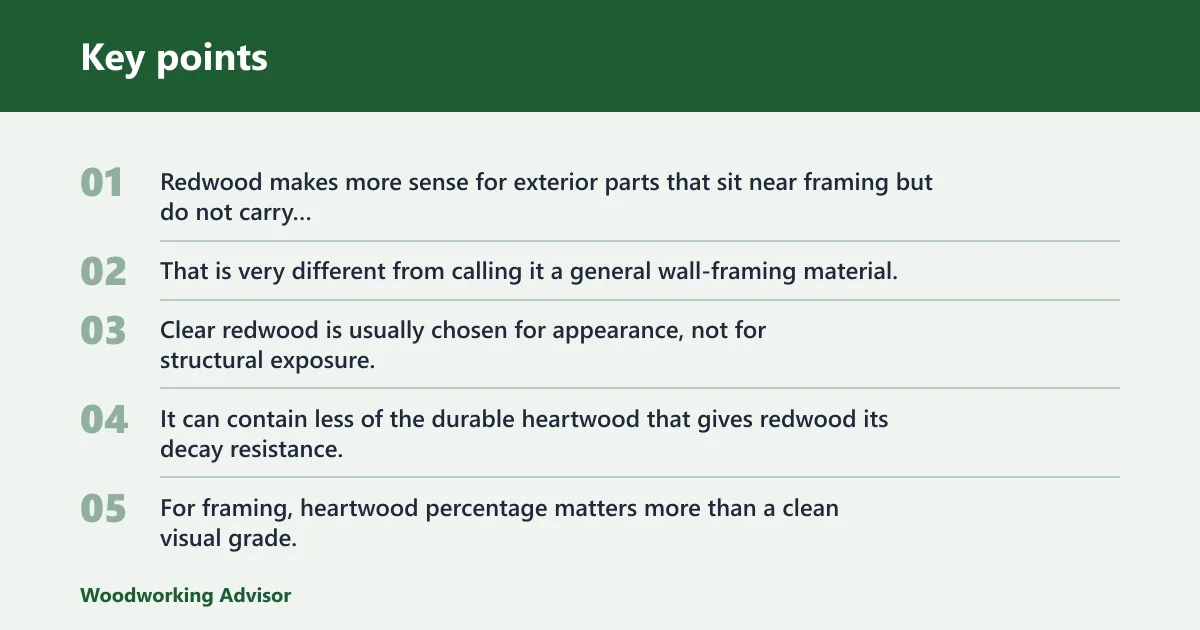
Redwood makes more sense for exterior parts that sit near framing but do not carry primary loads, such as non-structural fascia support, exposed blocking, or sleeper-like parts that stay dry enough to avoid sustained wetting. Its heartwood durability helps there. That is very different from calling it a general wall-framing material.
Why clear redwood is not the same as structural redwood
Clear redwood is usually chosen for appearance, not for structural exposure. It can contain less of the durable heartwood that gives redwood its decay resistance, so it should not be treated as equivalent to Construction Heart redwood. For framing, heartwood percentage matters more than a clean visual grade.
What Construction Heart grade changes
Construction Heart redwood is the better redwood choice when exposure is the issue, because it contains more durable heartwood. It is often chosen for exposed work when decay resistance is a priority. Even then, it is still not automatically the right answer for studs or major beams.
How does redwood compare to Douglas fir on strength and rot resistance?
Douglas fir wins on structural strength; redwood wins on natural decay resistance. That split is the whole decision. If the member must carry load, Douglas fir is usually the better framing choice. If the member is exposed to moisture but is not a primary structural element, redwood can be the better material.
Decay resistance is not structural strength
Redwood heartwood resists decay and insects on its own, but that does not make it the stronger framing lumber. A beam that spans a load needs stiffness and predictable grading first. A rot-resistant but softer member can still fail the job if it deflects too much or fasteners loosen.
Moisture risk rises when wood stays wet
Decay in both woods becomes much more likely once moisture content stays above 20%. That is why framing details matter: trapped water, unsealed end grain, and direct contact with damp materials create long-term risk. Dry design is still the best defense.
Does redwood need pressure treatment for framing?
Redwood heartwood often does not need pressure treatment in exposed but non-structural applications, because it already resists decay and insects. For actual framing, though, treatment requirements depend on grade, exposure, and code. If the piece will stay damp or contact soil, the answer changes fast.
Where pressure treatment still matters for Douglas fir
Untreated Douglas fir should be treated or otherwise protected outdoors and in damp service, especially at end grain and contact points. That includes cut ends, ledger-like connections, and places where water can sit. Pressure treatment extends service life where the wood cannot stay reliably dry.
Cut ends, contact points, and sealing
Even decay-resistant wood needs attention at cuts and joints. Sealing end grain slows moisture uptake, and it is especially important where water can wick into framing assemblies. If the wood stays wet, the durable heartwood advantage narrows quickly.
What grade of redwood should I buy for structural use?
If you are using redwood for any structural or exposed purpose, buy a structural grade with a high heartwood content, not an appearance-first clear grade. Construction Heart redwood is the better durability choice. Clear redwood is better for looks, but looks are not the same as load capacity or decay resistance.
Lumber grading affects allowable use
Structural grade and appearance grade generally are not interchangeable in framing. A board can look clean and still be the wrong grade for studs, beams, or rim boards. For redwood, the percentage of heartwood matters because it influences durability more directly than visual clarity does.
Common first-timer mistake
A common first-timer mistake is buying clear redwood because it looks straight and expensive, then assuming it is automatically better for framing. It may actually be the poorer choice if the goal is strength, grade reliability, or outdoor durability. The right grade matters more than the premium label.
Choose Douglas fir if… / Choose redwood if…
Choose Douglas fir when the member carries load, must pass structural inspection, or needs better value per board foot. Choose redwood when the piece will live in wet or splash-prone conditions, but only if it is non-structural or the code and grade clearly allow it. That is the real split.
Choose Douglas fir if…
- You need studs, beams, or rim boards.
- You want stronger framing per dollar.
- You need better fastener holding and lower movement risk.
- You are building a load-bearing assembly where grading matters more than appearance.
Choose redwood if…
- The part is exposed to moisture but is not a primary load-bearing member.
- You want naturally decay-resistant heartwood for exterior framing-adjacent work.
- You are buying Construction Heart redwood rather than clear redwood.
- You can keep the wood out of constant wet contact and allow it to dry.
Framing decision matrix

| Framing application | Douglas Fir | Redwood | Recommendation |
|---|---|---|---|
| Studs | Yes | No, except narrow code-approved exceptions | Douglas Fir |
| Beams | Yes | No for primary load-bearing beams | Douglas Fir |
| Rim boards | Yes | Usually no | Douglas Fir |
| Non-structural exterior framing-adjacent parts | Yes, if treated or protected | Yes, especially Construction Heart grade | Both, depending on exposure |
Studs
Douglas fir is the clear yes. Studs need predictable strength, stiffness, and grade consistency across the wall. Redwood is not the default structural choice here, even if it resists decay better.
Beams
Douglas fir is again the clear yes. Beam sizing depends on structural performance, and Douglas fir is commonly used for that purpose. Redwood is not the better choice for major load-bearing spans.
Rim boards
Douglas fir is the better fit for rim boards because they are part of the load path and need dependable fastening. Redwood’s durability does not outweigh its lower structural suitability in this location.
Non-structural exterior framing-adjacent parts
This is where redwood can make sense, especially Construction Heart grade. If the component is exposed to moisture but does not carry the main load, redwood’s decay resistance can be useful. Douglas fir can still work if it is treated and detailed to stay dry.
What lumber is best for beams and studs in damp areas?
Douglas fir is often a practical structural choice for beams and studs, including in damp areas, if you treat and detail it for moisture while keeping the load-bearing performance you need. Redwood is better when the piece is exposed to moisture but is not the main structure. If the part carries load, start with Douglas fir.
Practical buyer guidance
- Identify whether the part is load-bearing or only exposed.
- Check the structural grade before looking at color or species.
- Use Douglas fir for common framing uses like studs, beams, and rim boards unless a specific redwood grade is allowed.
- Use redwood only when heartwood durability is the main requirement and the member is not primary structure.
- Protect cut ends and contact points from persistent wetting.
Frequently asked questions
Is redwood or Douglas Fir better for framing?
Douglas fir is better for framing because framing depends on load capacity, stiffness, and grading consistency. Redwood is the better choice only when the piece is mainly exposed to moisture and not carrying the main structural load. For studs, beams, and rim boards, Douglas fir is usually the right answer.
Sponsored / affiliate links. As an Amazon Associate I earn from qualifying purchases. I may earn additional commission from eligible campaigns.