Rubio Monocoat vs Danish Oil: What Is the Difference?
Rubio Monocoat is a one-layer hardwax-oil system that bonds with wood fibers, while Danish oil is a penetrating wiping oil that usually needs more than one coat and leaves a softer finish that needs more upkeep. Choose the wrong finish and you may get weak stain resistance, slower repairs, or a surface that wears sooner than expected. This guide compares chemistry, workflow, and upkeep for furniture, tabletops, and floors.
Rubio Monocoat vs Danish oil: the core trade-off
| Factor | Rubio Monocoat | Danish Oil | Winner |
|---|---|---|---|
| Chemistry and film behavior | Reactive oil system; Oil Plus 2C is a two-part mix with an activator, and Rubio describes bonding to wood cellulose rather than building a thick film. | Penetrating oil blend based on purified Danish oil technology; it soaks into the wood and leaves a thin soft finish rather than a shell. | Rubio Monocoat |
| Coats and wipe-off window | One layer is the standard claim. The excess must be worked and wiped during the application window, with maintenance oil excess wiped within 15 minutes. | Usually needs multiple coats, with repeated soak-and-wipe passes until the wood stops taking oil. | Rubio Monocoat |
| Cure behavior and handling time | Oil Plus 2C is positioned for fast final handling after one application, with 0% VOC and no solvents claimed. | Drying and cure tend to be slower and more open-ended, so handling and refresh work often stretches over a longer period. | Rubio Monocoat |
| Repair method and maintenance cadence | Spot repair is usually the better path because the finish is low-build, but refreshed areas still need careful blending. Universal Maintenance Oil is the upkeep product, and it comes in 100ml and 500ml. | Repairs often mean re-oiling a wider area so the sheen and color blend. That makes routine upkeep simpler to understand, but more frequent. | Tie |
| Best use cases | Floors, tabletops, and furniture where you want a low-build, one-layer system with abrasion, water, and heat resistance claims. | Furniture, panels, and other interiors where you want a simple penetrating oil and are fine with periodic refresh work. | Depends on project |
Chemistry and film behavior
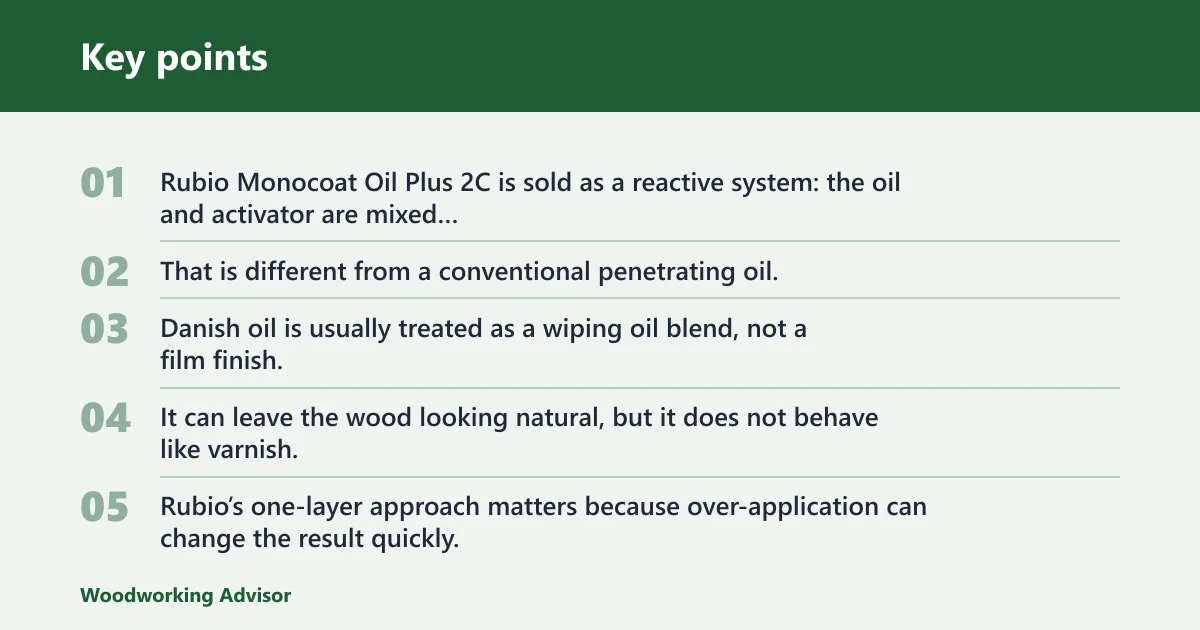
Rubio Monocoat Oil Plus 2C is sold as a reactive system: the oil and activator are mixed at 3:1, then the finish bonds with wood fibers. That is different from a conventional penetrating oil, which mainly soaks in and leaves more of its effect near the surface.
Danish oil is usually treated as a wiping oil blend, not a film finish. It can leave the wood looking natural, but it does not behave like varnish, and it should not be expected to form a hard shell.
Coats and wipe-off window
Rubio’s one-layer approach matters because over-application can change the result quickly. If excess finish remains on the surface, it can turn sticky or streaky, so the wipe-off step is not optional.
Danish oil usually gives you more room to build the look with repeat coats, but that also means more labor. You keep feeding the wood until it stops absorbing, then remove the extra so the surface does not feel gummy.
Cure behavior and handling time
Oil Plus 2C is designed for faster practical use after a single application, and Rubio also claims 0% VOC with no solvents and abrasion, water, and heat resistance. Those claims matter most when you need a finish that can move from application to use with less waiting.
Danish oil tends to ask for more patience. Because it penetrates rather than setting up as a tighter reactive layer, the schedule is usually less predictable and the surface can stay vulnerable longer during the early cure stage.
Repair method and maintenance cadence
Rubio Monocoat is often easier to touch up in a small area because the finish is relatively thin and the maintenance approach is meant for local refresh work. The tradeoff is that you have to follow the product’s maintenance routine, including the right prep and wipe-back timing.
Danish oil is simpler to understand at the can level, but spot fixes often spread farther than you want. If one section dulls or dries out, the repair can turn into a larger blend-in job so the sheen does not flash against the surrounding wood.
Say your 7-foot dining table gets a water ring near one end from a vase. A reactive, low-build finish is easier to spot-treat on that one zone, while a penetrating oil refresh may pull you into recoating a much larger section so the color does not shift.
Suppose you are finishing a 120-square-foot room of oak flooring and want fewer steps at the end of the day. The one-layer system cuts labor and waiting, while a traditional penetrating oil can mean more passes, more wipe-back, and more time before the room feels ready for normal use.
How does the chemistry differ?
Rubio Monocoat uses reactive oil chemistry aimed at wood cellulose, so the finish is designed to attach to the wood fibers rather than sit on top as a thick coat. Danish oil is a penetrating oil finish, so its main job is to soak into the wood and leave a softer surface effect.
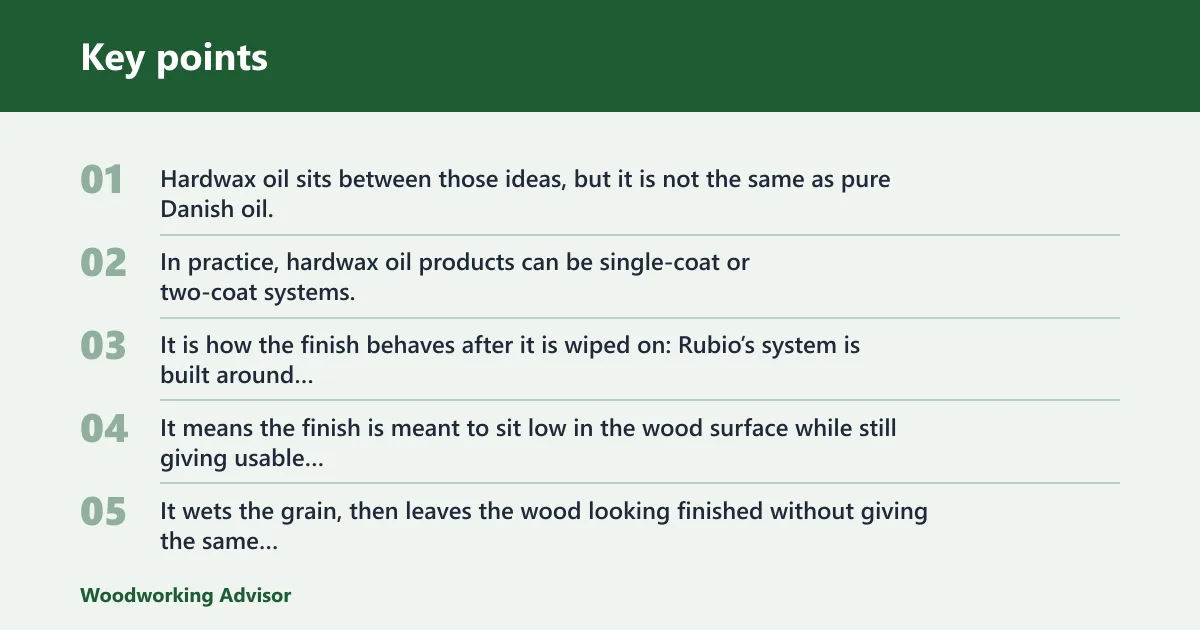
Hardwax oil sits between those ideas, but it is not the same as pure Danish oil. In practice, hardwax oil products can be single-coat or two-coat systems, and they often leave wax deposition closer to the surface than a simple penetrating oil does.
Reactive oil and wood cellulose
The main point is not the label. It is how the finish behaves after it is wiped on: Rubio’s system is built around bonding to wood cellulose, which is why a single-layer workflow is possible when the surface is prepared correctly.
That does not mean it becomes a thick film. It means the finish is meant to sit low in the wood surface while still giving usable abrasion, water, and heat resistance claims for indoor work.
Purified Danish oil and penetration
Danish oil works by penetration first. It wets the grain, then leaves the wood looking finished without giving the same low-build reactive effect you get from Rubio’s two-part system.
That difference matters on repair. A penetrating oil often asks for a broader refresh because the surrounding wood can absorb the new oil differently from the worn area.
Where hardwax oil fits in the comparison
Hardwax oil is the comparison class that most often confuses buyers because some products are marketed as one-coat systems and others are not. The practical clue is the wipe-off window: if the excess must be removed promptly and the surface is left with a thin waxy layer near the top, you are dealing with a finish that behaves differently from conventional Danish oil.
Rubio Monocoat is often grouped with hardwax oil because of its low-build, one-layer positioning, but its reactive chemistry is the key distinction. Danish oil stays in the penetrating-oil lane.
How do you apply each finish?
Both finishes rely on good prep. Sand cleanly, remove dust well, and do not leave abrasive residue behind; Rubio also specifies Cleaner after sanding and dust extraction to prepare the surface for Oil Plus 2C.
Rubio Monocoat application
With Oil Plus 2C, you mix the two parts at 3:1, spread the finish, and work it into the wood. Then you wipe off the excess within the working window so the surface does not stay wet or gummy.
The Cleaner step matters because it helps open the surface and get the wood ready for the reactive coat. Skipping that preparation can make the finish less even, especially on dense species or on parts with sanding dust still in the grain.
Danish oil application
Danish oil is simpler in motion: wet the surface, let it soak, then wipe back the excess. If the wood drinks the first pass quickly, you can repeat the process, but the point is still to avoid leaving a heavy surface layer.
The failure mode is easy to spot. If you leave too much product behind, the surface stays tacky longer, dust sticks to it, and the finish can look blotchy where the oil pooled.
Common mistakes to avoid
A common first-timer mistake is treating either finish like a varnish. Neither one should be left to build a thick topcoat. That approach usually causes sticky residue, uneven sheen, and a repair job that takes more time than the original finish.
Another mistake is wiping too late. On reactive oil systems, the timing is part of the chemistry; on Danish oil, the timing controls how much remains in the wood versus on the wood.
Which is more durable in real use?
Rubio Monocoat has the edge when you care about abrasion, water, and heat resistance on a low-build interior finish. Danish oil can look good, but it usually needs more frequent refresh work if the surface sees heavy contact, spills, or sliding objects.
That does not make Danish oil a weak finish. It means the finish type is better suited to projects where a softer, easier-to-refresh surface is acceptable.
Wear on tabletops and floors
On tabletops and floors, the difference is how quickly the finish shows traffic. A reactive one-layer system is less likely to ask for a broad refinish after normal wear, while a penetrating oil may need periodic upkeep to keep the surface looking even.
Rubio also publishes a coverage range of 30-50 m²/l, which is useful for planning material use on larger jobs. The coverage number does not make the finish tougher by itself, but it helps you budget the actual amount of product needed for a floor or built-in.
Heat, water, and spot resistance
Rubio lists resistance to abrasion, water, and heat, and those are the right kinds of claims to pay attention to on dining tables and kitchen-adjacent furniture. They speak to surface behavior under everyday use, not just how the wood looks on day one.
Danish oil can still look natural and attractive, but it is less likely to be the better pick if you expect frequent hot mugs, damp glasses, or repeated sliding contact. If you want a surface that can take more abuse before showing it, Rubio is the stronger fit.
Which finish is easier to repair?
Rubio Monocoat is usually easier to repair in a small area because the finish is low-build and the maintenance system is designed for localized work. Danish oil is easy to understand, but repairs often spread into larger recoat zones so the fresh oil does not flash against the old.
For upkeep, Rubio’s Universal Maintenance Oil is the relevant product. It is sold in 100ml and 500ml sizes, comes in white, colorless, and black, carries a 0 g/l VOC claim, dries in about 6-8 hours, and the excess should be wiped within 15 minutes.
Spot repair on Rubio Monocoat
Spot repair works best when you clean the damaged area, reapply the maintenance product carefully, and respect the wipe-off window. Because the finish is thin, you are not trying to rebuild a shell; you are restoring the treated wood surface.
That workflow is why Rubio often fits households that want to fix a small scratch or dull patch without redoing an entire tabletop. The job is still fussy, though. Timing matters.
Refresh coats on Danish oil
With Danish oil, maintenance is usually more like a refresh coat than a local patch. That can be simple if you have a small panel, but on a large tabletop or a floor section, the work can become a broader blend-in operation.
The upside is conceptually simple upkeep. The downside is that the finish may ask for that upkeep more often, especially in places that see spills, hand oils, or regular abrasion.
Choose Rubio Monocoat if… / Choose Danish Oil if…
Choose Rubio Monocoat if you want a one-layer system for furniture, tabletops, or floors and you care about lower build, faster handling, and a cleaner repair path. Choose Danish Oil if you want a simple penetrating finish, can accept more than one coat, and do not mind periodic refresh work.
Choose rubio monocoat if…
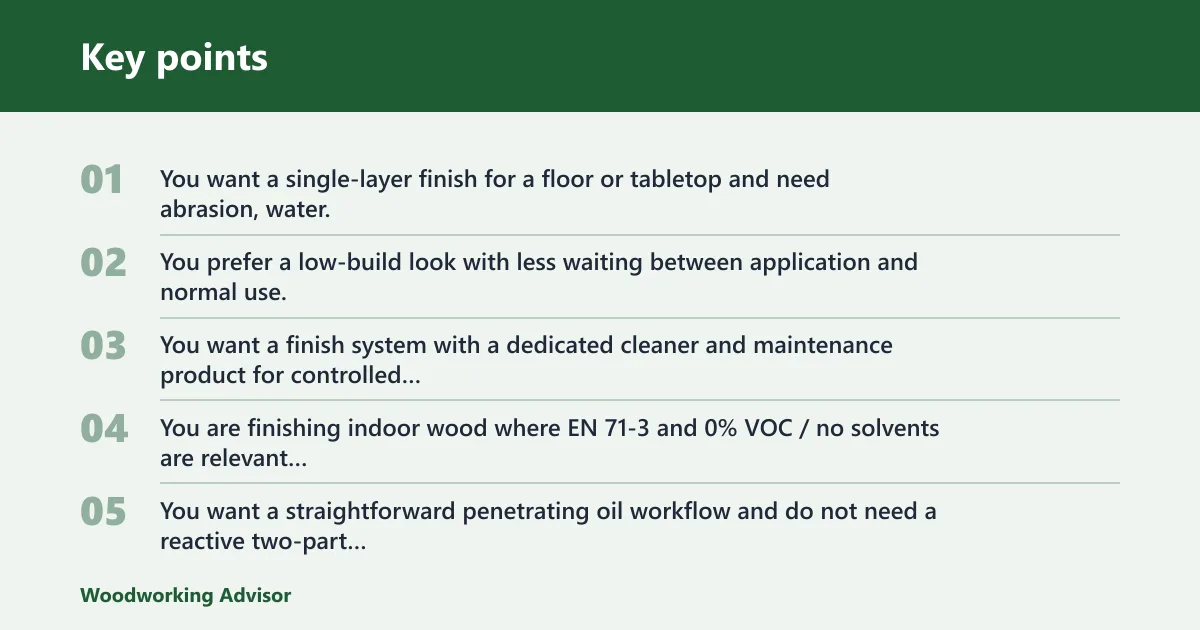
- You want a single-layer finish for a floor or tabletop and need abrasion, water, and heat resistance claims.
- You prefer a low-build look with less waiting between application and normal use.
- You want a finish system with a dedicated cleaner and maintenance product for controlled upkeep.
- You are finishing indoor wood where EN 71-3 and 0% VOC / no solvents are relevant purchase filters.
Choose Danish Oil if…
- You want a straightforward penetrating oil workflow and do not need a reactive two-part system.
- You are comfortable applying more than one coat and wiping back until the wood stops taking oil.
- You expect periodic refresh work and prefer that over a more technical one-layer system.
- You are finishing furniture or interior wood where a softer maintenance profile is acceptable.


Frequently asked questions
What is the difference between Rubio Monocoat and Danish oil?
Rubio Monocoat is a reactive one-layer system that bonds to the wood surface, while Danish oil is a penetrating oil finish that usually takes multiple coats. The practical difference is workflow and upkeep: Rubio aims for a low-build finish with tighter repair control, while Danish oil is simpler but more maintenance-heavy.
Is Rubio Monocoat more durable than Danish oil?
For abrasion, water, and heat resistance on furniture and floors, Rubio Monocoat is often the stronger pick. Danish oil can look very natural, but it usually needs more frequent refresh work and does not offer the same low-build resistance profile for high-touch surfaces.
Does Rubio Monocoat need one coat while Danish oil needs more?
Yes, that is the core workflow difference. Oil Plus 2C is sold as a one-layer coating, while Danish oil usually needs repeated coats because the wood keeps absorbing product until the surface is saturated enough for the finish to look even.
Which finish is easier to repair, Rubio Monocoat or Danish oil?
Rubio Monocoat is usually easier for small spot repairs because the finish is thin and the maintenance product is designed for localized work. Danish oil repairs are conceptually simple, but they often spread into larger areas so the fresh oil blends with the older finish.
Can you use Rubio Monocoat on bare wood like Danish oil?
Yes. Rubio Monocoat is meant for bare wood, but it expects the surface to be properly sanded, dust-free, and cleaned first. Danish oil also goes on bare wood, though it relies more on penetration than on reactive bonding to the wood surface.
Is Rubio Monocoat a hardwax oil or a Danish oil?
Rubio Monocoat is better understood as a reactive hardwax-oil system, not as a Danish oil. The distinction matters because hardwax-oil products can be engineered for one-layer use and surface wax deposition, while Danish oil is a conventional penetrating oil finish.
How long does Rubio Monocoat take to cure compared with Danish oil?
Rubio Monocoat is designed for faster practical handling after a single application, while Danish oil usually takes longer to dry and cure because it relies on penetration and repeated wipe-back. Exact timing depends on wood species, temperature, and ventilation, but Rubio is typically the quicker workflow.
Sponsored / affiliate links. As an Amazon Associate I earn from qualifying purchases. I may earn additional commission from eligible campaigns.