Temperature to Apply Minwax Stain
Minwax stain is generally more reliable when the wood, the can, and the drying space stay at or above 50°F for the full dry window; 60°F to 65°F is often a better target. Cold wood slows absorption and drying, so the finish can stay tacky, blotchy, or uneven. This guide gives a simple 50°F, 60°F, and 65°F decision rule for cool or changing weather.
What temperature works for Minwax stain?


Use about 70°F as the working target, with 50°F to 90°F as the broad published range for most stains. For Minwax, the practical rule is stricter than air temperature alone: the wood surface, the product, and the drying space all need to stay warm enough for the full dry window. The surface temperature matters as much as the room air.
Minwax says wood prep products and the wood surface should be above 65°F before starting, and the wood and prep products should sit at room temperature overnight. That is the key split many people miss. A garage can feel warm while the board stays cold, which can slow drying and leave the stain tacky longer. (Minwax)
What you’ll need
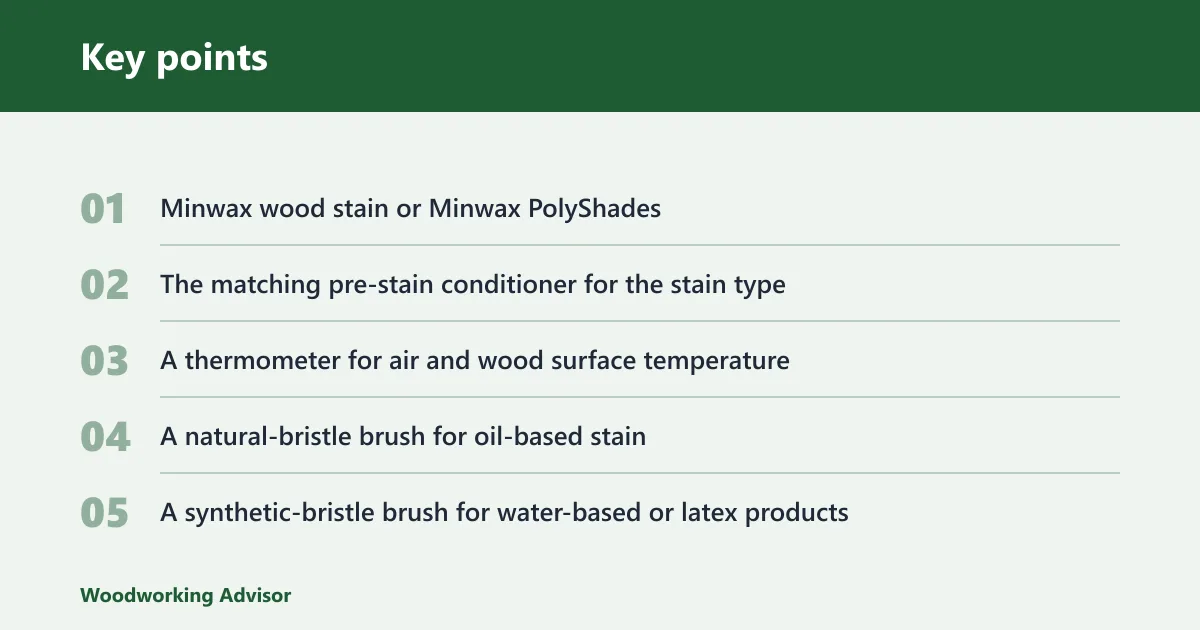
- Minwax wood stain or Minwax PolyShades
- The matching pre-stain conditioner for the stain type
- A thermometer for air and wood surface temperature
- A natural-bristle brush for oil-based stain
- A synthetic-bristle brush for water-based or latex products
- Clean rags or lint-free wipes
How to decide on 50°F, 60°F, or 65°F
- Measure the air temperature where the project will dry.
- Measure the wood surface temperature, not just the room.
- Check that the stain and conditioner have sat at room temperature overnight.
- Use 65°F as the floor for Minwax prep products and the wood surface.
- At 50°F, proceed only if the wood, product, and dry space all stay around that level for the whole drying period.
- At 60°F, work only if the board stays warm and the drying window stays steady.
- At 65°F, stain is usually workable, but enough dry time and low moisture risk still matter.
📊 Minwax says wood prep products and the wood surface should be above 65°F before starting. Source: Wood Preparation Do’s & Don’ts.
Can you apply Minwax at 50°F?
Only with caution. At 50°F, Minwax stain and its drying space are at the low edge of the published stain range, and Minwax prep products call for wood and surface temperatures above 65°F before starting. If the board is colder than the room, wait. Cold wood slows evaporation and can leave the product tacky longer.
Hold the can at room temperature overnight and check the board with a surface thermometer. If the surface is below 65°F, do not treat the air temperature as enough. Humidity or rain risk makes the call worse, because drying slows further and exterior work can need a much longer wait.
Cold-weather example
Suppose a 1×12 pine board reads 52°F on the surface in a 50°F garage, while the stain can has sat indoors overnight. The garage air looks acceptable, but the board is still too cold for Minwax prep products. Let both sit at room temperature overnight, then stain during a dry window with lower moisture risk.
Can you apply Minwax at 60°F?
Yes, if the wood surface is warm enough and the product has already reached room temperature. Sixty degrees is usually more workable than 50°F, but it is still below the 65°F surface target Minwax gives for prep products. Drying will be slower than it is around 70°F, so plan on a longer cure.
If you need conditioner, use the matching product first: Minwax Pre-Stain Wood Conditioner for oil-based stains, or Minwax Water-Based Pre-Stain Wood Conditioner for water-based stains. The oil-based conditioner dries in 15 minutes and helps prevent streaking and blotching. The water-based conditioner dries in 5 minutes and helps control grain raising. (Minwax)
How long should wood and stain sit before applying in cold weather?
Let both sit at room temperature overnight. That gives the board and the can time to reach the same starting point. If the board has been in a cold truck, shed, or garage, give it extra time to warm through instead of trusting the room air alone.
Can you apply Minwax at 65°F?
Yes, 65°F is a workable floor for Minwax prep products and a practical threshold for starting stain, as long as the wood surface, stain, and drying space all stay steady. Treat it as the beginning of safe working conditions, not a guarantee of fast cure. Damp air can still stretch dry time.
Watch the surface during the first hours after application. If the room is cool at night, the temperature drop can slow evaporation and leave the finish tacky longer. That matters even more with thicker coats and with PolyShades, which needs at least 6 hours and may need longer if humidity is high.
Minwax stain decision table
| Air temp | Wood temp | Product temp | Humidity/rain risk | Recommended action |
|---|---|---|---|---|
| 50°F | At least 65°F for prep products; otherwise wait | Room temperature overnight | High risk | Delay if the board is cool, the air will drop, or rain is near |
| 60°F | Warm to the touch and at least 65°F for prep products | Room temperature overnight | Moderate risk | Proceed only with a stable drying space and extra cure time |
| 65°F | At least 65°F | Room temperature overnight | Low to moderate risk | Workable for stain and conditioner; monitor for slower dry time |
| 70°F | At least 65°F | Room temperature | Low risk | Best working zone for most stains; apply thin, even coats |
| 90°F | Warm enough | Room temperature | Low or controlled risk | Possible, but work fast because the surface can dry too quickly and mark the lap lines |
Room-temperature prep for wood and products
Set the can and the wood indoors or in another stable space overnight before staining. That narrows the gap between the room reading and the actual board temperature. For a large panel, take the surface reading in the center and near the edge, because one cold corner can still affect the finish.
What is the best way to apply Minwax stain?
Apply it in thin, even coats with the grain after the wood and product have reached room temperature. Use a natural-bristle brush for oil-based stains and a synthetic-bristle brush for latex or water-based products. The best result comes from matching the brush, the stain type, and the dry-time window.
If you are using a conditioner, follow the correct type and wait time first: 15 minutes for Minwax Pre-Stain Wood Conditioner, or 5 minutes for Minwax Water-Based Pre-Stain Wood Conditioner. Then stain promptly. Letting the conditioner sit too long can reduce the benefit.
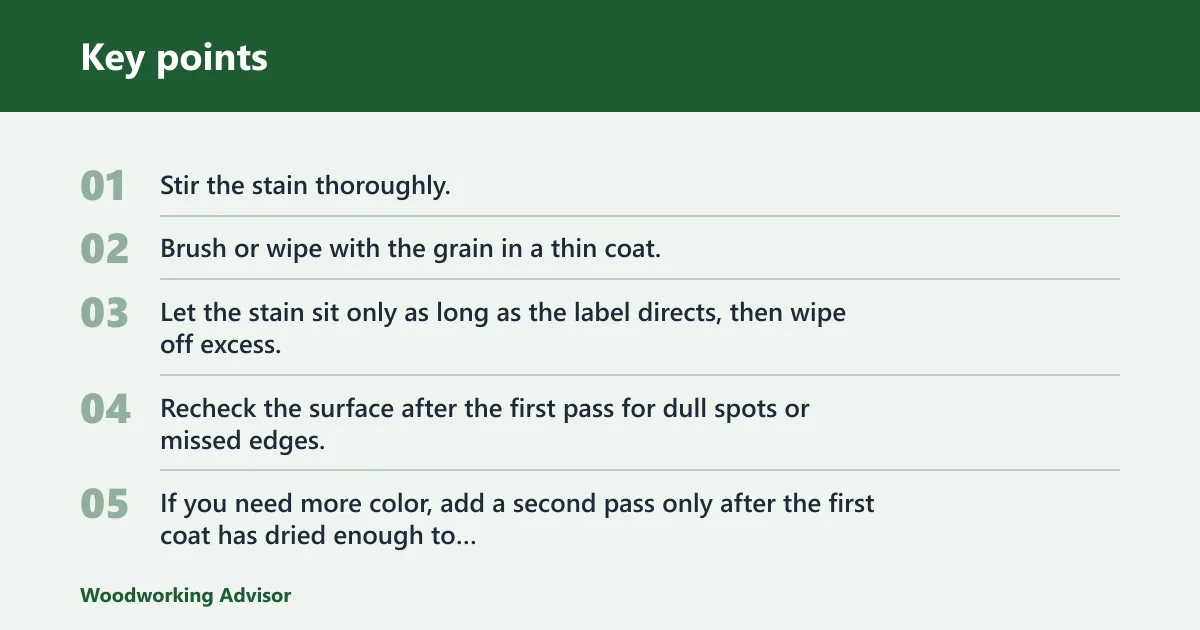
- Stir the stain thoroughly.
- Brush or wipe with the grain in a thin coat.
- Let the stain sit only as long as the label directs, then wipe off excess.
- Recheck the surface after the first pass for dull spots or missed edges.
- If you need more color, add a second pass only after the first coat has dried enough to handle.
Common mistakes in cold weather
The most common failure is treating the air temperature as the only number that matters. A warm room does not mean a warm board. Cold wood can slow penetration, stretch dry time, and make the finish look uneven even when the thermostat says the room is ready.
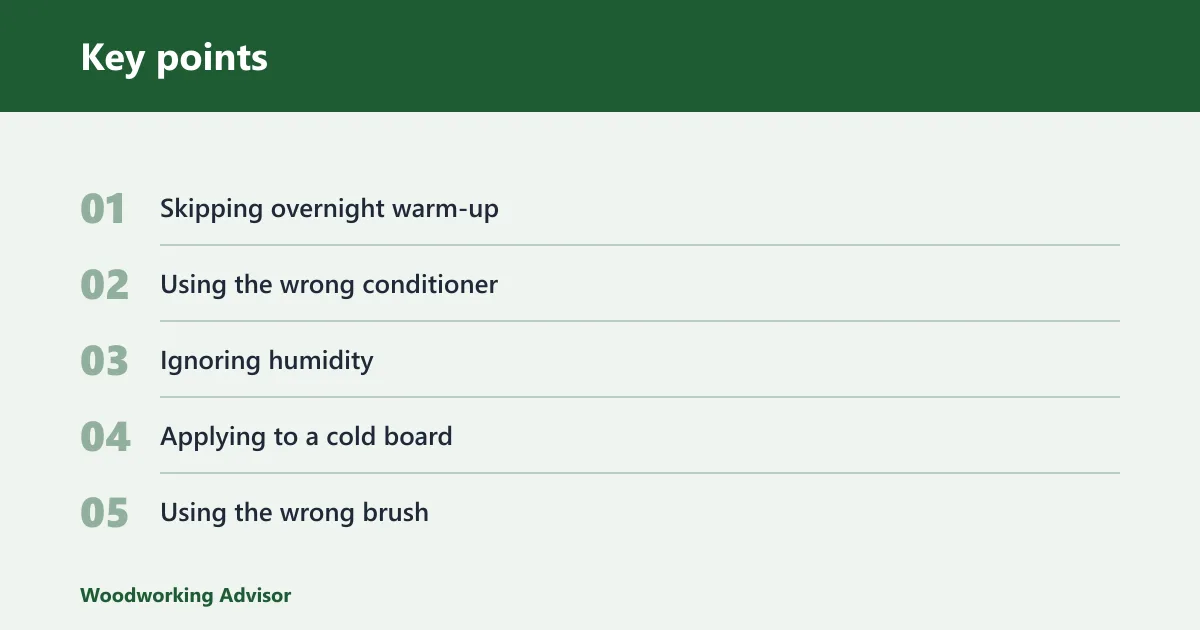
- Skipping overnight warm-up: wood and stain should sit at room temperature before use.
- Using the wrong conditioner: match oil-based stain with the oil-based conditioner, and water-based stain with the water-based conditioner.
- Ignoring humidity: damp air slows drying and can lead to haze, lap marks, and longer cure time.
- Applying to a cold board: the surface can feel ready while the core still lags behind.
- Using the wrong brush: natural bristle for oil-based, synthetic for water-based or latex products.
Say your garage holds 68°F after sunset but the oak panel reads 59°F at the center. That board is still too cool for Minwax prep products. Warm the board first, then stain it. Otherwise the first coat can sit on the surface and dry unevenly.
Picture a shelf panel coated with PolyShades on a damp evening. The air is 66°F at application, then drops overnight while humidity climbs. The finish may still need more than 6 hours, and the dry time can stretch well beyond that in humid conditions.
Frequently asked questions
What temperature should stain be applied?
For most stains, about 70°F is the best working target, with 50°F to 90°F as a broad safety range. For Minwax, check the wood surface too. If the board and product are not at room temperature, the air reading alone is not enough to start.
What temperature to apply Minwax stain?
Use 70°F as the practical target and 65°F as the minimum floor for Minwax prep products and the wood surface. If the room is cooler, let both the board and the can sit at room temperature overnight before you stain.
What temperature can you apply Minwax stain?
You can apply it in the broader 50°F to 90°F stain range, but Minwax works best when the wood, stain, and drying space are all near room temperature. Below 65°F, the board and prep products become the limiting factor, not the room reading.
What is the minimum temperature to apply Minwax stain?
For the wood surface and Minwax prep products, 65°F is the practical minimum. If the wood is colder than that, wait for it to warm up first. For the stain itself, the broader stain range goes lower, but the wood surface still controls the result.
Can Minwax stain be applied below 65°F?
Only with caution, and only if the wood, product, and drying space all stay warm enough for the whole dry window. At lower temperatures, drying slows and the finish can stay tacky longer. Humidity makes that problem worse, so a dry, stable room matters.
Does humidity change the temperature needed for staining?
Yes. Humidity does not change the number on the thermometer, but it changes how well the finish dries. High humidity slows curing, can extend dry time, and can contribute to haze and lap marks. In humid weather, give PolyShades more than 6 hours and exterior stain closer to 24 hours or longer.
Sponsored / affiliate links. As an Amazon Associate I earn from qualifying purchases. I may earn additional commission from eligible campaigns.