Rubio Monocoat vs Polyurethane: Which Lasts Longer?
Polyurethane usually gives stronger protection against abrasion, water, and heat. Rubio Monocoat is better for spot repair and day-to-day upkeep, but for tabletops and cabinets that take heavy abuse, polyurethane is the safer default. Pick the wrong finish and you can end up with premature wear, stain rings, chipped edges, or a repair that forces sanding a much larger area. This guide compares both finishes by failure mode, then matches each one to furniture, tabletops, and cabinets.
This guide is part of our Which Wood Finish to Use: Polyurethane, Oil, Wax or Varnish and How to Apply It series.
| Factor | Rubio Monocoat | Polyurethane | Winner |
|---|---|---|---|
| Scratch resistance | Good for normal furniture use, but the thin finish offers less sacrificial buildup against abrasion. | Usually better for repeated rubbing because it builds a protective film over the wood. | Polyurethane |
| Water resistance | Resists routine spills, but standing water and neglected rings are less forgiving than with a built film. | Usually stronger against spills and water rings because the coating sits above the wood. | Polyurethane |
| Repairability | Better for spot repair and local touch-ups; damaged areas can often be addressed without sanding the whole surface. | Repairs often blend less cleanly, especially if the film has failed in patches or edges. | Rubio Monocoat |
| Coat count | Oil Plus 2C is sold as a one-layer interior wood protection system and described as a natural-looking, one-coat approach. | Typically applied in multiple coats to build thickness and protection. | Rubio Monocoat |
| Cure time | Usable sooner in many projects because the system is designed as a one-layer finish with an accelerator, but full cure still matters before hard service. | Often needs a longer return-to-service window, especially for full hardness after multiple coats. | Rubio Monocoat |
| Maintenance burden | Lower when the goal is cleaning and occasional touch-up rather than full refinishing. | Lower day-to-day upkeep on a sound film, but harder and more labor-heavy when the film is damaged. | Tie |
| Best-use scenario | Furniture, cabinets, and pieces where the natural look and future repair matter most. | Tabletops, desks, and high-abuse surfaces where abrasion and spill resistance matter most. | Depends on the job |
How failure modes differ for dining tables
The main trade-off is direct: polyurethane usually gives stronger surface protection, while Rubio Monocoat usually gives easier repair and a softer visual feel. A film finish adds more built thickness, which helps against abrasion, water, and hot-item abuse. A thin penetrating finish gives you simpler spot repair and a more natural wood look, but less barrier material if the surface takes a beating.
What each finish is doing
Rubio Monocoat Oil Plus 2C is sold as a one-layer interior wood protection system and described as a natural-looking, one-coat approach. It also uses an accelerator, and Rubio says the product is 0% VOC. Polyurethane is a film-forming finish that is usually applied in multiple coats for abrasion and spill resistance.
Durability depends on the failure mode
That distinction matters because “durable” does not mean one thing. Scratch resistance, dent resistance, water resistance, chemical resistance, and heat resistance fail in different ways, so a finish can look strong in one category and weak in another. For interior furniture, the real question is which failure would be hardest to live with: scratches, rings, peeling, or repair labor.
Say your dining table sees kids sliding plates and cups across a 6-foot surface every day. Polyurethane is the safer default because the film gives you more cushion against abrasion and spills. If the same table is a low-traffic accent piece, Rubio Monocoat can be a better fit because small touch-ups are less disruptive.
Rubio Monocoat vs Polyurethane table
This table separates the main durability factors instead of bundling them into one score. That makes the decision more useful for real rooms, because a cabinet door, a desk edge, and a dining top fail differently.
| Decision factor | Rubio Monocoat | Polyurethane | Winner |
|---|---|---|---|
| Scratch resistance | Moderate | Higher | Polyurethane |
| Water resistance | Moderate | Higher | Polyurethane |
| Repairability | Higher | Lower | Rubio Monocoat |
| Coat count | One layer | Multiple coats | Rubio Monocoat |
| Cure time | Shorter return-to-service path, but full cure still matters | Usually longer before hard use | Rubio Monocoat |
| Maintenance burden | Lower for spot repair; periodic cleaning and touch-ups are simpler | Lower when intact, higher after film damage | Rubio Monocoat |
| Best use | Furniture and cabinets | Tabletops and high-abuse surfaces | Depends |
Why scratch resistance goes to polyurethane
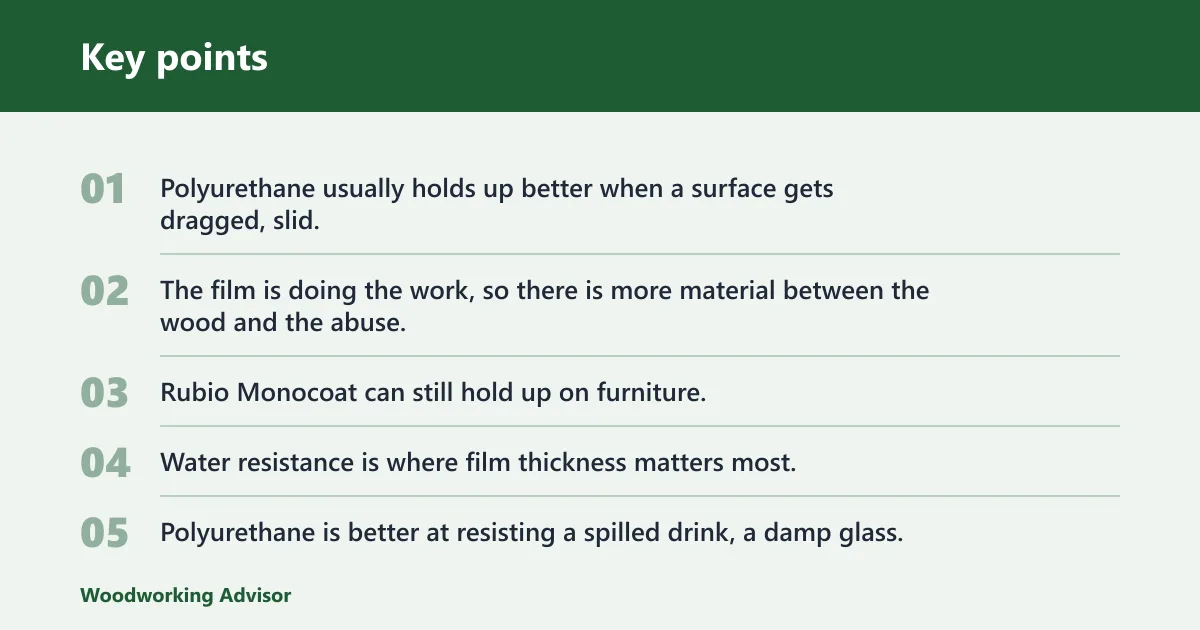
Polyurethane usually holds up better when a surface gets dragged, slid, or scrubbed repeatedly. The film is doing the work, so there is more material between the wood and the abuse. Rubio Monocoat can still hold up on furniture, but it does not rely on the same thick sacrificial layer.
Why water resistance goes to polyurethane
Water resistance is where film thickness matters most. Polyurethane is better at resisting a spilled drink, a damp glass, or a brief puddle because the coating sits as a barrier on top of the wood. Rubio Monocoat can handle normal interior use, but standing water is less forgiving.
A common first-timer mistake is to judge water resistance by dry-to-touch time. Dry does not mean fully cured. If a finish returns to service too early, a cold glass can still leave a ring or a soft spot even though the surface feels ready.
Why repairability goes to Rubio Monocoat
Spot repair is where Rubio Monocoat has a real advantage. A damaged patch is easier to treat locally because the system does not depend on a visible continuous film across the entire panel. Polyurethane often needs broader sanding and blending, especially if the film peels, chips, or dulls unevenly.
Why coat count, cure time, and use cases matter together
Oil Plus 2C is sold as a one-layer interior finish, which shortens the application stack. Polyurethane usually asks for multiple coats, more dry time between coats, and more total labor. That extra build is part of why polyurethane usually wins the durability contest, but it also raises the labor cost if the surface ever needs to be redone.
Does Rubio Monocoat resist wear like polyurethane?
Not usually at the same level for abrasive use. Rubio Monocoat can handle everyday interior wear, but polyurethane is generally better when the failure mode is repeated rubbing, sliding dishes, or edge wear on a high-traffic surface. The one-layer build favors repair simplicity more than maximum abrasion defense.
Abrasion on tabletops and shelves
On a dining top or writing desk, abrasion comes from plates, laptops, keys, and elbows. Polyurethane handles that abuse better because the film absorbs more of the contact. Rubio Monocoat can still be appropriate on lower-abuse furniture, but it is not the first pick for the hardest-working tops.
Edge wear and wear-through
Edges are usually where thin finishes fail first. Once wear-through starts on a corner or front edge, the difference between a film finish and a thin penetrating finish becomes obvious. Polyurethane gives you more margin before wood shows through, while Rubio Monocoat depends more on careful use and timely maintenance.
How do water and heat resistance compare?
Polyurethane is commonly better for spills, water rings, and brief heat exposure because it creates a thicker protective barrier. Rubio Monocoat can perform well in normal indoor settings, but it is less forgiving when water sits too long or when a hot dish is placed down without protection. Heat and moisture stress the coating, not just the wood.
Spills, rings, and standing water
For spilled coffee, condensation, or a wet vase, polyurethane is the safer choice. A sound film is more likely to resist penetration and leave the wood below untouched. Rubio Monocoat is more about resisting everyday contact than surviving neglect, so wipe-up habits matter more.
Hot dishes and brief heat exposure
Brief heat exposure is another place where film thickness matters. Neither finish should be treated like a trivet, but polyurethane is usually the stronger choice when a surface might see a warm serving dish or repeated hot mugs. If heat abuse is likely, use a protective pad regardless of the finish.
Where film thickness matters
Film thickness is not a marketing point here; it is the practical reason polyurethane usually lasts longer in abuse-heavy settings. More coats mean more material to absorb wear before the wood is exposed. Rubio Monocoat’s thinner build is part of why it repairs more easily, but that same trait limits its margin under harsh use.
Which is easier to repair and maintain?
Rubio Monocoat is generally easier to spot-repair, while polyurethane is often easier to live with when the film stays intact. Once a polyurethane surface starts peeling, cracking, or dulling in patches, repair gets messy fast. Rubio Monocoat usually asks for simpler touch-ups, but it can also need more frequent attention in hard-use zones.
Spot repair versus full recoating
Spot repair is the big difference. With Rubio Monocoat, local damage can often be handled without stripping the whole piece. With polyurethane, a damaged patch may telegraph through the repair unless you sand and recoat a larger area.
Cleaning and maintenance intervals
Maintenance interval matters because it changes the real cost of ownership. Rubio Monocoat usually means periodic cleaning and occasional touch-ups, with easier spot repair when a small area wears. Polyurethane can go longer without attention when intact, but once the film fails the labor bill grows.
- Check the surface for wear-through at edges, high-touch zones, and water-prone spots.
- Wipe with the mild cleaner recommended for the finish type.
- Decide whether the damage is local enough for a spot repair or large enough to justify broader recoating.
- Let the finish fully cure before returning the piece to hard service.
Failure modes: peeling, cracking, and dull spots
Polyurethane’s weak point is often film failure. Once the coating starts peeling or cracking, the repair usually becomes a refinishing job rather than a simple touch-up. Rubio Monocoat avoids that kind of film failure, but it can show wear, dulling, or localized abrasion sooner on aggressive-use surfaces.
Which finish fits tabletops, cabinets, and furniture?
Polyurethane is often the safer default for tabletops that see heavy use, while Rubio Monocoat is commonly a better fit for cabinets and furniture where easier future repair and a more natural look matter more. If the piece will face repeated spills, dragged objects, or hot dishes, prioritize surface protection. If the piece will be handled often but not abused, prioritize repairability.
Tabletops and desks
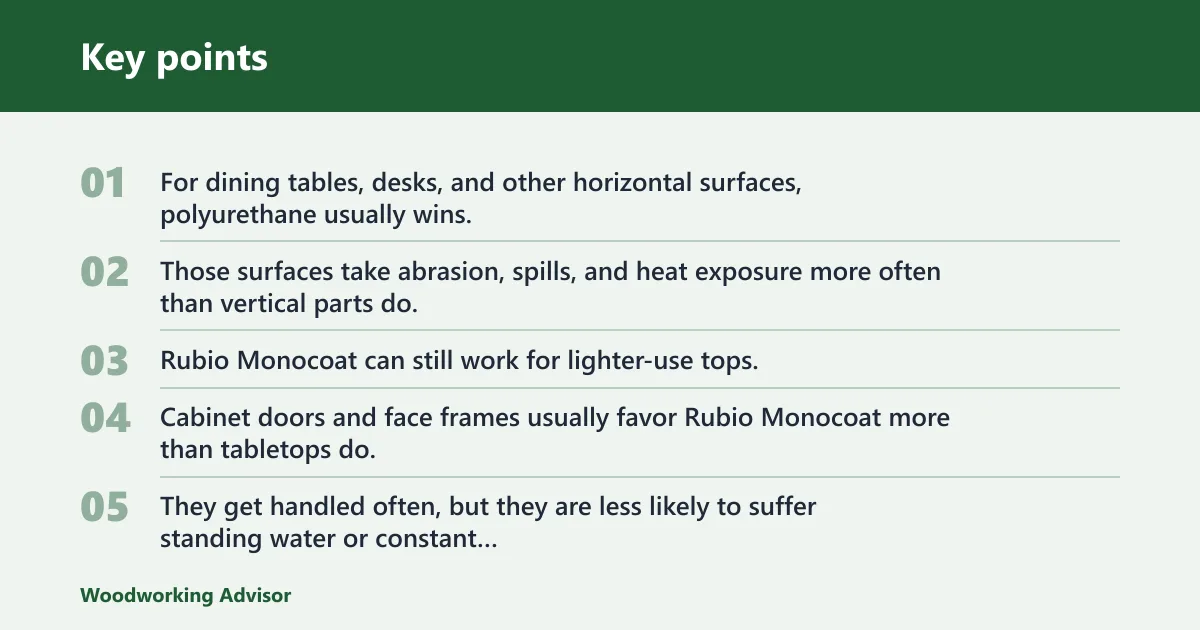
For dining tables, desks, and other horizontal surfaces, polyurethane usually wins. Those surfaces take abrasion, spills, and heat exposure more often than vertical parts do. Rubio Monocoat can still work for lighter-use tops, but it is the less conservative choice for a family table.
Cabinet doors and face frames
Cabinet doors and face frames usually favor Rubio Monocoat more than tabletops do. They get handled often, but they are less likely to suffer standing water or constant abrasion. A one-layer interior system also makes future spot repair easier if a door edge gets dinged.
Furniture that sees daily handling
For chairs, sideboards, benches, and case goods, the choice depends on abuse level. If the piece is likely to get bumped and cleaned often but not soaked, Rubio Monocoat is appealing. If the piece will take plate slides, cup rings, and hard daily wear, polyurethane is safer.
Suppose a 30-inch by 72-inch kitchen table is used for homework, meal prep, and craft glue. Polyurethane fits the abuse better because it resists abrasion and spill damage more effectively. If the same size top is a hallway console that mainly holds keys and mail, Rubio Monocoat is easier to live with and easier to refresh later.
Choose Rubio Monocoat if… / Choose Polyurethane if…
Choose Rubio Monocoat if the piece is interior furniture, cabinets, or a lower-abuse tabletop where easier spot repair matters more than maximum film protection. It is also the better pick if you want a more natural wood look, fewer coats, and a simpler maintenance path. Choose Polyurethane if the surface needs the strongest practical defense against abrasion, spills, and brief heat.
Choose rubio monocoat if…
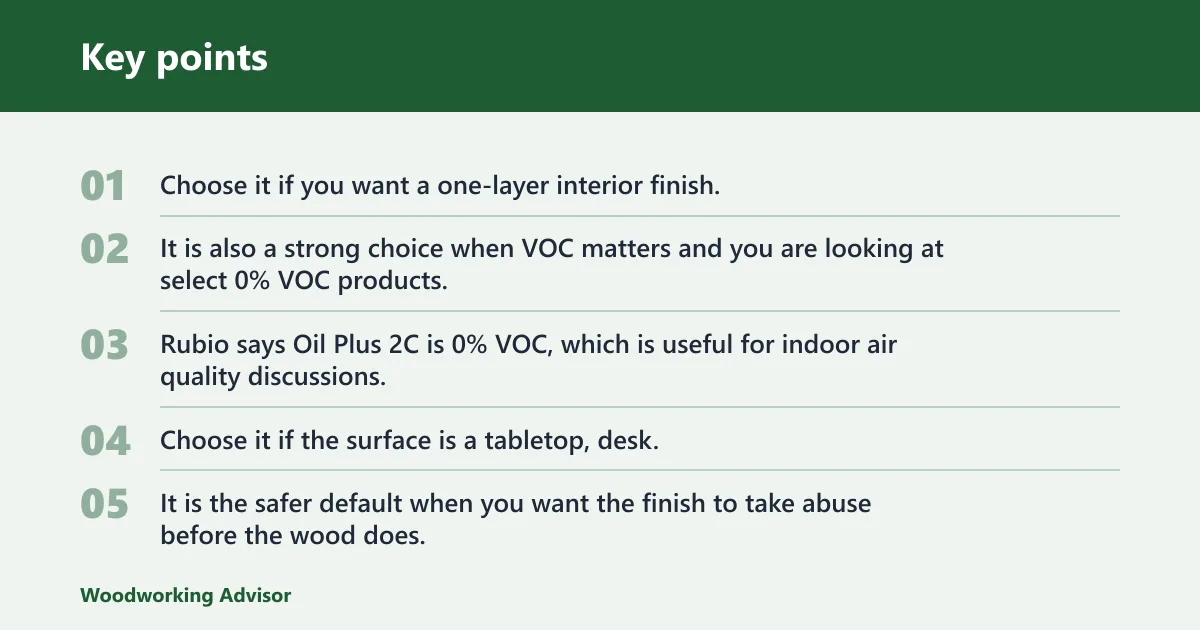
Choose it if you want a one-layer interior finish, you care about local repair rather than full refinishing, or you are finishing cabinets and furniture with moderate handling. It is also a strong choice when VOC matters and you are looking at select 0% VOC products. Rubio says Oil Plus 2C is 0% VOC, which is useful for indoor air quality discussions, though that claim is separate from durability.
Choose Polyurethane if…
Choose it if the surface is a tabletop, desk, or other high-wear area where abrasion and water resistance matter most. It is the safer default when you want the finish to take abuse before the wood does. If you want the piece to stay protected with fewer worries about rings, sliding objects, and repeat cleaning, polyurethane is usually the better fit.


Frequently asked questions
Is Rubio Monocoat more durable than polyurethane?
Usually not for heavy wear. Polyurethane is commonly reported as more durable against abrasion, water, and brief heat because it builds a protective film. Rubio Monocoat is more durable in the sense of easier repair and simpler upkeep, but that is a different kind of durability than surface resistance.
Does Rubio Monocoat hold up to scratches and water like polyurethane?
It holds up well for normal interior use, but usually not as well as polyurethane in scratch and water resistance. Polyurethane’s built film gives more protection against dragged objects, spills, and standing moisture. Rubio Monocoat is a better fit when local repair matters more than maximum barrier protection.
Which finish is better for tabletops and cabinets, Rubio or polyurethane?
Polyurethane is usually better for tabletops because those surfaces take the hardest abuse. Rubio Monocoat is often a better fit for cabinets because doors and face frames need more touch-friendly repair and less heavy spill resistance. If a cabinet top also sees daily use, the choice shifts back toward polyurethane.
How many coats does Rubio Monocoat need compared with polyurethane?
Rubio Monocoat Oil Plus 2C is sold as a one-layer interior wood protection system. Polyurethane is typically applied in multiple coats to build a protective film. That difference affects labor, cure timing, and how much material is available to take wear before the wood is exposed.
Does Rubio Monocoat peel or crack like film finishes?
No, not in the same way. Because it is not a built film finish, it does not usually fail by peeling or cracking across the surface. The trade-off is that it also does not give you the same thick barrier against abrasion or water as polyurethane.
How long does Rubio Monocoat take to cure before normal use?
Dry-to-touch and full cure are not the same thing. Rubio says DuroGrit dries in about three hours and reaches full curing in roughly three days, but that is an exterior product, not an interior one. For interior furniture, the safe rule is to follow the product’s cure guidance before returning the piece to hard use.
What maintenance does Rubio Monocoat need versus polyurethane?
Rubio Monocoat usually needs periodic cleaning and occasional touch-ups, with easier spot repair when a small area wears. Polyurethane needs less routine attention while the film is sound, but repairs are more involved once the finish chips, peels, or dulls unevenly. The maintenance burden shifts from routine care to repair labor.
Sponsored / affiliate links. As an Amazon Associate I earn from qualifying purchases. I may earn additional commission from eligible campaigns.