Where Should the Weight Be on a Pinewood Derby Car
Imagine this: race day is approaching, and your pinewood derby car is almost ready to roll down the track. You’ve sanded it to perfection, painted it with care, and attached the wheels.
But there’s one crucial detail left that can make or break your race—where should the weight be on your pinewood derby car? This is not just a small detail; it’s the secret sauce to achieving the maximum speed and performance.
Getting it right can mean the difference between watching your car zoom past the finish line first or falling behind the competition. The placement of weight affects the car’s balance, speed, and stability, all critical factors in the race. If you’re looking to give your car the winning edge, understanding weight placement is key. So, where exactly should you place the weight on your pinewood derby car to make it a speed demon? Let’s dive in and uncover the science and strategy that will have your car racing like a champion. Stay tuned to learn the best techniques that can lead you to victory!
Weight Distribution Basics
Pinewood Pro 2.5oz Tungsten Canopy Weight
Tungsten packs more weight into a smaller space than lead or steel, letting you hit the 5oz limit while keeping the weight concentrated exactly where you want it.
- Best for: Getting the most mass into the smallest, most precisely-placed pocket near the rear axle
- Why we picked it: Tungsten is roughly 1.7x denser than lead, so less material sticks out or needs a bigger cut into the car body
- Main drawback: Costs more per ounce than steel or lead weights
 OPTION 1 Pinewood Pro Dry Graphite Lubricant
|
 OPTION 2 Wheel Bore Polishing Kit
|
 OPTION 3 Wheel Alignment Tool
|
As an Amazon Associate we earn from qualifying purchases.
Placing the weight correctly is key. Weight near the back boosts speed. This helps the car move faster downhill. The center of gravity should be just in front of the rear axle. This position helps keep the car stable. Balance is important. Add weight evenly. It keeps the car from wobbling. Too much weight at the back can tilt the car. This slows it down. Use small weights. Adjust the position for best balance. Try different spots. Test the car to find the best speed. Adjust until the car runs smoothly. Enjoy the race!
Center Of Gravity
The center of gravity plays a crucial role in a car’s speed. Weight distribution affects how fast the car travels. If weight is placed incorrectly, the car might slow down. The car needs balance to move smoothly. Balance ensures that the car goes straight and fast.
Finding the best weight position is key. The best spot is usually towards the back. Too far back might cause problems. Weight at the back helps the car start fast. This position helps the car gain speed early. Experiment to find the right spot. Try different positions and test them. Each car might need a slightly different spot.
Front Vs. Rear Weight
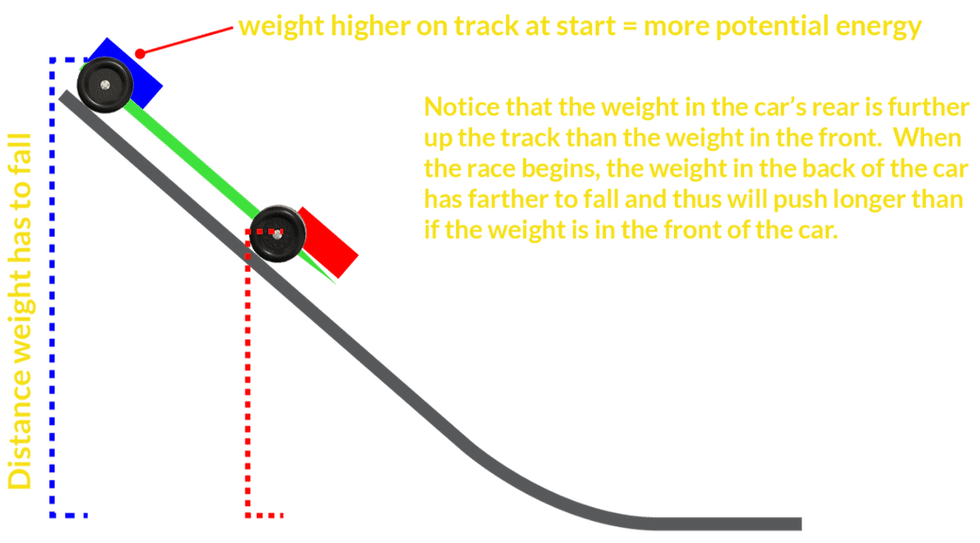
This is the single most important thing to get right, so let’s be direct about it: rear weight is what makes a pinewood derby car fast, not front weight. The real physics: a track is mostly a downhill ramp followed by a flat run. The higher up the ramp your center of mass sits when the car starts, the more distance it has to “fall,” and the more of that gravitational potential energy converts into speed. Weight placed toward the front lowers your effective starting height and gives up that energy — it does not make the car “start quickly” or “roll faster,” despite that being a common myth.
The competitive target most experienced builders use is placing the bulk of the weight about 0.75 to 1.5 inches in front of the rear axle (closer to 0.75–1.0 inches for a smooth, well-tuned track, and 1.0–1.5 inches if you can’t test runs ahead of time and want a safer margin for stability). Going much further back than that increases speed potential further but makes the car progressively harder to keep running straight, so there’s a real trade-off between raw speed and stability, not a one-directional “more rear weight is always better” rule.
Balancing For Stability
Keep your pinewood car stable. Place the weight towards the back. This helps in preventing wobbles. The car runs straight and true. Proper balance is key. An unbalanced car wobbles. It can slow down during the race. Weight distribution matters a lot. A stable car is a fast car.
Ensure the car runs smoothly. Align the wheels properly. This helps in achieving smooth runs. Avoid placing too much weight in one spot. Spread it evenly on the back. The car glides easily on the track. Smooth runs mean faster times. Always check the weight placement. It makes a big difference.
Material Choices
Placing weight at the rear of a Pinewood Derby car boosts speed. This helps the car to accelerate faster. Balancing weight properly ensures stability and smooth movement on the track.
Choosing The Right Weights
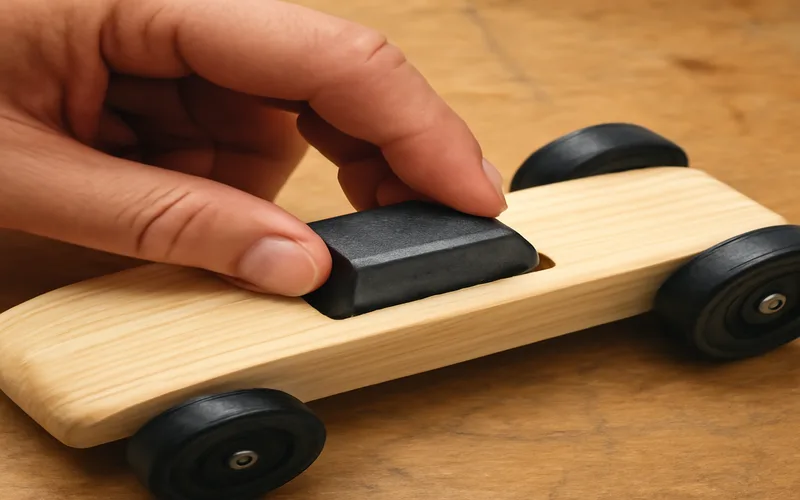
Pinewood derby cars need good weights. Metal weights are heavy and small. They fit nicely on the car. Lead is popular but can be toxic. Steel is safer and easy to use. Tungsten is super dense and really good. It costs more, though.
Impact On Performance
The weight affects how the car moves. More weight in the back helps speed. It makes the car go faster. Middle weight makes the car steady. It stays straight on the track. Front weight can slow the car. It’s not the best for racing.
Testing And Adjustments
Trial Runshelp find the best weight placement. Start with a few test races. Adjust the weight if the car is slow. Try moving the weight forward or backward. Observe how the car moves. Notice if it sways or slows down.
Use fine-tuning techniquesfor better results. Sand the wheels to make them smooth. Make sure the axles are straight. Check if the car rolls smoothly. Adjust the weight until the car is fast and steady. Testing is key to a winning car.
Common Mistakes
Many builders make their car too heavy. This can slow it down. Weight should be balanced. If too much on one side, it can tip over. Always check the rules. They tell how much weight is allowed. Use small weights. They are easy to move and adjust. A lighter car goes faster.
Cars need to be balanced. If one side is too heavy, the car will lean. Balance helps it go straight. Use weights to even it out. Put them in the middle. This way, it moves smooth. Test the car on a flat surface. Make sure it goes straight. Adjust until it does.
Frequently Asked Questions
How Much Weight Should You Put On A Pinewood Derby Car?
A pinewood derby car should weigh up to 5.000 ounces (about 141.7 grams) per official rules — check your specific pack’s exact rule sheet, since some add a small tolerance. Ensuring the weight is evenly distributed can enhance speed and stability. Use small weights to adjust and fine-tune the balance.
Where Exactly Do I Drill or Cut for the Weight?
Most builders rout or drill a pocket into the underside of the car body, roughly 0.75 to 1.5 inches in front of the rear axle, sized to fit your tungsten or steel weight snugly. Seal the weight in with epoxy or hot glue so it can’t shift during the race, then re-check your final balance point once it’s installed — adding weight always changes the car’s exact center of mass slightly from your plan.
Can You Put Weights On The Bottom Of A Pinewood Derby Car?
Yes, adding weights to the bottom of a pinewood derby car is allowed. It enhances stability and speed. Ensure the car meets weight restrictions and balances properly for optimal performance. Secure weights carefully to avoid affecting aerodynamics or causing damage during the race.
Where Do Most Experienced Racers Put the Weight?
Place weights towards the rear and bottom of the pinewood derby car. This lowers the center of gravity, improving speed. Ensure the car remains balanced and complies with weight regulations. Experiment with different placements for optimal performance. Secure the weights properly to avoid shifting during the race.
Conclusion
Choosing the right weight location boosts your Pinewood Derby success. Proper weight placement enhances speed and performance. Experiment with weight distribution for optimal results. Many racers find success placing weight towards the rear. This increases momentum on the track. Try different setups to suit your car’s design.
Balance is key for smooth racing. Remember, practice and adjustment make perfect. Learning from experience helps refine your strategy. Enjoy the thrill of the race with your finely tuned car. Happy racing!
Sponsored / affiliate links. As an Amazon Associate I earn from qualifying purchases. I may earn additional commission from eligible campaigns.