Wood Fence Designs: 10 Styles Compared by Cost & Privacy
Wood fence designs split into three groups — open styles like picket and post-and-rail, solid privacy styles like board-on-board and stockade, and decorative styles like lattice-top and horizontal slat — and the right pick depends on your privacy needs and what your HOA or local code allows. Most cities cap front-yard fences at 3–4 feet, and building over that limit means a teardown. This guide compares 10 wood fence designs by privacy level, installed cost per linear foot, durability, and DIY difficulty.
Quick Answer
The most common wood fence designs are board-on-board and solid privacy fencing (full privacy, $30–$55 per linear foot installed), picket and post-and-rail (open sightlines, $12–$30 per linear foot), and shadowbox or horizontal slat for a modern semi-private look ($25–$60 per linear foot). Cedar and redwood last 15–25 years — see our cedar fence cost breakdown for per-foot pricing by height. If you’ve settled on cedar specifically, our cedar fence ideas guide compares how board-on-board, shadowbox, horizontal-slat, and lattice-top styles perform built in cedar — while pressure-treated pine costs less but needs more upkeep.
Planning a fence is one of the most common outdoor upgrades homeowners tackle — for other outdoor and indoor build guidance, see our full woodworking projects and tips hub. If you like the idea of pairing wood with masonry rather than an all-wood look, our brick and wood fence combination ideas cover pillar-and-panel designs not included here.
What Are the Most Popular Wood Fence Designs?
The 10 most popular wood fence designs are board-on-board, solid privacy/stockade, shadowbox, picket, post-and-rail, lattice-top, horizontal slat, louver, board and batten, and basketweave. Each trades privacy, cost, and installation difficulty differently, so the same budget buys a very different fence depending on which one you choose.
The table below compares all 10 designs side by side on the four factors that actually decide which one fits a given yard: how private it is, what it costs installed, how hard it is to build yourself, and what situation it suits best. Ranges reflect 2026 national installed-cost surveys (materials plus labor); actual price varies by region, height, and wood species.
| Design | Privacy Level | Cost / Linear Ft (Installed) | DIY Difficulty | Best For |
|---|---|---|---|---|
| Board-on-Board | High | $30–$55 | Moderate | Backyard privacy, identical both sides |
| Solid Privacy / Stockade | High | $25–$50 | Moderate | Maximum privacy on a budget |
| Shadowbox (Good Neighbor) | Medium | $25–$45 | Moderate | Shared-yard privacy without blocking airflow |
| Picket | Low | $15–$30 | Easy | Front yards, curb appeal |
| Post-and-Rail (Split-Rail) | Low | $12–$25 | Easy | Property lines, livestock, rustic look |
| Lattice-Top | Medium | $30–$50 | Moderate | Extra height without a solid-wall look |
| Horizontal Slat (Modern) | Medium-High | $35–$60 | Hard | Modern homes, architectural statement |
| Louver | Medium | $40–$65 | Hard | Wind-prone yards needing privacy plus airflow |
| Board and Batten | High | $28–$48 | Moderate | Finished look on both sides |
| Basketweave / Herringbone | High | $45–$70 | Hard | Decorative statement fence |
Privacy Fence Designs: Board-on-Board, Stockade & Shadowbox
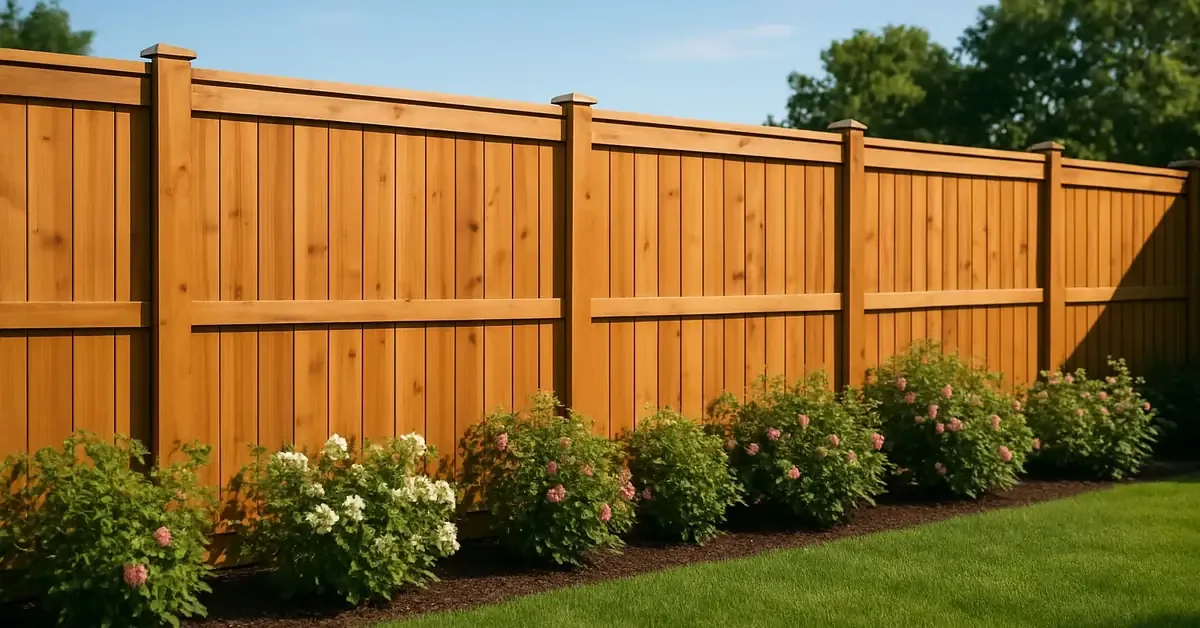
Full-privacy wood fence designs block sightlines completely and typically stand 6 to 8 feet tall. The three most common versions differ mainly in how the boards are arranged, which changes both the price and how the fence looks from your neighbor’s side. If you’d rather not build boards individually, pre-assembled 6×8 cedar panels come in several of these same styles ready to hang between posts.
What Is a Board-on-Board Wood Fence?
A board-on-board fence overlaps two staggered rows of vertical boards so no gaps show from either side, delivering full privacy. It costs $30–$55 per linear foot installed and uses roughly 30% more lumber than a single-layer privacy fence because of the overlap.
The overlap is also what makes it the “good neighbor” choice in the truest sense: both sides see a full run of boards rather than a flat, one-directional face. The tradeoff is material cost and installation time, since every board attaches twice — once to front rails, once staggered behind.
What Is a Shadowbox (Good Neighbor) Fence?
A shadowbox fence alternates boards on opposite sides of the rails with a small gap between them, so both neighbors see a nearly identical finished face. It runs $25–$45 per linear foot and handles wind better than a solid panel because air passes through the gaps.
Privacy is close to full but not absolute — the small gap lets in slivers of light and a narrow sightline at a direct angle. In exchange, a shadowbox fence rarely blows over in a storm the way a solid panel section can when wind has nowhere to go.
How Much Privacy Does a Solid Stockade Fence Provide?
A solid stockade fence uses tightly abutted vertical boards with no gaps, blocking sightlines completely at 6 to 8 feet tall. It’s the most budget-friendly full-privacy option at $25–$50 per linear foot, though a single flat layer can cup or warp faster than board-on-board.
Because boards butt directly against each other with no overlap, seasonal wood movement matters more here than on any other design — a 6-inch board that shrinks 1/8 inch in a dry summer opens a visible gap across a whole fence line.
Open & Decorative Wood Fence Designs
Open wood fence designs mark a boundary without blocking the view, while decorative designs add height or visual interest without going fully solid. Both cost less to build than a full privacy fence, mainly because they use fewer boards per linear foot.
What Is a Picket Fence Design?
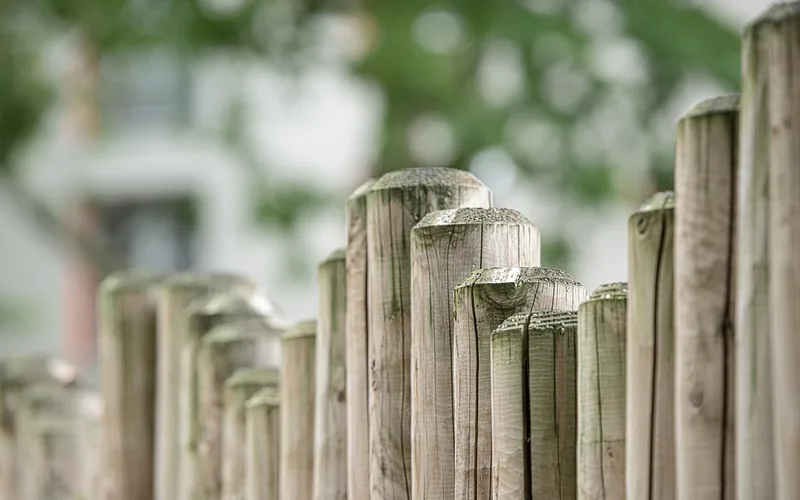
A picket fence uses evenly spaced vertical boards, usually 3 to 4 feet tall, with pointed, flat, or scalloped tops. It defines a front-yard boundary without blocking views and costs $15–$30 per linear foot — one of the cheapest designs to install.
Spacing between pickets typically runs 2 to 4 inches, wide enough to keep the open, welcoming look most homeowners want at the front of a house, but narrow enough that most municipal codes don’t count it as a “solid” fence subject to stricter height limits. See our full wood fence picket sizes and spacing guide for exact dog-ear, flat-top, and grade options.
What Is a Post-and-Rail (Split-Rail) Fence?
A post-and-rail fence uses horizontal rails set into vertical posts with open space between them and no pickets at all. It’s the least expensive design at $12–$25 per linear foot and suits marking property lines or containing livestock rather than privacy.
Two- and three-rail versions are most common; a third rail near the ground is what actually keeps smaller animals in, so a two-rail fence built for looks alone won’t hold a dog or goat the way a three-rail version will.
What Is a Lattice-Top Wood Fence?
A lattice-top fence tops a solid privacy or picket base with a crisscross lattice panel, adding 1 to 2 feet of height without a fully solid look. It costs $30–$50 per linear foot and works well where code caps solid-fence height but allows a see-through topper.
Because the lattice section is technically “open,” many municipalities don’t count it toward the solid-fence height limit — a common way homeowners legally get 8 feet of total height where code only allows 6 feet of solid board.
Modern Wood Fence Designs: Horizontal Slat, Louver & Board and Batten
Modern wood fence designs turn the boards sideways or angle them instead of standing them straight up, which is what gives contemporary homes their clean, linear look. All three designs below cost more per linear foot than a standard vertical privacy fence.
What Makes a Horizontal Slat Fence Look Modern?
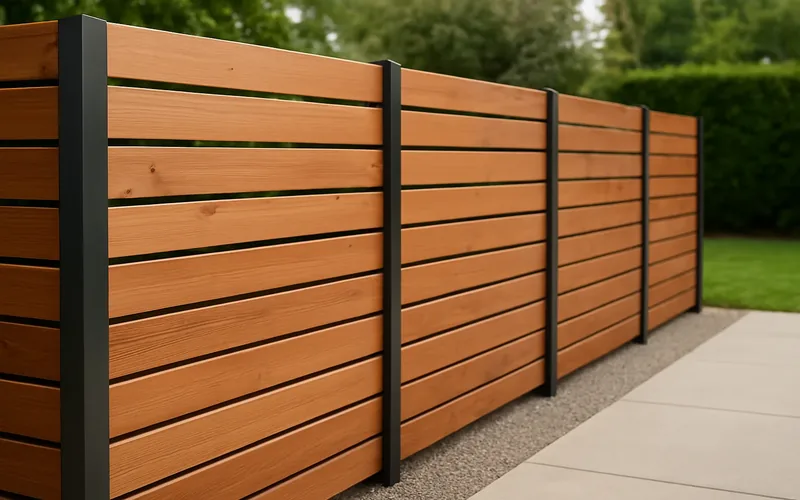
A horizontal slat fence mounts boards sideways between vertical posts instead of standing them upright, creating the clean linear look common on contemporary homes. It costs $35–$60 per linear foot — more than vertical designs — because the boards need blocking between posts for support.
Steel or aluminum posts paired with wood slats have become a popular hybrid version of this design, since metal posts stay perfectly straight over time while the horizontal wood boards still give the warm, natural look the design is chosen for.
What Is a Louver Fence Design?
A louver fence angles boards at roughly 45 degrees across the framework, blocking direct sightlines from outside while still letting air and light pass through. At $40–$65 per linear foot, it’s pricier than a flat privacy fence because each board requires angled cuts and precise spacing.
The angle also determines how much privacy it actually delivers — a shallower angle lets in more light and view, while a steeper angle approaches the privacy of a solid fence at the cost of more airflow resistance in high-wind areas.
What Is a Board and Batten Fence?
A board and batten fence covers the gaps between wide vertical boards with a narrower strip (the batten), giving a finished, seamless look on both sides. It runs $28–$48 per linear foot and reads as more upscale than a standard board-on-board design for similar money.
Because the batten strip covers the seam rather than relying on overlap, it uses less total lumber than board-on-board while still hiding every gap — a detail that matters more on a fence facing the street than one tucked in a side yard.
What Is a Basketweave or Herringbone Wood Fence?
A basketweave fence interlaces thin wood strips horizontally between posts in an over-under woven pattern, while herringbone angles strips into a zigzag. Both are the most labor-intensive wood fence designs, running $45–$70 per linear foot, because each strip is cut and fitted individually rather than installed as a panel.
The thin, flexible strips used in a basketweave design also make it one of the few wood fences that can follow a gentle curve rather than running dead straight, which is part of why it shows up most often as a decorative accent section rather than a full property perimeter.
How Much Does a Wood Fence Cost Per Linear Foot?
A wood fence costs $20 to $75 per linear foot installed, depending on design and height. According to 2026 national fence-installation cost data, a standard 6-foot privacy fence averages $25–$50 per linear foot, while an 8-foot privacy fence runs $45–$75 per linear foot in materials and labor combined.
Height is the single biggest cost driver within any one design — an 8-foot fence uses roughly a third more lumber than a 6-foot fence of the same style, plus longer posts set deeper for stability. Materials alone typically run $6–$13 per linear foot, with labor adding another $14–$35.
Design complexity is the second driver. Split-rail and picket fences are the cheapest and fastest to install because they use the fewest boards per foot, while basketweave and louver designs cost the most because of the extra labor needed to cut and fit each individual piece.
If budget is the deciding factor, it’s worth weighing these installed costs against a chain link vs wood fence cost and lifespan comparison before settling on a design — chain link often wins on total cost of ownership even though it can’t match wood on privacy or curb appeal.
If you are weighing wood against a lower-maintenance alternative instead, our PVC fence vs wood fence cost breakdown shows the exact point (usually around year five) where vinyl has a higher upfront price but starts paying for itself in avoided staining costs.
Which Wood Species Lasts Longest for a Fence?
Cedar, redwood, and mahogany last longest for a fence — 15 to 25 years above ground — because their natural oils resist rot, insects, and moisture without chemical treatment. Pressure-treated pine costs less upfront but typically lasts 10 to 15 years and is more prone to warping and cracking.
Cedar is the naturally rot-resistant pick, but fir (a lighter, cheaper framing-grade wood) is the more common budget alternative in many regions — our fir vs cedar fence comparison breaks down the real cost and maintenance gap between the two.
Landscape contractor Roger Cook, featured on This Old House, points to wood species as one of the biggest factors in fence longevity — a well-built fence lasts about 20 years overall, but the posts (the part actually in the ground) usually fail first, around 10 to 15 years, regardless of species. Our full wood species guide compares rot resistance, hardness, and cost across the species used most often in outdoor builds.
Cedar and redwood can also be left to weather naturally to a silvery gray with no stain at all, while pressure-treated pine needs a protective finish within the first year or two to slow moisture absorption and prevent early warping.
Will a Wood Fence Design Pass HOA Approval or Local Code?
Most municipalities cap front-yard fences at 3 to 4 feet and backyard fences at 6 to 8 feet, and corner lots often add sightline-triangle setbacks near intersections. HOAs frequently go further, restricting the specific design, material, and even the stain color before approving a permit.
On a typical suburban HOA review, submitting a site plan that names the exact design — board-on-board, shadowbox, and so on — along with height and stain color upfront avoids a second resubmission. A common holdup: a homeowner applies for a 6-foot backyard fence only to learn their corner lot’s sightline setback caps the first 10 feet back from the curb at 3 feet, forcing a stepped design at that end of the run.
Always get the permit and HOA sign-off before ordering lumber. A fence built outside the approved height or setback typically has to come back down, and the cost of tearing out and rebuilding a 100-foot run easily doubles the original budget.
Can You Build a Wood Fence Yourself, or Do You Need a Pro?
Picket and post-and-rail designs are DIY-friendly for a homeowner comfortable setting posts in concrete and working off a level and string line. Board-on-board, horizontal slat, louver, and basketweave designs are harder to self-install because they demand precise, consistent spacing across an entire run.
A common first-timer mistake is setting posts without a taut mason’s string line as a height reference — a single post set even half an inch high or low becomes obvious the moment boards go on, and by the third post the top rail visibly wanders off-level. Use a fence post spacing calculator before digging to confirm post count and spacing for the actual run length, not a rounded estimate.
Renting a gas-powered post-hole auger instead of hand-digging with a manual post-hole digger cuts post-setting time on a 100-foot run from a full weekend down to about half a day, which is usually the deciding factor in whether a design stays DIY or gets handed to a fencing contractor.
Frequently Asked Questions
What is the most durable wood fence design?
Board-on-board and solid stockade fences built with cedar or redwood are the most durable wood fence designs, typically lasting 15–25 years above ground. The double-layer overlap in board-on-board also resists warping better than a single flat panel because airflow moves between the boards on both sides.
Does a wood fence increase home value?
Yes. A well-built wood fence typically returns a meaningful share of its installed cost in added home value and can improve curb appeal enough to speed up a sale in neighborhoods where most yards are already fenced. Condition matters as much as style — a leaning or gray, unmaintained fence can hurt value instead of adding it.
How many years does a wood fence last?
A well-constructed wood fence lasts about 20 years on average. Naturally rot-resistant species — cedar, redwood, and mahogany — last 15–25 years above ground, while the in-ground posts typically wear out first, around 10–15 years, regardless of species.
A rotted post base doesn’t always mean starting over: a fence repair spur bolts onto the sound wood above the rot line and reinforces the post without pulling it or replacing the whole run.
Should I stain my fence every year?
No. Most wood fence stains and sealers need reapplication every 2–3 years, not annually, unless the fence faces direct year-round sun or coastal salt air. Cedar and redwood can also be left unstained to weather naturally to gray with no upkeep required. See our best fence stain picks for the current top-rated products by wood type.
Is pine or cedar better for a fence?
Cedar is better for durability: its natural oils resist rot, insects, and moisture without chemical treatment, and it lasts 15–25 years versus roughly 10–15 for pressure-treated pine. Pine costs less upfront but requires more frequent staining and is more prone to warping.
Choosing the Right Wood Fence Design
Match the wood fence design to what you actually need: open styles like picket or post-and-rail for a boundary marker, solid or board-on-board for full privacy, and horizontal slat or louver for a modern look with airflow. Check your local height limit and HOA rules before ordering lumber, and budget for cedar or redwood if 20-plus years of durability matters more than the lower upfront cost of pressure-treated pine.
Sponsored / affiliate links. As an Amazon Associate I earn from qualifying purchases. I may earn additional commission from eligible campaigns.