Wide Plank vs Narrow Plank Flooring in Small Spaces?
Narrow planks usually fit small rooms better because they add more visual lines and help the floor read longer. Use wider planks only when the room is short, opens to other spaces, or has plenty of light. Pick the wrong width, and the room can feel chopped up, cramped, or out of scale. This guide compares wide and narrow plank flooring by room shape, light, layout, and budget, then gives a room-by-room decision rule.
Plank width in small rooms

| Decision factor | Wide Plank | Narrow Plank | Winner |
|---|---|---|---|
| Visual scale in small rooms | Bold, modern look with fewer seams; can make rooms feel bigger and more open | Classic, traditional feel; more proportional in small spaces | Tie |
| Cost | Usually more expensive because it uses larger pieces of wood | Often more affordable | Narrow Plank |
| Humidity and temperature movement | More sensitive to environment changes | Handles temperature and humidity changes better | Narrow Plank |
| Small-room fit | Works best in open, bright rooms with long sightlines | Usually the safer fit for compact rooms, hallways, and bedrooms | Narrow Plank |
| Busy visual risk | Can overpower trim, furniture scale, or a tight layout | Less likely to feel oversized in a compact room | Narrow Plank |
Visual scale and seams
Board width changes how many seams you see and how fast the eye moves across the floor. Wide planks are typically 5 inches or wider, so they reduce seam frequency and can make a room read as more open. Narrow planks are usually 2 to 4 inches wide, so they create more lines and often feel more proportional in compact rooms.
That difference matters in a small room because the floor is a large visual field. Too few seams can make the surface feel oversized; too many can make it look busy. The right choice depends on whether the room needs calm openness or a finer visual grid.
Cost and wood usage
Wide planks are usually more expensive because they use larger pieces of wood. Narrow planks are often more affordable for the same reason, and that cost gap can matter once you add waste, trim, and installation labor. If you are balancing floor size against budget, plank width can move the project price more than many buyers expect.
Price alone should not decide the room, but it often narrows the field. In a compact space where narrow boards already fit the scale better, the lower cost is a useful second advantage.
Humidity and temperature movement
Narrow boards generally handle temperature and humidity changes better than wider boards. That makes them the steadier choice for rooms that swing between dry and damp seasons, or for homes where HVAC use varies across the year. Wider boards can move more because each piece spans more width.
This does not mean wide planks fail in every climate. It does mean you should be more careful in rooms that already see moisture fluctuation, especially if the room is small and repairs would be awkward.
Style read in compact rooms
Wide planks create a bold, modern look. In the right small room, that can read as clean and airy, not heavy. Narrow planks read as classic, traditional, and often calmer, which is why they usually look more natural in smaller bedrooms, hallways, and boxy living rooms.
Style is not separate from scale. A floor that looks good in a magazine spread can still feel too large for a narrow room with short walls and close furniture.
Do wide planks make a small room look bigger?

Wide planks can make a small room look bigger when the room has long sightlines, plenty of light, and few visual breaks. Fewer seams reduce line frequency, so the floor can read as one continuous plane rather than a tight grid. In the right layout, that creates a more open feeling.
They do not work that way in every compact room. If the room is short, boxed-in, or full of turns, extra-wide boards can feel under-detailed and oversized, which shrinks the sense of balance instead of expanding it.
When fewer seams help
Fewer seams help most when the eye can travel across the room without hitting a door opening, a return wall, or a sharp turn. A condo great room that opens to a kitchen often benefits more from wide planks than a narrow bedroom does. The continuous run makes the floor feel less chopped up.
Finish matters here too. A matte or low-sheen surface usually keeps that openness from turning glossy and harsh.
When wide boards feel too dominant
Wide boards can feel too dominant in a tiny room with short walls and a lot of furniture. The floor starts to compete with trim, bed frames, or built-ins, and the room can read as visually heavy. That is especially likely when board width is large relative to the room’s narrowest dimension.
Picture a 9-foot by 11-foot bedroom with a queen bed and two nightstands. A very wide board can pull focus away from the room’s shape and make the field feel less resolved.
How room shape changes the result
Long, narrow rooms often benefit from planks that run with the length of the space. That choice pulls the eye forward and makes the room seem longer. In a square or boxy room, the same wide board can feel flatter and less measured, especially if the room already lacks a strong focal point.
For that reason, room proportions matter more than style labels. The floor should echo the room, not fight it.
Are narrow planks better for small spaces?
Narrow planks are usually better for small spaces because they feel more proportional and create a finer visual rhythm. In compact rooms, that extra line frequency often makes the floor look intentional instead of oversized. They also handle temperature and humidity changes better, which helps in real homes where conditions vary.
That said, narrow does not mean busy by default. The look depends on board length, finish sheen, and installation direction as much as it does on width.
Why smaller boards feel proportional
Smaller boards match the scale of compact rooms more naturally. In a hallway, for example, the floor is already directing the eye down a long, narrow path. Narrow planks reinforce that direction without making each board feel like a broad stripe across the space.
This proportionality is why narrow boards often look settled in older homes and tighter floor plans.
Best fits for bedrooms and hallways
Bedrooms and hallways are two of the strongest fits for narrow planks. Bedrooms usually need calm, not visual drama, and hallways benefit from the extra line rhythm that helps the floor feel longer. In both spaces, the board width usually works with the room instead of competing with it.
If the room is low on natural light, the narrower format can also keep the floor from feeling too heavy.
Where narrow boards can feel busy
Narrow boards can feel busy when the floor already has a lot going on, such as strong grain, high contrast color, or a highly reflective finish. In a small room with a lot of pattern elsewhere, the added seams can create visual noise. That is more likely in a compact living room than in a simple bedroom.
A common first-timer mistake is choosing narrow planks and then pairing them with a glossy finish and dark furniture. The room starts to feel more crowded than planned.
Small-space plank matrix
This matrix gives a room-by-room rule for compact layouts. Use it as a starting point, then adjust for light, sightlines, and budget. The best result comes from matching board width to how the room is used and how the eye moves through it.
| Small-space scenario | Recommended plank width | Why it works visually | Main risk to avoid |
|---|---|---|---|
| Bedroom | 2 to 4 inches | Feels calm and proportional; the floor does not overpower the bed and trim | Using extra-wide boards that make the room feel too plain or too large for its furniture scale |
| Hallway | 2 to 4 inches | Reinforces length and keeps the passage visually organized | Too much visual noise from wide boards or a high-contrast finish |
| Galley living room | 2 to 4 inches | Supports the long, narrow shape without making the floor feel oversized | Installing wide boards across the short dimension, which can compress the room |
| Condo great room | 5 inches or wider | Creates fewer seams across a larger open area and reads more continuous | Choosing a very glossy finish that makes the space feel harsher than open |
| Low-light room | 2 to 4 inches | Smaller boards keep the floor from feeling heavy when light is limited | Picking wide, dark boards that absorb too much visual space |
| High-traffic space | 2 to 4 inches | Handles movement better and keeps the floor looking balanced under constant use | Ignoring humidity swings and choosing wide boards where movement may be more noticeable |
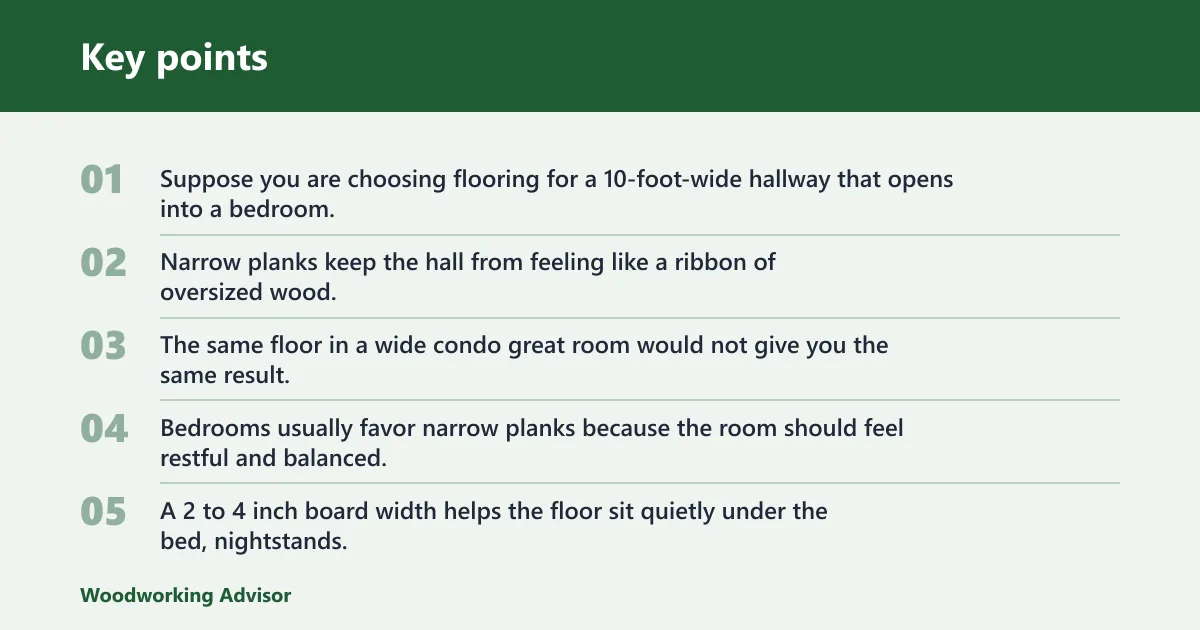
Suppose you are choosing flooring for a 10-foot-wide hallway that opens into a bedroom. Narrow planks keep the hall from feeling like a ribbon of oversized wood, and they carry the eye forward without overpowering the doorway. The same floor in a wide condo great room would not give you the same result.
Bedroom
Bedrooms usually favor narrow planks because the room should feel restful and balanced. A 2 to 4 inch board width helps the floor sit quietly under the bed, nightstands, and trim. Wide boards can still work if the bedroom is unusually open or has a lot of natural light, but that is the exception.
Hallway
Hallways usually look best with narrow planks. The extra seam rhythm supports the length of the corridor and keeps the space from feeling over-scaled. Wide boards can interrupt that flow and make the passage feel shorter than it is.
Galley living room
A galley living room is one of the clearest cases for narrow planks. The room already has a strong direction, so the floor should support that shape rather than compete with it. A wider board can make the room feel chopped if the layout has frequent furniture breaks or several openings.
Condo great room
A condo great room is one of the better places for wide planks in a small-footprint home. The space usually has longer sightlines and fewer interruptions, so the wider boards can create the open feel they are known for. Keep the finish controlled so the room still feels calm.
Low-light room
Low-light rooms usually favor narrow planks because they keep the floor from feeling like one large dark block. The finer seams help the surface read with more detail. Wide boards can work only if the room gets enough light from another source and the color is not too dark.
High-traffic space
High-traffic spaces often benefit from narrow boards because they stay visually organized and handle movement changes better. That matters in entries, busy family passages, and rooms that see season-to-season humidity swings. Wide planks can still work, but they demand tighter environmental control.
What affects the look beyond plank width?
Plank width matters, but it is not the only factor shaping how a small room reads. Board length, finish sheen, and installation direction can either calm the floor or make it feel busier. These details often decide whether a good width choice actually works in the room.
Board length
Longer boards usually feel calmer because they reduce interruption across the floor. Shorter boards can make seams more visible, which may be useful in a small room if you want structure, but too many short pieces can make the floor feel chopped. Width and length should be chosen together.
Finish sheen
High sheen reflects more light and can make seams stand out. In a small room, that can draw attention to the floor pattern rather than the room shape. A lower-sheen finish usually keeps the visual field quieter, especially if the planks are wide or the room is bright.
Installation direction
Run the boards with the room’s longest dimension when possible. That usually makes the space feel longer and less boxy. When the layout forces a different direction, plank width becomes even more important because the floor has less help from the room shape itself.
Choose Wide Plank if… / Choose Narrow Plank if…
Choose wide planks when the room is small but open, bright, and visually simple. Choose narrow planks when the room is compact, closed in, or broken up by doorways and furniture. The better choice is the one that fits the room’s proportions, not the one that looks best in a broad style photo.
Choose wide plank if…
- The room has long sightlines and few turns.
- Natural light is strong enough to keep the floor from feeling heavy.
- You want a bold, modern look with fewer seams.
- The space connects to other rooms and you want a more continuous read.
Choose narrow Plank if…
- The room is a bedroom, hallway, galley living room, or other compact layout.
- You want the floor to feel more proportional and less dominant.
- Budget matters, since narrow planks are often more affordable.
- The room sees humidity or temperature swings and you want better movement control.

Frequently asked questions
What is considered wide plank flooring?
Wide planks are typically 5 inches or wider. That size is commonly used to create a bold, modern look and reduce the number of seams across the floor. In small rooms, that wider format can feel open when the layout has enough light and sightline length to support it.
What is considered narrow plank flooring?
Narrow planks are usually 2 to 4 inches wide. They have a classic, traditional feel and often read as more proportional in compact rooms. Because they create more lines across the floor, they can help a small room feel organized rather than oversized.
Does plank width affect cost?
Yes. Wide planks are usually more expensive because they use larger pieces of wood. Narrow planks are often more affordable, so width can affect both material cost and the overall floor budget. That difference is worth considering before you choose a look that may not fit the room anyway.
Can wide planks work in small rooms without looking busy?
Yes, but only in the right small rooms. Wide planks work best where there are few turns, strong natural light, and a simple layout. If the room is boxy, dark, or packed with furniture, the same boards can look oversized and pull attention away from the room itself.
Which plank width is more durable in changing humidity?
Narrow planks are generally better for temperature and humidity changes. Wider boards are more sensitive to movement because each piece spans more width. In rooms with seasonal swings or variable climate control, that extra stability can matter as much as the visual choice.
What plank width looks best in a small bedroom?
Narrow planks usually look best in a small bedroom. They feel more proportional beside the bed, dresser, and trim, and they tend to keep the room calm. Wide planks can still work in a bright, open bedroom, but they are not the default best pick.
Do wide plank floors make a small room look bigger?
Sometimes. Wide planks can make a room feel bigger when they reduce seam count in a space with good light and long sightlines. In a tight or broken-up room, though, they can have the opposite effect by looking too dominant and making the floor feel under-detailed.
Sponsored / affiliate links. As an Amazon Associate I earn from qualifying purchases. I may earn additional commission from eligible campaigns.