Wood Finish Types Chart: Oil vs Wax vs Polyurethane vs Lacquer
For furniture and cabinetry, choose polyurethane when you need the highest wear and water resistance, lacquer for fast, repairable shop finishes, oil or wax for the least built-up look, and shellac when spot repair matters most; if you want one default, start with polyurethane on high-use pieces. Pick the wrong finish, and you can end up with sticky surfaces, swollen edges, visible scratches, or a coating that is hard to fix without stripping. This wood finish types chart compares oil, wax, polyurethane, lacquer, shellac, and varnish by the failure each one helps you avoid.
| Decision factor | Oil | Wax | Polyurethane | Lacquer | Winner |
|---|---|---|---|---|---|
| Wear, water, and heat protection | Low film protection; easy to renew | Lowest protection; poor against heat and moisture | High protection; practical for tables and cabinets | Moderate to high protection, but less forgiving in hard use | Polyurethane |
| Repair after scratches | Simple to refresh | Spot repair is easy, but the finish is fragile | Repairs usually show unless you recoat carefully | Best for re-dissolving into old lacquer | Lacquer |
| Natural look and feel | Warm, low-build appearance | Very soft sheen over another finish | Clear protection, but more film is visible | Can look clean and flat, especially on cabinets | Oil |
| DIY application difficulty | Simple wiping or brushing | Simple, but only as a final layer | Brush, spray, or wipe-on options | Usually spray application only | Oil |
| Maintenance cycle | Needs periodic renewal | Needs frequent touch-up and limits future recoats | Longer service life before recoating | Repairable, but best in a controlled spray workflow | Polyurethane |
Which wood finish fits your project?
The core trade-off is simple: protection, appearance, repair, and application do not line up the same way in every finish. A dining table needs resistance to water, heat, abrasion, alcohol, cleaners, and food spills. A display piece may need a lighter film and easier touch-up more than brute durability.
Read the chart by the failure you most want to avoid. If the worry is wear, polyurethane usually leads. If the worry is future repair, lacquer and shellac are easier to blend. If the worry is an artificial look, oil and wax stay closer to bare wood.
How to read the chart by use case
Start with the surface, not the can. Heavy-use tops need a film finish. Decorative work can tolerate lower protection. A finish that looks perfect on day one can still be the wrong choice if it is hard to repair, hard to spray, or too vulnerable to water and heat.
- Identify the main threat: abrasion, moisture, heat, or repair difficulty.
- Decide whether you want a film on top or a lower-build look.
- Check whether you can spray, brush, or only wipe.
- Confirm the maintenance cycle you can live with.
Wood finish decision chart
This matrix ranks the four finishes by use case and by the practical failure you are trying to avoid. It separates water resistance, heat resistance, repairability, application difficulty, and maintenance frequency so you can match the finish to the job instead of the label on the can.
| Use case | Oil | Wax | Polyurethane | Lacquer | Water resistance | Heat resistance | Repairability | Application difficulty | Maintenance frequency | Best fit |
|---|---|---|---|---|---|---|---|---|---|---|
| Dining table | Easy renewal, low protection | Not suitable alone | Best protection for spills and wear | Good in shop conditions, less forgiving at home | Polyurethane | Polyurethane | Oil or lacquer | Lacquer | Oil and wax need more frequent refresh | Polyurethane |
| Cabinet | Acceptable for a natural look | Too light for most cabinet use | Strong choice, especially water-based on light wood | Common in sprayed cabinetry | Polyurethane | Polyurethane | Lacquer | Lacquer | Oil needs periodic renewal | Polyurethane or lacquer |
| Display piece | Natural appearance | Soft final sheen | More protective than needed in many cases | Clean film with fast turnaround | Lacquer | Lacquer | Lacquer | Lacquer | Low to moderate | Lacquer |
| Antique repair | Easy to renew | Possible, but fragile | Can look too modern and be hard to blend | Useful if matching old lacquer | Oil | Oil | Lacquer | Oil | Oil needs repeat application | Oil or shellac |
| High-touch shelf | Better than bare wood, still light | Too weak for repeated handling | Better against abrasion and handling | Works well if sprayed and maintained | Polyurethane | Polyurethane | Lacquer | Polyurethane | Wax needs frequent touch-up | Polyurethane |
| Decorative box | Warm, natural feel | Soft luster | Can look heavier than needed | Fast, clean sprayed finish | Lacquer | Lacquer | Lacquer | Lacquer | Low | Lacquer |
| Spray-shop project | Slow compared with film finishes | Poor shop finish choice | Works, but slower than lacquer | Built for this workflow | Lacquer | Lacquer | Lacquer | Lacquer | Moderate | Lacquer |
| Beginner DIY | Simple and forgiving | Simple but limited | Reliable if you can apply it evenly | Less friendly without spray equipment | Polyurethane | Polyurethane | Oil | Oil | Oil or wax need more upkeep | Oil or polyurethane |
Dining table, cabinet, and shop use
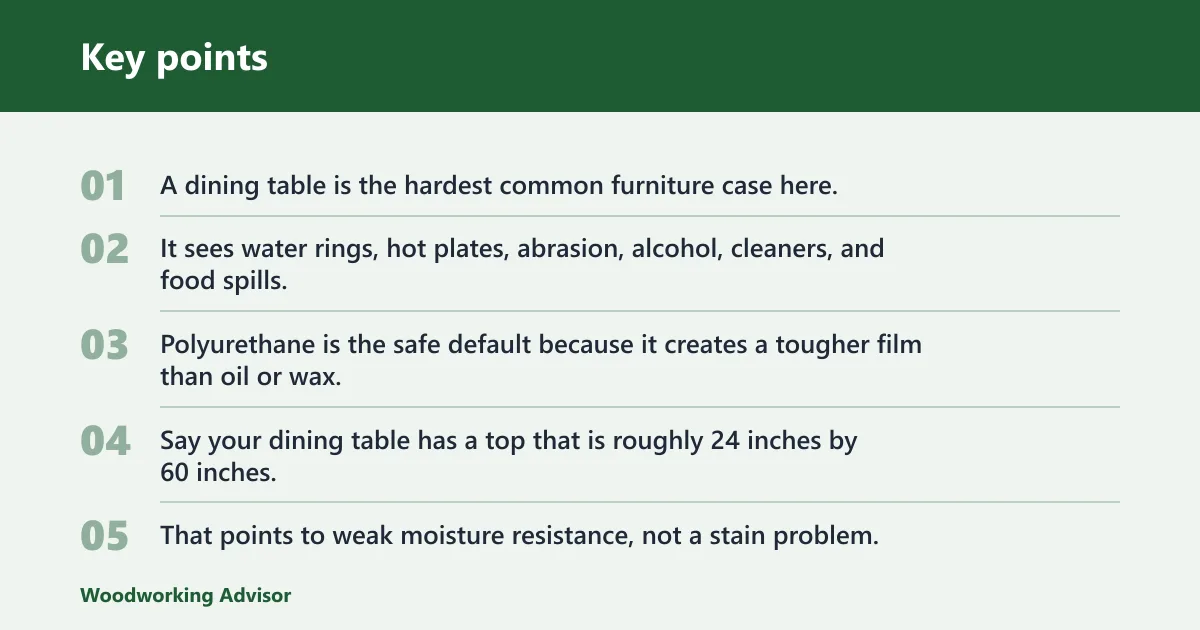
A dining table is the hardest common furniture case here. It sees water rings, hot plates, abrasion, alcohol, cleaners, and food spills. Polyurethane is the safe default because it creates a tougher film than oil or wax, and it is a practical choice for hard-wearing indoor tables or cabinets.
Say your dining table has a top that is roughly 24 inches by 60 inches, and the finish starts showing dull rings after a few wipe-downs. That points to weak moisture resistance, not a stain problem. A stronger topcoat is the fix, while stain would only change color.
Use-case ranking across the four finishes
For cabinets, polyurethane and lacquer are the common comparison. Water-based polyurethane is used for cabinets, furniture, and light-colored wood when you want less ambering. Lacquer is common for fast professional spray finishing, but it needs spray equipment and strong ventilation because of flammable vapors.
For a decorative box or display piece, lacquer often wins because it dries fast and repairs well in a spray workflow. Oil can also suit a display piece if the goal is a softer, warmer surface and less visible film.
Which finish holds up best?
Polyurethane usually holds up best for wear, water, and daily contact. Wax is the weakest for protection. Oil sits below film finishes because it soaks into wood fibers instead of building a hard shell. Lacquer can be durable on furniture and cabinetry, but it is chosen as much for speed and repair as for brute resistance.
Water resistance and heat resistance
Water resistance matters most where spills and wet cups are routine. Heat resistance matters when the surface sees hot dishes or sunlight near a window. Wax has limited resistance to water, heat, scratches, and chemicals, so it should be treated as a final sheen, not a durable tabletop finish.
Oil-based polyurethane is a common choice for tables, furniture, and trim. Water-based polyurethane is used for cabinets, furniture, and light-colored wood, and it is the clearer option with minimal odor and lower VOCs.
Abrasion resistance and scratch recovery
Abrasion resistance is the reason polyurethane stays near the top of most furniture charts. It creates a film that better resists scuffs than oil or wax. Lacquer can look excellent, but if the use case includes rough handling, the better repair story may matter more than the finish speed.
Suppose a hallway shelf gets keys dragged across it every day. Wax will mark quickly. Oil will show wear sooner than a topcoat, even though it is easy to renew. Polyurethane gives the best balance when the failure you want to avoid is repeated scratching.
Why polyurethane and varnish usually lead on wear
Varnish is a film-forming finish family, and consumer language often groups varnish with polyurethane. The practical point is that these finishes build a protective layer on top of the wood. That is why they are practical for hard-wearing indoor tables or cabinets. Varnish also appears in interior and exterior products, where flexibility and UV resistance matter.
Which finish looks most natural?
Oil usually looks the most natural because it soaks into the wood and leaves less film on top. Shellac also gives a warm appearance, but it is still a film finish. Wax gives a soft sheen over an already-finished surface, yet it does not offer the protection of a real topcoat.
Oil and shellac for warmth and chatoyance
Penetrating oil finishes are chosen when the goal is a warm or natural appearance. They are easy to renew, but they offer less protection than film finishes. Shellac dries fast and also looks warm, which is useful when you want a quick-build sealer or a finish for a small decorative project.
Shellac is vulnerable to alcohol and water. That matters on trays, tabletops, and bars. Dewaxed shellac is the safer choice when you want later topcoats to bond reliably. Waxed shellac can create compatibility problems if you plan to add another finish later.
Wax for low sheen over a cured surface
Wax is best used over a compatible cured finish. It gives a low-build final sheen, but its protection is limited. It is not a good standalone choice for heavy-use furniture, and it can contaminate a surface that later needs fresh finish coats.
A common first-timer mistake is putting wax on bare pine and expecting the result to hold up like polyurethane. The surface may feel pleasant at first, then show water marks, scratches, and dull spots quickly.
Water-based polyurethane versus oil-based polyurethane appearance
Water-based polyurethane keeps the wood clearer and is often used on light-colored wood. It is often reported to have less odor and lower VOCs, and it usually recoats faster. It can raise grain, so light sanding between coats is common.
Oil-based polyurethane adds amber tone and warmth. It also dries more slowly, and it takes longer to cure before normal use. If you want the wood to look slightly richer and do not mind a slower schedule, oil-based poly is the warmer-looking option.
Which finish is easiest to repair?
Lacquer and shellac are usually easiest to repair because fresh material can melt into older layers. Oil is also simple to renew, but it does not build the same protection as a film finish. Wax touch-ups are simple only until the surface needs future recoats, because wax can interfere with adhesion.
Oil refresh cycles
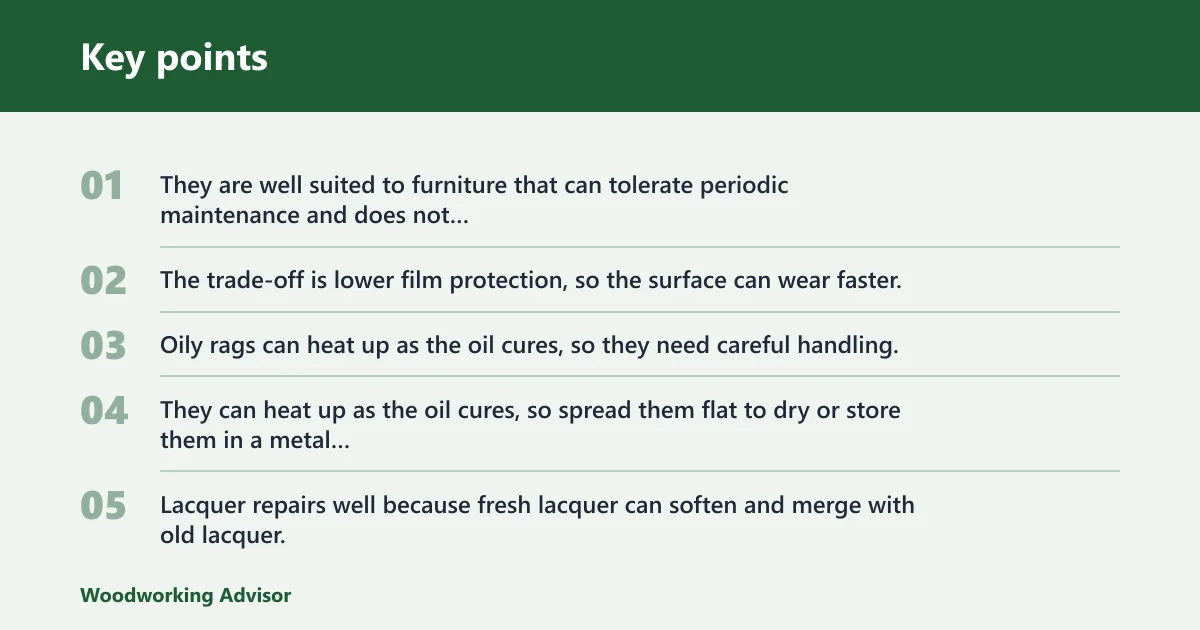
Oil finishes are easy to renew. That is their main advantage. They are well suited to furniture that can tolerate periodic maintenance and does not need a hard shell on top. The trade-off is lower film protection, so the surface can wear faster.
Oily rags can heat up as the oil cures, so they need careful handling. They can heat up as the oil cures, so spread them flat to dry or store them in a metal container with a lid. Do not leave them crumpled in a pile.
Lacquer repair by re-dissolving into old lacquer
Lacquer repairs well because fresh lacquer can soften and merge with old lacquer. That is one reason it is common for fast professional spray finishing. It also recoats within 30-60 minutes, and a three-coat finish can take 3-4 hours of elapsed time.
The catch is safety and setup. Lacquer needs spray equipment and strong ventilation because of flammable vapors. That makes it a poor match for a typical brush-only DIY workflow.
Wax touch-up limits and contamination risk
Wax is easy to buff on, but its repair limits show up later. Once wax is on a surface, future finishes may have trouble sticking well unless the wax is fully removed. That contamination risk is why wax is best treated as a last-step sheen, not a universal topcoat.
Shellac repair, and when waxed shellac causes problems
Shellac is fast-drying and easy to spot repair. That makes it useful for small furniture, trim, and quick sealing jobs. But it is vulnerable to alcohol and water, so it should not be the first choice for a table that sees spills every day.
Waxed shellac can complicate later topcoats. Dewaxed shellac is the better bridge coat when you want compatibility with other finishes.
Choose oil, wax, polyurethane, or lacquer if…
Choose by the failure you want to avoid. Oil wins when you want easy renewal and a warm look. Wax wins only as a final sheen over a cured finish. Polyurethane wins when wear and moisture are the main threats. Lacquer wins when fast spraying and later repair matter more than a brush-on workflow.
Choose oil if you want easy renewal and a natural look
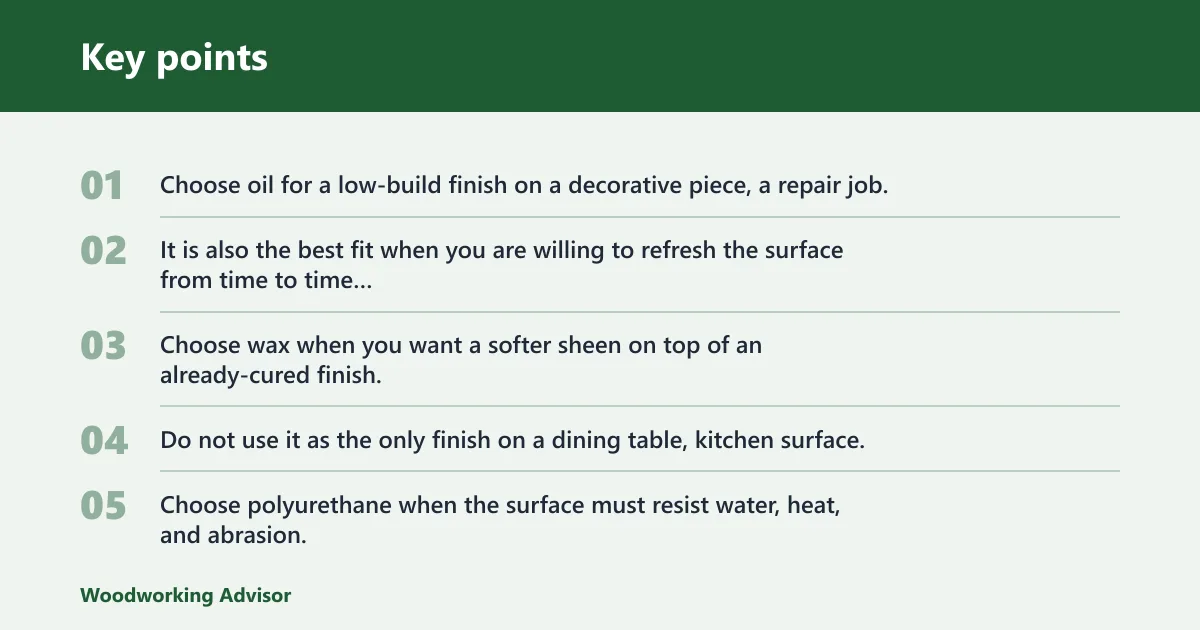
Choose oil for a low-build finish on a decorative piece, a repair job, or a project where you value a warm, wood-first appearance. It is also the best fit when you are willing to refresh the surface from time to time and do not need heavy film protection.
Choose wax only as a final sheen over a cured finish
Choose wax when you want a softer sheen on top of an already-cured finish, and only if the piece will not see heavy wear. Do not use it as the only finish on a dining table, kitchen surface, or other high-use top.
Choose polyurethane for a dining table, cabinet, or other hard-use surface
Choose polyurethane when the surface must resist water, heat, and abrasion. That includes dining tables, cabinets, trim, and shelves that get handled often. Water-based poly suits lighter woods and a clearer look. Oil-based poly suits tables and trim when you want warmth and durability.
Choose lacquer for sprayed furniture and cabinetry with fast turnaround
Choose lacquer for decorative furniture, cabinet doors, and shop work where spray equipment is already in play. It is a good fit when repairability and speed matter, but it is not the easiest choice for a first-time brush-only project. Strong ventilation is part of the job.

What about shellac and varnish?
Shellac and varnish do not fit neatly into the oil-versus-wax-versus-polyurethane-versus-lacquer split, but they matter in real projects. Shellac is a fast-drying sealer or finish with a warm look. Varnish is a film family that often gets grouped with polyurethane in consumer language, though interior and exterior versions are used differently.
Shellac as a sealer with alcohol and water limits
Shellac is useful when you need quick sealing or warm color. It dries fast, which helps on small parts and repair work. Its weakness is moisture and alcohol, so it is not the right answer for a table that gets frequent spill exposure.
Varnish and the polyurethane family
Varnish is often used broadly to describe hard film finishes, especially by shoppers comparing products on a shelf. In practice, polyurethane is the common pick for indoor wear, while some varnishes are tuned for flexibility or outdoor UV exposure. That difference matters if you are choosing between interior furniture and exterior trim.
Water-based polyurethane versus oil-based polyurethane
Water-based polyurethane is clearer, lower-odor, and lower-VOC. It can raise grain, so the first coat often needs a light sanding. Oil-based polyurethane ambers the wood, dries more slowly, and needs longer before normal use. Both are film-forming topcoats, but the look and schedule differ.
Frequently asked questions
What is the difference between oil, wax, polyurethane, and lacquer wood finish?
Oil soaks into wood fibers and is easy to renew, but it offers less film protection than a topcoat. Wax gives a low-build final sheen with limited resistance to water, heat, and scratches. Polyurethane builds a durable film. Lacquer is a fast-drying film finish that is usually sprayed.
Which wood finish is most durable for furniture?
Polyurethane is usually the most durable choice for furniture that takes daily abuse. It resists wear, water, and abrasion better than oil or wax, and it is practical for tables and cabinets. Lacquer can be durable too, but it is chosen more for speed and repair in spray work.
Is lacquer better than polyurethane for wood?
Lacquer is better when you need fast drying, a sprayed workflow, and easy repair by re-dissolving into old lacquer. Polyurethane is better when the main goal is maximum wear and water resistance. For many furniture pieces, polyurethane is the safer default; lacquer suits shop-finished decorative work.
Can wax be used as the only finish on wood?
Wax should not be the only finish on heavy-use wood. It has limited resistance to water, heat, scratches, and chemicals, so it works best as a final sheen over a compatible cured finish. On bare wood, it leaves too little protection for tables, counters, or high-touch parts.
Which finish is easiest to repair if scratched?
Lacquer is usually easiest to repair because fresh lacquer can melt into older lacquer. Shellac is also very repair-friendly for spot work. Oil is simple to renew, but it does not protect as well as a film finish. Wax repairs easily at first, then complicates later recoats.
What finish should I use on a dining table
Use polyurethane on a dining table if you want the best balance of water resistance, heat resistance, and abrasion resistance. A table faces spills, hot dishes, cleaners, and repeated wiping. Oil can look nicer at first, but it needs more maintenance and gives less protection.
What finish keeps wood looking most natural?
Oil usually keeps wood looking most natural because it soaks in and leaves a low-build surface. Shellac also gives warmth, but it reads more like a finish layer. If you want the wood grain to stay visually open while still getting some protection, oil is the closest match.
Is polyurethane or lacquer better for cabinets?
Both can work on cabinets, but the better choice depends on your workflow. Polyurethane is the easier protective default for many DIY cabinet projects, especially water-based poly on light woods. Lacquer is better in a spray shop where speed, recoat time, and repairability matter more than brush application.
Sponsored / affiliate links. As an Amazon Associate I earn from qualifying purchases. I may earn additional commission from eligible campaigns.