Wood Glue Clamp Time Chart by Type: Fast, Safe Release
Most PVA joints can leave clamps after about half an hour to an hour, but I still wait a full day before sanding or putting the part in service; epoxy and polyurethane can take several hours to a day or more, depending on temperature and joint fit. Pulling too early can creep the joint, starve the glue line, or ruin a repair. This guide gives a clamp-time chart by glue type, plus safe adjustments for joint stress, shop temperature, and humidity.
This guide is part of our Wood glue essentials: types, uses, and cure times series.
Wood glue clamp time chart by type


Use the chart below as a decision tool, not a guess. Match glue type to joint stress and shop conditions, then separate unclamp time, handling time, sanding time, and full-load time. I have seen a joint feel firm and still be nowhere near ready for machining or stress.
| Glue type | Joint category | Temperature band | Humidity band | Unclamp time | Handling time | Sanding time | Full-load time |
|---|---|---|---|---|---|---|---|
| PVA yellow/white | Edge joints, general joinery | 70°F / 21°C | 50% RH | 30–60 minutes | After unclamp, with care | 24 hours | 24 hours |
| PVA yellow/white | Panels, large glue-ups | 70°F / 21°C | 50% RH | 45–60 minutes | Same day, lightly handled | 24 hours | 24 hours |
| PVA yellow/white | End grain, chair parts, stressed joints | 70°F / 21°C | 50% RH | 60 minutes | Next day | 24 hours | 24 hours or more |
| Polyurethane | Gap-prone, outdoor, mixed-material | 70°F / 21°C | 50% RH | 1–2 hours | After full set, cautious handling | 24 hours | 24 hours |
| Epoxy, 5-minute | Small repairs, quick fixture work | 70°F / 21°C | 50% RH | About 15 minutes | Later the same day | 24 hours | 24–72 hours |
| Epoxy, slow-set/laminating | Structural, gap-filling, laminations | 70°F / 21°C | 50% RH | Per resin system, often overnight | After firm set | 24 hours or more | 24–72 hours |
| Liquid hide glue | Furniture joinery, reversible work | 70°F / 21°C | 50% RH | Overnight | Next day | 24–48 hours | 24–48 hours |
| Hot hide glue | Fast assembly, repair work | Warm joint and shop | Moderate | Minutes, often brief | After set | 24 hours | 24 hours |
| CA thin | Spot repairs, alignment tacking | 70°F / 21°C | 50% RH | 10–30 seconds | Very soon after set | Same day, cautiously | 24 hours |
| CA medium/thick | Small gaps, quick assembly aids | 70°F / 21°C | 50% RH | 30–60 seconds | Very soon after set | Same day, cautiously | 24 hours |
The chart uses about 70°F and 50% relative humidity as typical shop conditions. In cold shops, cure slows down. Heat cuts open time. High humidity affects evaporation-based glues and changes how fast the glue line loses water.
What is clamp time versus cure time?
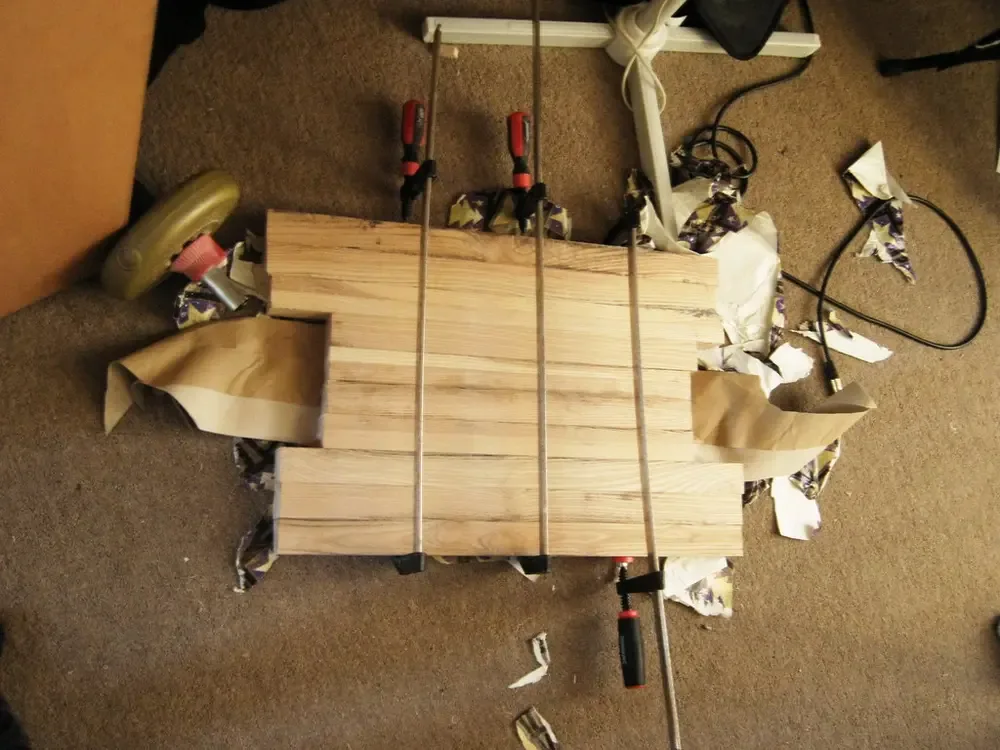
Clamp time is the minimum time under pressure before a joint can come apart without shifting. Cure time is when the glue reaches full strength and can safely take sanding, planing, machining, or service load. Those are not the same milestone, and mixing them up causes most glue failures.
Why a joint can come out of clamps before it is ready for stress
Many joints are stiff enough to hold shape before the adhesive is fully cured. That does not mean they are ready for twisting, clamping to the bench, or a load from seasonal movement. Early stress can open a glue line that looked fine at unclamp time.
Why full cure matters before planing, sanding, or machining
Fresh glue can clog abrasives, tear fibers, or shift under tool pressure. A joint that is still green may also creep under a planer bed or router pressure. For that reason, full cure matters before aggressive sanding, trimming, and any step that will bend the part.
What changes when a joint is still green
Green glue lines are vulnerable to squeeze-out smear, clamping marks, and spring-back. They also crush more easily when clamped too hard. If the joint will see stress soon, wait for full cure even if the clamps can come off earlier.
How long should you clamp PVA wood glue?
Standard PVA wood glue, including yellow and white polyvinyl acetate glues, usually needs 30–60 minutes of clamp time in normal shop conditions. It has about 4–6 minutes of open time and reaches full strength in 24 hours. For edge joints and light joinery, unclamp after the minimum; for panels and stressed work, wait longer.
Yellow glue timing for edge joints, panels, and general joinery
For edge joints and cabinet parts, 30–60 minutes is the practical unclamp window at 70°F and 50% RH. Panels and wider glue-ups do better near the longer end of that range because alignment pressure takes longer to settle across the full joint. Leave sanding and load for 24 hours.
White glue timing for light-duty assemblies
White PVA behaves similarly in clamp time, but thin joints and light-duty assemblies can fool the eye. The surface may look dry while the joint below is still building strength. Treat it the same as yellow glue unless the manufacturer says otherwise.
Why cold wood or a cold shop stretches the schedule
At 50°F, PVA clamp time is about 2–4 hours and full cure is 48 hours or more. At 90°F plus, clamp time drops to about 15–20 minutes. Cold lumber matters as much as cold air, because a chilled board pulls heat from the glue line and slows the bond.
How long do you clamp polyurethane, epoxy, and hide glue?
Polyurethane glue usually needs 1–2 hours of clamping and cures in 24 hours. Epoxy depends on the formula: 5-minute epoxy can be unclamped in about 15 minutes, while slow-set versions often need overnight or longer. Hide glue sets fast, with liquid hide glue listed as an overnight slow set and hot hide glue opening for only 30–60 seconds.
Polyurethane clamp time and foaming behavior
Polyurethane glue is moisture-cured and expands as it cures. That expansion helps in imperfect fits, but it can also push parts out of alignment if clamped poorly. Use enough pressure to control squeeze-out, not so much that you force all adhesive out of the joint.
Epoxy timing for 5-minute and slow-set formulas
Five-minute epoxy can be unclamped in about 15 minutes, but that does not mean full strength. It can take 24–72 hours to fully cure. Slow-set and laminating epoxies are better for structural work, gap-filling, and larger surfaces because they allow more working time and steadier bond development.
Hide glue timing for liquid and hot hide versions
Liquid hide glue is useful where reversibility matters, and hot hide glue sets fast when the joint and glue are prepared correctly. Hot hide glue has 30–60 seconds of open time, so the assembly sequence must be ready before the glue is applied. Both forms respond to heat and moisture when repairs are needed.
Which wood glue has the shortest clamp time?
CA glue has the shortest clamp time. Thin CA has a 5–15 second open time and a 10–30 second hold, while medium or thick CA has a 15–60 second open time and a 30–60 second hold. That speed is useful for tiny repairs and temporary tacking, not for every structural joint.
Where CA glue fits and where it does not
CA is good for small parts, alignment points, and quick patch work. It is a poor choice for large stressed joints, long glue lines, or assemblies that need open time for careful clamp setup. Fast set is not the same thing as durable structure.
When a faster glue still needs a longer hold
Even when the joint feels set, resist the urge to load it immediately. CA can bond quickly, but full cure still takes about 24 hours. That matters if the part will be sanded, trimmed, or subjected to vibration soon after assembly.
How temperature and humidity change clamp time
Temperature is the first variable to check. Cold wood and cold air slow glue development, while heat shortens open time and can rush setup before the parts are aligned. Humidity matters most with evaporation-based glues, where higher moisture content in the air can slow water loss from the glue line.
Cold shops and cold lumber
If the shop is cold, extend clamp time before moving the assembly. For PVA, the jump from 70°F to 50°F is large enough to change a 30–60 minute unclamp into a 2–4 hour wait. Warm the wood, not just the room, when possible.
High humidity and evaporation-based glues
High humidity slows the drying side of PVA behavior, which can leave the glue line green longer than expected. That is one reason a joint that normally releases cleanly can still creep or print through finish in damp conditions. In humid shops, give the joint more time rather than squeezing harder.
When to adjust the schedule instead of the clamp pressure
Do not try to fix cold or humid conditions by overtightening clamps. More pressure cannot replace time, and it can starve the joint. Adjust the clock first, then the clamping method. A longer hold is safer than forcing a marginal bond.
How long does epoxy need to clamp on wood?
Epoxy often needs longer clamp time than fast PVA, especially in cool shops or on larger joints. A 5-minute formula may come out in about 15 minutes, but slow-set and laminating epoxies often need overnight clamping and 24–72 hours for full cure. Joint fit and temperature decide the safe window.
Gap-filling structural use
Epoxy is the better choice when the joint has small voids, irregular grain, or an edge that cannot be made perfectly tight. It can carry load well when mixed and applied correctly. Treat it as a full-strength material only after the full cure window has passed.
What to watch during cleanup and early machining
Epoxy squeeze-out should be cleaned before it hardens into a ridge that ruins the next sanding step. Early machining can also smear partly cured resin into abrasives. If the piece must be handled soon, protect the glue line rather than rushing the clamp removal.
A shop-safe clamp-time matrix and checklist
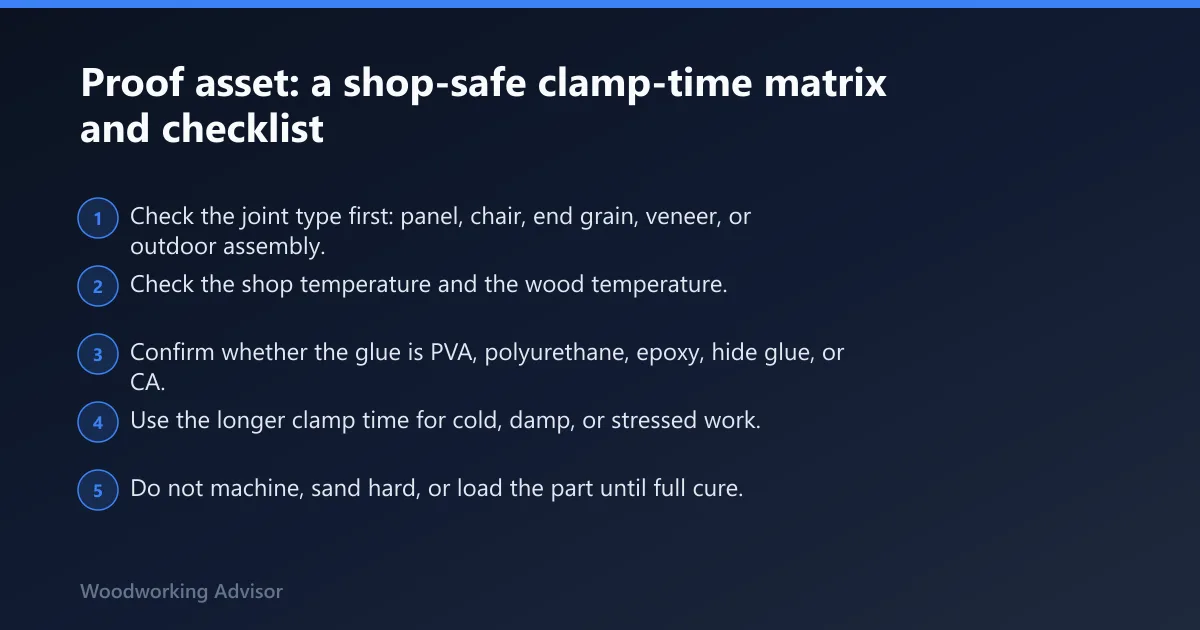
Use this matrix when the joint is cold, large, difficult to clamp, or high risk. It pairs glue type with joint stress and shop condition so the timing decision is practical, not theoretical. For unknown brands, follow the label first and use this as a conservative floor.
| Glue type | Joint category | Temperature | Humidity | Unclamp time | Handling time | Sanding time | Full-load time |
|---|---|---|---|---|---|---|---|
| PVA | Panels, edge joints, general joinery | 70°F / 21°C | 50% RH | 30–60 minutes | Same day, gently | 24 hours | 24 hours |
| PVA | Cold shop, cold lumber | 50°F | 50% RH | 2–4 hours | After full set | 48 hours or more | 48 hours or more |
| Polyurethane | Outdoor, gap-prone, mixed-fit | 70°F / 21°C | 50% RH | 1–2 hours | After set | 24 hours | 24 hours |
| Epoxy, 5-minute | Small repair, fixture, fill | 70°F / 21°C | 50% RH | About 15 minutes | Later same day | 24 hours | 24–72 hours |
| Hide glue | Furniture joint, reversible work | Warm conditions | Moderate | Overnight or brief for hot hide | Next day | 24–48 hours | 24–48 hours |
| CA | Spot repair, tacking | 70°F / 21°C | 50% RH | Seconds | Very soon after set | Same day, cautiously | 24 hours |
- Check the joint type first: panel, chair, end grain, veneer, or outdoor assembly.
- Check the shop temperature and the wood temperature.
- Confirm whether the glue is PVA, polyurethane, epoxy, hide glue, or CA.
- Use the longer clamp time for cold, damp, or stressed work.
- Do not machine, sand hard, or load the part until full cure.
- For end grain, chairs, and outdoor parts, stay conservative even if the surface feels hard.
Cold-weather and complex glue-up checklist: warm the parts if possible; dry the joint faces; stage clamps before spreading glue; verify open time before starting; use moderate pressure, not crushing pressure; plan cleanup before the parts meet; leave extra time for panels, chairs, veneers, and any joint that will carry movement or impact.
Frequently asked questions
How long should wood glue be clamped by type?
PVA usually needs 30–60 minutes, polyurethane 1–2 hours, liquid hide glue overnight, hot hide glue only a brief clamp once it grabs, and CA only seconds to a minute. Epoxy varies widely. The safe rule is to match clamp time to glue type, joint stress, and shop temperature.
What is the difference between clamp time and cure time?
Clamp time is the minimum time the joint must stay under pressure before release. Cure time is when the adhesive reaches full strength. A joint can be unclamped and still be too weak for sanding, planing, or service load. Treat full cure as the point for real stress.
How long does PVA wood glue take to clamp?
Standard PVA has about 4–6 minutes of open time and a 30-minute to 1-hour minimum clamp time in normal shop conditions. At 50°F, that can stretch to 2–4 hours. At 90°F plus, the clamp time can drop to about 15–20 minutes.
How long do you clamp polyurethane wood glue?
Polyurethane glue usually needs 1–2 hours of clamp time and then about 24 hours to cure. It is moisture-cured and expands as it cures, so the clamp setup needs to control movement without squeezing the adhesive out of the joint. Cold conditions can extend the schedule.
Can you unclamp wood glue after 30 minutes?
Sometimes, yes, especially with PVA in a warm shop and a simple joint. But 30 minutes is only the lower edge of the usual clamp window, not a universal safe point. For panels, end grain, or cool conditions, wait longer before releasing the clamps.
How long before sanding after gluing wood?
For PVA, epoxy, polyurethane, hide glue, and CA, the safest sanding point is usually after full cure, often 24 hours or longer. Light cleanup of squeeze-out can happen sooner if done carefully, but aggressive sanding too early can gum the paper, smear the glue, or shift the joint.
Sponsored / affiliate links. As an Amazon Associate I earn from qualifying purchases. I may earn additional commission from eligible campaigns.