Wood Glue Open Time Chart: Brand-by-Brand Comparisons
Open time is the working window before glue skins over or stops wetting wood well. Clamp time is how long the joint needs pressure before you can unclamp it. Full cure time is when the bond reaches near-full strength. Those three numbers are different, and mixing them up is how rushed glue-ups fail.
What open time, clamp time, and cure time really mean


Open time: the usable window before the joint starts to skin over
With PVA wood glue, open time is the span after spreading when parts still slide into place and the glue still wets both faces. Once the film skins, the bond line can turn dull, grab poorly, and leave dry spots that look fine until the joint takes stress.
Clamp time: pressure, not final strength
At 70°F, PVA clamp time is listed as 30 min–1 hr. That is the minimum pressure window, not proof that the joint has full strength. I see woodworkers unclamp too early because the assembly feels solid, then rack it, scrape it, or plane it before the bond has really set.
Full cure time: when the bond reaches near-full strength
Full cure usually takes longer than clamp time. For many PVAs, the bond is often near full strength after about a day, while some epoxies and hide-glue setups may take longer or vary with the formulation. If the glue line will be machined, stressed, or loaded hard, plan around cure, not clamp release.
How temperature and humidity change glue working time
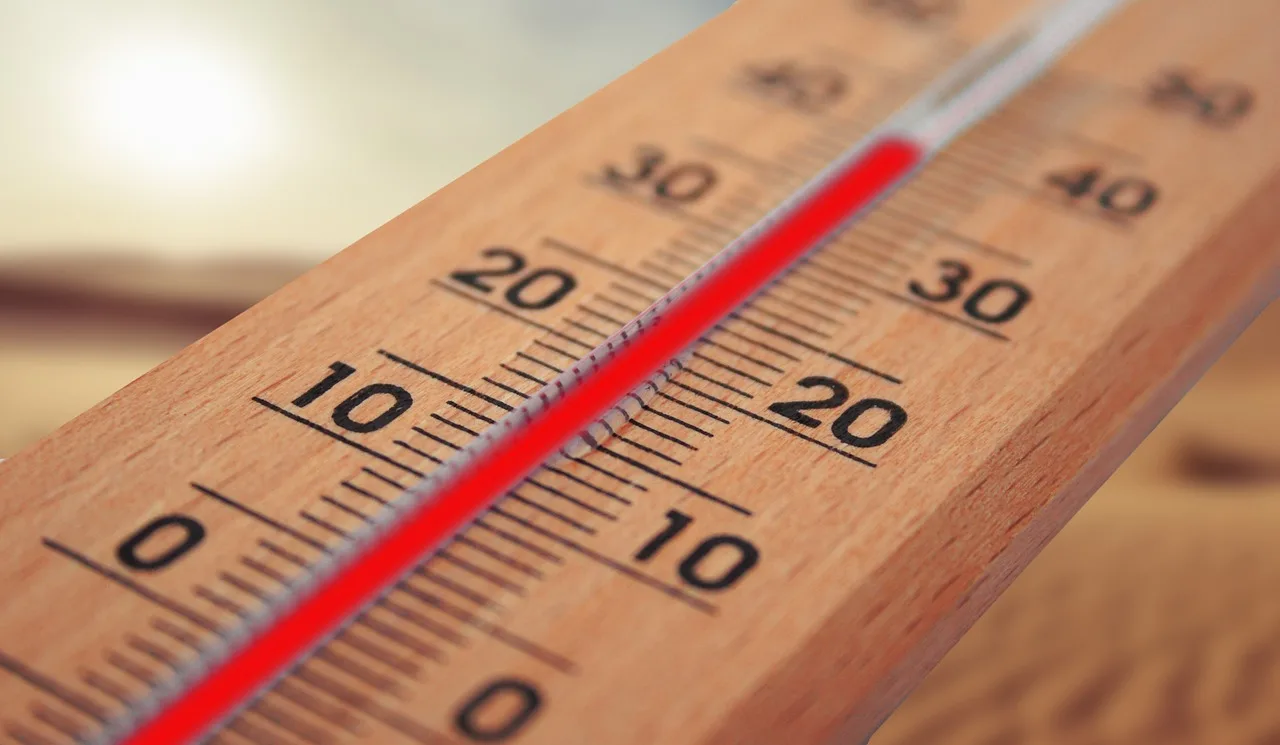
Warm, dry air shortens open time because the water or solvent leaves the glue line faster and the film skins sooner. A cold shop can slow cure and throw off the schedule, making the joint feel “not ready” even after the clamp window has passed. Bottle labels assume normal shop conditions, not every shop.
Why warm, dry air shortens open time
Heat speeds skinning. Low humidity helps the surface dry faster. On a dry day, a glue that feels generous can turn fussy on wide panels, long edge joints, or any assembly that needs clamp repositioning. That is when a 10-minute glue can feel noticeably shorter, sometimes closer to 6 minutes.
Why a cold shop slows cure and misleads your schedule
A cold shop may leave the glue line rubbery longer, but that does not mean the joint had extra working time at the front end. It usually means cure lags behind the clock. If parts are moved or stressed because they “seem fine,” the bond can still be weak inside.
When a bottle label is only a starting point
Label numbers help you pick a product, but they are not a full assembly plan. Part size, spread rate, porosity, and clamp choreography all change the real working window. For large glue-ups, treat the label as the center of a range, not the edge.
Wood glue open time chart by brand
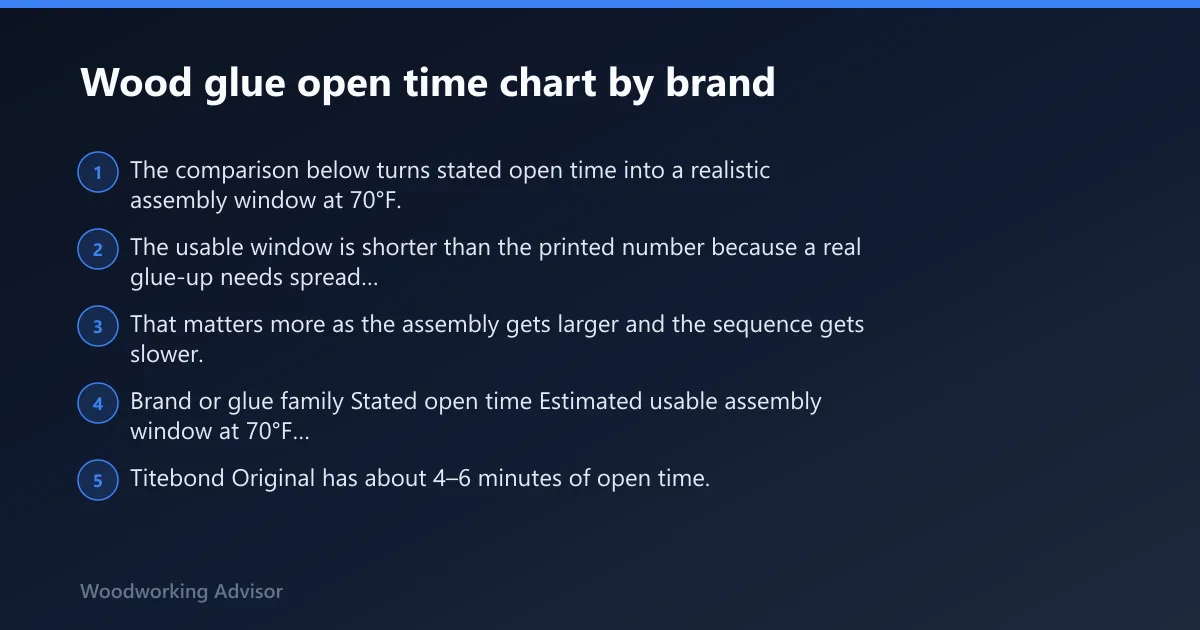
The comparison below turns stated open time into a realistic assembly window at 70°F. The usable window is shorter than the printed number because a real glue-up needs spread time, part alignment, and clamp tightening. That matters more as the assembly gets larger and the sequence gets slower.
| Brand or glue family | Stated open time | Estimated usable assembly window at 70°F | Recommended project size | Failure-risk note |
|---|---|---|---|---|
| Titebond Original | 4–6 minutes | About 3–4 minutes | Small assemblies, face frames, quick edge joints | Skinning and slip if the sequence runs long |
| Titebond II | 3–5 minutes | About 2–3 minutes | Fast clamp-ups, small cabinet parts | Least forgiving when parts need repositioning |
| Titebond III | 8–10 minutes | About 6–8 minutes | Medium glue-ups, edge-glued panels, tabletops with good staging | Better margin, but still easy to overrun on wide parts |
| Titebond Extend | 15 minute open time | About 10–12 minutes | Large panels, long rails, solo assembly with more layout time | More time helps, but clamp pressure still needs discipline |
| Polyurethane glue | 10–20 minute open time | About 8–15 minutes | Gap-filling joints, damp wood, dissimilar materials | Foam, mess, and poor fit can hide weak prep |
| Liquid hide glue | 10 minute open time | About 6–8 minutes | Restoration, reversible joints, moderate-size repair work | Short window on large assemblies, especially in warm shops |
| Hot hide glue | 30–60 second open time | Seconds, not minutes | Small, rehearsed joints and historic work | Skinning is immediate if the sequence is not perfect |
| 5-minute epoxy | 3–5 minute open time | About 2–3 minutes | Small repairs, mixed materials, emergency fixes | Too fast for complex layout; mix errors are common |
| Slow-set epoxy | 20–60 minute open time | About 15–45 minutes | Oily woods, large gap-filling work, mixed-material joints | Long cure and mix ratio mistakes are the usual trouble points |
PVA wood glue and the main brand split
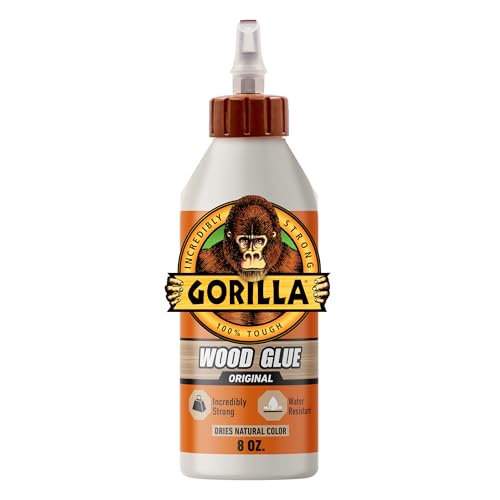
PVA wood glue is the default shop family because it cleans up with water, bonds wood well, and covers most joinery. Titebond Original has about 4–6 minutes of open time. Titebond II is listed with a 3–5 minute open time. Titebond III has an 8–10 minute open time. Titebond Extend is listed with a 15 minute open time.
Other glue families when PVA is not the right pick
Polyurethane glue is shown with a 10–20 minute open time and a 1–2 hour clamp time. It is useful where waterproofing, gap filling, or dissimilar materials matter more than easy cleanup. Liquid hide glue is listed with a 10 minute open time. Hot hide glue is listed with a 30–60 second open time. 5-minute epoxy is shown with a 3–5 minute open time, and slow-set epoxy is shown with a 20–60 minute open time.
Which glue has the longest open time for a big glue-up?
Slow-set epoxy has the longest working window on this list, but it is not the default answer for furniture. For most big wood glue-ups, Titebond Extend or slow-set epoxy are the practical choices, with the better pick determined by fit, cleanup, and whether the joint is wood-to-wood or mixed material.
Large panels and tabletops
For edge-glued panels and tabletops, a longer-open-time PVA usually gives the best balance of working speed, cleanup, and final bond behavior. Titebond Extend is the simplest answer when the shop setup is the limiting factor. The extra minutes matter most when one person is spreading, aligning, and tightening clamps alone.
Solo glue-ups versus two-person workflows
Two people can often make a short-open-time glue behave like a longer one because one person spreads while the other clamps. Solo work is different. The same glue can move from comfortable to frantic once the assembly gets wider than your reach or taller than your clamp stack.
When extra open time matters more than fast clamp release
Longer open time helps when assembly speed is the weak link, not bond strength. A face frame with a few sticks does not need it. A wide top, a long case side, or a set of angled parts usually does. If the sequence cannot be rehearsed, pick the longer window.
Which glue should I use for my project size?
Match glue to the scale of the assembly, not the marketing on the bottle. Small face frames, cabinet parts, and fast repairs do well with short-open-time PVA. Medium panels and tabletops usually need more breathing room. Restoration, oily woods, and mixed-material work often need a different chemistry entirely.
Small face frames and quick repairs
Titebond II or Titebond Original fits small, quick work where the parts can be aligned right away. These glues are less forgiving, but that speed helps when clamp layout is simple and the joinery is already dry-fit. Use them when the whole sequence is predictable.
Edge-glued panels and cabinet parts
Titebond III or Titebond Extend is the better fit when the joint line gets longer and alignment takes longer. The extra open time reduces panic, but it does not excuse weak clamping or sloppy spread. The goal is enough working time to coat all faces and close the joints before skinning starts.
Restoration, oily woods, and mixed-material joints
Hide glue is valuable in restoration because it is reversible. Epoxy is better when the wood is oily, the fit is imperfect, or the joint mixes wood with metal, stone, or another non-porous surface. Polyurethane glue can also help in those cases, especially when a little gap filling is useful.
How do I avoid a starved joint or skinned-over glue line?
Avoiding failure starts before the bottle opens. Dry-fit the assembly, stage the clamps, and rehearse the order in which each joint closes. Spread glue fast enough for the whole joint, then clamp firmly without squeezing all the adhesive out. If the glue skins over first, the bond line can go dry and weak.
Dry-fit, stage clamps, and rehearse the sequence
Lay out every clamp, caul, and reach point before spreading glue. On a bigger job, that planning matters more than the brand choice. The wrong order creates slip, missed corners, and frantic tightening. A short-open-time glue punishes that mistake fastest.
Spread glue fast enough for the full joint
Do not coat one end, stop to hunt a clamp, then come back to the other end. That is how skinning begins. Work in a steady rhythm so the first wet face is still active when the last joint closes. For long glue lines, the spread step should be timed like a drill.
Clamp firmly without squeezing all the adhesive out
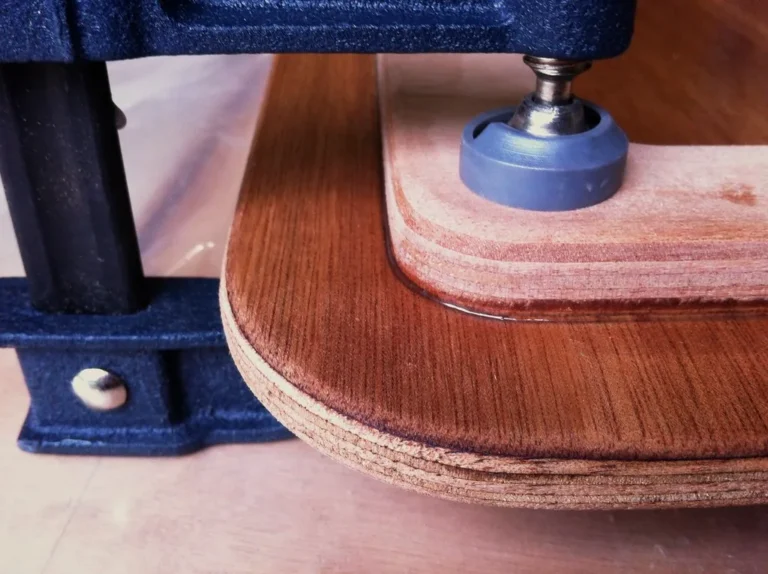
Starved joints happen when pressure is high enough to force the glue line too thin. That can happen with any glue family, especially on very flat, tight-fitting parts. Tight is good. Bone-dry is not. Stop when the joint closes and a small, even squeeze-out appears along the seam.
What happens if wood glue skins over before assembly?
When wood glue skins over before the parts meet, the adhesive loses wetting ability and the bond line starts weak. The parts may skate instead of seat, squeeze-out can turn patchy, and the finished joint may look closed while the center is under-bonded. That is a workflow failure, not a mystery.
Weak wetting and poor bond formation
Glue bonds by wetting both surfaces and grabbing the fibers as it cures. A skinned film cannot do that well. The result can be a joint that feels tight at clamp-up but fails later when the wood moves, flexes, or gets planed.
Slip, alignment drift, and panic cleanup
Skinned glue often makes parts slip unpredictably during clamp-up. That leads to crooked corners, raised edges, and a scramble to wipe away glue while also trying to correct alignment. The time lost there often matters more than the glue brand itself.
Does polyurethane glue have more open time than PVA?
Sometimes yes, but the comparison is not a clean win for polyurethane. Polyurethane glue is shown with a 10–20 minute open time, which can beat many PVAs, but the tradeoff is mess, foaming, and a fit that must already be good enough. It is useful for gaps and dissimilar materials, not for every bench job.
Where polyurethane glue earns its keep
Polyurethane glue is a practical choice when water resistance, some gap filling, or unusual material pairing matters. It can help on damp stock or on assemblies where the joint is not perfectly tight. That said, the foam byproduct can hide problems rather than solve them.
When is hide glue or epoxy better than standard wood glue?
Hide glue is better when reversibility matters, especially in restoration or repairs that may need to be opened again. Epoxy is better when the joint involves oily wood, imperfect fit, or mixed materials. Standard PVA is still the default for most furniture, but it is not the answer for every joint.
Hide glue for restoration and reversibility
Liquid hide glue is useful when future repair matters. Hot hide glue sets fast and is suited to small, rehearsed work, while liquid hide glue gives more time. Both are common in restoration because the bond can be opened later with heat or moisture.
Epoxy for oily woods and mixed materials
Epoxy handles gaps and stubborn surfaces better than standard PVA. A slow-set version gives the longest working window for larger or more awkward assemblies. For oily species or mixed-material joints, epoxy often beats wood glue simply because it can wet and fill where PVA struggles.
Frequently asked questions
How long is wood glue open time for Titebond Original vs Titebond III?
Titebond Original has about 4–6 minutes of open time, while Titebond III has an 8–10 minute open time. That extra window helps on wider parts and slower clamp-ups. It does not change the need to dry-fit, stage clamps, and move with purpose once the glue is spread.
What is the difference between open time, clamp time, and cure time?
Open time is the working window before the glue skins over. Clamp time is how long pressure must stay on before unclamping, and cure time is when the bond approaches full strength. A joint can be unclamped and still not be ready for heavy machining or load.
How long do I need to clamp PVA wood glue before removing clamps?
At 70°F, many PVA formulas want roughly 30 minutes to 1 hour before unclamping. That range is a minimum, not a guarantee of full cure. Bigger panels, cooler shops, and dense stock can all call for more time before the joint is handled hard.
Which wood glues work best for large panels or tabletops?
For large panels or tabletops, Titebond III and Titebond Extend are the most practical PVA choices because they give more working time. Slow-set epoxy is an option when the joint also needs gap filling or mixed-material bonding. The best pick is the one that matches the assembly pace.
How can I avoid a starved joint when clamping wood glue?
Use enough glue to wet both surfaces, then clamp only until the joint closes with a small, even bead of squeeze-out. Overclamping can squeeze the adhesive out of the bond line. A dry-fit and a rehearsed clamp sequence are the best defense on complex glue-ups.
Sponsored / affiliate links. As an Amazon Associate I earn from qualifying purchases. I may earn additional commission from eligible campaigns.