How to Prevent Planer Snipe: Causes and 7 Proven Fixes
Planer snipe is the shallow dip a thickness planer cuts into the first and last few inches of a board, and it comes from changing roller pressure and a flexing table, not mainly from dull knives. You can stop most of it by supporting both ends at bed height, taking light final passes and feeding boards end to end. This guide covers the causes, a symptom chart, seven fixes and how to measure your own machine.
What Causes Planer Snipe?
Planer snipe is a shallow, tapered dip cut into one or both ends of a board as it passes through a thickness planer (called a thicknesser outside the US). Wikipedia traces it to the change in downward force the feed rollers apply as the board enters and leaves, which lets the planer table flex so the cutter head effectively rises relative to the wood. A Woodweb knowledge base entry describes the same sequence: the board is first held by the infeed roller, then by both rollers, then only by the outfeed roller, and the ends are the two moments when that grip changes.
That is why the best fixes are mechanical. Keep the board end held and level through each hand-off, and you remove most of the problem. The box below is the support gear most shops buy first.
|
Best Planer Infeed and Outfeed Stand Pick |
||||
|
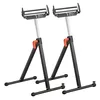
VEVOR 2-Pack Folding Roller Stands (27-43 in), $45.82 Two matched stands let you set the same support height at the infeed and the outfeed, which is the fix for the unsupported board ends this guide keeps coming back to.
|
|||
As an Amazon Associate we earn from qualifying purchases.
Planer Snipe Symptoms: What the Dip Tells You
Where the dip shows up points toward the cause. The chart below is a field guide built from the roller-and-table mechanism the sources describe, not a lab result, so treat it as a first guess and confirm with the test in the measuring section.
| What you see | Likely cause | First thing to try |
|---|---|---|
| Dip at both ends, similar depth | Roller pressure changes as the board enters and leaves, plus table flex | Feed boards in a train with sacrificial boards, lighten the last pass, lock the carriage if yours has a lock |
| Dip at the leading end only | Infeed support or table height not matching the bed, so the board enters tilted | Check the infeed table or stand against a straightedge laid across the bed |
| Dip at the trailing end only | The tail of a long board sags or lifts once it leaves the infeed roller | Add an outfeed-side stand and have the tail supported at bed height |
| Wavy cuts or marks along the whole board | Not snipe: warp, chips on the bed, or dull or nicked knives | See our guide to why a planer leaves lines, and flatten the board first |
Seven Ways to Prevent Planer Snipe
These seven fixes are ordered roughly from biggest effect to smallest. Most shops get the result they want from the first three.
1. Support Both Ends at Bed Height
A board that droops or lifts as it leaves a roller changes the pressure the cutter sees. Roller stands, or infeed and outfeed tables that sit in the same plane as the bed, keep it level. Lay a straightedge across the joint between each table and the bed and look for a gap or a step. Wikipedia lists supporting long pieces level with the planer table on stands or roller supports as a standard remedy.
The same support idea shows up on the table saw, where an outfeed surface keeps long stock from tipping. If you are building shop support anyway, see our guide to building a table for a table saw and our look at a portable outfeed table, then size the stands for the planer the same way.
For very long boards, one Woodweb entry suggests setting the far ends of long infeed and outfeed conveyors 1 to 2 inches higher than the planer table to counter sag. That advice was written about large machines, so on a benchtop planer start level and only adjust if the board still dips.
2. Feed Boards in a Train With Sacrificial Boards
Feed a scrap board of the same thickness in front of your workpiece and another behind it, butted end to end so the rollers never lose their grip on a continuous surface. The scrap boards take the snipe, and Wikipedia notes they can be reused as long as they match the final thickness. This costs only some scrap and works on any planer, so it is the best first fix if you do not own stands.
3. Take a Light Final Pass
The deeper the cut, the harder the rollers have to press, and the bigger the pressure change at each end. Wikipedia recommends making the final pass at reduced cutting depth. A common rule of thumb is 1/16 inch or less for finishing passes. For reference, the DeWalt DW734 manual lists a maximum depth of cut of 1/8 inch for boards 6 inches wide or less, so a 1/16 inch finishing pass is half of the machine’s limit.
4. Keep Infeed and Outfeed Tables Coplanar With the Bed
Extension tables help only when they sit in the same plane as the bed. A table that is even slightly low turns every board into a ramp. Check with a straightedge, then adjust the table screws until the straightedge rests flat across both surfaces. Many benchtop planers, including the DeWalt DW733, have adjustable tables for this reason.
5. Lock the Cutter Head Carriage If Your Planer Has a Lock
Wikipedia notes that some planers include a lock that supports the table or cutter head assembly more firmly, and the DeWalt DW734 manual describes a four-column carriage lock meant to minimize movement and reduce snipe. Check your own manual for a lock lever, and release it again before changing the cutting depth.
6. Lift or Support the Tail Gently
On long boards, have a helper or a stand carry the tail so its weight does not tip the board as it clears the infeed roller. Keep any hand pressure light and away from the infeed opening.
7. Start With Flat, Sharp, Clean Stock
Snipe is not caused by dull knives, but sources including Woodweb and Woodworks Library list sharp knives and a clean, waxed bed as part of a good setup, because worn knives raise cutting force and debris on the bed can disturb how a board sits. Flatten badly warped stock first, since a planer follows a bent board instead of straightening it. If the problem is a wavy surface rather than end dips, see why a planer leaves lines.
How to Measure Your Planer’s Snipe
Most articles stop at “reduce snipe.” You will make better decisions if you know the number for your machine. Wikipedia states that larger, stiffer planers typically leave snipe of 0.002 inch or less, so a measured value well above that points to a setup problem you can fix.
- Joint or choose a straight scrap board about 24 inches long and feed it through at your normal finishing depth with no stands or sacrificial boards.
- Measure thickness with calipers at about 1 inch, 3 inches and 6 inches from each end, and at the middle.
- Subtract each end reading from the middle reading. The largest difference is your snipe depth, and the distance where it disappears is your snipe length.
- Repeat with stands or a sacrificial train. The change tells you which fix is worth keeping.
- Add that snipe length to every part you cut so the dip lands in the offcut.
The exact numbers vary by machine, board and depth, so run this on your planer rather than trusting a number from a website, including ours.
Thin Stock, Short Boards and Sleds
Thin boards flex more. The Woodweb entry reports that boards under about 7/8 inch are more prone to snipe and describes an auxiliary table about 3/4 inch thick to support stock thinner than 5/8 inch. That works on the same principle as a sled, which is a flat carrier board that the workpiece rides on. The sled’s own ends exit the planer, so they take the snipe instead of the workpiece, much like the sacrificial train above. Make sure the workpiece cannot shift on the sled, and follow your planer manual for minimum stock thickness.
Short boards are a separate limit. The DeWalt DW734 manual says the machine cannot plane wood shorter than 12 inches, so glue short pieces to a longer carrier or choose another tool for them. A spiral cutterhead is often pitched as a snipe cure, but the mechanism described above is rollers and table flex, so view it mainly as a tear-out and noise upgrade; see our spiral vs straight planer comparison for the trade-offs.
Fixing Snipe After It Happens
If a board already has snipe, you have three options from Wikipedia’s list of remedies: cut the sniped ends off if the board is long enough, level the dip with a jointer or drum sander, or work it out by hand sanding or planing. Hand work can cost some flatness, so stop as soon as the straightedge rests flat. For wide glued panels or slabs, our guides to flattening a wood slab and handheld versus benchtop planers show which tool suits which job.
Prep Your Wood Before It Reaches the Planer
Clean, square-ended boards feed more evenly. Cut parts a bit long so the snipe lands in the waste, and avoid loose knots or cracks right at the ends, where the cutter is most likely to catch and chip.

Planer Safety Notes
Follow your planer’s manual for minimum and maximum board dimensions and depth of cut, such as the 12 inch minimum length in the DW734 manual. Never reach into the infeed or outfeed opening while the machine runs, keep hands clear of the board ends, and wear eye and hearing protection with dust collection connected. Planers are loud and throw heavy chip loads. These are general precautions rather than a substitute for your machine’s manual.
Snipe-Prevention Methods Compared
| Method | Setup effort | Cost | Best for |
|---|---|---|---|
| Roller stands (matched pair) | About 10 minutes once, then recheck height | Roughly $35 to $70 for a pair | Long boards and repeated milling |
| Sacrificial board train | None, per batch | Scrap wood | One-off boards and no stands on hand |
| Light final pass | None, slower milling | Free | Figured or wider stock |
| Coplanar tables and carriage lock | Straightedge check, a few adjustments | Free | Every machine that has adjustable tables or a lock |
| Sled or carrier board | 30 to 60 minutes to build | Scrap wood | Thin, short or warped stock |
Frequently Asked Questions
What causes snipe on a planer?
Snipe is caused by a change in the downward force the feed rollers put on the board as its ends enter and leave the machine. That change lets the planer table flex, so the cutter head takes a slightly deeper bite over the first and last few inches. A board end that is not supported at bed height makes it worse.
How do you prevent snipe on a thickness planer?
Support both ends of the board at the same height as the planer bed, keep the infeed and outfeed tables coplanar with the bed, take light final passes, and feed boards end to end so a scrap board takes the snipe instead of your workpiece. Locking the cutter head carriage, if your planer has a lock, also helps.
Do dull knives cause planer snipe?
Not by themselves. The sources we read trace snipe to roller pressure changes and table flex. Dull knives raise cutting force and tear the wood, which can make the dip worse, but sharpening alone will not cure a setup problem.
Does feeding a board at an angle stop snipe?
Angling the board is a popular trick, but we did not find a manufacturer or standards source that measures it. Treat it as something to test on scrap, and rely on support, shallow passes and sacrificial boards, which the sources do back.
How much snipe is normal?
Some snipe is normal on most machines. Wikipedia notes that larger, stiffer planers typically leave 0.002 inch or less, so a lighter machine will often show more. Measure your own machine on a scrap board with calipers so you know how much length to add to each part.
How do you keep a handheld electric planer from breaking out the end of a board?
This is tear-out at the end of a pass rather than snipe. A common fix is to clamp a scrap block flush against the far end so the cutter exits into the scrap, or to plane in from both ends toward the middle. Test the setup on an offcut first.
Conclusion
Snipe is a support problem more than a sharpness problem. Match your support height to the bed, feed boards in a train, finish with a light pass, and measure your machine once so you know how much length to allow. If one change is all you can afford, make it the sacrificial boards, and add stands when you mill long stock often.
Sponsored / affiliate links. As an Amazon Associate I earn from qualifying purchases. I may earn additional commission from eligible campaigns.