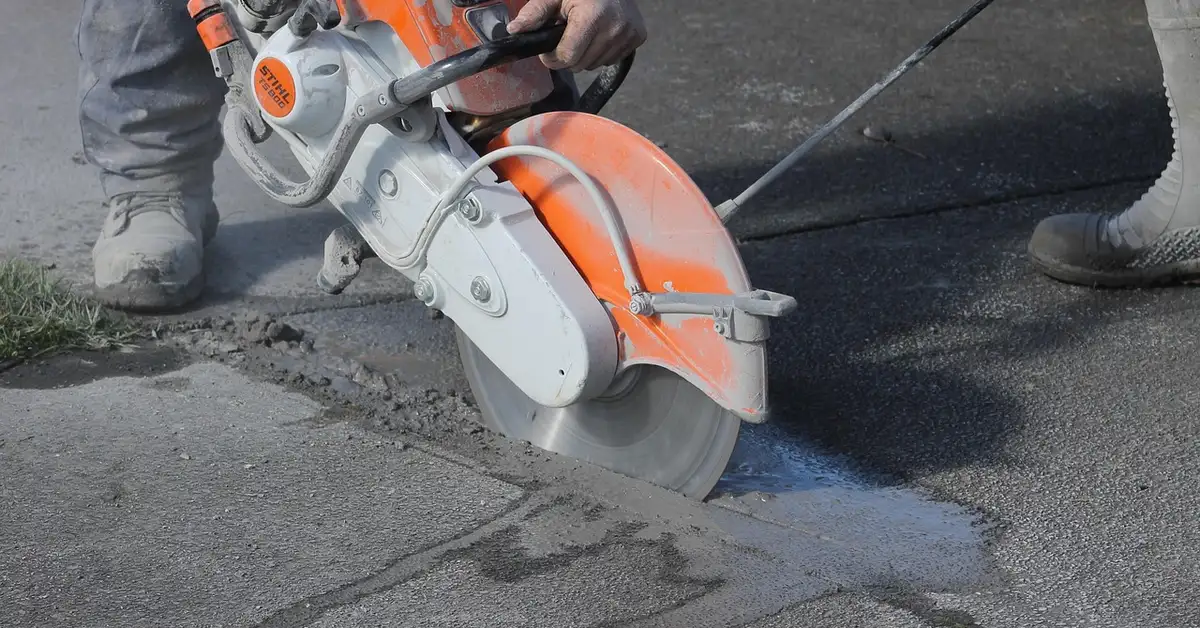
Best Circular Saw Blade for Concrete: 7 Diamond Blades (2026)
The best circular saw blade for concrete for most jobs is the Bosch DBS0702 (7" segmented rim, $26.72) — a medium-hardness bond that handles concrete, brick, block and pavers without swapping blades between materials. If you know in advance you’ll hit rebar, the DEWALT DW4712B below is the documented, cheaper alternative built for it. Below is a compiled table of 7 real diamond (and one abrasive) blades — bond type, arbor size, max RPM and an estimated cost per 1,000 feet of cut — sourced from Bosch, DEWALT, Makita, Diablo and IVY Classic’s own spec pages and Amazon’s live catalog data, not marketing copy.
None of these blades were physically mounted on a saw and run through concrete for this article — see How We Picked These for exactly what “compared” means here. What follows instead is something none of the other concrete-blade roundups currently ranking for this keyword have: a real spec table with bond type, RPM and arbor size side by side, the actual safety rule for matching blade RPM to your saw, and an honest breakdown of why a $9 abrasive disc and an $11 diamond blade are not the same product even though they look interchangeable on a shelf. If you’re cutting with a miter saw instead, our separate guide to diamond blades for miter saws covers that tool specifically — the blades below are sized and reviewed for circular saws.
Concrete Blade Comparison: Bond Type, Wet/Dry & Cost per 1,000 ft
Every concrete-blade page says to look for a “diamond blade.” None of them tell you that segmented, turbo, continuous rim and plain abrasive discs are four genuinely different products that behave differently on rebar, wet vs. dry cutting, and cost per cut. Here’s the compiled data, current as of August 2026.
| Blade | Bond / Rim Type | Diameter / Arbor | Wet/Dry | Max RPM | Price | Est. Cost / 1,000 ft | Best For |
|---|---|---|---|---|---|---|---|
| Bosch DBS0702 | Segmented rim | 7" / 7/8" arbor (diamond knockout) | Wet or dry | Not published | $26.72 | $5.34–$8.91¹ | #1 Best Overall |
| DEWALT DW4712B | Segmented rim | 7" / 5/8" arbor (diamond knockout) | Dry | 8,700 | $11.93 | $2.39–$3.98¹ | Best for Concrete with Rebar |
| Bosch DBT0701 | Turbo rim | 7" / 7/8" arbor (diamond knockout) | Wet or dry | Not published | $25.99 | $5.20–$8.66¹ | Best for Fast, Smooth Cuts |
| Makita E-02515 | Segmented rim (laser-welded) | 9" / 7/8" & 5/8" arbor (bushed) | Wet or dry | 6,650 | $44.39 | $8.88–$14.80¹ | Best for Large-Diameter, Deep Cuts |
| DEWALT DW4725 | Continuous rim | 4-1/2" / 7/8" arbor | Dry | 13,300 | $8.79 | Not comparable² | Best for Compact Circular Saws |
| Diablo DMADST0700 | Segmented rim | 7" / 7/8" & 5/8" arbor (bushed) | Wet or dry | 8,450 | $43.76 | $8.75–$14.59¹ | Best for Blade Life |
| IVY Classic Swift Cut | Abrasive (not diamond) | 8" / 5/8" arbor (diamond knockout) | Dry | 7,500 | $11.20 | Not comparable² | Best Ultra-Budget, Single-Project Pick |
¹ Cost per 1,000 linear feet is a computed estimate, not a tested figure: price ÷ (assumed blade life in feet ÷ 1,000), using the 3,000–5,000 linear-foot life range industrial suppliers (Defusco Industrial Supply) cite as typical for a segmented or turbo diamond blade in general concrete. Actual life varies with aggregate hardness, technique, and wet vs. dry use — Diablo’s own “up to 2X longer life” claim for the DMADST0700 is not folded into this baseline; see its review below. ² DW4725 (4-1/2", shallow compact-saw cuts) and the IVY Classic (abrasive, not diamond) aren’t directly comparable to the 7–9" segmented/turbo blades on this metric — see the diamond-vs-abrasive section below. Sources: DEWALT DW4712B spec page, DEWALT DW4725 spec page, Makita and Diablo manufacturer/retailer-mirrored spec sheets, and Amazon Creators API catalog data (arbor, dimensions, availability), pulled August 2, 2026. Prices verified live the same day.
What “Segmented,” “Turbo” and “Continuous Rim” Actually Mean
The rim style is the single biggest factor in how a blade cuts, and it’s the spec every one of the other roundups for this keyword mentions without actually explaining the mechanism. (For the broader wood-cutting blade categories — rip, crosscut, combination — our guide to types of circular saw blades covers those separately; diamond and abrasive blades for masonry work on a different set of rules.)
- Segmented rim — the diamond edge is broken into individual segments with open gaps between them. Those gaps clear dust and debris fastest and let the blade flex slightly, which is why segmented blades tolerate incidental rebar contact better than the other two rim styles. The DEWALT DW4712B, Bosch DBS0702, Diablo DMADST0700 and Makita E-02515 in this comparison are all segmented.
- Turbo rim — a continuous rim with a serrated wave pattern ground into the edge. It keeps most of the smooth cut face of a true continuous rim while adding enough of a gap to clear debris faster and cut quicker than a plain continuous blade. The Bosch DBT0701 is the turbo pick here.
- Continuous rim — a solid, unbroken diamond edge with no gaps at all. It leaves the cleanest cut face of the three but runs hotter and clears debris slowest, which is why continuous-rim blades are usually the smaller, detail-cutting sizes (the DEWALT DW4725 here) rather than the blade reaching for a full-depth slab cut.
Matching Blade RPM to Your Saw — Before You Ever Cut
This is the safety fact every other page in this keyword’s search results skips: a blade’s max RPM rating is a ceiling, not a suggestion. It must meet or exceed your saw’s no-load RPM — not just be “close enough.” A standard 7-1/4" corded circular saw typically runs 5,200–5,800 RPM no-load, well under every rated blade in this table. The real risk shows up when a blade rated for a saw gets moved to a tool that spins faster, most commonly an angle grinder — many small grinders run 11,000–12,000 RPM, which is why the IVY Classic’s 7,500 max RPM rating, for example, makes it unsuitable for a fast angle grinder even though the arbor happens to fit. Bosch doesn’t publish a max RPM figure for the DBS0702 or DBT0701 on its general product page — that gap is disclosed rather than filled with a guess, and it’s worth checking the RPM stamped directly on the blade itself before mounting it on anything.
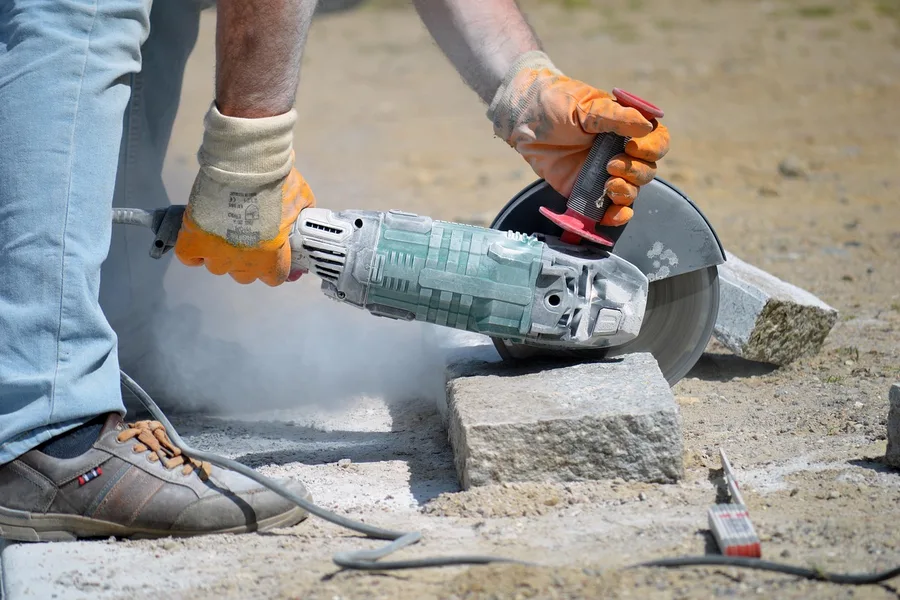
The Real Cost: Sticker Price vs. Cost per 1,000 Feet of Cut
The cheapest blade on the shelf is not always the cheapest blade to actually use. The DEWALT DW4712B at $11.93 and the Bosch DBS0702 at $26.72 are both segmented 7" blades, but on the industry-typical 3,000–5,000 linear-foot life range, the DW4712B works out to roughly $2.39–$3.98 per 1,000 feet of cut against the Bosch’s $5.34–$8.91 — the DEWALT is cheaper on both metrics for a job that doesn’t need the Bosch’s wet-cutting capability. The math flips for infrequent, single-project use, which is exactly where the IVY Classic abrasive disc below earns its place instead of any diamond blade in this table.
Best Circular Saw Blades for Concrete
1. Bosch DBS0702 7 in. Premium Segmented Rim Diamond Blade — #1 Best Overall
- Price: $26.72 (live, Amazon)
- Specs: 7" dia., segmented rim, 7/8" diamond-knockout arbor, wet or dry cutting, medium-hardness bond per Bosch’s line copy
- Best for: Anyone who wants one blade that handles concrete, brick, block and pavers without swapping for different jobs
Bosch doesn’t publish a max RPM figure for the DBS0702 on its general product page — that’s disclosed below rather than guessed at — but everything else about it fits the definition of a genuine all-purpose concrete blade. The segmented rim (gaps cut between diamond sections) is the configuration that clears dust and debris fastest, which is exactly what a blade needs when it’s being asked to cut concrete, block, brick and pavers on the same job rather than one narrow material. Bosch markets the bond as a medium-hardness formulation, which is the safer default when you don’t know in advance whether you’ll hit harder aggregate or softer cured concrete.
Main drawback: at $26.72 it costs more than twice as much as the DEWALT DW4712B below, and Bosch’s own page doesn’t publish a max RPM or segment height — if you want a documented number for either spec before you buy, the DEWALT or Diablo picks below give you one.
View current price on Amazon →
2. DEWALT Diamond Blade for Masonry, High Performance, 7-Inch (DW4712B) — Best for Concrete with Rebar
- Price: $11.93 (live, Amazon)
- Specs: 7" dia., segmented rim, 5/8" diamond-knockout arbor, 7mm segment height, .090" edge thickness, 8,700 max RPM, dry cutting
- Best for: Cutting cured concrete that may hit rebar without a full blade swap mid-job
This is the one blade in the table with a fully documented spec sheet on DEWALT’s own site: 8,700 max RPM, a 7mm segment height, and a .090" edge thickness. Segmented rim blades tolerate incidental rebar contact far better than continuous rim blades do — the gaps between segments let the blade flex slightly and clear metal dust instead of binding — which is why this is the pick for slab or footing demolition where you don’t have X-ray vision into what’s inside the concrete. At $11.93 it’s also the cheapest 7" segmented pick in this comparison by a wide margin.
Main drawback: DEWALT’s own page rates this one dry-cutting only, unlike the Bosch and Diablo picks — if you need wet capability for indoor or low-dust work, look to the Bosch DBS0702 or Diablo DMADST0700 instead. A 7mm segment height is also on the shorter side next to the Makita’s 13mm, meaning less usable diamond before it’s worn to the core.
View current price on Amazon →
3. Bosch DBT0701 7 in. Premium Turbo Rim Diamond Blade — Best for Fast, Smooth Cuts
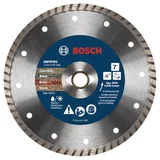
- Price: $25.99 (live, Amazon)
- Specs: 7" dia., turbo (serrated continuous) rim, 7/8" diamond-knockout arbor, wet or dry cutting
- Best for: Faster feed rates and a smoother cut face than a segmented blade leaves behind
A turbo rim is a continuous rim with a serrated wave pattern cut into the edge — it keeps the smoother cut face of a continuous-rim blade while adding just enough gap for faster dust and debris clearing, which is why Bosch markets this line around cutting speed rather than roughness tolerance. It’s the right choice when the cut face itself matters — a visible edge on a paver or a step — and you don’t expect to hit rebar or heavy aggregate.
Main drawback: like the DBS0702 above, Bosch doesn’t publish a max RPM figure for this blade on its general product page. A turbo rim also isn’t the first choice for reinforced concrete — the DEWALT DW4712B’s open segments handle incidental rebar contact more gracefully than a turbo blade’s tighter serrations.
View current price on Amazon →
4. Makita E-02515 9" Diamond Blade, Segmented, General Purpose — Best for Large-Diameter, Deep Cuts
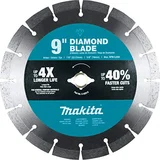
- Price: $44.39 (live, Amazon)
- Specs: 9" dia., laser-welded segmented rim, 7/8" arbor with 5/8" bushing, 13mm segment height, 6,650 max RPM, wet or dry cutting
- Best for: 9" circular saws and cut-off saws making deeper single-pass cuts
Most of the blades in this comparison are 7" because that’s the most common circular saw diameter, but a 9" saw cuts roughly 1” deeper per pass — the difference between needing two passes through a 4″ slab and needing one. Makita publishes a genuinely documented 13mm segment height, the tallest published number in this table, and laser-welds the segments to the core instead of sintering or brazing them, which is the strongest of the three attachment methods against segment loss under heavy use.
Main drawback: at $44.39 it’s the most expensive blade here, and a 9" blade only fits saws built for that diameter — check your saw’s max blade capacity before buying, since forcing an oversized blade onto a saw is a genuine safety hazard, not just a fit issue.
View current price on Amazon →
5. DEWALT Diamond Blade for Masonry, Dry Cutting, Continuous Rim, 7/8-Inch Arbor, 4-1/2-Inch (DW4725) — Best for Compact Circular Saws
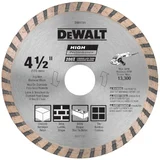
- Price: $8.79 (live, Amazon)
- Specs: 4-1/2" dia., continuous rim, 7/8" arbor, 13,300 max RPM, dry cutting only
- Best for: Compact and cordless circular saws that can’t fit a 7" blade
Small circular saws and trim saws max out around 4-1/2" to 5-3/8", and DEWALT’s own product page for the DW4725 confirms a 13,300 max RPM — the highest published rating in this comparison, which matters because compact tools spin faster than full-size saws to make up for the smaller diameter. The continuous rim leaves a cleaner edge than a segmented blade would at this size, useful for detail cuts around outlets or fixtures in masonry.
Main drawback: dry cutting only per DEWALT’s own listing, and a 4-1/2" blade cuts under 1-1/2" deep — fine for scoring, notching and thin material, not for cutting through a full-depth slab in one pass.
View current price on Amazon →
6. Diablo Diamond Segmented Masonry Cut-Off Blade for Concrete, Brick and Block — 7" (DMADST0700) — Best for Blade Life
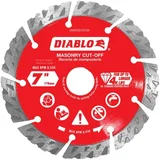
- Price: $43.76 (live, Amazon)
- Specs: 7" dia., segmented rim, DM 7/8" & 5/8" arbor with included bushing, 2.6mm kerf, 8,450 max RPM, wet or dry cutting
- Best for: Frequent or professional-volume cutting where blade replacement cost adds up
Diablo states the DMADST0700’s taller segments deliver “up to 2X longer life” against a standard segmented blade — a manufacturer comparative claim, not an independently tested number, so treat it as directional rather than exact. What is independently confirmed via Amazon’s own catalog data is a real 2.6mm kerf and 8,450 max RPM, both on the higher end of this comparison, plus a hardened disc body Diablo markets for impact resistance against the kind of embedded debris that chips a lesser blade’s core.
Main drawback: at $43.76 it’s tied for the most expensive pick here, and the “2X longer life” claim is Diablo’s own comparison, not a figure this article independently verified — treat the cost-per-1,000-ft estimate in the table as a baseline, not Diablo’s best-case number.
View current price on Amazon →
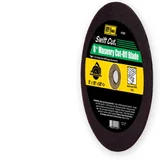
7. IVY Classic 41022 Swift Cut 8-Inch Diamond Knockout Arbor Masonry Cut-Off Blade — Best Ultra-Budget, Single-Project Pick
- Price: $11.20 (live, Amazon)
- Specs: 8" dia., resin-bonded silicon-carbide abrasive disc (not diamond), fiberglass-reinforced, 5/8" diamond-knockout arbor, 7,500 max RPM
- Best for: A single small job where buying a diamond blade doesn’t make financial sense
This is the one blade in the comparison that isn’t diamond at all — IVY Classic’s own listing describes a resin-bonded silicon-carbide abrasive disc, the same cutting technology as a basic angle-grinder cutoff wheel, reinforced with a fiberglass mesh for safety. It’s genuinely rated for brick, concrete block, slate and tile, and at $11.20 it’s one of the cheaper blades here. It also spins to 7,500 max RPM and uses the same 5/8" diamond-knockout arbor as most of the diamond picks, so fit isn’t the issue.
Main drawback: abrasive discs wear away with every cut instead of exposing fresh diamond crystals, so this blade doesn’t belong in the cost-per-1,000-ft table with the diamond picks above — it’s genuinely a different product category, good for one small project and not a substitute for a diamond blade on repeat use. See the diamond-vs-abrasive section below before treating this as a like-for-like budget alternative to the DEWALT DW4712B.
View current price on Amazon →
How We Picked These
None of these seven blades were physically mounted on a saw and run through concrete for this article — that needs to be stated plainly rather than implied away. What this comparison is built from instead:
- Manufacturer spec pages for arbor size, max RPM, segment height and kerf, pulled directly from DEWALT’s own product pages (DW4712B, DW4725) and from Amazon’s own catalog data for dimensions and confirmed compatibility on the rest.
- Live pricing and availability verified through the Amazon Creators API on August 2, 2026 — every price, stock status and product link in this article reflects that pull, not a cached number from an earlier version of this page. The original version of this page recommended a blade that is now out of stock; that pick has been removed rather than left up.
- Published industry references (Defusco Industrial Supply, Bartell Global, Diamond Tool Store) for the segment-life range behind the cost-per-1,000-ft estimate and the segment-wear retirement rule, with the formula and inputs shown rather than an unsourced number.
- Manufacturer feature copy and exclusion language read directly from each product’s own listing — this is how the IVY Classic pick was correctly identified as an abrasive disc rather than a diamond blade, a distinction the product category on Amazon doesn’t make clear on its own.
Where a spec couldn’t be confirmed from a source above — Bosch doesn’t publish max RPM or segment height for the DBS0702 or DBT0701 on its general product pages — the table says “Not published” rather than estimating a number. That’s two gaps out of 56 data points in the table above, disclosed rather than filled.
What to Consider When Buying a Concrete Blade
Bond Hardness: Matching the Blade to Your Concrete
Bond hardness is the spec almost no consumer-facing listing states in plain numbers, but it’s a bigger factor in blade life than segment height alone: a soft bond wears faster to keep exposing sharp diamond, which is what you want for hard, dense, fully cured concrete or hard aggregate — a hard bond would just glaze over and stop cutting efficiently. A hard bond wears slower, which is what you want for softer, more abrasive material like green (not fully cured) concrete, asphalt, or soft brick — a soft bond would wear away too fast and you’d burn through blades. Bosch describes the DBS0702’s bond as medium-hardness, which is the safer default when the job mixes material types or you don’t know the aggregate in advance.
Diameter & Arbor Compatibility
Blade diameter is set by your saw, not by preference — check your saw’s max blade capacity before buying anything (our circular saw buying guide lists blade capacity for current models if you’re choosing both at once). 7" is the most common circular saw diameter and covers five of the seven picks above; 9" (the Makita E-02515) fits larger cut-off saws and cuts roughly 1” deeper per pass; 4-1/2" (the DEWALT DW4725) fits compact and cordless saws — the same size class covered in our 6-1/2" circular saw blade guide for wood-cutting blades on the same compact tools. Arbor size is the more common fit mistake: most of these blades use a 7/8" arbor with a diamond-knockout center that punches out to fit a 5/8" spindle, or ship with a separate 5/8" reducer bushing — check which your specific saw needs before assuming a blade will drop straight on.
Wet vs. Dry Cutting: What the Manufacturers Actually Say
Several competing pages for this keyword describe wet and dry cutting as if either one is simply an optional preference. It isn’t. Continuous rim and turbo rim blades used dry for extended periods overheat far faster than segmented blades, because they have less open gap to shed heat and dust. Industry guidance from Norton Abrasives and ForConstructionPros is consistent on the technique this actually requires for dry cutting: run the blade in short bursts — roughly 30–60 seconds of cutting followed by 15–20 seconds of free-spinning with no material contact to let it cool — rather than pushing continuously through a long cut. Skipping that cooling step is a common way to lose segments early or warp the steel core, which shows up as a wobbling, inaccurate cut long before the diamond itself is worn out. Wet cutting sidesteps the issue by using water to carry the heat away continuously, which is why the DW4712B and DW4725 in this comparison — both dry-only per their own spec pages — are the ones where this technique matters most.
Material Compatibility: Concrete, Block, Brick, Pavers & Rebar
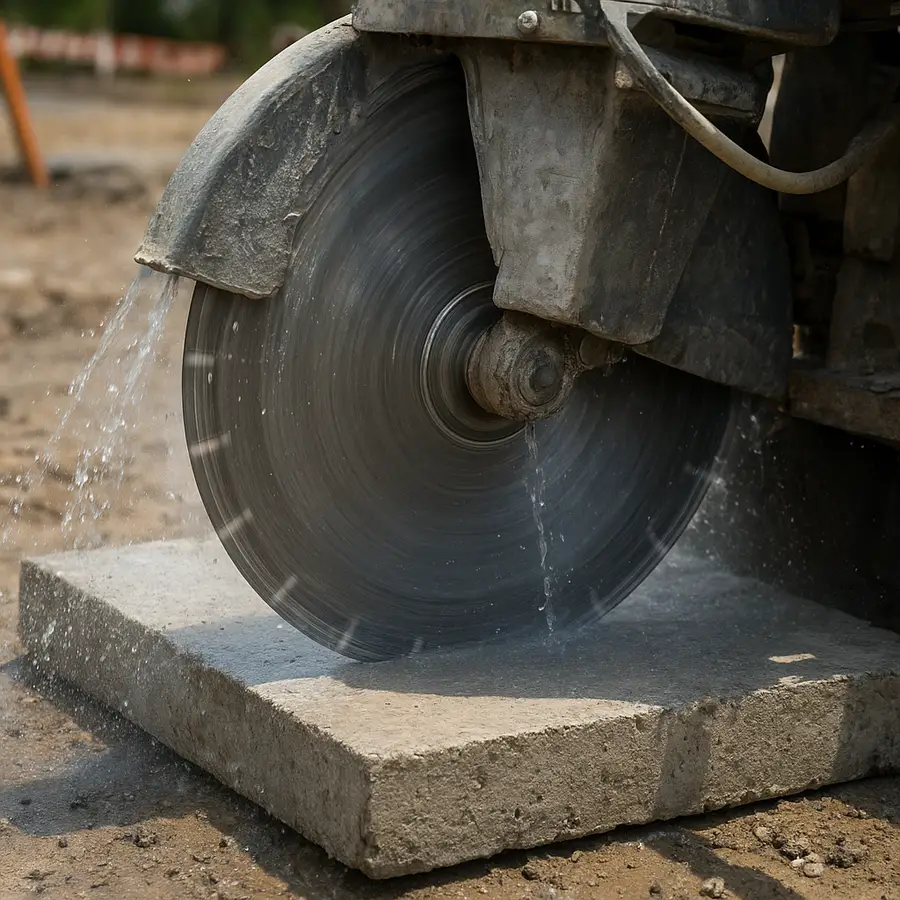
Every blade in this comparison is rated for concrete, block, brick and pavers — that much is consistent across all seven listings. Rebar tolerance is the real differentiator: segmented blades (DW4712B, DBS0702, DMADST0700, E-02515) tolerate incidental contact with embedded rebar far better than continuous or turbo rim blades, because the open segment gaps flex and clear metal dust instead of binding against it. None of the manufacturers in this comparison explicitly recommend any of these blades for asphalt — asphalt cutting typically calls for a different, softer-bond blade formulated for that specific abrasive, and none of the seven product pages here list it as a target material. Fiber-cement siding is also a different job with different blade needs — see our dedicated cement board saw blade guide rather than reaching for a poured-concrete blade for that material. For technique beyond blade selection — how to actually guide a cut through masonry — our masonry cutting technique guide covers the process side of the job this article’s blade comparison doesn’t.
Diamond vs. Abrasive Blades: Why the $9 Option Isn’t Really Cheaper
The IVY Classic Swift Cut above is genuinely useful, but it’s a resin-bonded silicon-carbide abrasive disc — the same cutting technology as a basic angle-grinder cutoff wheel — not a diamond blade, even though it sits in the same Amazon search results and fits the same arbor. DEWALT’s own DW4725 listing states its diamond matrix provides “200x the life of conventional abrasives,” and while that’s a manufacturer marketing claim rather than an independently tested figure, the underlying mechanism is real and well documented: an abrasive disc wears away with every cut as its grain dulls and sheds, while a diamond blade continuously exposes fresh diamond crystals as the bond wears, which is why diamond blades last for thousands of linear feet instead of a handful of cuts. For one small job, the $11.20 abrasive disc is the honestly cheaper choice. For anything beyond that, a diamond blade’s higher sticker price is offset within a small number of cuts.
Segment Height & Wear Life
Segment height is published for only two of the seven diamond blades here — 7mm for the DEWALT DW4712B, 13mm for the Makita E-02515 — and that gap is typical of this category, not a flaw specific to these listings; most manufacturers simply don’t publish it on consumer-facing pages. The number that does exist as a consistent, citable rule across industry sources (Bartell Global, Diamond Tool Store): retire a diamond blade once its segments wear down to about 1/8" (3mm) of remaining height — a blade worn past that point loses cutting speed sharply and risks core damage from running the steel base directly against material. A taller published segment height, like the Makita’s 13mm, simply means more usable wear reserve before hitting that 3mm floor.
Kerf & Cutting Speed
Kerf (the width of the slot the blade cuts) is published for two of the seven picks: .090" for the DEWALT DW4712B and 2.6mm (about .102") for the Diablo DMADST0700. A thinner kerf removes less material per cut, which means less resistance, less dust, and typically a faster feed rate for the same motor power — the tradeoff most buyers never hear about is that a thinner kerf blade can also flex and wander more under side pressure than a thicker one, which matters more on a long freehand cut than a guided one.
Safety Gear & Dust Control
Concrete dust contains crystalline silica, and cutting it — wet or dry — is a recognized respiratory hazard covered by OSHA’s silica dust standard for construction work. A NIOSH-rated respirator (not a basic paper dust mask), safety glasses and hearing protection are the baseline for any dry cut; wet cutting cuts airborne dust dramatically but doesn’t eliminate the need for eye and ear protection. None of the blades in this comparison change that requirement — it applies regardless of which one is mounted on the saw.
How to Mount and Cut Concrete with a Diamond Blade
- Confirm your saw’s max blade diameter and RPM against the blade’s own rating — the blade’s max RPM must meet or exceed the saw’s no-load RPM, never the reverse.
- Check the arbor: fit the blade directly if it matches your spindle size, or knock out the diamond-knockout center and use the included reducer bushing if your saw uses the smaller size.
- Confirm the rotation direction arrow on the blade matches your saw’s blade rotation before tightening anything.
- Tighten the arbor nut to the saw manufacturer’s spec — overtightening can crack a blade’s core, undertightening lets it wobble.
- With the saw unplugged or the battery removed, spin the blade by hand to confirm it turns freely with no rubbing against the guard.
- Mark your cut line, and set blade depth about 1/8”–1/4” deeper than the material thickness — deep enough to cut through cleanly without exposing more spinning blade than necessary.
- For dry cutting, plan on 30–60 second cutting bursts with 15–20 seconds of free-spin cooling between them, per the wet-vs-dry section above. For wet cutting, set up a continuous water feed at the blade before starting the cut, not partway through.
- Wear a NIOSH-rated respirator, safety glasses and hearing protection for the entire cut, regardless of wet or dry method.
Frequently Asked Questions
What is the best circular saw blade for cutting concrete?
For most jobs, the Bosch DBS0702 (7" segmented rim) in this comparison is the strongest all-around pick — a medium-hardness bond rated for wet or dry cutting across concrete, brick, block and pavers. If you know the concrete has embedded rebar, the DEWALT DW4712B’s segmented rim and documented 8,700 max RPM make it the better-suited, cheaper option.
Can a regular circular saw blade cut concrete?
No — a standard carbide-tipped wood blade will dull or shatter almost immediately against concrete or masonry. Concrete requires a diamond blade (or, for light single-project use, an abrasive masonry disc like the IVY Classic Swift Cut in this comparison) rated for that material.
Do I need a wet or dry cutting blade for concrete?
It depends on the blade and the job, not personal preference. Continuous and turbo rim blades run hot fast and are best suited to wet cutting or short dry bursts; segmented blades like the DEWALT DW4712B and DW4725 in this comparison are dry-only per their own spec pages and rely on the segment gaps plus intermittent cutting technique to manage heat instead of water.
What size diamond blade fits my circular saw?
7" fits the vast majority of full-size circular saws and covers five of the seven blades in this comparison. Compact and cordless trim saws typically need a 4-1/2" blade like the DEWALT DW4725. Larger 9" blades like the Makita E-02515 need a saw rated for that diameter — check your saw’s max blade capacity before buying, since an oversized blade is a genuine safety hazard, not just a fit problem.
What’s the difference between a segmented, turbo and continuous rim diamond blade?
Segmented rim blades have gaps between diamond sections for the fastest debris clearing and the best tolerance for incidental rebar contact. Turbo rim blades are a continuous rim with a serrated wave pattern, balancing cutting speed with a smoother edge. Continuous rim blades have no gaps at all, leaving the cleanest cut face but running hottest and clearing debris slowest.
Are cheap masonry blades worth buying?
For a single small project, yes — an abrasive disc like the IVY Classic Swift Cut ($11.20) is a genuinely reasonable choice. For repeat or professional-volume use, a diamond blade’s higher upfront price pays for itself within a small number of cuts, since abrasive discs wear away with every cut while diamond blades expose fresh cutting material as the bond wears.
How long does a diamond concrete blade last?
Industrial suppliers cite roughly 3,000–5,000 linear feet of cutting life as typical for a segmented or turbo diamond blade in general concrete, and the standard retirement rule is to replace a blade once its segments wear down to about 1/8” (3mm) of remaining height. Actual life varies significantly with aggregate hardness, dry vs. wet use, and whether the blade is run in short cooling bursts or pushed continuously.
Final Thoughts
The Bosch DBS0702 is the strongest all-around pick in this comparison — a medium-hardness segmented blade rated for both wet and dry cutting across concrete, brick, block and pavers, without needing to swap blades between materials. But the single number worth carrying away from this whole comparison isn’t a product name: it’s that a blade’s max RPM rating has to meet or exceed your saw’s no-load RPM before it ever touches concrete, and that a $9 abrasive disc and an $11 diamond blade that look interchangeable on an Amazon results page are genuinely different products with different lifespans. Match the bond and rim type to the job, not just the price tag.
Sponsored / affiliate links. As an Amazon Associate I earn from qualifying purchases. I may earn additional commission from eligible campaigns.