Best Mop for Wood Floors: 7 Compared by Water Control (2026)
The O-Cedar EasyWring Microfiber Spin Mop & Bucket System is the best manual mop for wood floors: its hands-free foot-pedal wringer gets the microfiber head genuinely damp-not-wet, the closest a bucket-and-mop system gets to the low-moisture standard hardwood needs. This page covers manual mops only — string, flat and spray mechanisms — compared on wring-dry moisture control, refill cost-per-use, and where each one is (and isn’t) safe for a wood floor. For motorized spin and steam mops, see our electric mop guide instead.
7 Manual Mops for Wood Floors Compared
Every cell below comes from this session’s live Amazon Creators API pull and each product’s own manufacturer-published features — not a competitor’s numbers. The Residual-Moisture column is a mechanism-level tier we built by cross-referencing each mop’s wringing (or non-wringing) hardware against the NWFA-sourced moisture ratings in our hardwood cleaning-methods dataset, which names hand-wrung “bucket-and-mop” as a method to avoid on hardwood, full stop. Not every bucket-and-mop system wrings the same — that gradient is the point of this table. A spin mop with a foot-pedal wringer and a plain cotton string mop with no wringer at all can both technically be described as “bucket-and-mop,” but they behave nothing alike once the head hits the floor — that’s the distinction the rest of this article is built around.
| Mop | Mechanism | Wring / Moisture Control | Pad Material | Mfr. Refill Interval | Refill Price (live) | Residual-Moisture Tier | Price |
|---|---|---|---|---|---|---|---|
| O-Cedar EasyWring Spin Mop & Bucket | Spin mop + bucket | Built-in foot-pedal wringer basket (hands-free) | Microfiber (triangle head) | 3 months | $9.47/refill (~$3.16/mo) | Low — mechanical wring | $34.96 |
| Bona Premium Spray Mop | Spray-integrated, no bucket | Micro-mist trigger — nothing to wring | Microfiber, dual-zone pad (500 washes, mfr.) | Not stated by pad wash-count usage | $14.08/4-pack concentrate | Lowest — mist-only | $47.24 |
| Beyoco Spray Mop | Spray-integrated, no bucket | Micro-mist trigger — nothing to wring | Microfiber (3 pads incl.) | Not published | Not published | Lowest — mist-only | $19.98 |
| JOYMOOP Mop & Bucket with Wringer | Flat mop + bucket | Insert-and-pull squeeze wringer | Microfiber (4 pads incl.) | 1–2 months | $9.99/2-pack (~$3.33/mo) | Low — mechanical wring | $39.89 |
| Swiffer PowerMop Wood | Spray-integrated, battery-assist trigger only | Micro-mist trigger (battery powers spray, not the mop head) | Proprietary glide-strip pad | Not published | $18.97/11-pad pack ($1.72/pad) | Lowest — mist-only | $26.94 |
| MR.SIGA Professional Microfiber Mop | Flat mop, no bucket | None built-in — hand-wrung or pre-dampened | Microfiber, double-sided (3 pads) | Not published | $16.99/3-pack ($5.66/pad) | Moderate — no dedicated wringer | $35.99 |
| Tidy Tools Cotton String Mop | String mop, no bucket | None — fully hand-wrung | Cotton, 4-ply | Not published | ~$15/head (cross-brand reference) | Highest — matches NWFA’s hand-wrung caution | $24.99 |
How the cost-per-month cells were computed: refill pack price ÷ pads or refills per pack, at the replacement interval each manufacturer states in its own product listing. O-Cedar and JOYMOOP are the only two picks here whose manufacturer discloses a specific interval; every other “not published” cell reflects a genuine gap in what each brand discloses, not a missed search — we’d rather leave a cell blank than invent a number. Separately, per The Cleaning Station’s hardwood mop testing, microfiber pads generally endure 150–200 machine washes against a cotton string mop’s 15–30 — one more reason the cotton pick above is rated highest-moisture and lowest-durability at the same time.
Best Manual Mops for Wood Floors
These seven span the real axis of choice in manual mops: mechanical-wringer bucket systems, no-bucket spray mops, and a plain cotton string mop kept in for honest comparison. We didn’t pick a random assortment of best-sellers — each one earns its spot by representing a mechanism the comparison table above treats as genuinely different, not just a different color or brand of the same design.
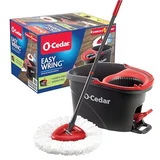
1. O-Cedar EasyWring Microfiber Spin Mop & Bucket System — #1 Best Overall
Check price on Amazon — $34.96
- Built-in foot-pedal wringer basket — hands-free, hands stay dry
- Machine-washable microfiber triangle head, 360° rotation
- Telescoping handle extends to 48 inches
- Manufacturer recommends a refill every 3 months (~$9.47 each)
Pros:
- Hands-free wringer gets the head genuinely damp-not-wet without any hand-wringing technique to learn
- Triangle head reaches corners and baseboards better than a flat pad
- Machine-washable head cuts down on disposable refill waste
Cons:
- Refills add up to roughly $38/year if replaced on the manufacturer’s own 3-month schedule
- A full bucket system is bulkier to store than any spray mop on this list
This is the mop we’d hand someone who wants one system for the whole house, not just the hardwood room. The bucket’s splash guard keeps spray contained while wringing or carrying it between rooms, which matters more than it sounds once you’ve mopped a hallway and two bedrooms in one pass. It’s not the cheapest mop here, and the ongoing refill cost is real — budget roughly $38 a year if you follow O-Cedar’s own 3-month replacement schedule. Where it’s actually weak is corners tight enough that even a 360°-rotating triangle head can’t quite reach flush against a baseboard; a flat mop like the JOYMOOP below edges it out there. For a household with mixed flooring — hardwood, tile, laminate — that wants one mop and bucket to own, this is still the one to buy first.
Verdict: The most balanced pick here — closest a bucket-and-mop system gets to genuinely low residual moisture, because of its own hands-free mechanical wringer, not because of the pad material alone.
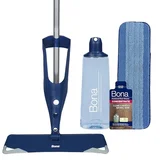
2. Bona Hardwood Floor Premium Spray Mop — Best Spray Mop for Hardwood Floors
Check price on Amazon — $47.24
- Dual-zone microfiber pad, manufacturer-rated reusable up to 500 washes
- Micro-mist trigger applies cleaner to the pad, not the floor
- Specifically formulated for unwaxed, unoiled, polyurethane-finished wood
- Safer Choice certified, 95% USDA-certified biobased concentrate
Pros:
- Same low-moisture mist-and-wipe category as the site’s own #1 hardwood cleaning pick
- 500-wash pad life is an actual disclosed number, not a marketing estimate
- Soft, flexible corners avoid scuffing furniture and baseboards
Cons:
- Priciest pick in this table at $47.24 before any refills
- Locked into Bona’s own concentrate pouches ($14.08 for a 4-pack) rather than any floor cleaner
Bona built its name on hardwood specifically, not as a general floor-care brand that also sells a hardwood SKU, and this mop reads that way — the concentrate is formulated for polyurethane finishes and nothing else, and the pad’s disclosed 500-wash rating is the kind of specific number most competitors don’t publish at all. The real tradeoff is cost of entry: $47.24 up front plus $14.08 every time the concentrate 4-pack runs out is the most expensive way onto this list. It’s also a single-purpose tool — if the household has tile or laminate too, this cartridge system won’t cross over the way a plain-water microfiber mop will. Worth it specifically for someone who has invested in a real hardwood finish and wants a mop built for nothing else.
Verdict: If the only floor being mopped is sealed hardwood, this mechanism carries the least residual moisture of any bucket-free option here.
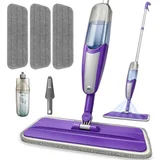
3. Beyoco Spray Mop for Hardwood Floors — Best Budget Spray Mop for Wood Floors
Check price on Amazon — $19.98
- 500ml refillable tank, takes any diluted floor cleaner
- 3 washable microfiber pads included
- 360° rotating head
- Ergonomic trigger for mist control
Pros:
- Same micro-mist, no-bucket mechanism as the Bona above, at under half the price
- Refillable tank isn’t locked to a proprietary concentrate
- Lightweight body, easy for anyone with wrist or grip limitations
Cons:
- Manufacturer doesn’t publish a pad wash-count, so long-term cost isn’t verifiable the way O-Cedar’s or JOYMOOP’s is
- Newer brand with a thinner track record than Bona or O-Cedar
Beyoco isn’t a brand with the same 20-plus-year hardwood-specific reputation as Bona or O-Cedar, and that’s the honest tradeoff for a spray mop at under $20: the mechanism is genuinely the same low-moisture, mist-and-wipe format, but the company hasn’t published the kind of specific wash-count number Bona has, and there’s less of a track record to point to. What it does get right is the refillable tank taking any diluted cleaner rather than a proprietary cartridge, which keeps the ongoing cost close to zero beyond the pads themselves. Good for a renter or a second mop kept in a different part of the house, not necessarily the only mop a household owns.
Verdict: The cheapest entry point into the lowest-moisture mechanism on this page.
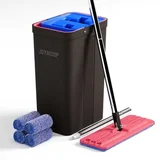
4. JOYMOOP Mop and Bucket with Wringer Set — Best Flat Mop and Bucket System
Check price on Amazon — $39.89
- Insert-and-pull squeeze wringer built into the bucket
- 13 x 4.9-inch flat head, 360° rotation
- 4 washable microfiber pads included
- Manufacturer recommends pad replacement every 1–2 months
Pros:
- Flat head reaches under furniture and into corners better than a round or triangular head
- Wringer keeps hands out of dirty water without a foot pedal
- Lower per-refill cost than the O-Cedar ($4.995/pad vs. effectively similar territory)
Cons:
- The squeeze-style wringer doesn’t wring as dry in practice as O-Cedar’s spin mechanism
- Bucket-and-handle assembly is bulkier to store than any spray mop here
The appeal here is the flat head’s reach — it slides under a couch or bed frame in a way a round or triangular spin-mop head physically can’t, and the 26.5-to-60.9-inch adjustable handle covers a wider range of user heights than O-Cedar’s fixed 48-inch max. The wringer works on an insert-and-pull mechanism rather than a foot pedal, and in practice that means slightly more hand involvement, even though hands never touch the wet pad directly. At $39.89 it sits almost exactly between the O-Cedar and the Bona on price, which makes it a reasonable middle pick for someone who’s decided against a spray mop but still wants a flat pad instead of a spin head.
Verdict: The flat-mop-and-bucket alternative to the O-Cedar spin system, for anyone who prefers a flat pad’s coverage.
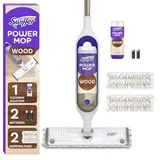
5. Swiffer PowerMop Wood — Best Battery-Assisted Spray Mop for Wood Floors
Check price on Amazon — $26.94
- Batteries power the spray trigger only — the mop head itself is 100% manually operated, not motorized
- QuickDry Lemon solution dries up to 2x faster than a general all-purpose cleaner, per Swiffer
- Kit includes mop, 2 pads, solution and batteries to start immediately
Pros:
- No separate bucket to buy, fill, or store
- Doesn’t overlap with this site’s dedicated electric-mop roundup, since nothing here is motorized
- QuickDry formula is built specifically not to over-wet a finished floor
Cons:
- Manufacturer states explicitly: do NOT use on unfinished, oiled, or waxed wood — sealed/finished floors only
- Pad refills ($18.97 for 11) aren’t listed as machine-washable the way the other picks’ pads are, so ongoing cost behaves more like a semi-disposable system
We’re including this specifically because it’s easy to mistake for an electric mop and it isn’t one — the two AA batteries in the kit run the spray trigger’s motor, not the mop head, so the actual cleaning motion is identical to any other push mop on this page. That distinction is why it belongs here and not on this site’s dedicated electric mop roundup, which covers genuinely motorized spin and steam mechanisms. Swiffer’s own packaging is unusually direct about where not to use it — unfinished, oiled, or waxed wood is explicitly excluded — which is more finish-specific honesty than most spray-mop packaging bothers with. The main limitation is the semi-disposable pad economics: without a published wash-count, the ongoing cost looks more like a subscription than an investment.
Verdict: Best for someone who wants spray-mop convenience without a bucket, on a sealed floor specifically — check your finish first.
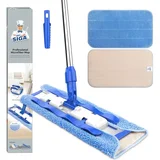
6. MR.SIGA Professional Microfiber Mop — Best Microfiber Mop for Cost Per Use
Check price on Amazon — $35.99
- Double-sided pad: microfiber side for wet/dry mopping, plush side for waxing
- Double-lock telescoping stainless steel handle
- 3 reusable, machine-washable pads included
- Refill 3-pack: $16.99 ($5.66/pad)
Pros:
- Lowest per-pad refill price of any flat mop on this page that discloses a refill price
- Double-sided pad doubles as a waxing/buffing tool
- Telescoping handle locks at any length
Cons:
- No bucket or built-in wringer included at all — moisture control depends entirely on hand-wringing or pre-dampening technique
- Manufacturer doesn’t publish a wash-count for the pad
MR.SIGA’s pitch is straightforward: sell the mop hardware cheaply and make the recurring pad cost the lowest of any flat mop on this page that actually discloses a price. At $5.66 per pad against JOYMOOP’s $4.995 or O-Cedar’s $9.47 per refill, the math favors MR.SIGA over a year of ownership even though the up-front kit costs more than the JOYMOOP. The catch is that nothing about moisture control is built in — there’s no bucket, no wringer, not even a spray bottle included. This is the pick for someone who already has a routine (a spray bottle of diluted cleaner, a pre-dampening habit) and just wants a well-made, double-sided pad to pair with it, not someone looking for a complete system out of the box.
Verdict: Best chosen deliberately with a spray bottle or pre-dampened routine, not a bucket-and-dunk habit, given the lack of any wringer.
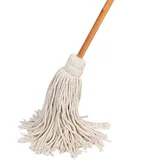
7. Tidy Tools Cotton String Mop — Best Traditional String Mop — and Why We Wouldn’t Use It on Hardwood
Check price on Amazon — $24.99
- 4-ply cotton head, 11 oz, wire-wound onto a solid wood handle
- 43-inch handle, 59 inches total height
- No bucket or wringer included — use with any bucket you already own
Pros:
- Cheapest mop in this table
- Genuinely more absorbent than any microfiber pad here, which is useful on non-wood floors, garages, decks, and heavy spill cleanup
- Solid wood handle, no plastic parts to crack
Cons:
- No wringer of any kind — the entire moisture-control burden falls on hand-wringing
- Hand-wrung bucket-and-mop is exactly the method our own NWFA-sourced hardwood cleaning-methods dataset already flags to avoid on hardwood
- Cotton heads wear out faster than microfiber in general cleaning-industry testing (roughly 15–30 washes vs. 150–200, per The Cleaning Station’s hardwood mop testing)
We almost left a plain cotton string mop off this page entirely, since it’s the one pick here we’d actively steer a hardwood owner away from. We kept it because it’s still the single best-selling, most familiar mop format in the country, and pretending it doesn’t exist wouldn’t help anyone who’s about to buy one by habit without knowing why the other six mechanisms exist. If the destination is a garage floor, a basement, a deck, or ceramic tile, this is a genuinely well-made version of the format — the wood handle won’t crack the way a plastic one eventually does, and 4-ply cotton holds far more liquid per pass than any microfiber pad on this page, which is exactly what you want mopping up a real spill on a non-wood surface. On a hardwood floor specifically, that same absorbency becomes the problem: more water held in the head means more water transferred to the wood, with no mechanical wringer here to control it.
Verdict: A genuinely good mop — just not for a hardwood floor. Keep it for the garage, deck, or tile, and use one of the other six picks on the wood floor.
How We Picked These
We haven’t physically tested these seven mops side by side, so we’re not going to write as if we had. Every price, in-stock status, weight and manufacturer feature claim in the table and picks above came from a live pull of Amazon’s Creators API run this session — not carried over from memory or a competitor’s article. Refill prices and pad wash-counts came from the same live pull, cross-referenced against each brand’s own product-listing copy. Where a manufacturer simply doesn’t publish a number (a pad wash-count, a refill interval), the table says “not published” rather than guessing. The one outside citation in this article — the 150–200 vs. 15–30 wash-count comparison between microfiber and cotton — is attributed by name to The Cleaning Station’s own hardwood mop testing, not presented as our own lab result. The moisture-control tiering cross-references this site’s own NWFA safety findings for hardwood cleaning, which is the closest thing to an authoritative, checkable source that exists for this question. We also deliberately kept this page to manual mechanisms only — nothing here is motorized or generates steam — so if a pick looked even borderline electric (a motorized spin basket, a heated steam generator), it went on our separate electric mop roundup instead of being folded in here for the sake of a rounder list.
What to Consider When Buying a Manual Mop for Wood Floors
Mechanism: Spin Mop vs. Flat Mop vs. String Mop vs. Spray Mop
A spin mop (O-Cedar) pairs a triangle or round head with a bucket that has a built-in wringer basket. A flat mop (JOYMOOP, MR.SIGA) uses a rectangular pad that reaches under furniture more easily. A spray mop (Bona, Beyoco, Swiffer PowerMop) skips the bucket entirely and mists cleaner directly onto the pad. A string mop (Tidy Tools) is the oldest format and, on this page, the only one with no wringer of any kind included.
Wring-Dry Capability — The #1 Hardwood Safety Factor
This is the single biggest differentiator in the comparison table above. A mop that leaves a floor visibly wet, or that takes more than about 60 seconds to dry, is pushing more moisture into the wood than a hardwood finish is built to shed quickly. Spray mops apply the least moisture because there’s no soaking step at all. Mechanical wringers (foot-pedal or squeeze) come next. A mop with no wringer at all — hand-wrung only — carries the most risk, which is exactly why our cotton string mop pick above comes with an honest warning instead of a plain recommendation.
Pad Material: Microfiber vs. Cotton
Microfiber’s fine strands trap dirt without the abrasive grit that a cotton string mop can hold between uses, and microfiber pads generally last far longer — roughly 150–200 machine washes against cotton’s 15–30, per The Cleaning Station’s hardwood mop testing. Cotton isn’t a bad material in general; it’s simply a worse match for a finish that’s sensitive to both scratching and standing moisture.
Reusable Pad Lifespan and Refill Cost
Check whether the manufacturer states an actual replacement interval (O-Cedar: 3 months; JOYMOOP: 1–2 months) or just says “reusable” with no number. A published interval lets you compute a real cost-per-month; an unpublished one means the ongoing cost is a guess until you own it.
Reservoir Size for Spray Mops
Beyoco’s tank holds 500ml. Bona and Swiffer don’t publish an exact reservoir volume in their Amazon listings, so factor in how often you’ll be refilling if that matters for your routine — a whole-house mop session with a small tank means more mid-job refill stops.
Weight and Handle Length
O-Cedar’s handle telescopes to 48 inches; JOYMOOP’s adjusts from 26.5 to 60.9 inches. A taller household member mopping with a short, fixed-length string mop handle will be bending over far more than with an adjustable one.
What Cleaner to Use (and What to Avoid)
Plain water is enough for most microfiber pads. If you want an actual cleaning solution, our wood floor cleaner comparison covers pH-balanced, hardwood-safe formulas by brand. Swiffer PowerMop’s own packaging is explicit that its formula isn’t for unfinished, oiled, or waxed wood — always check your specific finish before using any spray-mop cartridge system.
Total Cost of Ownership
The cheapest mop up front (Tidy Tools at $24.99) isn’t necessarily the cheapest over a year once refill cadence and pad durability are factored in. Compare the full row in the table above, not just the sticker price, before deciding. A mop that costs $10 more up front but publishes a real refill interval is easier to budget around honestly than one that’s cheaper today but leaves the ongoing cost as a guess.
Storage Footprint
A bucket system needs a spot for both the bucket and the handle — typically a closet or utility room corner. A spray mop or string mop needs only enough space to hang or lean a single handle. If storage is genuinely tight (a small apartment, a shared laundry closet), that alone can be a tie-breaker between the O-Cedar or JOYMOOP bucket systems and one of the three spray mops on this page.
Household Size and Floor Area
A small reservoir or a pad that saturates quickly is a minor annoyance in a studio apartment and a real time cost across an entire single-family home’s worth of hardwood. Beyoco’s 500ml tank and any of the pad-based mops here will need more mid-session refills or pad swaps the larger the floor area gets — factor in square footage, not just the mechanism, when comparing these seven for a specific home.
Sealed vs. Unsealed Wood — Why It Changes Every Answer Here
Every recommendation on this page assumes a sealed, finished floor — polyurethane, oil-modified urethane, or a comparable factory or site-applied finish that forms a moisture barrier on top of the wood. Unsealed, waxed, or oiled hardwood has no such barrier, and every manual mop mechanism on this page, including the driest-wringing spray mops, applies more moisture than raw wood should see. Swiffer PowerMop Wood’s own packaging states this outright: not for unfinished, oiled, or waxed boards. If there’s any doubt which category a floor falls into, a water-drop test tells you fast — a few drops of water that bead up and sit on the surface for a minute or two mean the finish is doing its job; water that darkens the wood or soaks in within seconds means there’s no real moisture barrier left, and a damp mop of any kind is the wrong tool until the floor is refinished.
What a Complete Manual Mop Setup Actually Costs
Budget route: the Beyoco Spray Mop ($19.98) plus a bottle of diluted all-purpose cleaner most households already have = about $20 to start, with the caveat that its pad life isn’t manufacturer-disclosed, so the true year-one cost is a genuine unknown rather than a hidden one. No-compromise route: the O-Cedar EasyWring system ($34.96) plus four replacement refills across a year ($9.47 × 4 = $37.88) = roughly $73 for a full year of hands-free-wrung, hardwood-appropriate mopping. That’s the same order of magnitude as buying the cheaper spray mop twice over a year on faith about its refill economics — the disclosed number, even when it’s higher up front, is the one we’d actually budget around.
How to Mop a Wood Floor by Hand the Safe Way
- Dry-sweep (see our guide to the best brooms for hardwood floors) or vacuum first. Grit dragged across a finish by a wet mop is what actually scratches hardwood, not the water itself.
- Choose the right cleaner for your finish. Confirm your floor is sealed/finished before using any spray-mop cartridge, and match the cleaner to your finish type.
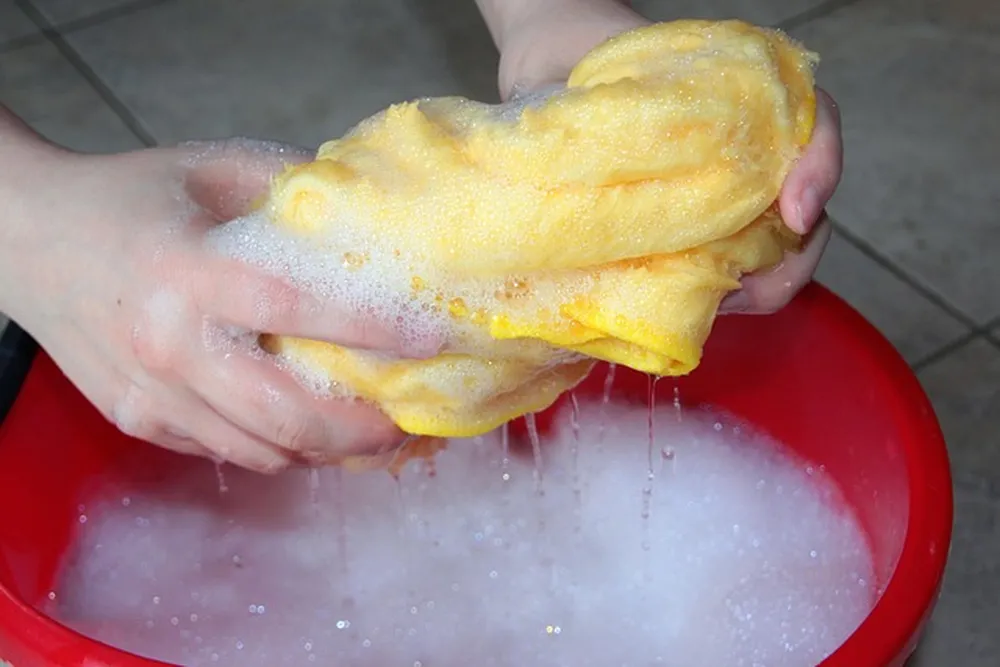
- Wring the mop until it’s barely damp. If you can see water beading on the head, it’s too wet to put on hardwood — use a mechanical wringer if your mop has one.
- Mop with the grain, in small sections. Work one manageable area at a time rather than flooding the whole room at once.
- Dry the floor immediately after each section. A clean, dry microfiber cloth behind the mop head prevents any standing moisture at seams.
- Rinse or replace the pad before it’s saturated. A pad that’s carrying more dirt than it can hold just redeposits grit instead of lifting it.
Frequently Asked Questions
What is the best manual mop for wood floors?
The O-Cedar EasyWring Microfiber Spin Mop & Bucket System, because its hands-free foot-pedal wringer gets the microfiber head closer to the low-moisture standard hardwood needs than any other bucket-based system in this comparison.
Is a string mop bad for hardwood floors?
A plain cotton string mop with no built-in wringer is the highest-moisture-risk option in our comparison table. It’s not that cotton itself is unsafe — it’s that hand-wrung bucket-and-mop is the specific method the NWFA’s own guidance, cited in our hardwood cleaning-methods dataset, names as something to avoid on hardwood.
Are microfiber mop pads better than cotton for wood floors?
Generally yes, on two counts: microfiber traps grit without holding it against the finish the way a loose cotton head can, and it lasts roughly 150–200 machine washes versus cotton’s 15–30, per The Cleaning Station’s hardwood mop testing.
How wet should a mop be before I use it on hardwood?
Barely damp — if you can see water beading or dripping off the head, it’s too wet. A floor mopped correctly with any of the picks above should be dry to the touch within about a minute.
How often should I replace my mop pad or head?
It depends on the product: O-Cedar states 3 months, JOYMOOP states 1–2 months, and several other brands in our table simply don’t publish a number. As a general rule, replace a pad once it no longer wrings out close to clear water or starts leaving streaks, since a saturated or worn pad stops lifting dirt and starts redepositing it instead. Households mopping several times a week will wear through any pad faster than the manufacturer’s stated interval assumes, since those intervals are typically based on average, not heavy, use.
Can I use a spray mop on unfinished or waxed wood floors?
Not the ones in this comparison. Swiffer PowerMop Wood’s own packaging explicitly excludes unfinished, oiled, or waxed wood, and the same caution applies generally to cartridge-based spray mop cleaners — they’re formulated for sealed, polyurethane-finished floors.
What’s the difference between a manual mop and an electric mop for hardwood floors?
A manual mop’s cleaning motion is entirely human-powered, even if a battery assists the spray trigger (as with the Swiffer PowerMop). An electric mop uses a motor to spin or vibrate the pad itself, or generates steam. Our separate guide to electric and steam mops covers those motorized and steam options separately.
Final Thoughts
The O-Cedar EasyWring Microfiber Spin Mop & Bucket System is our overall pick because its hands-free wringer does the one thing that matters most on a wood floor: it controls moisture without asking the user to judge it by feel. If you take one number from this dataset, make it this one — a hand-wrung mop with no wringer at all is the method our own NWFA-sourced research already flags to avoid on hardwood, regardless of how good the pad material is. Choose a mechanism with real wring control first, then worry about pad material and price.
If a bucket system isn’t the right fit, either spray mop — the Bona for a sealed floor you’re treating carefully, the Beyoco if budget matters more than a 20-plus-year brand history — lands in the same low-moisture tier for a fraction of the setup hassle. The one mop on this page we wouldn’t put on a hardwood floor at all is the plain cotton string mop, not because it’s poorly made, but because its complete lack of a wringer runs directly into the same hand-wrung caution our hardwood cleaning-methods dataset already documents. Save that one for the garage.
Sponsored / affiliate links. As an Amazon Associate I earn from qualifying purchases. I may earn additional commission from eligible campaigns.