Best Cleaning Supplies for Wood Floors: 7 Compared by pH (2026)
Bona Hardwood Floor Cleaner Spray is the safest default spray-and-wipe cleaner for finished hardwood: its Safety Data Sheet lists a pH of about 7 (neutral), and it’s EPA Safer Choice Certified. If price per gallon matters more, Murphy Oil Soap Concentrated dilutes down to $0.22 a gallon — but its own SDS lists a pH near 10, high enough that flooring manufacturers warn against repeated use on polyurethane-finished floors.
This guide covers spray-and-wipe chemical cleaners specifically — the bottled or concentrated products you spray, mop, or dilute onto a finished wood floor. If you’re still deciding whether a chemical cleaner is even the right tool for the job — versus a dry microfiber pass, a steam mop, or an electric spin mop — see our full comparison of hardwood floor cleaning methods first. Once you know you want a liquid cleaner, the seven products below are compared on the four things that actually decide whether one is safe for your floor’s finish: pH, ingredient safety, scent, and real cost per gallon of usable solution.
Wood Floor Cleaner Comparison: pH, Safety & Cost per Gallon
Every number below is sourced from the product’s own Amazon listing, its manufacturer Safety Data Sheet (SDS), or its brand website — not estimated. Where a brand hasn’t published an exact pH value, the cell says not published rather than a guess. “Cost per gallon” is a computed figure: for ready-to-use sprays it’s the bottle price scaled to 128 fl oz; for concentrates it’s the bottle price divided by the number of gallons of solution the manufacturer’s own dilution instructions yield. The formula for each concentrate is shown under its pick below so you can check the math.
| Product | Price | Format | pH (source) | Cost / Gal of Solution | Verdict |
|---|---|---|---|---|---|
| Bona Hardwood Floor Cleaner Spray | $8.97 / 32 oz | Ready-to-use | ~7, neutral (SDS) | $35.88 | Safest default |
| Bona Hardwood Floor Cleaner Refill, Unscented | $18.99 / 128 oz | Ready-to-use refill | ~7, neutral (SDS) | $18.99 | Best scent-free |
| Method Squirt + Mop, Almond | $1.99 / 25 oz | Ready-to-use | Not published | $10.19 | Best value |
| Weiman Hardwood Floor Cleaner, 128 oz | $24.98 / 128 oz | Ready-to-use, clean+shine | Neutral (claimed, no number) | $24.98 | Best for high-traffic |
| Rejuvenate All Floors Cleaner | $8.55 / 32 oz | Ready-to-use | 8.5–9.5, mildly alkaline (SDS) | $34.20 | Best multi-surface |
| Murphy Oil Soap Wood Cleaner, Concentrated | $10.63 / 3-pack | Concentrate (1/4 cup per gal) | ~10, alkaline (SDS, secondary-sourced) | $0.22 | Cheapest, use with caution |
| Aunt Fannie’s Hardwood Floor Cleaner, Vinegar-Free | $14.99 / 32 oz | Ultra-concentrate (1/2 cup per 2 gal) | Not published; vinegar-free by design | $0.94 | Best non-toxic |
Why pH is the column that matters most: the National Wood Flooring Association states plainly that “a pH-balanced cleaner ensures that the wood finish is protected and won’t be stripped away by harsh chemicals,” and separately warns that vinegar’s acidic nature “can damage the wood floor and finishes over time” despite being one of the most commonly recommended DIY hardwood cleaners online. On the alkaline side, oil-based soaps can leave a residue that keeps future maintenance or recoat finishes from adhering properly. A cleaner sitting near neutral pH (6–8) is the one least likely to cause either problem with repeated use.
Show Your Work: How the Cost-per-Gallon Numbers Were Calculated
Two different formulas produced the “cost per gallon” column, depending on whether a product ships ready-to-use or as a concentrate you dilute yourself:
- Ready-to-use sprays (Bona, Method, Weiman, Rejuvenate): bottle price ÷ bottle size in fl oz × 128. Example — Bona’s 32 oz spray at $8.97 → ($8.97 ÷ 32) × 128 = $35.88/gal.
- Concentrates (Murphy Oil Soap, Aunt Fannie’s): bottle price ÷ the number of gallons the manufacturer’s own label instructions yield from that bottle. Murphy’s label calls for 1/4 cup (2 fl oz) per gallon of water, so one 32 oz bottle makes 32 ÷ 2 = 16 gallons of solution; at $3.54 per bottle (the 3-pack price of $10.63 divided by 3), that’s $3.54 ÷ 16 = $0.22/gal. Aunt Fannie’s label calls for 1/2 cup (4 fl oz) per 2 gallons of water — 2 fl oz per gallon — so a 32 oz bottle also yields 16 gallons; at $14.99 per bottle, that’s $14.99 ÷ 16 = $0.94/gal.
Every input in that math — bottle price, bottle size, and dilution ratio — is cited from the product’s own Amazon listing or manufacturer label, not estimated. No competitor roundup we reviewed while researching this page runs this calculation at all, let alone shows the arithmetic behind it.
The 7 Best Wood Floor Cleaning Supplies
1. Bona Hardwood Floor Cleaner Spray, 32 fl oz — #1 Best Overall
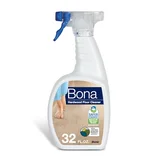
$8.97 • 32 fl oz ready-to-use spray. Bona’s own Safety Data Sheet lists a pH near 7, and the product listing itself states the formula is “pH-neutral… Safe for all unwaxed, unoiled, polyurethane finished wood floors.” That’s a stronger claim than most competitors make because it’s backed by a published SDS number, not just marketing copy. The formula is also 95% USDA-certified biobased and carries the EPA’s Safer Choice certification.
It dries fast, leaves no residue, and the spray-and-mop design means there’s no bucket to fill or dump. The catch is cost: at $8.97 for a 32 oz bottle, it works out to roughly $35.88 per gallon of usable cleaner — among the priciest in this table if you keep rebuying the small bottle instead of switching to the 128 oz refill (pick #2).
Pros
- pH ~7 confirmed by manufacturer SDS, not just a marketing claim
- EPA Safer Choice Certified and 95% USDA-certified biobased
- Residue-free, fast-drying, no bucket or dilution required
- Refillable bottle cuts long-term plastic waste
Cons
- Highest cost-per-gallon of any ready-to-use pick unless you buy the refill
- The standard spray isn’t sold unscented — only the refill (pick #2) is
Best for: anyone with a factory-finished polyurethane hardwood or engineered floor who wants the safest, best-documented default and doesn’t mind paying a small premium for it. Skip it only if $35.88/gallon is genuinely outside your budget — in that case, jump to the refill (pick #2) or Method (pick #3).
2. Bona Hardwood Floor Cleaner Refill, Unscented, 128 fl oz — Best Scent-Free
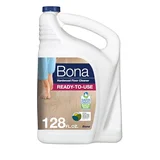
$18.99 • 128 fl oz refill. Same pH-neutral, Safer Choice-certified formula as the spray above, just unscented and sold in the larger refill size meant for topping off your own spray bottle or mop cartridge. Because there’s no small-bottle markup, it prices out to $18.99 per gallon — almost half the per-gallon cost of buying the 32 oz spray repeatedly.
This is the pick for households with fragrance sensitivities, pets that lick floors, or anyone who’s decided they like Bona’s chemistry but don’t want to keep paying the ready-to-spray premium. You do need your own spray bottle or a Bona mop cartridge to use it — it doesn’t ship with a sprayer.
Pros
- Same pH ~7, Safer Choice-certified formula as the #1 pick
- Zero added fragrance
- Roughly half the per-gallon cost of the small spray bottle
Cons
- Not ready-to-spray on its own — needs a bottle or mop cartridge to decant into
Best for: households buying Bona long-term who want the same lab-documented pH-neutral formula without an added scent, or who mop often enough that the per-gallon savings over the small spray bottle actually add up. Skip it if you want a bottle you can spray straight out of the box — get pick #1 instead.
3. Method Squirt + Mop Hardwood Floor Cleaner, Almond, 25 fl oz — Best Value
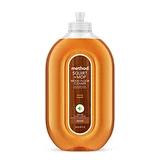
$1.99 • 25 fl oz ready-to-use. Method’s squirt-and-mop bottle is the cheapest ready-to-use cleaner in this entire comparison — about $10.19 per gallon, roughly a third of Bona’s per-gallon cost. It’s wax-free and uses naturally-derived fibers in the formula, and it’s sold in almost every grocery store, which matters if you’d rather not wait on shipping.
The honest gap: Method has not published an exact pH value for this product on its own site or in its SDS the way Bona has. The ingredient list shows mild alkaline buffering agents (sodium bicarbonate/sesquicarbonate), which is typical for a “no residue” floor cleaner, but without a lab number the finish-safety claim rests on the brand’s own “no buildup” language rather than a verifiable reading.
Pros
- Cheapest ready-to-use option by a wide margin ($10.19/gal)
- Wax-free formula, widely available in grocery stores
- Pleasant almond scent, squirt-top bottle needs no separate sprayer
Cons
- No published pH value from the manufacturer
- Formula details are thinner than Bona’s or Rejuvenate’s published SDS
Best for: budget-conscious buyers who want a mainstream, grocery-store-available cleaner and are comfortable trusting a brand’s own “no residue” claim without a published lab pH. Skip it if a documented SDS number matters more to you than price — go with Bona instead.
4. Weiman Hardwood Floor Cleaner, 128 oz Refill — Best for High-Traffic Floors
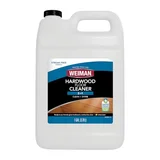
$24.98 • 128 fl oz (1 gallon). Weiman markets this as a “2-in-1 clean + shine” formula, and that’s the real distinction from the residue-free picks above: it’s designed to leave a light shine layer behind, not strip everything back to bare finish. Weiman’s own site describes the formula as neutral pH and free of VOCs and solvents, though (like Method) it doesn’t publish a numeric SDS value.
For a busy, high-traffic household that wants floors to look freshly shined between deep cleans, that trade-off is a feature. It’s a worse fit if you’re planning to recoat or refinish the floor soon — a polish layer, even a light one, is exactly the kind of residue that can interfere with a new coat bonding properly.
Pros
- 2-in-1 cleans and restores shine in one pass
- No VOCs or solvents; plant-derived formula
- Large 128 oz size covers a lot of floor before a refill
Cons
- Leaves a light polish residue by design — skip it before a refinish
- pH is a marketing claim (“neutral”), not a published SDS number
Best for: high-traffic homes that want floors to look freshly shined between deep cleans and aren’t planning a refinish anytime soon. Skip it if you’re within a couple of years of recoating — the polish layer can interfere with adhesion.
5. Rejuvenate All Floors Cleaner, 32 fl oz — Best for Multi-Surface Homes
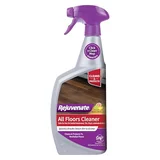
$8.55 • 32 fl oz ready-to-use. Rejuvenate’s own SDS lists a pH range of 8.5–9.5 — mildly alkaline, not neutral — and the product is classified non-hazardous. What it buys you is one bottle that’s labeled safe across sealed hardwood, tile, vinyl and laminate, so a household with mixed flooring doesn’t need four different cleaners under the sink.
That convenience comes with a caveat this table makes visible: at 8.5–9.5, Rejuvenate sits outside the neutral band the NWFA recommends for a cleaner used repeatedly on a polyurethane finish. Fine for occasional or weekly use across a mixed-surface home; not the pick if hardwood is the only floor you’re cleaning several times a week.
Pros
- One bottle rated safe for hardwood, tile, vinyl, and laminate
- Fresh citrus scent, non-hazardous SDS classification
- Compatible with Rejuvenate’s Click n Clean spray mop
Cons
- 8.5–9.5 pH is mildly alkaline, not neutral — the highest of the ready-to-use picks
- $34.20/gal puts it near the top of the cost table too
Best for: homes with mixed flooring (hardwood plus tile, vinyl, or laminate) that want one bottle for everything and don’t mop the hardwood portion daily. Skip it for a hardwood-only home doing frequent cleaning — the mildly alkaline pH is a better fit for occasional use.
6. Murphy Oil Soap Wood Cleaner, Concentrated, 32 fl oz (3-Pack) — Cheapest Per Gallon — Use With Caution
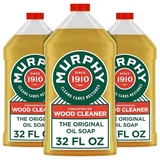
$10.63 for three 32 oz bottles ($3.54/bottle). Diluted per Murphy’s own label instructions (1/4 cup per gallon of water for regular cleaning), one bottle makes 16 gallons of cleaning solution — $0.22 per gallon, by far the cheapest number in this entire table. It’s also a genuinely traditional formula (the brand dates to 1910), 99% natural ingredients, dye-free, and phosphate-free.
Main drawback, stated plainly: Murphy’s own SDS lists a pH near 10 — the most alkaline product in this comparison, and it contains a small percentage of sodium hydroxide as a listed ingredient. Oil-soap-based cleaners like this one are the specific category the National Wood Flooring Association and several flooring manufacturers caution against for factory-finished floors: repeated use can leave a residue that keeps a future maintenance coat or recoat from bonding properly, and Murphy’s own label says not to use it on unfinished, unsealed, or waxed wood. It’s a reasonable pick for finished floors you have no plans to refinish — not for a floor still under a manufacturer’s finish warranty.
Pros
- Cheapest cost-per-gallon of any product here, by a wide margin ($0.22/gal)
- 99% natural ingredients, dye-free, 0% phosphates
- Familiar traditional brand, also works on finished wood furniture
Cons
- ~pH 10 (alkaline) per SDS — the highest of any pick in this table
- Not recommended by flooring manufacturers for repeated use on polyurethane finishes; can leave residue that affects future recoats
- Label itself warns against unfinished, unsealed, or waxed wood
Best for: budget-first buyers cleaning finished floors and furniture they have no near-term plans to refinish. Skip it on any floor still under a manufacturer finish warranty, or on unfinished/waxed wood, where Murphy’s own label says not to use it.
7. Aunt Fannie's Hardwood Floor Cleaner, Vinegar-Free, Lemon, 32 fl oz — Best Non-Toxic
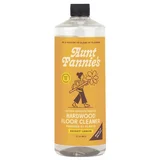
$14.99 • 32 fl oz ultra-concentrate. The headline feature is right on the label: vinegar-free. That matters because most other “natural” wood floor cleaners on the market actually are vinegar-based — and the NWFA specifically warns that vinegar’s acidic nature can damage wood floor finishes over time despite being a popular DIY recommendation. Aunt Fannie’s plant-based formula sidesteps that problem entirely, and it’s EWG A-rated, dermatologist-tested, and hypoallergenic.
Diluted per the label (1/2 cup of concentrate into 2 gallons of water, or 2 fl oz per gallon), one 32 oz bottle makes about 16 gallons of solution — $0.94 per gallon, the second-cheapest in this table behind only Murphy’s Oil Soap. The gap in the data: Aunt Fannie’s hasn’t published an exact numeric pH the way Bona or Rejuvenate have, so “non-toxic” here is backed by the EWG rating and the vinegar-free formulation, not a lab pH reading.
Pros
- EWG A-rated, dermatologist-tested and hypoallergenic
- Deliberately vinegar-free — avoids the acidic-pH problem most “natural” competitors have
- Concentrate dilutes to under $1/gallon
Cons
- No published numeric pH value
- Must be diluted before use — can’t spray straight from the bottle like Bona or Method
Best for: EWG-conscious buyers who specifically want to avoid vinegar-based “natural” cleaners and are comfortable mixing a concentrate. Skip it if you want a lab-verified numeric pH reading — go with Bona for that instead.
How We Picked These
No product on this list was physically tested for this article — we’re saying that plainly rather than dressing it up. What went into these picks instead:
- Live pricing and product data pulled via the Amazon Creators API on the date this article was last refreshed (see the date at the bottom of this page).
- Manufacturer Safety Data Sheets (SDS) for pH values and hazard classifications, sourced directly from each brand where publicly available. Where a brand hadn’t published a number, this article says so instead of estimating one.
- National Wood Flooring Association (NWFA) guidance on pH-balanced cleaning and what damages a polyurethane finish over time.
- Each brand’s own published ingredient and certification claims (EPA Safer Choice, EWG ratings, USDA biobased content) — cited, not repeated as fact without a source.
That makes this a Tier C, spec-and-data-led comparison, not a hands-on test. The dataset table above is the part that isn’t available anywhere else: no other wood floor cleaner roundup we checked while researching this page publishes actual pH values or a cost-per-gallon breakdown side by side.
What to Consider When Buying a Wood Floor Cleaning Supply
pH Balance: the #1 Safety Factor
A finished hardwood floor is really a layer of polyurethane (or wax, on older floors) sitting on top of the wood. That finish, not the wood itself, is what a cleaner actually touches. The NWFA’s guidance is direct: a pH-balanced cleaner protects that finish, while a cleaner far outside neutral — acidic (vinegar) or strongly alkaline (some oil soaps) — can dull or damage it with repeated use. Aim for a product sitting close to 6–8 if you mop more than once a week.
Residue-Free vs. Polish/Shine Formulas
Some cleaners (Bona, Method) are built to leave literally nothing behind. Others (Weiman) are a light polish and cleaner combined, which restores shine but does leave a thin film. Residue-free is the safer default if you might recoat or refinish the floor in the next few years; a light-polish formula is fine if refinishing isn’t on the horizon and you want the shine back between deep cleans.
Ready-to-Use vs. Concentrate
This is where the real cost story is. A ready-to-use spray costs more per gallon because you’re paying for water and packaging along with the active cleaner — Bona’s spray runs $35.88/gallon that way. A concentrate you dilute yourself, like Murphy’s Oil Soap or Aunt Fannie’s, can drop under $1/gallon once mixed. The trade-off is convenience: concentrates need a spray bottle or bucket and a measuring cup, not just a squeeze of the trigger.
Scent and Fragrance Sensitivity
Every product in this table except Bona’s unscented refill carries some fragrance — lemon (Aunt Fannie’s), almond (Method), citrus (Rejuvenate), citronella oil (Murphy). If anyone in the house has fragrance sensitivities, asthma, or pets that spend a lot of time nose-to-floor, the unscented Bona refill is the only genuinely fragrance-free option in this comparison.
Ingredient-Safety Certifications
Third-party certifications are worth more than a brand’s own “natural” label. EPA Safer Choice (Bona) and an EWG A-rating (Aunt Fannie’s) both involve independent ingredient review. A product that only advertises “plant-based” or “99% natural” on its own packaging, with no third-party certification attached, is making a self-graded claim — not necessarily untrue, just unverified by anyone outside the company. For a deeper dive into which formulas actually qualify as non-toxic across brands beyond this list, see our full non-toxic wood floor cleaner roundup.
Finished vs. Unfinished, Waxed, or Oiled Wood
Every product on this list is formulated for sealed, finished wood floors — polyurethane, typically. None of them are the right choice for unfinished, waxed, or oil-finished floors; using a water-based or alkaline cleaner on those surfaces can cause staining, swelling, or a cloudy finish. Check your floor’s finish type before buying, and if you’re not sure, our guide to caring for waxed wood floors covers the different cleaning rules that apply.
Multi-Surface vs. Hardwood-Only Formulas
Rejuvenate’s All Floors Cleaner is built to be safe across hardwood, tile, vinyl, and laminate in one bottle. That’s genuinely convenient for a mixed-flooring home, but a hardwood-specific formula like Bona’s is usually the more precisely tuned option if hardwood is most of what you’re cleaning. If your home leans laminate or engineered wood instead, see our dedicated guide to caring for engineered hardwood floors, and if you’re mixing hardwood with carpeted rooms, our carpet-and-hardwood cleaner comparison covers products built for both.
Spray Bottle vs. Mop-Compatible Cartridge
Bona and Rejuvenate both sell cartridge refills compatible with their own spray-mop systems (Bona’s spray mop, Rejuvenate’s Click n Clean), which is worth checking if you already own one of those mops — buying the matching cartridge is usually cheaper than the standalone spray bottle. Haven’t picked the mop hardware itself yet? Our manual mop comparison covers seven spin, flat and spray mops by how well each one wrings dry.
Storage and Shelf Life
Ready-to-use sprays (Bona, Method, Weiman, Rejuvenate) are stable in their original bottle for the timeframe printed on the label, typically a few years unopened, and don’t need to be mixed fresh each time — spray and go. Concentrates are different: mix only what you’ll use in one cleaning session. A diluted batch of Murphy’s Oil Soap or Aunt Fannie’s sitting in an open bucket for days can lose effectiveness and, in the case of an oil-based concentrate, separate. Keep the concentrated bottle itself capped and out of direct sunlight, and mix a fresh batch each time rather than pre-diluting a large supply to save a step.
Warranty Compatibility
Most major hardwood flooring manufacturers (Bruce, Mohawk, Shaw, and others) list approved or compatible cleaner types in their finish warranty documentation, and a cleaner outside that spec — typically anything wax-based, oil-based, or with an alkaline pH well above neutral — can technically void the finish warranty on a newer floor even if it doesn’t visibly damage anything right away. If your floor is still under a manufacturer warranty, check that document before reaching for anything other than a pH-neutral, residue-free cleaner like Bona’s. This is a second, independent reason the pH column in the comparison table matters beyond just what the NWFA recommends.
VOC Content and Indoor Air Quality
Volatile organic compounds (VOCs) are chemicals that off-gas into indoor air as a cleaner dries, and the EPA’s own Total Exposure Assessment Methodology (TEAM) study found indoor VOC concentrations running 2–5 times higher than outdoors, which matters more for a floor cleaner than most household products since it’s applied to a large surface area and left to air-dry. Weiman and Rejuvenate both explicitly state their formulas are VOC- or solvent-free on their own product pages; Bona’s Safer Choice certification also requires meeting the EPA’s VOC criteria as part of that program. None of the seven products here disclosed a specific VOC percentage, so “VOC-free” in this comparison means the brand’s own claim, not an independently measured number.
How to Use a Wood Floor Cleaning Spray Safely
Regardless of which product you pick, the safe process is the same for every pH-neutral or near-neutral spray-and-wipe cleaner:
- Dry-sweep or vacuum first. Grit under a wet mop pad is what actually scratches a finish — the cleaner itself rarely does.
- Confirm your floor’s finish. These products are for sealed, finished wood. Skip them on unfinished, waxed, or oil-finished floors.
- Spray lightly, or dilute per the label — concentrates like Murphy’s Oil Soap and Aunt Fannie’s have specific dilution ratios; using it stronger than directed raises the effective pH exposure on the finish, not just the cost.
- Mop with a well-wrung microfiber pad. Standing water is the enemy of a wood floor regardless of the cleaner’s pH — don’t oversaturate.
- Let the floor air-dry before walking on it or setting furniture back down.
- Buff any cloudy spots with a dry microfiber cloth if a residue-leaving formula (like a clean+shine product) leaves streaks.
FAQ: Wood Floor Cleaning Supplies
Is vinegar safe to clean hardwood floors?
Not for repeated use. Vinegar is acidic, and the National Wood Flooring Association states that its acidic nature can damage a wood floor’s finish over time, even though a vinegar-water solution is one of the most commonly recommended DIY hardwood cleaners online. A pH-neutral cleaner like Bona or a vinegar-free formula like Aunt Fannie’s is the safer choice for a floor you clean regularly. The same logic applies to other common household cleaners people reach for out of habit — see our breakdown of whether Pine-Sol is actually safe on wood floors for another example.
What pH should a hardwood floor cleaner be?
As close to neutral (roughly 6–8) as possible for a floor you clean weekly or more. Bona’s SDS lists a pH near 7. Products further outside that range, like Murphy’s Oil Soap (~10) or Rejuvenate (8.5–9.5), aren’t necessarily harmful for occasional use, but they’re a worse fit for a daily or weekly cleaning routine on a factory-finished floor.
Can I use Murphy Oil Soap on polyurethane floors?
Occasionally, on a floor you’re not planning to refinish soon — but flooring manufacturers generally caution against making it a regular routine. Its alkaline pH (~10) and oil-soap base can leave a residue over repeated use that interferes with a future recoat bonding to the finish. Murphy’s own label also says not to use it on unfinished, unsealed, or waxed wood.
Are natural or non-toxic wood floor cleaners as effective as regular ones?
Based on the ingredient and certification data in this comparison, yes — EWG-rated and Safer Choice-certified options like Aunt Fannie’s and Bona are formulated specifically to clean finished wood without needing harsher solvents. “Natural” isn’t automatically safer for a floor’s finish, though — a vinegar-based natural cleaner can still be a pH problem, which is exactly why Aunt Fannie’s vinegar-free formulation matters.
How often should I clean hardwood floors with a spray cleaner?
Weekly for normal traffic, or every 2–3 days for high-traffic areas or homes with pets and kids, with a dry sweep or vacuum in between wet cleanings. Daily wet-mopping isn’t necessary and adds more moisture exposure than most finishes need.
What’s the difference between a wood floor cleaner and a wood floor polish?
A cleaner (Bona, Method, Aunt Fannie’s) is meant to lift dirt and leave nothing behind. A polish or “clean + shine” product (Weiman) cleans and also deposits a thin protective/shine layer. Polishes make floors look shinier between deep cleans but shouldn’t be used right before a refinish, since the layer they leave behind can interfere with a new coat adhering.
Is Bona or Method better for hardwood floors?
Bona has the stronger documentation — a published SDS pH near 7 and EPA Safer Choice certification. Method is the better budget pick at roughly a third of Bona’s cost per gallon, but it hasn’t published an exact pH value, so the finish-safety case for Method rests on brand claims rather than a lab number the way Bona’s does.
Which wood floor cleaner is cheapest to use long-term?
By the per-gallon math in the comparison table, the two concentrates win by a wide margin: Murphy’s Oil Soap works out to about $0.22/gallon diluted and Aunt Fannie’s to about $0.94/gallon, versus $18.99–$35.88/gallon for the ready-to-use sprays — Bona’s ready-to-spray bottle costs roughly 160x more per gallon than Murphy’s diluted concentrate. That gap doesn’t automatically make Murphy the better buy, though: its ~pH 10 formula is the one this article flags as the least finish-friendly for frequent, long-term use.
Final Thoughts
Bona Hardwood Floor Cleaner Spray stays the #1 pick here for one reason the whole dataset above supports: it’s the only product in this comparison with a manufacturer-published SDS pH near neutral (about 7) and a third-party Safer Choice certification behind it. If you only remember one number from this page, make it this one — Murphy Oil Soap is 160x cheaper per gallon ($0.22 vs. $35.88), but its ~pH 10 formula is exactly the category the National Wood Flooring Association warns against for a floor you plan to clean, and eventually recoat, for years to come.
Still deciding whether a spray cleaner is even the right tool, versus a steam mop, dry vacuum pass, or electric spin mop? Our guide to every hardwood floor cleaning method walks through when each approach makes sense before you buy a bottle of anything. For general upkeep beyond the weekly clean, our guide to making hardwood floors last longer covers the maintenance habits that matter between cleanings.
Sponsored / affiliate links. As an Amazon Associate I earn from qualifying purchases. I may earn additional commission from eligible campaigns.