Best Paint Sprayer Tips for Furniture (2026): We Compared
For furniture, a common starting point is a 0.008–0.010 inch tip for thin finishes and a 0.012–0.013 inch tip for most primers and paints, then move smaller for detail and larger only for high-build coatings. Wrong tip size causes orange peel, heavy texture, runs, overspray, and wasted sanding. This guide maps tip size to cabinets, chairs, tables, trim, coating type, sprayer type, and defect risk.
This guide is part of our Drying Time Chart: Paint, Stain & Polyurethane By Coat series.
Best overall tip size for furniture
For many cabinets and painted furniture, a 311 or 313 airless tip is often a good starting point because it balances control and coverage. The right choice still depends on the part you are spraying, the coating viscosity, and the defect you want to avoid.
Quick comparison
A smaller fan gives you more control on rails, legs, and spindles. A wider fan speeds coverage on flat panels, but it raises overspray risk if you use it on narrow furniture parts.
How we chose
The decision points here are the ones that change results on furniture.
- Furniture part detail: flat panels, rails, legs, spindles, and chair backs all need different fan control.
- Coating viscosity: thinner stains and clear coats need less opening than thick primers and many paints.
- Sprayer compatibility: airless tips, HVLP nozzles, and handheld systems are not interchangeable across brands and series.
- Finish defect risk: the tip should help you avoid orange peel, sags, dry spray, lap marks, and overspray.
Those factors matter more than the paint label alone. A “latex” label tells you less than the actual thickness, the part geometry, and the sprayer system.
Which tip works for cabinets and panels?
For cabinet doors, drawer fronts, and other flat panels, a 311 or 313 is a strong starting point because it gives enough fan width to cover a field panel without flooding the edges. If you are working on very large flat sections, a slightly wider fan can speed coverage, but it also increases overspray and overlap sensitivity.
What to choose on cabinet doors
Use the smaller side when the door has raised detail, inset edges, or narrow stiles and rails. Use a wider fan when the center panel is broad and the goal is to keep your passes even without stopping often.
On cabinets, the wrong tip often shows up as lap marks along the edge where passes meet. If the coating goes on pebbly, the tip may be too small for the material or the pressure may be too low for the sprayer model.
Which tip works for chairs, rails, and spindles?
For chairs, rails, spindles, and other tight geometry, stay on the smaller side so you can control the spray cone and avoid coating the wrong surface. A smaller fan usually reduces overspray and dry spray on narrow parts, but it slows production on larger chair frames or grouped components.
Detail-heavy parts need control first
On spindles and chair backs, too much fan width wastes finish and makes it harder to keep the coat even around rounded surfaces. A smaller tip or lower-output nozzle gives you better placement, though you may need more passes to keep film build consistent.
Say your chair has closely spaced spindles and you choose a tip meant for broad panels. The spray cone can wrap around the wrong face, leaving one side heavy and the opposite side dusty. A smaller tip narrows the pattern and makes that mistake less likely.
Furniture tip decision table
Use this table to match the furniture part, coating, and defect risk before you set up the sprayer. It is a decision aid, not a universal chart; the sprayer manual still sets the compatible tip family and pressure range.
| Furniture part | Coating type | Recommended tip-size range | Likely defect if wrong | Setup notes for airless, HVLP, and handheld sprayers |
|---|---|---|---|---|
| Cabinet door panel | Primer or water-based paint | 0.011–0.013 inch | Orange peel or lap marks | Airless: 311/313 style for controlled coverage; HVLP: use the smallest nozzle that atomizes cleanly; handheld: choose the maker’s fine-finish nozzle and keep the gun moving. |
| Drawer front | Enamel or trim paint | 0.010–0.012 inch | Runs on edges or dry spray on corners | Airless: narrow fan helps near profiles; HVLP: adjust fluid flow before opening fan; handheld: keep distance steady and test on scrap first. |
| Table top | Clear coat or polyurethane | 0.008–0.012 inch | Texture, orange peel, or dry spray | Airless: smaller tip improves control; HVLP: often better for clear finishes; handheld: use the finest compatible nozzle and avoid over-thinning. |
| Rails and stiles | Primer or paint | 0.010–0.012 inch | Overspray and edge build-up | Airless: 211/311 style tips help on narrow members; HVLP: lower flow suits trim; handheld: choose a narrow fan for corners and joints. |
| Spindles | Stain or water-based finish | 0.008–0.010 inch | Heavy texture or missed coverage | Airless: use the smallest tip that still wets out; HVLP: preferred for delicate control; handheld: keep output low to limit bounce-back. |
| Chair backs | Primer or topcoat | 0.009–0.011 inch | Dry spray on curved surfaces | Airless: narrow pattern and closer control; HVLP: often easier on curves; handheld: watch overlap where curves change direction. |
| Flat table apron | Oil-based paint or enamel | 0.011–0.013 inch | Sags or heavy texture | Airless: wider fan may help on long runs; HVLP: may need more passes; handheld: keep speed even to avoid wet edges. |
What size spray tip should I use for furniture?
For most furniture work, a 0.010–0.013 inch tip is the practical starting range, with smaller openings reserved for detail and thicker coatings pushed toward the upper end. If the piece has many rails, curves, or spindles, choose control first. If it has broad flat fields, choose enough fan width to cover evenly.
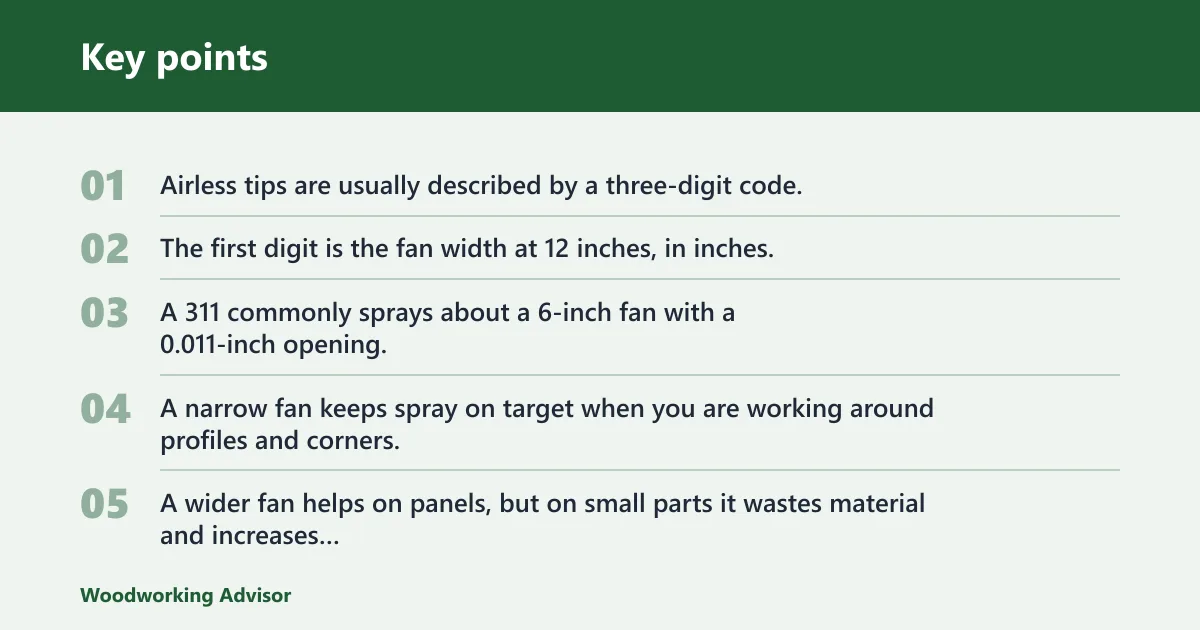
Airless tips are usually described by a three-digit code. The first digit is the fan width at 12 inches, in inches, and the last two digits are the orifice size in thousandths of an inch. A 311 commonly sprays about a 6-inch fan with a 0.011-inch opening; a 313 uses the same fan width with a 0.013-inch opening.
Why fan width matters
A narrow fan keeps spray on target when you are working around profiles and corners. A wider fan helps on panels, but on small parts it wastes material and increases overspray. That tradeoff matters more on furniture than on walls because the target area changes every few inches.
Tip wear also matters. As the orifice enlarges with use, the tip delivers more material and a less consistent pattern, which can turn a formerly balanced setup into one that runs or textures too heavily. Replace a worn tip when the pattern looks uneven or the finish quality drops despite normal setup.
Do I need a different tip for primer, stain, and topcoat?
Yes. Primer usually needs a larger opening than stain, and many topcoats sit in between. Thick primer can clog a small tip and leave a rough film, while stain through an oversized tip can flood details and create blotches or wasteful overspray.
Water-based paint often needs more attention to viscosity and atomization than stain, while polyurethane and clear coats usually reward a smaller, cleaner fan. Oil-based materials may flow better through a given tip, but they still need the right opening for the sprayer and the part geometry.
How viscosity changes the choice
Paint viscosity affects clogging, atomization, and texture. Thicker coatings usually need a larger tip or light thinning approved by the coating maker, while thinner coatings can use smaller tips for more control. If the material spits or pulses, the opening may be too small for the coating or the inlet may be starving the gun.
Do not thin just to force a small tip to work. That can reduce film build and change cure or sheen. Match the tip to the coating first, then use thinning only when the product instructions allow it.
Are paint sprayer tips universal?
No. Paint sprayer tips are not universal across all brands, guns, or spray systems. Airless tips, HVLP nozzles, and handheld sprayer parts often use different mounting systems, fluid paths, and pressure ranges, so compatibility must match the sprayer model and the manufacturer’s tip family.
Even within airless systems, guards and tips are often tied to a specific series. A tip may fit one brand’s guard but not another’s, and some handheld units accept only their own nozzle set. Check the manual before buying replacements.
Airless, HVLP, and handheld are different tools
Airless sprayers push coating at high pressure and rely on the tip to shape the fan. HVLP moves more air and less pressure, which usually gives finer control on furniture but often slower coverage. Handheld units are compact and convenient, but their output and tip options are usually more limited.
A common first-timer mistake is assuming a tip that works on a wall sprayer will work on a cabinet gun. That mismatch often shows up as poor atomization, uneven flow, or a pattern that is simply too large for the furniture part.
Which tip size is best for cabinets and furniture?
For cabinets and most painted furniture, 311 or 313 is often the best place to start because it gives a narrow enough fan for edges while still covering a door or drawer front efficiently. Choose the smaller end when the piece has raised detail or many short turns, and move wider only when the panel area clearly justifies it.
On large cabinet sides, the wider fan can save time. On face frames, the smaller fan usually gives cleaner control and fewer hard edges where passes overlap.
How do I avoid orange peel, runs, and overspray on furniture?
Match the tip opening to the coating thickness, keep the fan appropriate for the part size, and test on scrap before spraying the actual piece. Orange peel often points to too little fluid for the coating or poor atomization, while runs and sags usually point to too much material, too slow a pass, or a fan that is too wide for the part.
Fix the defect, not the label
If the finish looks pebbly, move up one size or check whether the material needs more thinning within the maker’s limits. If the finish sags at edges, move down one size or reduce fluid delivery and slow the build on vertical surfaces. If overspray dusts the surface, the fan may be too wide, the gun too far away, or the pressure too high for the part.
Suppose a drawer front gets orange peel with a 311 tip, but the same coating looks smooth on a smaller spindle set. The problem is more likely flow or atomization on the flat field than coating type alone. A 313 may help on the panel, while the spindles stay with the smaller tip.
JOUTYFOR spray tip set: best for mixed furniture work
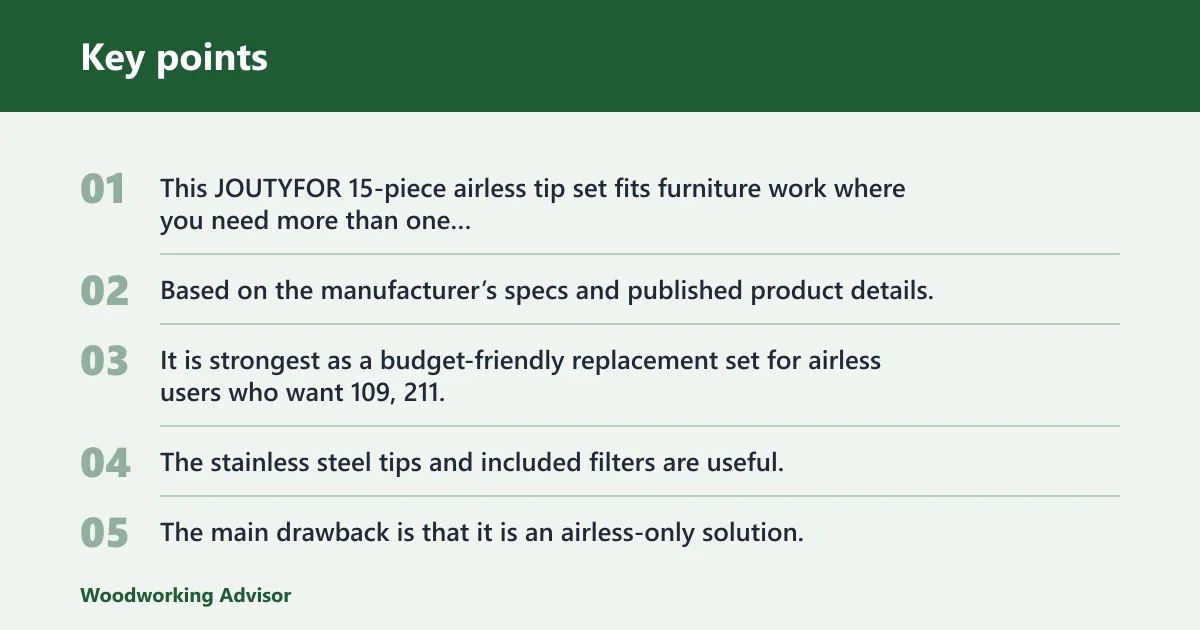

This JOUTYFOR 15-piece airless tip set fits furniture work where you need more than one opening on hand. Based on the manufacturer’s specs and published product details, the six sizes give you a practical spread for switching between detail parts, cabinet faces, and thicker primers without buying separate kits.
It is strongest as a budget-friendly replacement set for airless users who want 109, 211, 315, 417, 517, and 623 options in one package. The stainless steel tips and included filters are useful, but the set still depends on compatibility with your specific airless guard and sprayer system, so it is not a universal fit.
The main drawback is that it is an airless-only solution, so it does not solve HVLP or handheld compatibility. It is also a mixed-size kit rather than a purpose-built fine-finish package, which means furniture finishers still need to pick the correct size for each part instead of assuming one tip will cover everything.
Which one should you buy?
If you want one airless tip for most furniture, start with a 311 or 313-style size. If your work leans toward trim, chair parts, and tight rails, go smaller. If you spray more cabinet panels and broad table parts, keep a slightly wider tip on hand for coverage speed.
If you need one kit for mixed furniture, a multi-size airless set makes more sense than a single tip. That is where the JOUTYFOR set fits: it gives you a range for primers, paints, and detail work, but you still need the right sprayer match and the right coating preparation.
For HVLP users, the better choice is usually the nozzle and fluid setup recommended by the gun maker, not an airless-style number chart. For handheld units, choose the exact nozzle family listed for that model and confirm it can atomize your coating before committing to the piece.
Frequently asked questions
Is a 311 or 313 tip better for furniture paint?
A 311 is usually better for thinner paint or when you want a bit more control with less material output. A 313 is often better when the paint is thicker or when you need a slightly fuller film. The best choice depends on the coating viscosity and the part geometry.
What spray tip size is best for detailed furniture pieces?
Detailed pieces usually need the smaller end of the furniture range, often around 0.008–0.010 inch, because control matters more than speed. That choice helps on spindles, chair backs, and narrow rails where a wide fan would waste material and coat the wrong face.
Sponsored / affiliate links. As an Amazon Associate I earn from qualifying purchases. I may earn additional commission from eligible campaigns.