Spray Paint vs Brush Paint for Wood Furniture: Which Wins?
Spray Paint wins on curved, slatted, or detail-heavy wood furniture; Brush Paint wins on flat, simple pieces where brush marks are acceptable and you want easier control. Poor prep or the wrong method can leave drips, lap marks, clogged detail, or a finish that chips early. This guide compares both by furniture shape, prep burden, finish quality, and repair risk so you can choose the better method for your piece.
| Decision factor | Spray Paint | Brush Paint | Winner |
|---|---|---|---|
| Finish quality on complex shapes | Atomizes into a smoother, more even coat on curves, spindles, grooves, and carved surfaces. | Can leave brush marks, drag lines, and puddles in recesses unless you work carefully. | Spray Paint |
| Prep, masking, and cleanup burden | Needs more masking, ventilation, and cleanup, especially with overspray control. | Needs less masking and less cleanup around the work area. | Brush Paint |
| Control and touch-up work | Harder to place paint only where you want it, especially near edges and nearby surfaces. | Better for precision, small repairs, and controlled coverage on tight areas. | Brush Paint |
| Best fit for furniture geometry | Better on ornate, slatted, or profiled pieces where brushing would leave visible texture. | Better on flat panels, drawer fronts, and previously painted pieces that need a controlled refresh. | Tie |
| Repairability after a bad coat | Can need sanding to remove orange peel, dry spray, or overspray texture before recoating. | Can be sanded and recoated, and small flaws are easier to isolate and correct. | Brush Paint |
Spray paint vs brush paint: the real trade-off
The core choice is not speed alone. Spray Paint usually gives the cleaner surface on furniture with curves, grooves, legs, and carved detail, while Brush Paint gives more control on flat or already-painted surfaces where you want to place material exactly and keep the setup simple.
Finish quality versus control
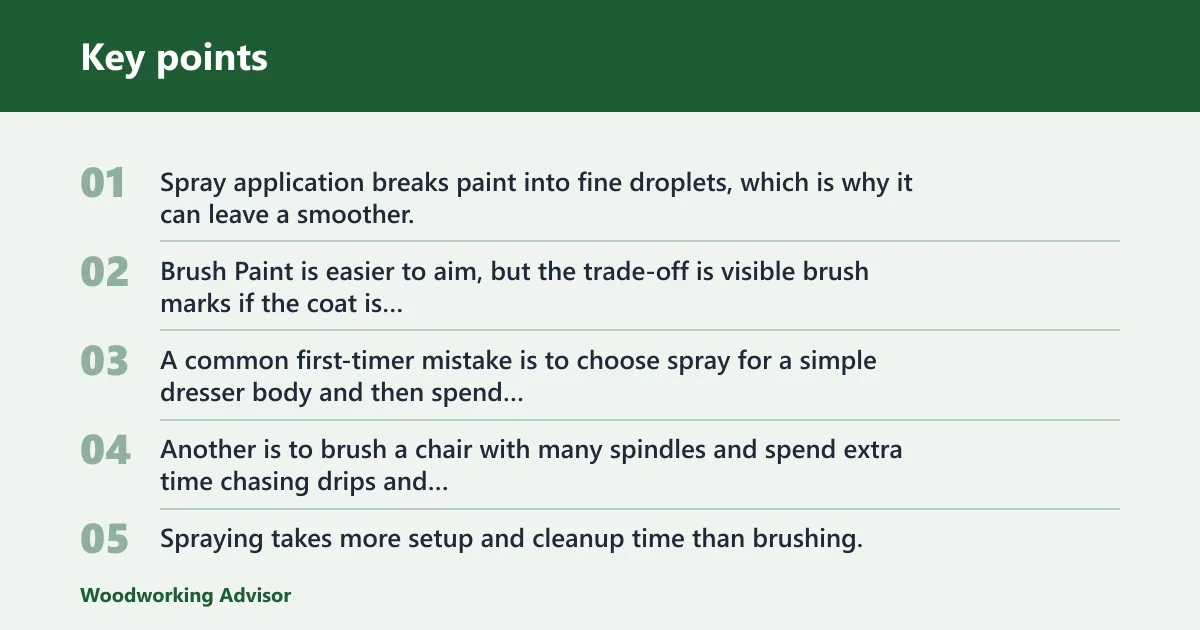
Spray application breaks paint into fine droplets, which is why it can leave a smoother, more even finish on furniture with profiles and edges. Brush Paint is easier to aim, but the trade-off is visible brush marks if the coat is too thick, the paint starts to drag, or you overwork an area.
A common first-timer mistake is to choose spray for a simple dresser body and then spend more time masking than painting. Another is to brush a chair with many spindles and spend extra time chasing drips and missed corners.
Prep, masking, and cleanup burden
Spraying takes more setup and cleanup time than brushing. You need to protect nearby surfaces, set up ventilation, and deal with overspray, which can travel farther than people expect and settle on floors, walls, and hardware.
Brush Paint usually has a lower setup burden. You still need sanding and cleaning, but you are not wrapping the workspace in masking paper for the same level of overspray protection.
Where each method tends to fail
Spray Paint can fail with orange peel, dry spray, thin coverage on hidden edges, and heavy buildup where you move too slowly. Brush Paint can fail with lap marks, bristle trails, sags, and drips, especially on vertical parts or around molding where paint gathers.
Suppose you are coating a roughly 6-foot cabinet door with recessed panels. Spray can give the flatter look, but only if you control coat thickness and keep the gun moving. Brush can work too, yet the panel edges are more likely to show texture unless you lay on thin coats and stop before the paint starts to skin over.
Furniture paint decision matrix
| Furniture scenario | Spray Paint | Brush Paint | Winner |
|---|---|---|---|
| Tabletop | Smoother on broad, flat areas if you can control dust and overspray. | Easier to control around edges and less risky in a small workspace. | Brush Paint |
| Chair spindle | Reaches round, narrow surfaces and ornate turns more evenly. | Hard to cover cleanly without puddling in grooves. | Spray Paint |
| Dresser body | Good if the piece is large and you can mask well. | Often easier on flat panels and existing paint. | Brush Paint |
| Cabinet door | Strong finish quality on flat or profiled doors with careful prep. | Good when you need careful edges and limited mess. | Tie |
| Drawer front | Useful when fronts have grooves or routed edges. | Useful when the front is flat and you want easy touch-up work. | Tie |
| Carved detail | Gets into crevices and open detail better. | Brush tips can miss recesses and leave heavy buildup on peaks. | Spray Paint |
| Laminate piece | Possible, but setup and adhesion prep matter more. | Often easier to control after the right primer. | Brush Paint |
| Previously painted piece | Good if the old coat is sound and the shape is complex. | Often easier when the goal is a controlled refresh with less masking. | Brush Paint |
Tabletop
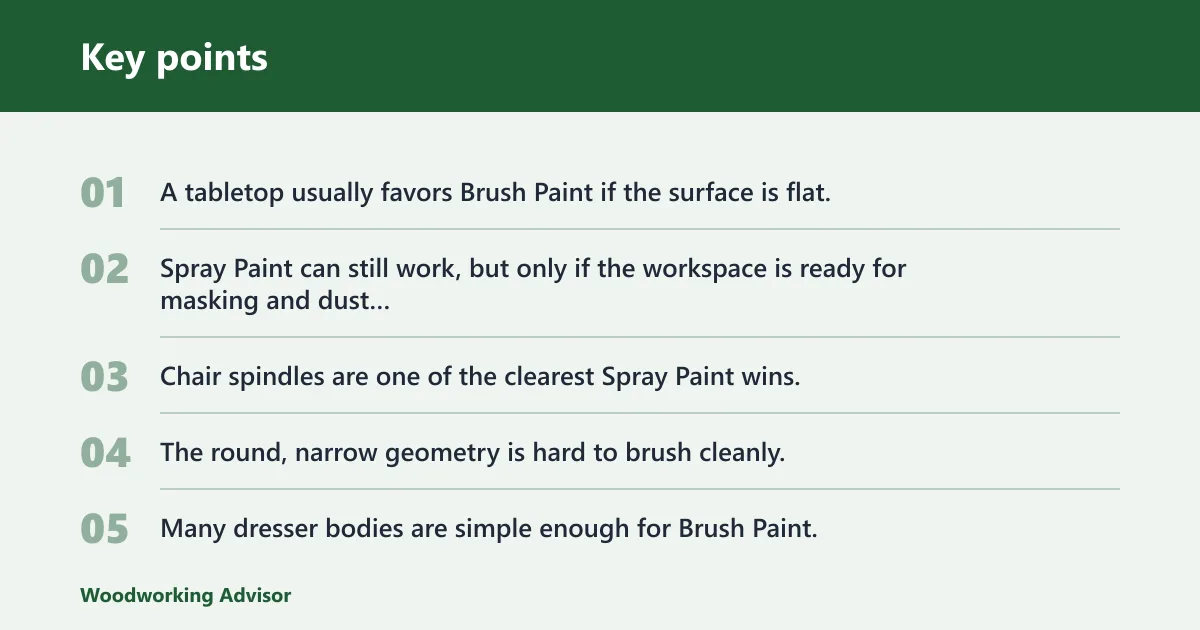
A tabletop usually favors Brush Paint if the surface is flat, because you can control the edge line and avoid spraying the floor, walls, and nearby tools. Spray Paint can still work, but only if the workspace is ready for masking and dust control.
Chair spindle
Chair spindles are one of the clearest Spray Paint wins. The round, narrow geometry is hard to brush cleanly, and atomization helps cover the sides without leaving heavy strokes in the valleys.
Dresser body
Many dresser bodies are simple enough for Brush Paint, especially if the surface is already painted and you want to keep the job contained. If the dresser has beadboard, trim, or inset lines, Spray Paint starts to look better because it reaches the detail more evenly.
Cabinet door
Cabinet doors sit near the middle. Flat doors can go either way, while raised panels and routed edges often look better with Spray Paint if you can manage the masking and dust.
Drawer front
Drawer fronts are a tie because they can be flat or profiled. Flat fronts favor Brush Paint for control, while shallow grooves and edge detail favor Spray Paint for more even coverage.
Carved detail
Carved detail strongly favors Spray Paint because the paint can reach recesses that a brush may skim over. Brush Paint can still work on small repairs, but detail buildup and missed pockets are common failure points.
Laminate piece
Laminate needs careful prep either way, but Brush Paint often gives you more control over adhesion problems and edge coverage. A primer made for slick, sealed surfaces matters more than the application method itself.
Previously painted piece
Previously painted furniture often favors Brush Paint when the old finish is stable and you want less masking. If the piece has spindles, grooves, or trim profiles, Spray Paint can still be the cleaner route.
Does spray paint give a smoother finish?
Yes, spray paint usually gives a smoother finish than Brush Paint on wood furniture because the coating lands in finer droplets instead of being dragged across the surface. That matters most on curved parts, slats, grooves, and carved areas where brush hairs can leave texture.
How atomization changes surface texture
Atomization lays down a more uniform film when you keep the can or sprayer moving and stay at the right distance. HVLP sprayers, which use high volume low pressure, are commonly used for furniture because they give excellent control over paint flow while cutting overspray compared with many other spray setups.
Orange peel, dry spray, and overspray
Smoother does not mean flawless. Spray Paint can still produce orange peel if the coat is too thick or too dry when it lands, and dry spray can leave a rough, dusty feel if the paint starts drying before it reaches the surface. Overspray is the other cost: it is one of the main tradeoffs and is why masking matters so much.
When a smooth finish still needs sanding
Even a sprayed coat may need light sanding before the next coat or before the final finish. A smooth-looking coat can still show nibs, texture, or edge buildup once the light hits it at an angle, especially on tabletops and cabinet doors.
When should you brush paint furniture instead?
Brush Paint makes sense when the furniture is flat, the workspace is limited, or you need close control near edges and hardware. It is also a better choice for touch-up work, because you can target a small area without masking an entire room around the piece.
Flat panels and existing paint
Flat panels often favor Brush Paint because the geometry is easy to control and brush texture is less noticeable on a simple surface. Previously painted wood furniture is another good fit, especially when the goal is a controlled refresh rather than a glass-smooth finish.
Tight profiles, edges, and repair work
Brush Paint is useful on tight profiles where masking would take longer than the paint step itself. It is also the easier choice for repairing one door, one drawer front, or one damaged edge without coating the whole piece again.
How to reduce brush marks and drips
Use thin coats, avoid overloading the brush, and keep a wet edge so the paint levels before it starts to skin over. Synthetic brushes usually pair well with water-based paint, while natural-bristle brushes are typically paired with oil paint. If brush marks still show, sand lightly after drying and apply another thin coat.
Sprayer, aerosol, or brush: which setup fits the job?
These are not the same workflow. An HVLP sprayer is a tool setup that gives good control but needs setup, thinning, and cleanup. Aerosol spray cans are the most convenient option for small projects and touch-ups, while Brush Paint keeps the process simpler and wastes less material.
HVLP sprayer basics
An HVLP sprayer is a high volume low pressure system. It is commonly used for furniture because it gives excellent control over paint flow and can produce a clean finish, but it still requires setup, thinning, and cleanup time that you should count before choosing it.
Aerosol spray paint for small projects
Aerosol spray paint is best for small projects and touch-ups. It dries fast and is convenient, but it still creates overspray and tends to cost more per square foot than Brush Paint, so it is usually not the best value for large furniture pieces.
Brush paint for control and lower waste
Brush Paint is relatively inexpensive compared with paint sprayers and is ideal for small furniture pieces or touch-up work. It also wastes less material than spraying, which matters when you are painting a single chair, drawer front, or side table.
Primer, paint type, and adhesion
Primer matters on finished or sealed wood, on laminate, and on older paint that may not want to bond cleanly with a new topcoat. A common prep sequence is to clean, sand, prime, then topcoat. Skip one step and the final finish is more likely to fail at the edges or chip during normal handling.
When to use BIN shellac-based primer or 123 primer
Shellac-based primers and bonding primers are commonly chosen when you need help with adhesion on sealed surfaces or on slick finishes. For latex paint, the source recommendation is a high quality, low-VOC primer.
Water-based paint versus oil-based paint
Water-based paint dries faster and is easier to apply, which makes cleanup easier too. Oil-based paints are described as durable and glossy, and professionals typically use oil-based paints to paint furniture. If you brush oil paint, use natural-bristle brushes; water-based paint usually pairs better with synthetic brushes.
Sanding and sealing before the topcoat
Sand enough to dull the old sheen and give the primer something to grab. On open-grain wood, fill or seal only if the finished look calls for it; on sealed or glossy furniture, primer choice and surface prep matter more than extra paint coats.
Choose Spray Paint if… / Choose Brush Paint if…
Choose Spray Paint if the furniture has curves, spindles, grooves, carved detail, or profiles that a brush would struggle to cover cleanly. Choose Brush Paint if the piece is mostly flat, the workspace is tight, you want lower material waste, or you need easier touch-up control.
Choose spray paint if…
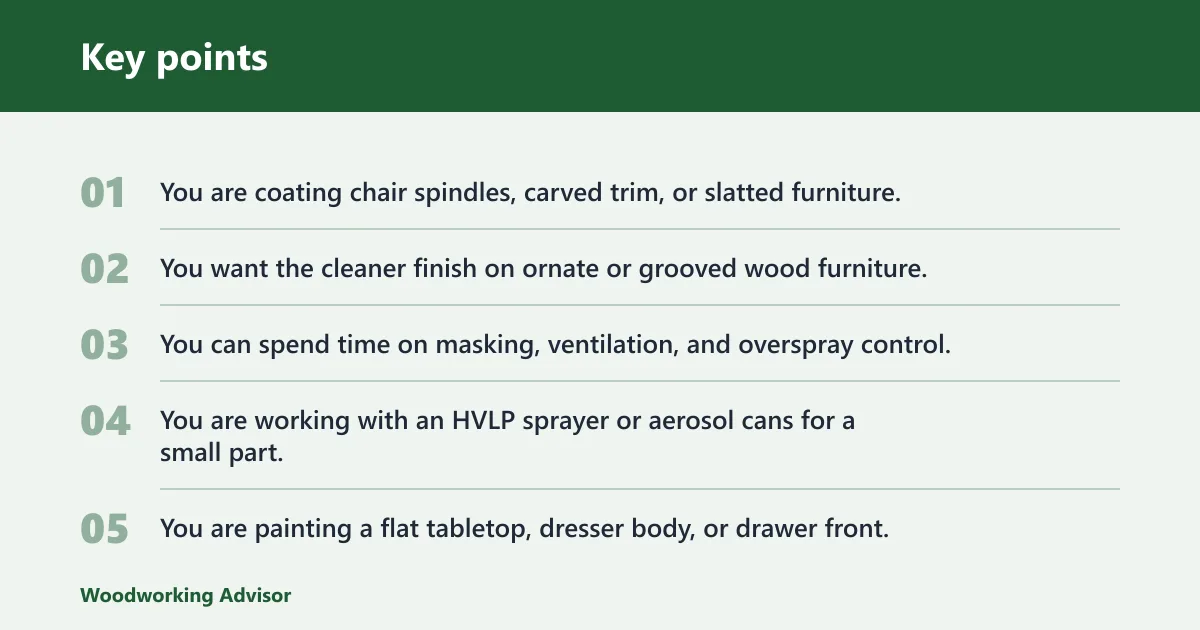
- You are coating chair spindles, carved trim, or slatted furniture.
- You want the cleaner finish on ornate or grooved wood furniture.
- You can spend time on masking, ventilation, and overspray control.
- You are working with an HVLP sprayer or aerosol cans for a small part.
Choose brush paint if…
- You are painting a flat tabletop, dresser body, or drawer front.
- You need controlled coverage near edges, hardware, or nearby walls.
- You want a lower-cost method with less setup and cleanup.
- You are fixing a small area and do not want to mask the whole room.


Frequently asked questions
Is it better to spray paint furniture or use a brush?
Spray Paint is better for curved, slatted, or detail-heavy furniture because it can cover complex surfaces more evenly. Brush Paint is better for flat pieces, small repairs, and jobs where you want less masking, less overspray, and tighter control around edges.
Does spray paint give a smoother finish than brush paint on wood furniture?
Usually, yes. Spray Paint generally leaves a smoother finish because the paint lands in finer droplets instead of brush strokes. That advantage is strongest on ornate furniture, but a sprayed coat can still show orange peel, dry spray, or dust if the prep or technique is off.
When should I brush paint furniture instead of spraying it?
Brush Paint makes more sense on flat panels, previously painted furniture, small pieces, and touch-up work. It is also the practical choice when masking would take more time than painting or when the work area is too tight for overspray control.
Can you spray paint wood furniture without primer?
Sometimes, but finished, sealed, laminate, or glossy wood usually needs primer for better adhesion. BIN shellac-based primer and 123 primer are common examples used for difficult surfaces, and latex paint often pairs with a high quality, low-VOC primer.
How do you avoid brush marks when painting furniture?
Use thin coats, avoid overbrushing, and choose the right brush for the paint type. Synthetic brushes are a common fit for water-based paint, while natural-bristle brushes are typically paired with oil paint. Light sanding between coats helps flatten marks and drips.
Which is cheaper for painting furniture, spray paint or brush paint?
Brush Paint is usually cheaper per project because brushes are relatively inexpensive and paint waste is lower. Aerosol spray paint is often the most expensive per square foot, and even an HVLP sprayer adds setup and cleanup time that counts as cost, even if the finish is better on some pieces.
What type of paint works best for wood furniture?
There is no single best paint for every piece. Oil-based paints are commonly used by professionals for furniture and are known for durability and gloss, while water-based paints dry faster and are easier to apply. The better choice depends on the finish you want and the brush or spray setup you plan to use.
Do professionals spray or brush paint furniture?
Professionals often spray furniture when the shape rewards it, especially on ornate pieces, doors, and cabinets. They also brush or roll and tip where control matters more than atomized finish. Oil-based paints are often used in pro furniture work, but the method still depends on geometry, prep, and the finish target.
Sponsored / affiliate links. As an Amazon Associate I earn from qualifying purchases. I may earn additional commission from eligible campaigns.