Best Bandsaw Blades for Woodworking: 7 Ranked by Cost/Foot (2026)
For most 14-inch woodworking band saws the best all-round buy is the POWERTEC 13603 93-1/2" assortment 3-pack at $29.99. Three blades covering 1/8", 1/4" and 1/2" widths works out at $1.28 per linear foot of steel — the cheapest blade in this comparison once you normalise for length, and the only pick that spans scrollwork and rip cuts out of one box. A bandsaw blade is the right call for curves; for straight rips and crosscuts on sheet goods, see our guide to picking a plywood blade instead.
The seven blades below are compared on four numbers that decide whether a blade will actually do the job you bought it for: cost per linear foot, minimum cutting radius, the thinnest stock the tooth pitch allows, and gauge. The last three come from manufacturer selection charts, not from opinion — and they disqualify the blade most roundups call "best overall" from most curve work.
Bandsaw Blade Comparison: Cost per Foot, Radius and Minimum Stock
Band saw blades are sold in different lengths for different saws, so sticker price is not comparable between them. A 111" blade contains 19% more steel than a 93-1/2" blade and a 70-1/2" blade contains 25% less. Dividing price by blade length puts every blade on one axis. The formula is cost per linear foot = price ÷ (blade length in inches ÷ 12), multiplied by the number of blades in the pack. A 12-inch Craftsman band saw, for example, takes an 80-inch blade on most models — check your specific length before ordering.
| Blade | Width × TPI | Length · gauge | Price | Cost / linear ft | Min cutting radius | Thinnest stock | Verdict |
|---|---|---|---|---|---|---|---|
| POWERTEC 13603 Assortment (3-pack) | 1/8", 1/4", 1/2" × 14/6/6 TPI | 93-1/2" · not published | $29.99 | $1.28 | 3/16" – 2-1/2" | 1/4" – 1/2" | Best all-round buy |
| POWERTEC 13118 | 1/8" × 14 TPI | 93-1/2" · 0.025" | $11.99 | $1.54 | 3/16" | 1/4" | Tightest curves here |
| POWERTEC 13181 | 1/4" × 6 TPI | 70-1/2" · 0.014" | $10.49 | $1.79 | 5/8" | 1/2" | Benchtop saws only |
| Olson FB14593DB | 1/4" × 6 TPI skip | 93-1/2" · 0.025" | $16.95 | $2.18 | 5/8" | 1/2" | Curves in thicker stock |
| FOXBC 93-1/2 resaw | 3/4" × 3 TPI hook | 93-1/2" · 0.025" | $19.99 | $2.57 | 5-1/2" | 1" | Cheapest true resaw |
| Timber Wolf 111 | 3/4" × 3 TPI | 111" · 0.032" | $42.99 | $4.65 | 5-1/2" | 1" | Low-tension, big saws |
| Dark Stone DS23293 | 3/4" × 2 TPI carbide | 93-1/2" · not published | $99.98 | $12.83 | 5-1/2" | 1-1/2" | Resaw only, long life |
Minimum cutting radius is a published engineering limit — a 3/4" blade physically cannot turn tighter than a 5-1/2" radius, no matter how carefully you feed it. Minimum stock thickness comes from the rule that at least three teeth must be in the workpiece at all times; below that figure the teeth straddle the cut, snatch, and strip. Both are on manufacturer charts, and neither appears in any competing bandsaw-blade roundup we could find.
Two results are worth pausing on. First, ranking by cost per foot reorders five of the seven blades against ranking by price. The $10.49 POWERTEC 70-1/2" looks like the budget option but is third-cheapest per foot, because it is a short blade. The $29.99 assortment pack looks like the fifth most expensive but is the cheapest steel on the list. Second, the Timber Wolf costs 2.15× the FOXBC on sticker but only 1.81× per foot — a third of that gap is simply extra blade.
One more thing worth knowing before you buy a resaw-capable blade like the FOXBC above: the saw matters as much as the blade. A benchtop import can run a 3/4-inch blade, but a heavier cabinet saw holds tension and tracking more consistently through a long resaw cut – see our Harvey Ambassador and Alpha bandsaw review for what a step up to a cabinet saw actually changes.
Best Bandsaw Blades for Woodworking
1. POWERTEC 13603 93-1/2" Assortment 3-Pack — #1 Best Overall
#1 Best Overall
| Price | $29.99 ($10.00 per blade) |
| Cost per linear foot | $1.28 — lowest here |
| Contents | 1/8" × 14 TPI, 1/4" × 6 TPI, 1/2" × 6 TPI |
| Length | 93-1/2" (14" saws) |
| Material | High-grade carbon steel |
| Radius range | 3/16" to 2-1/2" |
This is the pick for anyone who owns a 14" band saw and currently owns one blade. The set covers three genuinely different jobs — the 1/8" blade turns a 3/16" radius for bandsaw boxes and scrolled profiles, the 1/4" handles general curve work down to a 5/8" radius, and the 1/2" blade rips and cuts tenon cheeks. Buying those three widths separately from most brands costs more than $29.99.
The honest limit is the 1/2" × 6 TPI blade. Six teeth per inch is a general-purpose pitch, not a resaw pitch: in a 6"-deep cut the gullets fill with dust before they clear the workpiece, the cut slows and the blade heats. If you resaw regularly, treat this set as your curve-and-general kit and add a dedicated 3 TPI blade alongside it.
Carbon steel is the right call at this price. It stays flexible enough for the 1/8" blade to survive the wheel diameter, and a dull carbon blade is a $10 problem rather than a $100 one.
- Three widths cover scrollwork, general curves and rip cuts
- $1.28 per linear foot — cheapest steel in this comparison
- Fits the common 14" saws: Delta/Rockwell, Grizzly, Rikon, Jet, Shop Fox, Craftsman
- Gives you a spare on the shelf, which is the real reason blades sit unchanged too long
- Carbon steel dulls faster than bi-metal or carbide in abrasive hardwoods
- The 1/2" blade is 6 TPI, which is fine-pitched for deep resawing
- Gauge is not published by POWERTEC
Main drawback: the 1/2" × 6 TPI blade is not a resaw blade. It will cut a 6" board, slowly and warm, but a 3 TPI blade does that job several times faster.
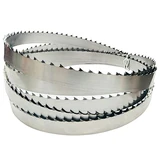
2. FOXBC 93-1/2" × 3/4" 3 TPI — Best Bandsaw Blade for Resawing
Best Bandsaw Blade for Resawing
| Price | $19.99 |
| Cost per linear foot | $2.57 |
| Width × TPI | 3/4" × 3 TPI hook |
| Gauge | 0.025" |
| Material | Japanese SK8 carbon steel |
| Min cutting radius | 5-1/2" |
| Thinnest stock | 1" |
Resawing is the job that most exposes a wrong blade, and this is the cheapest blade here that is genuinely built for it. Three teeth per inch means deep gullets that clear a tall cut, and 3/4" of width resists the sideways deflection that produces a barrelled, wandering face. For the full resaw-specific breakdown — tension PSI by brand, riser-block blade lengths, and carbide options — see our dedicated resaw blade comparison.
Before buying, check what width your saw is rated to tension. A large number of 14" cast-iron saws (the Delta clones and their descendants) are rated to 1/2" or 5/8" without a riser block and spring upgrade. A 3/4" blade on a saw that cannot tension it will wander worse than a properly tensioned 1/2" blade — more width is not automatically more accuracy. Our guide to how tight a bandsaw blade should be covers how to judge this on your own saw.
SK8 is a Japanese high-carbon tool steel, hardened at the tooth and left flexible in the back. It is the same class of steel as most quality carbon blades, and at $19.99 the blade is cheap enough to treat as a consumable rather than something to nurse.
- Genuine 3 TPI resaw pitch, not a general-purpose blade sold as one
- 3/4" width gives the beam strength that keeps a deep cut straight
- $2.57 per linear foot — 45% less than the Timber Wolf equivalent
- Fits the standard 93-1/2" 14" saw population
- Many 14" cast-iron saws cannot properly tension a 3/4" blade
- Carbon steel, so edge life in hard maple or white oak is limited
- Useless for curves — 5-1/2" minimum radius
Main drawback: 3/4" is more width than many 14" saws can tension. Confirm your saw’s rated maximum blade width before ordering, or step down to the 1/2" version.
3. Olson FB14593DB 1/4" × 93-1/2" 6 TPI Skip — Best for Cutting Curves and Bandsaw Boxes
Best for Cutting Curves and Bandsaw Boxes
| Price | $16.95 |
| Cost per linear foot | $2.18 |
| Width × TPI | 1/4" × 6 TPI skip |
| Gauge | 0.025" |
| Material | Hard Edge Flexible Back carbon steel |
| Min cutting radius | 5/8" |
| Thinnest stock | 1/2" |
A 1/4" blade is the width most woodworkers should leave on the saw by default. It turns a 5/8" radius, which covers cabriole legs, curved rails, bandsaw boxes and most template work, and it still tracks well enough for a straight cut in 4/4 stock.
The skip-tooth grind is what separates this from a general 1/4" blade. Skip teeth are spaced with wide, flat gullets at a zero rake angle — Grizzly’s own blade-selection sheet recommends the geometry for thick wood, and it is noticeably better than a regular tooth in wet softwood or resinous pine, where a fine gullet packs solid and starts burnishing instead of cutting.
The trade-off is surface finish. Fewer teeth in contact means a coarser face, so if you are cutting curves you intend to leave unsanded, a regular-tooth blade is the better choice. For cutting circles and curves in wood, the coarser face is usually irrelevant because the edge gets faired anyway.
- Skip-tooth gullets clear damp and resinous softwood without packing
- 5/8" minimum radius suits most furniture curves and bandsaw-box work
- Olson is the source of the width/radius chart the whole industry reprints
- Hard edge, flexible back — the right construction for a narrow blade on 14" wheels
- Skip tooth leaves a rougher face than a regular-tooth blade of the same pitch
- 6 TPI rules it out of anything thinner than 1/2"
- Costs 70% more than POWERTEC’s 1/4" blade
Main drawback: 6 TPI means it should not be used on stock thinner than 1/2". On 1/4" plywood the teeth straddle the cut and snatch.
4. POWERTEC 13118 93-1/2" × 1/8" 14 TPI — Best for Tight Scrollwork
Best for Tight Scrollwork
| Price | $11.99 |
| Cost per linear foot | $1.54 |
| Width × TPI | 1/8" × 14 TPI |
| Gauge | 0.025" |
| Material | High-grade carbon steel |
| Min cutting radius | 3/16" — tightest here |
| Thinnest stock | 1/4" |
This is the blade that changes what a band saw can do. At 1/8" wide it turns a 3/16" radius — tighter than a 3/8" drill bit — which puts scrolled brackets, small bandsaw boxes and tight interior curves within reach of a machine most people only use for straight cuts.
Two practical cautions. First, a 1/8" blade is running around a 14" wheel with far less cross-section to absorb the bending stress, so it will break sooner than a wider blade; that is physics, not a defect. Second, factory guide blocks on many saws are set up for 1/4" and wider, and a 1/8" blade needs the guides brought in close and square or it will twist.
At 14 TPI the pitch is fine enough for 1/4" plywood and thin hardwood, which is exactly the material scrolled work is usually cut from. Do not run it in 8/4 stock — the gullets are too small to clear that depth and the blade will overheat.
- 3/16" minimum radius — the tightest curve any blade in this comparison can cut
- 14 TPI leaves a clean enough face to go straight to sanding
- $11.99 for a blade that replaces a scroll saw for many jobs
- Cuts stock as thin as 1/4" without tooth strippage
- 1/8" blades fatigue and break faster than any other width
- Most 14" saw guide blocks need adjusting or replacing to support 1/8"
- Completely unsuitable for resawing or long rip cuts
Main drawback: 1/8" blades have the shortest service life of any width. Buy it for the jobs that need it, not as a blade to leave on the saw.
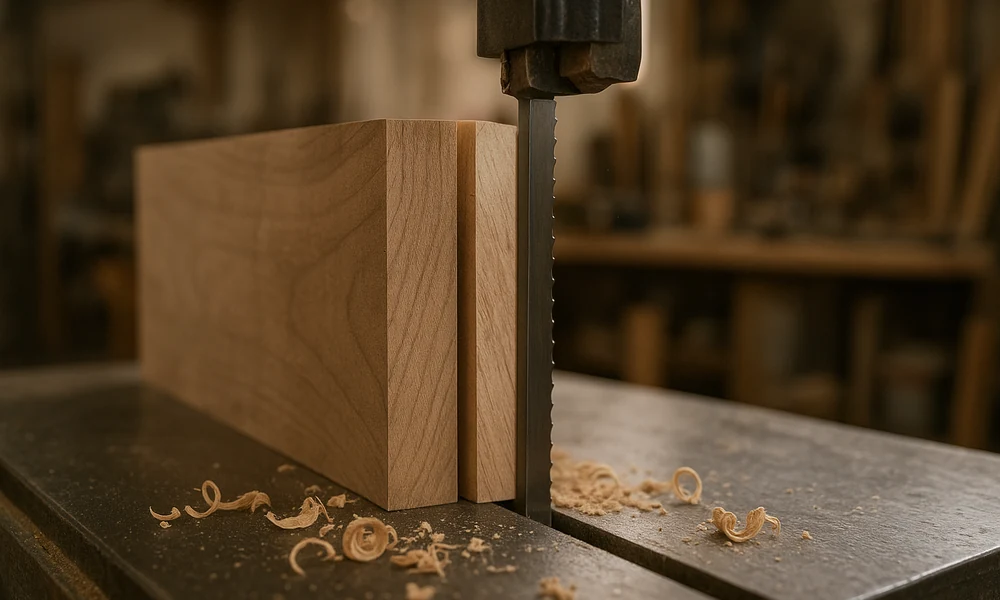
5. Timber Wolf 111" × 3/4" 3 TPI — Best for Resawing on a Low-Powered Saw
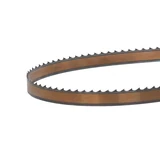
Best for Resawing on a Low-Powered Saw
| Price | $42.99 |
| Cost per linear foot | $4.65 |
| Width × TPI | 3/4" × 3 TPI |
| Length · gauge | 111" · 0.032" |
| Material | High silicon, low carbide steel |
| Min cutting radius | 5-1/2" |
| Thinnest stock | 1" |
Timber Wolf’s selling point is specific and testable from the maker’s own description: the blade is built to run under lower tension than a conventional blade. On a saw that is underpowered, or one whose tension spring has softened with age, that matters more than tooth material — a blade that cuts straight at lower tension is the difference between a usable resaw and a wandering one.
The 0.032" gauge is the other reason it belongs on a bigger saw and not a small one. Thicker steel resists deflection in a deep cut, but it also fatigues faster around a small wheel. Matching gauge to wheel diameter is a real constraint, not a marketing line.
Per foot of steel it is the second most expensive non-carbide blade here. Whether that is worth it comes down to whether your saw struggles to tension a conventional blade. If it does not, the FOXBC does the same cut for 45% less per foot.
- Designed to run at lower tension, so it needs less horsepower to cut straight
- High-silicon steel runs cooler than plain carbon in long resaw cuts
- 0.032" gauge adds beam strength for deep cuts on larger wheels
- 111" fits the bigger 17"–18" saws that 93-1/2" blades do not
- $4.65 per linear foot — 81% more than the FOXBC per foot of steel
- 111" will not fit a standard 14" saw
- Stock was limited at the time of checking
Main drawback: at 111" it fits larger saws only. Measure your saw’s blade length before ordering — our guide to measuring a band saw blade explains how.
6. Dark Stone DS23293 93-1/2" × 3/4" 2 TPI Carbide — Best Carbide-Tipped Blade for Hardwood
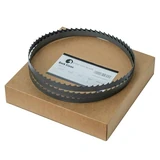
Best Carbide-Tipped Blade for Hardwood
| Price | $99.98 |
| Cost per linear foot | $12.83 — highest here |
| Width × TPI | 3/4" × 2 TPI hook |
| Teeth | Carbide-tipped |
| Backer | Alloy steel |
| Min cutting radius | 5-1/2" |
| Thinnest stock | 1-1/2" |
Carbide is the correct answer to one specific problem: abrasive timber destroying carbon steel edges. Teak, ipe, reclaimed lumber with grit in it, and heavily figured exotics dull a carbon blade in a fraction of the cuts they take from carbide.
The honest problem is that nobody publishes the number that would justify the price. Highland Woodworking, which sells carbide bandsaw blades, states only that they have "a much longer usable service life than standard bandsaw blades" — no multiplier. Without a published figure, the break-even against a $19.99 FOXBC is not something we can calculate honestly: you would need this blade to outlast five FOXBC blades simply to draw level on steel cost, before counting the time saved not changing blades.
Note also the 2 TPI constraint. At two teeth per inch the three-teeth-in-the-cut rule puts the minimum stock thickness at 1-1/2". This is not a blade you leave on the saw; it is a blade you fit for a resawing session and take off afterwards.
- Carbide teeth hold an edge far longer than carbon steel in abrasive and exotic timbers
- 2 TPI hook geometry clears chips from very deep cuts
- Alloy steel backer tracks smoothly and resists the vibration that ruins a resaw face
- The right tool if you resaw figured or exotic stock regularly
- $12.83 per linear foot — ten times the cost of the assortment pack
- 2 TPI means it should not touch stock thinner than 1-1/2"
- Straight-line cutting only; no curve work at all
- No lifespan multiplier is published, so the payback is not calculable
Main drawback: $12.83 per linear foot with no published lifespan multiplier to justify it. Buy it if you resaw abrasive or exotic stock often; otherwise the FOXBC does the same cut for a fifth of the cost per foot.
7. POWERTEC 13181 70-1/2" × 1/4" 6 TPI — Best for 9- and 10-Inch Benchtop Band Saws
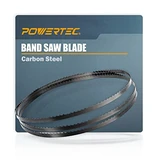
Best for 9- and 10-Inch Benchtop Band Saws
| Price | $10.49 — lowest here |
| Cost per linear foot | $1.79 |
| Width × TPI | 1/4" × 6 TPI |
| Length · gauge | 70-1/2" · 0.014" |
| Fits | Craftsman 21400, Rikon 10-305, Rikon 10-3061 |
| Min cutting radius | 5/8" |
| Thinnest stock | 1/2" |
The specification that matters here is not the price, it is the 0.014" gauge. A blade bends around the wheel on every revolution, and the tighter the wheel, the more strain that puts into the steel. The 93-1/2" blades in this comparison are 0.025" and the 111" Timber Wolf is 0.032"; this benchtop blade is roughly half the thickness of the latter. Fitting a thicker blade to a 10" saw is the most common cause of blades that crack at the weld after a few hours.
At 1/4" and 6 TPI it turns a 5/8" radius and handles stock from 1/2" upward, which matches what a benchtop saw is realistically used for — small curved parts, light ripping and trimming. Benchtop saws also rarely have the tension capacity for anything wider.
It also demonstrates why cost per foot is the more useful number. At $10.49 it is the cheapest blade on this page, but at 70-1/2" it is also the shortest; per foot of steel it sits third, behind the assortment pack and the 1/8" POWERTEC.
- 0.014" gauge is matched to small wheels, which is why it survives on a benchtop saw
- Lowest sticker price in this comparison
- 1/4" × 6 TPI is the correct default width and pitch for a small saw
- Fits the most common 10" benchtop models
- Third-cheapest per linear foot despite the lowest sticker price
- Carbon steel with a thin gauge — a genuine consumable
- 70-1/2" fits nothing larger than a 10" saw
Main drawback: at 70-1/2" it fits 10" benchtop saws only, and the thin 0.014" gauge that makes it right for small wheels also makes it a short-life consumable.
How We Picked These Bandsaw Blades
Nobody at Woodworking Advisor physically tested these seven blades, and this article does not claim otherwise. It is a specification and price comparison, and the value it adds is in putting numbers side by side that manufacturers publish separately and nobody publishes together. Here is exactly what was done, so you can check it.
- Prices and availability were pulled from the Amazon Creators API on 2 August 2026. Every price in the table is the live buy-box price on that date, and all seven blades returned an in-stock status. Prices move; the date is stated so you can judge how stale the figure is.
- Minimum cutting radius comes from the Olson Saw Company blade-width chart, reproduced in the RIKON band saw blade selection guide hosted by Highland Woodworking. The same figures were independently confirmed against the ISCO Blades "Blade Width Versus Radius Guide" and a third published chart — three sources, identical numbers.
- Minimum stock thickness comes from the Olson TPI chart on the same sheet, whose stated basis is that at least three teeth must be in the workpiece at all times.
- Tooth geometry definitions (hook, skip, raker) are from the Grizzly blade-selection sheet supplied with its 14" band saws, cross-checked against Laguna Tools’ blade education page.
- Cost per linear foot is our own calculation, not a manufacturer figure. The formula is in the section above so you can reproduce it.
- Specifications were taken from manufacturer listings. Where a manufacturer does not publish a figure — gauge on two of these blades — the table says "not published" rather than estimating it.
The limits of this method, stated plainly: a spec comparison cannot tell you how long a given blade stays sharp, how smooth its finish is in a particular species, or how consistent one brand’s welds are. Those need hands-on use over time. What it can tell you — and what decides most wrong purchases — is whether a blade can physically perform the cut you are buying it for. A blade that cannot turn your radius or clear your depth of cut will not improve with practice.
What to Consider When Buying Bandsaw Blades
Blade Width and Minimum Cutting Radius
Width is the first decision because it sets a hard physical limit. A blade cannot turn inside its minimum radius; forcing it twists the band, destroys the tooth set and often throws the blade off the wheels. This chart is published by Olson Saw Company and reprinted across the industry:
| Blade width | Minimum cutting radius | Diameter of tightest circle | What that means in practice |
|---|---|---|---|
| 1/8" | 3/16" | 3/8" | Scrolled work, small bandsaw boxes, tight interior curves |
| 3/16" | 5/16" | 5/8" | Tight decorative curves |
| 1/4" | 5/8" | 1-1/4" | Cabriole legs, curved rails, most furniture curves |
| 3/8" | 1-1/2" | 3" | Gentle curves plus decent straight tracking |
| 1/2" | 2-1/2" | 5" | General ripping, tenon cheeks, wide curves |
| 5/8" | 4" | 8" | Straight cuts, light resawing |
| 3/4" | 5-1/2" | 11" | Resawing only — no practical curve work |
| 1" | 7" | 14" | Dedicated resaw on large saws |
The practical consequence is the one most roundups skip: the 3/4" 3 TPI resaw blade that gets named "best overall" on most comparison pages cannot cut a circle smaller than 11 inches across. It is an excellent resaw blade and a useless curve blade. If your saw only ever wears one blade, a 1/4" or 3/8" is the more defensible default.
TPI and the Three-Teeth Rule
Teeth per inch controls finish, feed rate and — less obviously — the thinnest material the blade may safely cut. At least three teeth must be engaged in the workpiece at all times. With fewer, individual teeth take too big a bite, catch on the far face and strip. That gives a floor of roughly 3 ÷ TPI inches of stock thickness.
| TPI | Minimum stock thickness (published) | 3 ÷ TPI (derived) | Typical use |
|---|---|---|---|
| 2 | 1-1/2" | 1.500" | Deep resawing, green wood |
| 3 | 1" | 1.000" | Resawing 4/4 and thicker |
| 4 | 3/4" | 0.750" | Fast general cutting in 3/4" stock |
| 6 | 1/2" | 0.500" | General curves and ripping |
| 8 | 3/8" | 0.375" | Thinner hardwood, smoother face |
| 10 | 5/16" | 0.300" | Thin stock, good finish |
| 14 | 1/4" | 0.214" | Plywood, thin hardwood, scrollwork |
| 18 | 5/32" | 0.167" | Thin sheet material |
| 24 | 1/8" | 0.125" | Very thin stock, plastics |
| 32 | 3/32" | 0.094" | Thin plastics and non-ferrous sheet |
The derived column is worth a moment. Applying 3 ÷ TPI reproduces the published chart exactly on seven of its ten rows, and the largest disagreement anywhere is 0.036 inches. That confirms the chart really is just the three-teeth rule expressed as a table — which means you can compute the floor for any pitch that is not listed, including the variable-pitch blades that give a range rather than a single number.
Tooth Geometry: Hook, Skip and Regular
Three grinds dominate wood blades, and Grizzly’s blade-selection sheet defines them precisely:
- Regular (raker): equally spaced teeth at a 0° rake angle. Recommended for thinner workpieces and general use. Best surface finish of the three.
- Hook (claw): wide gullets and a positive rake angle. Cuts fast with good surface finish and pulls itself into the cut, so it needs less feed pressure. The standard resaw grind.
- Skip: wide, flat gullets at a 0° rake with teeth spaced further apart. Recommended for thick wood, and the best of the three at clearing damp or resinous material.
Matching grind to job matters more than brand. A hook tooth in thin stock is aggressive and grabby; a regular tooth in a 6" resaw cut loads its gullets and burns. Grizzly’s own chart maps hook teeth to resawing and thick ripping, raker teeth to crosscutting and most contour work, and skip teeth to sharp curves in thicker material.
Blade Material: Carbon, Silicon, Bi-Metal and Carbide
Carbon steel is differentially heat treated — hard at the teeth, flexible in the back — and is what five of the seven blades here use. It is cheap, flexible enough for narrow widths, and dulls fastest. Silicon steel (Timber Wolf) runs cooler in long cuts. Bi-metal welds a high-speed steel edge to a flexible backer and is mainly a metal-cutting construction. Carbide-tipped blades hold an edge longest and cost the most per foot by a wide margin.
One limitation is worth knowing before spending on carbide: Highland Woodworking notes that most carbide-tipped blades are 1/2" or wider and therefore "work best for straight line cutting or for cutting very slight curves". Carbide buys blade life on straight cuts, not versatility.
Blade Length and Saw Compatibility
Blade length is fixed by your saw’s wheel diameter and wheel spacing, and it is the one spec that makes a blade simply unusable rather than merely wrong. 93-1/2" covers the large population of 14" saws (Delta/Rockwell, Grizzly, Rikon, Jet, Shop Fox, Craftsman); 70-1/2" covers common 10" benchtop saws; 111" and 115" are for 17" and larger machines. If you do not know yours, measure the blade you have rather than guessing from the saw’s throat size. Owners of older Craftsman machines should note that 80-inch Craftsman band saw blades are a separate size again.
Gauge, and Why Small Saws Need Thin Blades
Gauge is blade thickness, and it has to be matched to wheel diameter. Every revolution bends the blade around the wheel, and thicker steel bent around a smaller radius accumulates fatigue faster. The pattern in this comparison is consistent: the 70-1/2" benchtop blade is 0.014", the 93-1/2" blades are 0.025", and the 111" blade for larger saws is 0.032". Fitting a 0.025" blade to a 10" saw is a common cause of blades that crack at the weld early.
Cost per Linear Foot, Not Sticker Price
Because blades are sold in lengths dictated by the saw, sticker price compares nothing. The table at the top of this page shows that ranking these seven blades by cost per foot moves five of them relative to ranking by price. If you are comparing blades across brands for different saws — or deciding whether a multi-pack is really cheaper — divide by length first.
Tension and Your Saw’s Horsepower
A wider blade needs more tension to stay straight, and more tension needs a frame and spring that can supply it plus a motor that can pull the resulting cut. Buying a 3/4" blade for a saw rated to 1/2" produces a blade that wanders more than the narrower one it replaced. Check your saw’s rated maximum width first, and see our guide to bandsaw blade tension for how to judge whether a blade is properly tensioned.
Blade Drift and Tooth Set
Drift is the tendency of a blade to cut at a slight angle to the fence, and it comes from uneven tooth set, a dull side, or guides that are not square. It is a property of the individual blade, not the saw, which is why it changes when you fit a new one. The fix is to set the fence to the blade’s drift angle rather than to the table’s mitre slot. A blade that drifts badly and cannot be corrected by tension or guide adjustment is usually dull on one side — sharpening a bandsaw blade can help, though on cheap carbon blades replacement is usually the economic choice.
Tooth set is how far each tooth is bent sideways, and it is what makes the kerf wider than the blade body so the steel does not bind. Grizzly’s blade sheet names two sets used on wood blades. Alternate set bends teeth evenly left and right and is the all-purpose arrangement. Raker set repeats a group of three — one bent left, one bent right, one left straight — and Grizzly describes it as ideal for most contour cuts, which is why it turns up on the narrower curve-cutting blades.
How to Change a Bandsaw Blade
The blade-change sequence below follows the procedure Olson Saw Company prints on its band saw blade instruction sheet.
- Unplug the saw and release the tension on the upper wheel. Open both wheel covers.
- Back off all the blade guides — the upper and lower thrust bearings and the side guides — so the blade can pass freely between them.
- Remove the old blade and slip the new one around both wheels, teeth pointing down at the front of the blade and toward the table. A blade fitted inside out will cut nothing.
- Apply enough tension to hold the blade on the wheels, then track it: turn the upper wheel by hand while adjusting the tilt of the wheel axis until the blade rides in the middle of the rim. Never track a blade with the motor running and the cover open.
- Bring the tension up to the correct setting for the blade width.
- Reset the thrust bearings first, upper and lower, then the side guides. Use a square to confirm you are not pushing the blade out of line, and slip a piece of paper between guide and blade to set the clearance.
- Close the covers, plug in, and make a test cut in scrap to check for drift before cutting anything that matters.
Once the blade is on and tracking true, the technique for actually running stock through it is its own skill — see our complete guide to using a bandsaw for blade-guide height, hand position, and cutting technique.
Frequently Asked Questions
What TPI bandsaw blade should I use for resawing hardwood?
Two or three teeth per inch. A coarse pitch gives deep gullets that can carry sawdust out of a tall cut without packing. Olson’s chart puts the minimum stock thickness at 1" for a 3 TPI blade and 1-1/2" for a 2 TPI blade, so a 3 TPI blade is the more flexible choice unless you are resawing very thick stock exclusively.
What blade width do I need for tight curves?
It depends on the tightest radius in your design. A 1/8" blade cuts a 3/16" radius, 3/16" cuts 5/16", and 1/4" cuts 5/8". Measure the tightest curve on your drawing and pick the widest blade that will make it — wider blades cut straighter everywhere else, so there is no benefit to going narrower than the job requires.
Can I use one bandsaw blade for everything?
Not well. A 3/4" resaw blade cannot cut a circle under 11" across and should not touch stock under 1" thick; a 1/8" scroll blade cannot resaw at all. The nearest thing to a single do-everything blade is 1/4" or 3/8" at 4–6 TPI, which handles curves down to 5/8" or 1-1/2" radius and rips 4/4 stock acceptably.
How long do bandsaw blades last?
No manufacturer in this comparison publishes a figure, because blade life depends almost entirely on what you cut. Carbon steel dulls fastest, especially in abrasive species, reclaimed timber and anything containing grit or hidden fasteners. Carbide-tipped blades hold an edge substantially longer — Highland Woodworking describes "a much longer usable service life" without quantifying it. Treat published lifespan multipliers you find elsewhere with suspicion unless the source is named.
Should I choose carbon steel, bi-metal or carbide bandsaw blades?
Carbon steel for general woodworking and anything narrow, because it is flexible and cheap enough to replace freely. Carbide-tipped for repeated resawing of abrasive, exotic or figured hardwood, accepting roughly ten times the cost per foot. Bi-metal is primarily a metal-cutting construction and is rarely the right answer for wood.
How do I stop my bandsaw blade from drifting?
First check tension and that the guides are square and set close to the workpiece. If the blade still cuts at an angle, the drift belongs to that blade: make a test cut freehand along a pencil line in scrap, note the angle the blade wants to follow, and set your fence parallel to that angle rather than to the mitre slot.
What size bandsaw blade does my saw take?
Blade length is set by your saw’s wheel diameter and spacing, and it is model-specific rather than predictable from the saw’s nominal size. The reliable methods are to check the manual or to measure the blade currently fitted. 93-1/2" suits most 14" saws, 70-1/2" most 10" benchtop saws, and 111"–115" the larger machines.
Final Thoughts
For a 14" saw, the POWERTEC 13603 assortment at $29.99 remains the most defensible first purchase: $1.28 per linear foot is the cheapest steel here, and three widths mean the saw can actually do the three jobs it is capable of. Add the FOXBC 3/4" 3 TPI at $19.99 when you start resawing, and the 1/8" POWERTEC at $11.99 when a design calls for a radius under 5/8".
If you’re shopping for the saw itself and not just a replacement blade, see our comparison of seven current band saws for woodworking, scored by throat depth, resaw capacity and cost per inch of resaw.
If one number leaves with you, make it this one: a 3/4" blade cannot cut a circle smaller than 11 inches across. Blade width is not a quality ranking where wider is better — it is a trade between how straight a blade tracks and how tight it can turn, and the chart above tells you exactly where that trade lands before you spend anything.
For more on choosing and using the machine itself, see our guide to what a band saw is used for, the band saw versus table saw comparison, and the wider woodworking tools and saws guide.
Sponsored / affiliate links. As an Amazon Associate I earn from qualifying purchases. I may earn additional commission from eligible campaigns.