3 Best Stain Colors for Ash Wood (2026): research shows
For ash wood, the best stain color is usually a medium brown or light walnut if you want the grain to stay visible; use darker stains only when you want higher contrast. Pick the wrong tone and ash can look muddy, blotchy, or overly red, which is costly on furniture and trim. This guide explains which stain colors work for open-grain ash, how undertones change the result, and when to choose dye, stain, or clear finish.
This guide is part of our Ash lumber overview: workability, grain, and value series.
Quick comparison
| Product | Badge | Best for | Price | ||
|---|---|---|---|---|---|
 |
Minwax 1 qt Minwax 70047 Weathered Oak Wood FinishMinwax | Our pick | Minwax 1 qt Weathered Oak Oil-Based Stain | $13.93
Price as of 11 Oct 2026
|
View |
 |
General Finishes Oil Base Gel Stain, 1 Pint, JavaGeneral Finishes | Also great | General Finishes 1 Pint Gel Stain | $39.95
Price as of 11 Oct 2026
|
View |
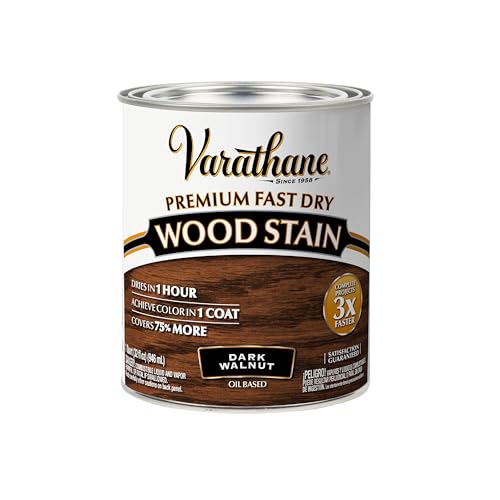 |
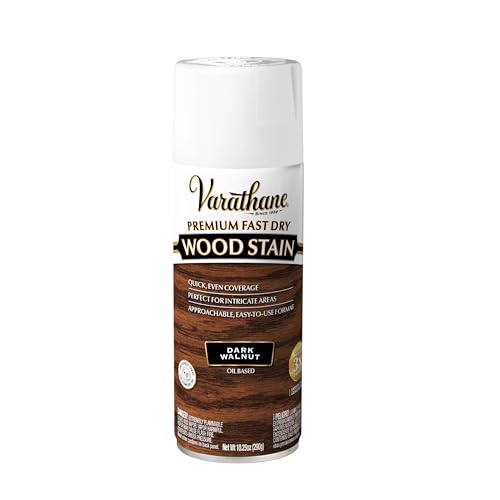
Varathane Premium Fast Dry Dark Walnut Wood StainVarathane | Budget pick | Varathane Premium Fast Dry Dark Walnut | $15.97
Price as of 11 Oct 2026
|
View |
 |
Old Masters 44104 1 Quart Penetrating Stain, Crimson FireOld Masters | Also great | Old Masters 1 Quart Penetrating Stain | $30.00
Price as of 11 Oct 2026
|
View |
 |
Watco Dark Walnut Danish Oil Wood FinishWatco | Our pick | $14.98
Price as of 15 Oct 2026
|
View |
Use the table as a design shortcut, not a final decision. Ash is often light and open-pored, so the same color can read clean and Scandinavian on one project, then heavier or more traditional on another.
Opacity matters as much as color. Benjamin Moore lists translucent, semi-transparent, semi-solid, and solid stain, and each step down the scale hides more grain.
How we chose these ash stain colors
The best match for ash depends on three things: how much grain you want to keep visible, the room style you are targeting, and whether the project sits indoors or outdoors. Ash accepts color clearly because its base color is light, but poor sanding or skipped dust removal can still make it blotchy.
Grain visibility and opacity
Translucent stain gives the most wood character. Semi-transparent still leaves most grain and texture visible. Semi-solid and solid push ash toward a painted look, which can help if the goal is darker trim or a more uniform exterior piece.
Style goal and room setting
Scandinavian rooms usually favor pale, clear, or slightly ambered ash. Mid-century pieces often look best in light walnut or medium brown. Rustic rooms tolerate deeper brown, and modern interiors can handle blackened tones if the grain still needs some definition.
Interior vs. exterior durability needs
Interior furniture is judged mainly by color and grain. Exterior furniture also needs protection from sunlight and moisture, and exterior stain can provide a UV- and mildew-resistant coating. Benjamin Moore also notes that staining outdoor furniture can be a weekend project, but it should be absolutely dry before staining.
Natural clear: best for showing ash grain
Clear or near-clear ash is the right call when you want the open pores and strong figure to do the work. A translucent stain or clear finish keeps the wood looking light, which fits Scandinavian furniture, pale trim, and simple built-ins where the grain should stay the feature.
Ash’s light natural color accepts this look well, but the result depends on prep. Sand from 40- to 80-grit up to 180- to 220-grit, then remove every trace of dust, so the surface stays even instead of absorbing color unevenly.
When clear is the best fit
Choose clear when you want the least color shift and the most grain visibility. It is also the safest choice if the piece is already near the room’s desired tone and only needs protection, not a style change.
Walnut brown: best for classic furniture
Light walnut and medium brown are the most dependable choices for ash furniture because they add warmth without burying the grain. This is the sweet spot for mid-century dressers, table bases, cabinets, and trim that should feel finished rather than dark.
For ash, a semi-transparent stain usually gives the best balance here. It keeps most grain and texture visible while softening the pale base color that can otherwise look flat in indoor light.
Why walnut tones work on ash
Ash’s prominent grain gives brown tones visible movement. Walnut tones also avoid the red cast that some warmer stains can create on light hardwoods, which is useful when you want a clean brown rather than an orange finish.
Blackened modern: best for bold trim and contemporary pieces
Blackened modern tones work when you want ash to read as graphic and architectural. They suit modern trim, accent furniture, and cases where contrast matters more than wood color. The tradeoff is clear: the darker the stain, the less grain you see.
For this look, semi-solid can be a practical middle ground. It keeps some texture and grain pattern visible while pushing ash into a deeper, more deliberate color field than translucent or semi-transparent options.
Where dark ash looks best
Dark ash works best in larger, simpler forms. Thin trim, tight rails, and heavily detailed pieces can lose definition if the stain is too opaque or too black. On furniture, the design should still be readable at arm’s length.
What stain color looks best on ash wood?
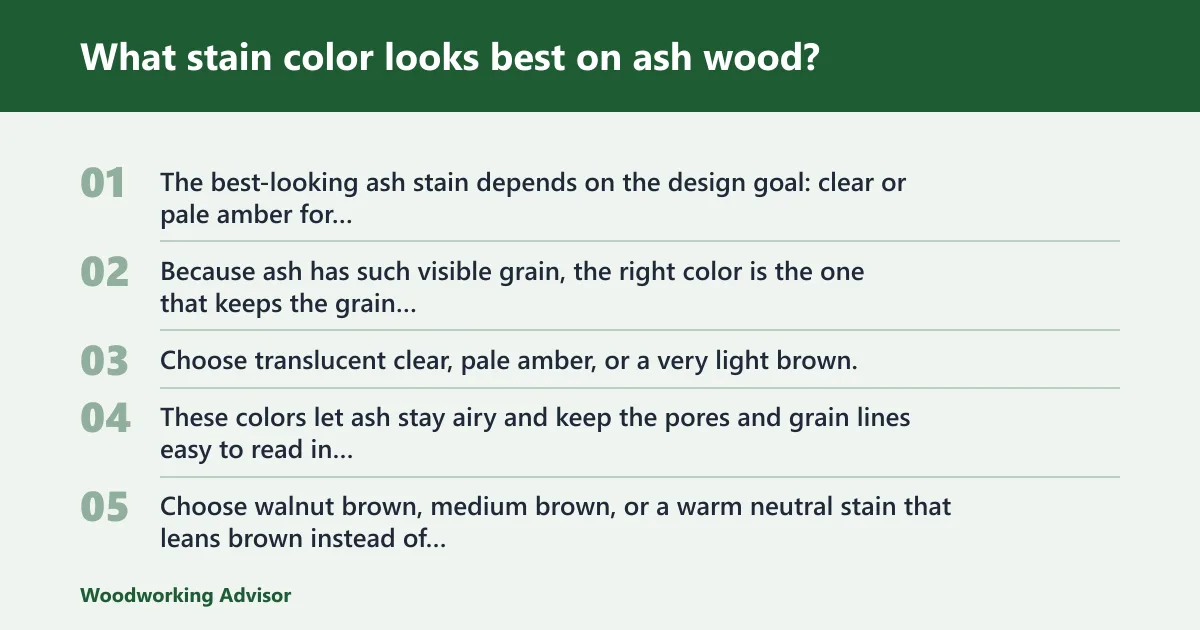
The best-looking ash stain depends on the design goal: clear or pale amber for Scandinavian, light walnut for mid-century, and deeper brown or blackened tones for rustic or modern work. Because ash has such visible grain, the right color is the one that keeps the grain readable at the distance the piece will be seen.
Choose translucent clear, pale amber, or a very light brown. These colors let ash stay airy and keep the pores and grain lines easy to read in daylight and under indoor lighting.
Mid-century and warm brown looks
Choose walnut brown, medium brown, or a warm neutral stain that leans brown instead of red. This gives ash enough color to feel finished while still showing the dramatic linear grain that makes the species appealing.
Rustic or modern dark looks
Choose dark walnut, blackened brown, or a near-black finish only if the design can handle reduced grain visibility. Rustic pieces can absorb more color, while modern pieces often benefit from the higher contrast created by a darker stain.
Three-sample test plan for ash stain colors
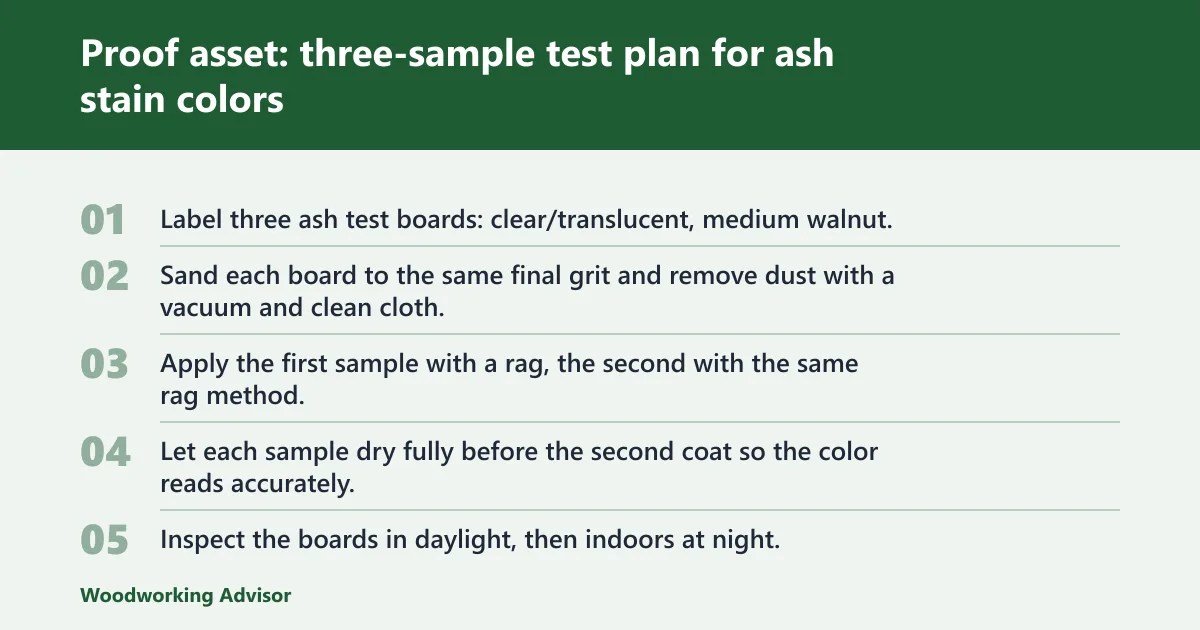
Use three test boards cut from the same ash board or from matching offcuts. The point is to compare color families under the same conditions, not to compare different sanding jobs or different lighting. That is how you separate a good stain choice from a prep problem.
Use the same sanding grit on every sample
Sand all three boards through the same schedule you plan to use on the project, such as 120-grit, then 180-grit, then 220-grit. Benjamin Moore’s prep guidance includes moving from 40- to 80-grit to 180- to 220-grit, and the key point is consistency across samples.
Apply each stain with the same tool and coat count
Use one method for all three samples, such as a rag for wipe-on colors or a brush for a brushed finish. Apply the same number of coats to each board; for comparison, two coats gives a clearer read on how the color builds than a single quick pass.
Compare samples in daylight and indoor light
Check the boards near a window in daylight, then again under the room’s usual lamps. Ash can shift from clean to yellowed, red, or muddy depending on the light, and the “best” stain is the one that still looks right in both settings.
- Label three ash test boards: clear/translucent, medium walnut, and dark walnut or blackened.
- Sand each board to the same final grit and remove dust with a vacuum and clean cloth.
- Apply the first sample with a rag, the second with the same rag method, and the third the same way.
- Let each sample dry fully before the second coat so the color reads accurately.
- Inspect the boards in daylight, then indoors at night, and choose the board that matches the room setting.
Say your ash dining table sits under warm pendant lights and near a bright window. A light walnut board may look balanced in the evening but too orange in daylight, while a clear sample may look washed out; the test boards reveal that before you stain the table.
Suppose your ash trim is going in a hallway with limited natural light. A dark sample may crush the grain into a flat surface, while a semi-transparent brown could keep the lines visible enough to read from across the room.
Which one should you buy?
For preserving grain, start with a translucent or semi-transparent clear-to-walnut color. For warming ash without making it look heavy, choose medium brown or light walnut. For the darkest look, choose a blackened brown or dark walnut, but accept that grain visibility will drop as opacity rises.
Best choice for preserving grain
Pick a clear, natural, or very light amber stain. That gives the strongest grain visibility and the least risk of ash looking muddy.
Best choice for warmer color
Pick a medium walnut or brown walnut tone. This is the safest middle path for furniture and trim that need more depth but still should read as wood.
Best choice for the darkest look
Pick a dark walnut or blackened modern tone with semi-solid behavior if your goal is a bold, contemporary appearance. Use it where reduced grain is acceptable.
What stain opacity works best on ash furniture?
Semi-transparent is the best default for ash furniture because it keeps most grain and texture visible while still adding real color. Translucent works when you want the lightest possible change, while semi-solid is better when you want a deeper tone without fully covering the wood.
How opacity changes the result
Benjamin Moore describes translucent stain as allowing the full beauty of the wood to show through, semi-transparent as allowing most of the grain pattern and texture to show through, semi-solid as allowing the texture and some grain pattern to show through, and solid as allowing only the texture of the wood to show through.
How do I keep ash grain visible after staining?
Use a lighter or medium-opacity stain, keep the color in the brown family, and finish with a clear topcoat rather than a second heavy color coat. The more opaque the product, the more ash starts to lose the open-grain look that makes it distinctive.
Surface prep that helps grain stay readable
Sand evenly, remove every trace of dust, and let the wood dry completely before staining. A conditioner or washcoat can be worth considering on especially thirsty or uneven stock, but use it only when the product instructions call for it and after a test board confirms the look.
Why does ash look blotchy when stained?

Ash can look blotchy when sanding is uneven, dust remains in the pores, or the surface absorbs color at different rates. Although ash is not as notorious as some softwoods for blotching, its open pores can still make poor prep obvious, especially with dark or very transparent stain.
Common causes
Skipped grit steps, uneven pressure, and stain left sitting too long can all exaggerate color differences. If the first coat looks patchy, the problem is usually prep or application consistency rather than ash itself.
Do I need a conditioner before staining ash wood?
Usually no, not as a default step. Ash is often fine with a careful sanding schedule and clean surface, but a conditioner or washcoat can help when the boards vary in density or when a very even pale finish matters more than maximum grain contrast.
When a conditioner is worth considering
Use one if your test boards show dark lap marks, uneven absorption, or sudden jumps in color. If the samples already look even after proper sanding, skip the conditioner and keep the system simpler.
How do I test stain colors on ash before finishing?
Make three labeled sample boards, finish them with the same sanding schedule as the project, and compare them under the same room lighting where the piece will live. Testing is the fastest way to see whether ash should stay clear, move to walnut, or go dark.
What to record on each sample
Note the stain name or color family, the number of coats, the application tool, and whether the board was wiped or brushed. Also note the result in daylight and indoor light, because ash can read very differently between the two.
Frequently asked questions
Does ash wood stain well?
Yes, ash usually stains well because its light natural color accepts changes clearly and its grain reads strongly through translucent and semi-transparent colors. Results improve when you sand evenly, remove dust, and avoid trying to force a very opaque look on a piece that needs visible grain.
Should I use a clear, natural, or dark stain on ash?
Use clear for the most grain visibility, natural or light amber for a soft shift, and dark only when the design calls for contrast. For most trim and furniture, a medium brown is easier to live with than a full dark finish.
Sponsored / affiliate links. As an Amazon Associate I earn from qualifying purchases. I may earn additional commission from eligible campaigns.