3 Best Stains for Cabinets (2026): Based on Specs and Reviews
For cabinets, choose gel stain for blotch-prone woods or vertical faces, oil-based stain for the deepest traditional warmth, and water-based stain when fast dry time and easy cleanup matter most. Pick the wrong type and you can get uneven color, lap marks, or a finish that adds work instead of saving it. This guide compares gel, oil, and water-based stains by cabinet-specific failure mode so you can choose with less guesswork.
For cabinets, choose gel stain for blotch-prone woods or vertical faces, oil-based stain for the deepest traditional warmth, and water-based stain when fast dry time and easy cleanup matter most. Pick the wrong type and you can get uneven color, lap marks, or a finish that adds work instead of saving it. This guide compares gel, oil, and water-based stains by cabinet-specific failure mode so you can choose with less guesswork.
Quick comparison
| Product | Badge | Best for | Price | ||
|---|---|---|---|---|---|
 |
Minwax 1 qt Minwax 70047 Weathered Oak Wood FinishMinwax | Our pick | 1 qt · Weathered Oak · Oil-Based | $13.93
Price as of 21 Oct 2026
|
View |
 |
General Finishes Oil Base Gel Stain, 1 Quart, Antique WalnutGeneral Finishes | Upgrade pick | 1 Quart · Antique Walnut · Oil Base Gel | $60.87
Price as of 21 Oct 2026
|
View |
 |
Varathane Premium Fast Dry Cabernet Wood Stain | Oil-Based,Varathane | Budget pick | Quart · Cabernet · Oil-Based Fast Dry | $15.97
Price as of 21 Oct 2026
|
View |
Gel, oil, and water-based stains can all color cabinets, but they behave very differently on doors, face frames, and shelves. The best pick depends on control, dry time, odor, cleanup, and how much grain you want to keep visible.
How we chose
The comparison focuses on four cabinet realities: color control on vertical parts, blotch risk on common cabinet woods, dry time and odor in a kitchen setting, and topcoat or refinishing compatibility. It also accounts for product behavior that matters during application, not only the color on the can.
For cabinet work, the failure mode matters more than the label. Doors and face frames punish thin stains that run; blotch-prone woods punish stains that soak unevenly; rushed projects punish slow dry times.
| Cabinet decision point | Gel stain | Oil stain | Water-based stain |
|---|---|---|---|
| Blotch resistance | High control on pine, maple, birch, and cherry because it sits more on the surface | Moderate; depends more on the wood and prep | Moderate; more even than some liquids, but can still highlight uneven absorption |
| Grain visibility | Lower grain emphasis than penetrating stains | Strong grain visibility and traditional depth | Often keeps grain visible, with a cleaner modern look |
| Open time | Long enough for controlled wiping, but product-specific | Long open time and familiar wipe-on workflow | Usually shorter working time than many oil products |
| Dry time | Usually slower than water-based; General Finishes lists 8–24 hours before topcoat | Often slower than water-based | Faster dry time than many oil products |
| Odor and cleanup | Oil-based odor and solvent cleanup are common | Oil-based odor and solvent cleanup are common | Lower odor and easier water cleanup |
| Vertical-surface control | Very good on doors and face frames because it is thick and less run-prone | Fair to good, but runs are easier to create on large vertical parts | Good if sprayed carefully, but liquid run control still matters |
| Best cabinet use case | Blotch-prone woods, vertical surfaces, and color correction | Traditional penetrating color where the wood and grain should read clearly | Fast-turnaround jobs where low odor and quick recoat matter |
Gel stain: best for control on cabinets
Gel stain is the safest cabinet pick when you need control. It has a thick, pudding-like consistency and sits on the wood surface instead of penetrating deeply, so it helps reduce blotching on maple, pine, birch, and cherry while giving you more time to wipe back color evenly.
Why gel stain helps on blotch-prone woods
Blotch-prone woods absorb liquid unevenly, which is why pine and maple cabinet doors often show dark patches and lighter islands after a conventional stain. Gel stain reduces that risk because less of the color sinks deep into the fibers at once.
That does not mean the finish is foolproof. You still need proper prep, an even application, and a test area on the exact wood or substrate you are finishing.
Why it works well on doors and face frames
Cabinet doors and vertical surfaces are prone to runs and drips with thin liquid stain. Gel stain is better suited to these parts because the thicker body stays where you put it, which helps with even color across large flat panels and rails.
If you need to correct color or soften a too-dark pass, gel stain is also easier to manage in small sections than a thin penetrating stain.
Example product notes: General Finishes gel stain
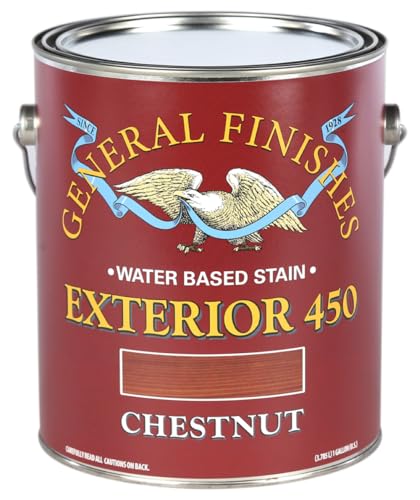
General Finishes gel stain is oil-based, and the line is useful on MDF, fiberglass, and metal. The manufacturer lists dry time of 8–24 hours before topcoat, and common colors include Java, Antique Walnut, Gray, and American Oak.
One drawback is practical: it is too thick for conventional spray guns and HVLP systems, so it is a wipe-on or brush-applied product rather than a spray-first choice.
Oil-based stain: best for traditional color depth
Oil-based stain is the classic penetrating option for cabinets when you want a familiar wipe-on workflow and deeper grain emphasis. Compared with gel stain, it soaks in more and tends to read as a more traditional stained-wood finish.
Long open time and wipe-on workflow
Oil stain gives you more open time than many fast-drying products, which helps when you are working across multiple cabinet doors or matching color between face frames and drawer fronts. That extra time can make wipe-off more predictable.
For many woodworkers, that is the main appeal: the workflow is familiar, and the stain behaves like the reference point most finishing schedules are built around.
When liquid penetration is the better fit
If the cabinet wood has attractive grain and you want that grain to remain a main visual feature, oil stain can be the better fit. It is a stronger choice when you want warmth from within the wood rather than a more surface-colored look.
Picture a set of oak cabinet doors where the grain should stay prominent. Oil stain is usually the more natural match than gel, provided the surface is prepared evenly and the stain is wiped consistently.
Where oil stain can be harder to control
On vertical cabinet parts, thin oil stain can create lap marks, drips, or uneven edges if you work too slowly or load the surface too heavily. It also tends to be less forgiving on woods that absorb unevenly.
That is why oil stain is a better color-first option than a control-first option. If the cabinet parts are already difficult to stain cleanly, gel usually gives you more margin.
Water-based stain: best for fast turnaround
Water-based stain is the best fit when low odor, fast dry time, and easier cleanup matter more than the deepest traditional look. It is also more spray-friendly than gel stain, which makes it useful for cabinet parts that are easier to finish off the piece.
Low odor and faster dry time
Water-based stain dries faster than many oil products, so it can help a kitchen project move faster from stain to topcoat. That matters when you need to keep disruption low or when a project schedule is tight.
The tradeoff is that quick dry time can reduce working time. You get speed, but less room to correct errors after application.
Spray-friendly application on cabinet parts
Water-based stain is compatible with spray application, which can be useful for cabinet boxes, doors, and drawer fronts when the workflow is set up for it. Compared with gel, it is the more spray-oriented choice.
Still, sprayability is not the same as forgiveness. Runs and overlap marks can still appear if you apply too much on a vertical surface.
Grain raising and how to manage it
Water-based stain can raise the grain, especially on sanded wood that is ready to accept finish. A light scuff between coats or a careful pre-raise step can help keep the surface from feeling rough after coloring.
If the cabinet parts are already finely sanded, expect the first water-based coat to change the texture a bit. That is normal and should be planned for before topcoating.
Can you stain cabinets over an old finish?
Yes, but an old finish changes the job. Cabinets with an existing finish usually need cleaning, sanding, and a test area before you can expect stain to behave consistently, and some finished surfaces may not take stain evenly at all.
What prep an existing finish usually needs
Start by cleaning away grease, wax, and kitchen residue. Then scuff sand to create tooth, remove dust, and test a hidden area before committing to the visible faces.
If the old finish is intact and smooth, stain may sit on top instead of coloring the wood beneath. That can be useful for correction, but it can also make the result less predictable.
When a test area matters most
A test area matters most when you are trying to match existing cabinets or blend in a repair. Say your base cabinet has a worn patch near the toe kick and the rest still has an older amber tone; a small test spot tells you whether the new stain will blend or stand out.
If the finish is failing in patches, a stain may not be the right fix. In that case, a more complete refinish process is usually the better path.
Which one should you buy?
Choose gel stain if the wood blotches, the surface is vertical, or you need more control on doors and face frames. Choose oil-based stain if you want classic penetrating color and a familiar wipe-on workflow. Choose water-based stain if speed, low odor, and easier cleanup matter most.
Choose gel if control is the priority
Gel is the safer choice for pine, maple, birch, and cherry when color uniformity matters more than deep grain penetration. It is also the stronger pick for cabinet doors, face frames, and other vertical parts that would rather not be flooded with thin liquid stain.
Choose oil if traditional warmth matters most
Oil stain makes sense when you want deeper penetration and strong grain visibility. It is a better fit for cabinet parts that can be stained flat and wiped carefully, and for projects where a classic stained-wood look is the target.
Choose water-based if turnaround matters most
Water-based stain is the practical choice for low-odor jobs or when you need to move quickly from color to topcoat. It is also the more natural pick when spraying is part of the process and you are prepared to manage grain raising.
Practical cabinet-part guide
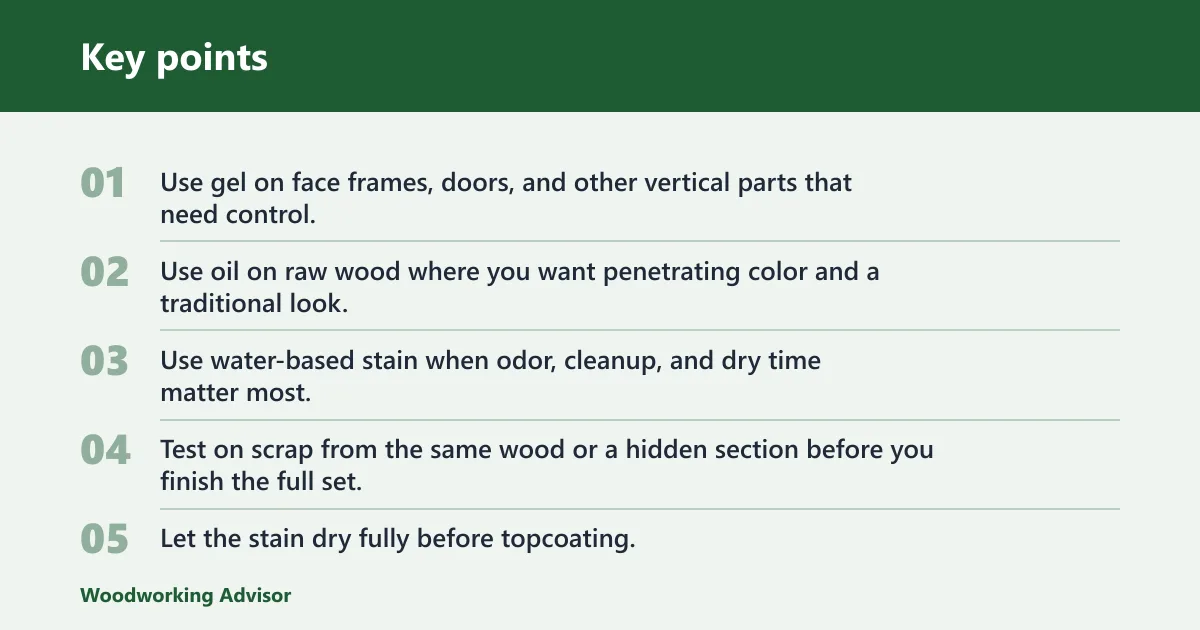
- Use gel on face frames, doors, and other vertical parts that need control.
- Use oil on raw wood where you want penetrating color and a traditional look.
- Use water-based stain when odor, cleanup, and dry time matter most.
- Test on scrap from the same wood or a hidden section before you finish the full set.
- Let the stain dry fully before topcoating, especially with gel products that need more time.
A common first-timer mistake is treating all cabinet stain the same. A stained maple door can read even and calm with gel, while the same color in a thin oil stain may go patchy if the wood is thirsty in one area and sealed in another.
Suppose you are refinishing six drawer fronts in birch and the side panels on the cabinet boxes are already installed. Gel gives you more control on the vertical parts, while water-based stain may save time if odor is a concern and you can manage the grain raise with sanding and a compatible topcoat plan.
Frequently asked questions
Is gel stain better than oil or water-based stain for cabinets?
Gel stain is often the safer cabinet choice when you need control on vertical surfaces or when the wood is blotch-prone. Oil stain is better when you want traditional penetrating color, and water-based stain is better when faster dry time and low odor matter more than that classic look.
Will gel stain hide blotching on pine, maple, or birch cabinet doors?
Gel stain can reduce blotching on pine, maple, and birch because it sits more on the surface than penetrating stains do. It does not guarantee perfect hiding, though. A test board is still the right move before you commit to full cabinet doors.
Can I use water-based stain over cabinets without raising the grain too much?
Yes, but you should expect some grain raise on raw wood. Lightly sanded cabinets, a careful test area, and a plan for scuff sanding after the first coat help manage the texture. Water-based stain is useful here, but it asks for more prep discipline.
Do I need to sand cabinets differently for gel stain versus liquid stain?
Yes. The page recommends sanding to 150-grit before gel stain, then removing dust with a tack cloth. If the wood is sanded too fine, lightly scuff it so the color can sit more evenly. Liquid stains still need prep, but they do not rely on the same surface control.
How long should cabinet stain dry before applying a topcoat?
Dry time depends on the stain type and the specific product label. General Finishes gel stain lists 8–24 hours before topcoat. Other oil and water-based products can vary, so the safest rule is to let the stain dry fully before sealing.
Can I stain cabinets that already have an old finish on them?
Sometimes. You usually need cleaning, sanding, dust removal, and a test area first. If the old finish is intact, stain may not penetrate evenly, which can make blending difficult. In that case, a full refinish or another color-correction method may work better.
What topcoat works best over gel-stained cabinets?
Oil-based polyurethane, water-based polyurethane, lacquer, and a dewaxed shellac barrier coat are common options, depending on the stain and the final finish plan. General Finishes notes that water-based polyurethane can be used over gel stain with a dewaxed shellac barrier coat when needed.
Can gel stain be sprayed, brushed, or wiped on cabinet doors?
Gel stain is commonly applied with a foam brush, cloth, or natural bristle brush. It is not a conventional spray-gun product and is too thick for conventional spray guns and HVLP systems. For cabinet doors, wipe or brush control is usually the better approach.
What is the biggest cabinet mistake with stain choice?
The biggest mistake is choosing by color alone instead of by failure mode. A stain that looks right on the shelf can still run on a door, blotch on maple, or dry too slowly for your schedule. Start with the surface, then choose the stain type.
Sponsored / affiliate links. As an Amazon Associate I earn from qualifying purchases. I may earn additional commission from eligible campaigns.