Best Wall Anchors for Drywall (2026): we compared
For drywall, use toggle bolts for heavy or loaded-out fixtures, self-drilling metal anchors for medium loads, and plastic expansion anchors only for light, centered items; if the load can swing, pull out, or pry, move to a toggle or find a stud. The wrong anchor can tear the paper skin, drop the fixture, and turn a small job into drywall repair. This guide compares anchors by failure mode, load shape, and installation steps for shelves, art, TVs, curtain rods, and light fixtures.
This guide is part of our Drilling guide for bits, tools, and materials series.
The best overall choice for many drywall jobs is a toggle-style anchor, because it resists pull-out better than basic expansion or self-drilling designs when the load is off-center or can move.
Quick comparison
| Product | Badge | Best for | Price | ||
|---|---|---|---|---|---|
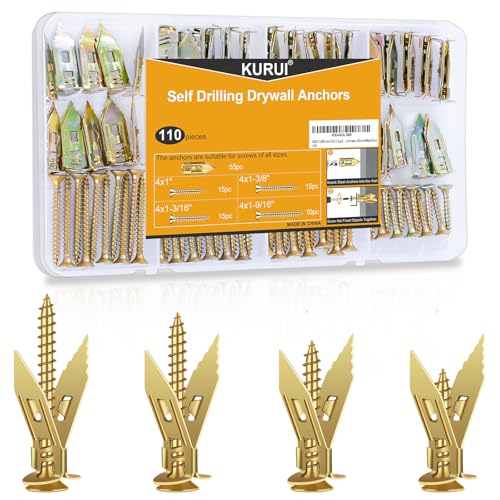 |
KURUI 110Pcs Self Drilling Drywall Anchors with Screws Kit,KURUI | Budget pick | 110-piece self-drilling metal anchor and screw kit | $7.19
Price as of 12 Oct 2026
|
View |
 |
KURUI Heavy Duty Hollow Drywall Anchors for SheetrockKURUI | Our pick | 28-piece heavy-duty hollow drywall toggle bolts | $9.99
Price as of 12 Oct 2026
|
View |
 |
T. K. Excellent Heavy Duty Zinc Plated Steel Molly BoltT.K.Excellent | Also great | 68-piece zinc plated steel molly bolt set | $17.99
Price as of 12 Oct 2026
|
View |
Use this table to line up the anchor with the task, not just the weight. Standard 1/2-inch drywall is the baseline for most ratings; 3/8-inch drywall leaves less material around the hole and can lower the safety margin.
A load shared across two or more anchors can work well, but only if the spacing is correct and the wall can keep each hole from elongating.
📊 Bob Vila’s tested drywall anchors cost between $15 and $60. Source: The Best Drywall Anchors, According to Our Testing.
How we chose
We compared anchors by how they fail in real drywall: spinning, stripping, pulling through, hole enlargement, or crushing the board. We also looked at whether each type suits 1/2-inch drywall, 3/8-inch drywall, and older plaster walls.
Ease of installation mattered, but not at the expense of failure risk. A fast anchor is useless if it breaks the paper face or leaves an oversized hole that is hard to patch.
Tool needs and hole size were part of the decision, too. A drill, screwdriver, and setting tool cover most jobs, but some anchors need a larger opening or a more controlled installation than others.
KURUI 110Pcs Self Drilling Drywall Anchors with Screws Kit: best for fast medium-duty installs
This kit fits light shelves, framed art, towel bars, and other medium-duty hardware when you want no-pre-drill installation. Based on the spec sheet and owner feedback, the all-metal build is the main draw, and Bob Vila lists a similar self-drilling style as a medium-duty pick.
The honest drawback is failure risk under abuse. Self-drilling anchors can strip, spin, or break if you overdrive them, use the wrong screw, or ask them to carry a load that creates strong pull-out force.
Use this type when the wall is sound, the item is centered, and the load is not expected to cantilever far from the wall. It is faster than many alternatives, but speed should not be the reason you choose it for a TV or a deep shelf.
KURUI Heavy Duty Hollow Drywall Anchors for Sheetrock Ceiling: best for heavy hollow-wall loads
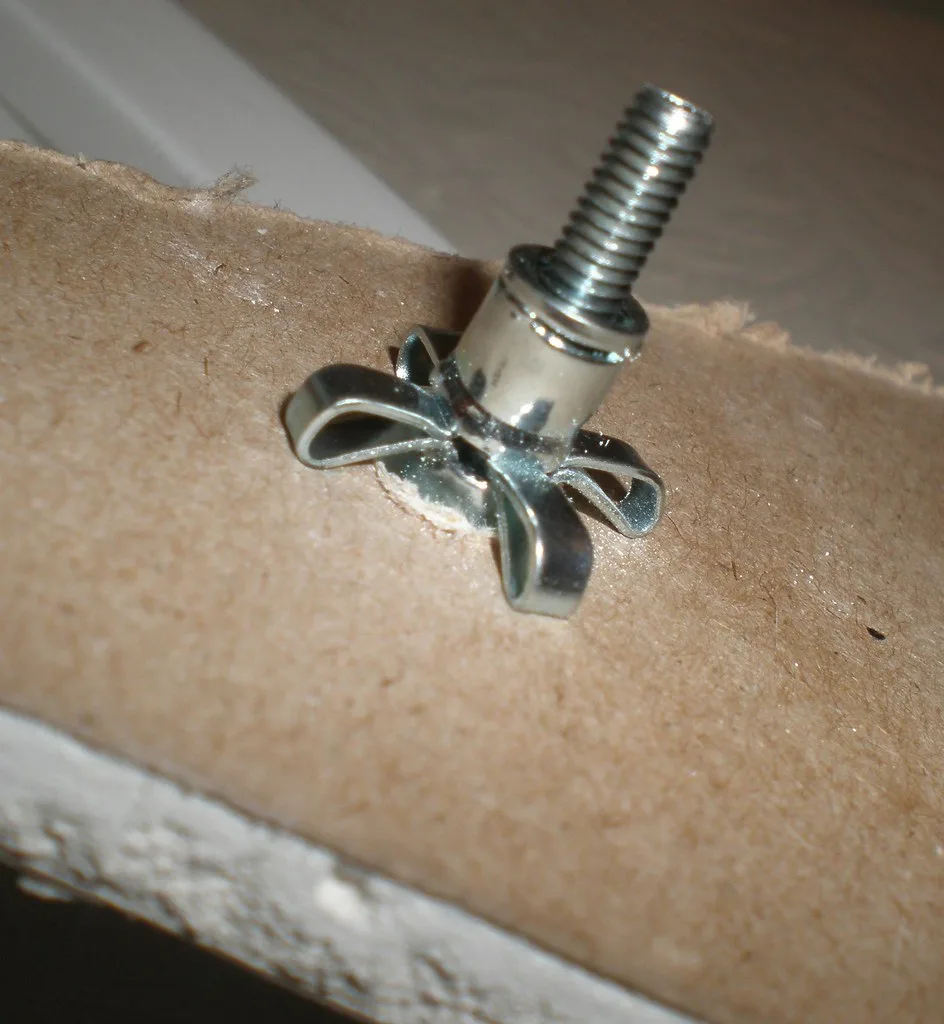
This is the right family for heavy hollow-wall jobs where you cannot hit a stud and need the load spread behind the drywall. Toggle bolts work by opening a wing or butterfly behind the panel, which gives them far better pull-out resistance than a small expansion plug.
The downside is installation complexity. You need a larger hole, room for the toggle to open, and care not to crush the drywall face while tightening. Bob Vila lists toggle bolts as the heavy-duty tier, with some toggle styles rated up to 200 or 300 pounds in ideal conditions.
Choose toggles for shelves, large mirrors, and many TV backup installs where the load is mostly straight down but can also tug forward. They are less friendly to thin, damaged, or crumbly drywall, because the wall itself becomes the weak point before the metal does.
T.K.Excellent Heavy Duty Zinc Plated Steel Molly Bolt Hollow Drive Wall Anchor Screws Set: best for repeatable medium-heavy hold
Molly bolts suit jobs that need a firmer, more repeatable grip than plastic or basic threaded anchors can give. A molly uses a metal sleeve that expands behind the wall, which grips differently from a toggle and can work well where you want a cleaner installed profile.
The tradeoff is removal and setup. Many molly bolts need a setting tool, and they are harder to remove cleanly than a screw-in anchor. Bob Vila lists molly bolts as able to support up to 100 pounds, but that is still a guideline, not a promise for every wall.
Mollys are a good middle path for towel bars, rails, and hardware that may be removed and reinstalled, but they are less ideal overhead unless the manufacturer specifically allows ceiling use. For a ceiling fixture, the safer choice is usually a toggle or a stud.
What are the best wall anchors for drywall
The best wall anchors for drywall are the ones that match the load shape, not just the advertised pounds. For light centered items, plastic expansion anchors are fine; for medium loads, self-drilling or molly bolts are better; for heavy or pulling loads, toggle bolts are usually the safest hollow-wall choice.
Drywall alone will not reliably hold a screw under pull-out force or vibration. Once the paper face tears or the hole enlarges, the screw loses grip quickly. That is why anchor style matters as much as weight rating.
How ratings should be read
Use load ratings as guidance. Bob Vila says expansion drywall anchors are usually good for up to about 25 pounds, threaded drywall anchors can support up to 75 pounds, molly bolts can support up to 100 pounds, and toggle bolts can hold up to 200 or 300 pounds.
Those numbers assume suitable drywall, proper installation, and a load that does not create unusual leverage. A 30-pound shelf with a deep bracket can stress the wall more than a 30-pound framed print that sits flat.
Which drywall anchors are best
The best drywall anchors are the ones that fail gracefully for the job you have. If the item can wobble, swing, or pull away from the wall, choose a toggle. If it is medium weight and installed correctly in sound 1/2-inch drywall, a self-drilling metal anchor or molly bolt is often enough.
If you only need to hang a small picture or light decor, a plastic expansion anchor is the least expensive option. It is also the easiest to overdrive, so the hole size and screw fit need to be right.
Failure mode matters more than the headline number
Some anchors fail by spinning in the hole. Others strip out the wall face, enlarge the opening, or crush the gypsum core. The best anchor is the one least likely to fail in the way your load asks it to fail.
Toggle bolts: best for heavy loads
Toggle bolts are the strongest common hollow-wall choice when you cannot hit a stud. The winged or butterfly design spreads force over more of the wall cavity, which gives better pull-out resistance than a small ribbed anchor or screw-in plug.
Bob Vila’s tested picks include the Toggler Snaptoggle BA Heavy-Duty Toggle Bolts as an upgrade pick and the Toggler Snaptoggle BB Heavy-Duty Toggle Bolts as a heavy-duty pick. The E-Z Ancor Toggle Lock Drywall Anchors are rated for up to about 100 pounds.
Why winged toggles hold well in hollow walls
The toggle opens behind the drywall and bears against the rear face of the panel. That spreads the load across a larger area, so the fastener is less likely to pull through the front paper skin under tension.
This makes toggles useful for shelves, large mirrors, curtain rods with strong side pull, and many TV mounts when a stud is not available. They are also a practical backup when the mounting hole lands between studs.
Hole size, install steps, and where they fit best
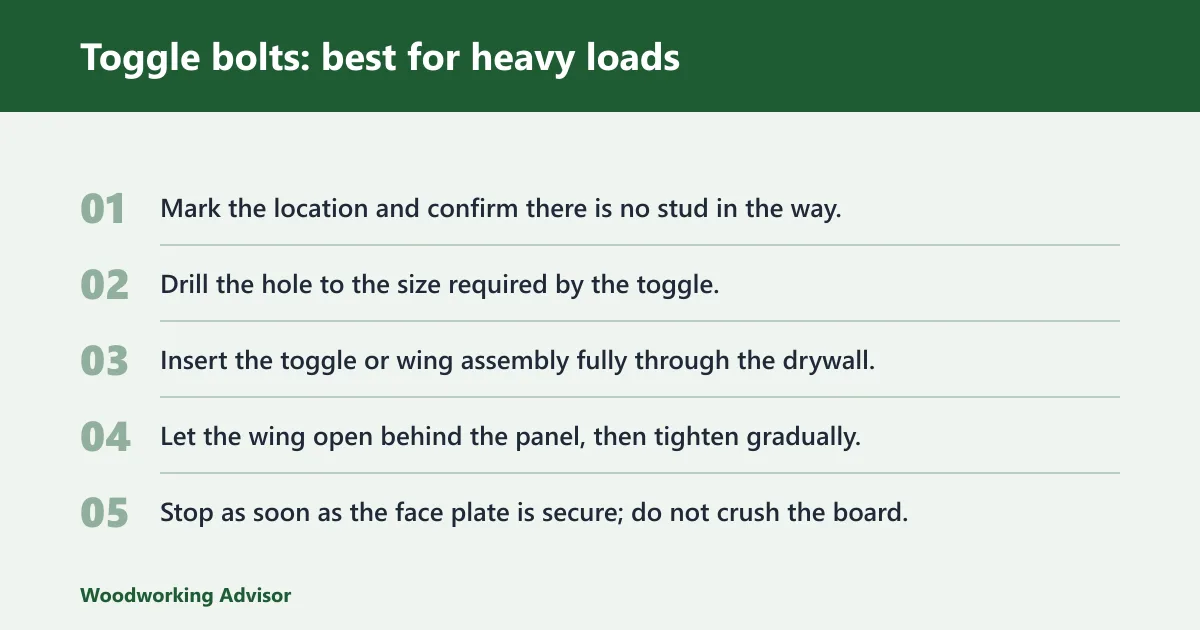
- Mark the location and confirm there is no stud in the way.
- Drill the hole to the size required by the toggle.
- Insert the toggle or wing assembly fully through the drywall.
- Let the wing open behind the panel, then tighten gradually.
- Stop as soon as the face plate is secure; do not crush the board.
The common failure modes are oversized holes, crushed drywall, and over-tightening. Once the hole grows too large, the toggle can tilt or pull through the opening.
What is the best drywall anchor for shelves?
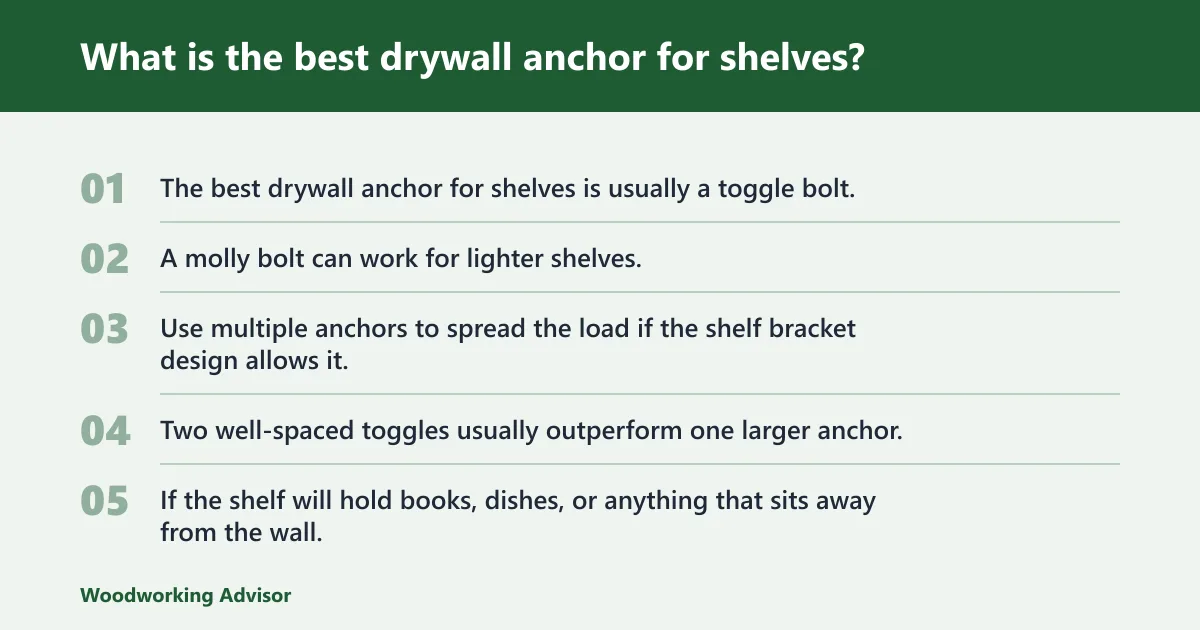
The best drywall anchor for shelves is usually a toggle bolt, because shelves create both downward load and pull-out force at the bracket. A molly bolt can work for lighter shelves, but a shelf that projects far from the wall should get the stronger anchor or, better, a stud.
Use multiple anchors to spread the load if the shelf bracket design allows it. Two well-spaced toggles usually outperform one larger anchor, because they resist twisting and reduce the chance of one hole failing first.
When to use toggles versus molly bolts or a stud
If the shelf will hold books, dishes, or anything that sits away from the wall, a stud is still the first choice. If that is impossible, toggles are the next best option for hollow drywall. Molly bolts are more appropriate for moderate loads with less leverage.
How to spread the load across multiple anchors
Place anchors as far apart as the bracket or rail allows. Keep the shelf level and use screws that fit the anchor without wobble. A loose screw can start movement, and movement leads to hole enlargement.
Self-drilling anchors: best for fast installs
Self-drilling anchors are a good fit when you want speed and medium-duty holding power. Bob Vila lists threaded drywall anchors as easy to install without pre-drilling, and one of the tested picks, the Toggler SnapSkru Self-Drilling Drywall Anchors, is a medium-duty option.
The main limit is overload. These anchors are not the right choice for a TV, a heavy shelf, or anything with strong side-to-side movement. They work best on sound 1/2-inch drywall with a centered load.
No pre-drill variants and when they save time
No pre-drill anchors save time for repeated installs, such as several picture frames or a row of light fixtures. They also reduce the chance of making a hole that is too large before the anchor goes in.
How stripping and breakage usually happen
Stripping happens when the screw thread chews the anchor before the anchor can bite into the drywall. Breakage often follows over-tightening, which can split the plastic or metal shell and leave the hole weak. If the anchor spins, stop and move to a larger or stronger type.
What drywall anchor should i use for a curtain rod
For a curtain rod, use a toggle bolt if the rod will see regular pull, heavy drapes, or frequent opening and closing. Lightweight rods with sheer curtains can use a self-drilling or plastic anchor, but side load at the brackets matters more than the curtain weight alone.
The rod pulls outward every time it is touched. That repeated motion is why curtain hardware often fails with a simple plastic anchor even when the pound rating seems adequate.
Motion matters on curtain hardware
A curtain rod adds vibration and leverage. Each tug at the drape creates a small pull-out force, and that repeated stress can enlarge the hole long before the rated weight is reached.
Molly bolts: best for repeatable medium-heavy hold
Molly bolts are the best middle-ground choice when you want more grip than a screw-in anchor but less bulk than a toggle. The metal sleeve expands behind the drywall and locks the fastener in place, which can make for a tidy, dependable hold in the right wall.
Bob Vila says molly bolts can support up to 100 pounds, but ceiling use is a separate question. Unless the manufacturer allows overhead installation, do not treat a wall rating as a ceiling rating.
Setting tool needs and removal difficulty
Many molly bolts need a setting tool to flare the sleeve correctly. Once set, they are harder to remove cleanly than a plastic anchor or self-driller, so expect a larger repair if you later move the fixture.
Ceiling suitability and when to avoid them
Use them only when the package clearly allows overhead service and the load is modest. For ceiling fixtures, a toggle or a stud is usually the safer route, especially if the item can sway or vibrate.
What is the best drywall anchor for a tv mount?
The best drywall anchor for a TV mount is usually no drywall anchor at all; a stud mount is the first choice. A TV is not only heavy. It also creates leverage, motion, and long-term stress on the wall, which is why hollow-wall anchors are a backup plan rather than a primary recommendation.
If studs are not available, a heavy-duty toggle can be the better hollow-wall option, but only if the mount design and wall condition support it. Old drywall, damaged board, or questionable plaster should push you back toward a stud or a different mounting plan.
Why TVs are a motion and leverage problem
The mount can shift when the screen is adjusted, and that movement multiplies force at the fasteners. A flat static weight rating does not fully capture the stress from a wall arm or a mount that sits far from the surface.
When a hollow-wall anchor is a backup, not the primary plan
Use hollow-wall anchors only when the mount manufacturer permits them and the bracket design spreads load across several fasteners. Even then, inspect the wall regularly for flex, cracking, or loose screws.
Plastic expansion anchors: best for light-duty jobs
Plastic expansion anchors are the low-cost option for light, centered items. Bob Vila says expansion drywall anchors are usually good for up to about 25 pounds, which fits small pictures, lightweight fixtures, and simple hardware when the wall is in good shape.
They depend on the right pilot hole and a snug screw fit. If the hole is too large, the anchor will spin or pull out; if it is too small, the anchor can deform before it expands properly.
Ribbed body, pilot hole, and low-cost use cases
The ribbed body bites into the drywall as the screw goes in. This makes the anchor cheap and easy to use, but not especially forgiving. It is best for framed art, small hooks, and very light bathroom accessories.
Why they fail in soft, thin, or damaged drywall
These anchors fail fast when the drywall is crumbly, water-damaged, or only 3/8-inch thick. The reduced thickness leaves less material to compress, so the anchor can chew out the hole before it creates a firm hold.
Which one should you buy?
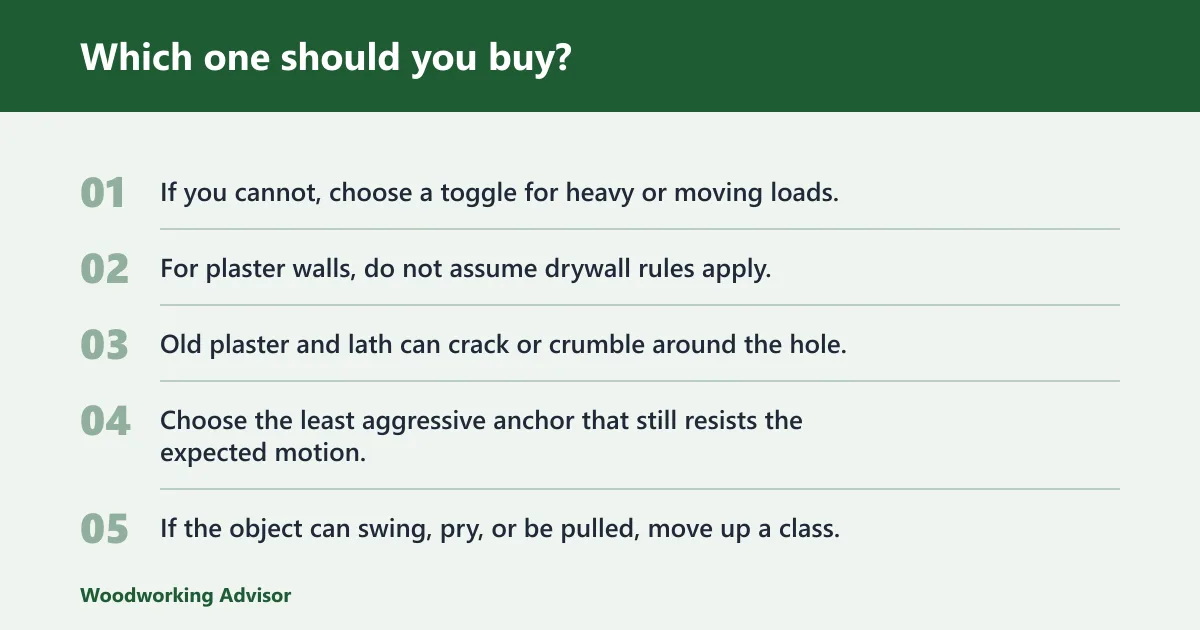
Start with a stud if you can find one. If you cannot, choose a toggle for heavy or moving loads, a molly bolt for repeatable medium-heavy hold, a self-drilling anchor for fast medium-duty installs, and a plastic expansion anchor only for light, centered items.
For plaster walls, do not assume drywall rules apply. Old plaster and lath can crack or crumble around the hole, and many drywall anchors are unsafe there unless the wall is first inspected and the fastener is rated for that material.
Decision rules by budget, load, and wall condition
Choose the least aggressive anchor that still resists the expected motion. If the object can swing, pry, or be pulled, move up a class. If the wall is damaged, soft, or unknown, stop and reassess before drilling.
Say your curtain rod is 48 inches wide and the drapes are heavy. A pair of light plastic anchors may hold for a while, but a toggle at each bracket is a better answer because the load keeps tugging outward every time the curtains move.
Suppose your shelf holds a few framed photos and a small plant. A self-drilling anchor can be enough in sound 1/2-inch drywall, but a deeper shelf carrying books should move up to toggles or a stud.
What to do when the wall is plaster, damaged, or unknown
On old plaster/lath, test cautiously. If the surface sounds hollow and crumbly, or the hole starts to chip as soon as you drill, many drywall anchors become a poor choice. A fastener meant for plaster or a stud-based approach is safer.
How do you put drywall anchors in the wall
Most drywall anchors go in with a drill, screwdriver, or setting tool, depending on the type. The key is to match the hole size to the anchor and stop tightening as soon as the anchor seats. Over-tightening can crush drywall and enlarge the opening.
Basic installation checklist
- Mark the location and check for a stud.
- Choose the anchor type for the load and wall thickness.
- Drill the correct pilot hole if the anchor requires one.
- Insert or set the anchor straight.
- Drive the screw until snug, not crushed.
Plastic expansion anchors need a pilot hole. Self-drilling anchors often skip that step. Toggles need a larger hole, and molly bolts may need a setting tool to expand the sleeve properly.
Common repair consequences after failure
When an anchor fails, the repair is rarely just a tiny hole. A spun anchor can oval the opening, a toggle can leave a larger entry hole, and a crushed area may need patching compound, sanding, and repainting.
Frequently asked questions
what are the strongest wall anchors for drywall
Toggle bolts are usually the strongest common choice for hollow drywall because they spread load behind the panel. Molly bolts are next in many cases, followed by heavier threaded or self-drilling anchors. Strength still depends on drywall thickness, hole size, and whether the load is shared across several anchors.
what anchors are best for plaster walls
Plaster walls need more caution than drywall. Many drywall anchors can crack old plaster or lose grip in lath gaps. Use fasteners specifically suited to plaster when possible, and treat crumbly, layered, or damaged plaster as a sign to avoid standard drywall anchors altogether.
Sponsored / affiliate links. As an Amazon Associate I earn from qualifying purchases. I may earn additional commission from eligible campaigns.