Best Countersink Bit for Wood Screws: How to Choose
For wood screws, match the countersink angle to the screw head, often 82° for U.S. flat-head screws and 90° for many metric screws, then use a depth stop for repeatable flush seating. The wrong angle or depth leaves proud heads, splits softwood, burns hardwood, or sends you back to patch holes. This guide shows how to choose the right bit for screw head type, wood species, and depth control.
Best countersink bit for wood screws: top pick and quick picks


The best countersink bit for wood screws is the one that matches the screw head angle, gives steady depth control, and clears chips cleanly in your material. For most woodworkers, a hardened 82° countersink with a pilot drill and adjustable stop collar is the safest all-around choice for flat-head wood screws.
Quick picks
- Best overall for flat-head wood screws: 82° countersink bit with pilot drill and stop collar.
- Best for metric flat-head screws: 90° countersink bit, especially when the screw spec calls for a 90° head.
- Best for hardwood: Carbide or carbide-tipped bit, with a pilot hole sized to the screw shank and a stop collar for repeatability.
- Best for plywood and veneer: Single-flute or sharp multi-flute countersink with careful depth control to reduce tear-out.
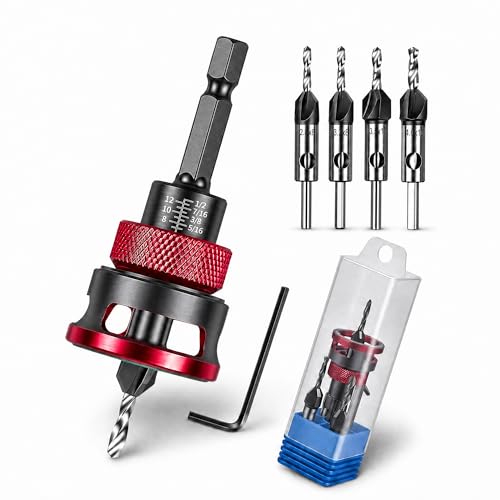
- Best combo tool: Combination drill-and-countersink bit when you need faster setup and consistent pilot-plus-recess drilling.
What each pick is best for
An 82° bit is the default for standard U.S. flat-head wood screws because the screw head angle should match the conical recess. A 90° bit fits many metric flat-head screws and some specialty fasteners. For frequent repetitive work, a countersink drill bit set with a stop collar is more useful than a loose single bit.
What makes a countersink bit right for wood screws?
A countersink bit for wood screws must match the screw head angle, cut a clean conical recess, and control depth well enough to leave the head flush or slightly below the surface. The right setup also depends on pilot hole size, flute geometry, and whether the wood tends to chip, crush, or burn.
Countersink angle and screw head angle
Standard flat-head wood screws often use an 82-degree head angle, so the countersink angle should match that angle for good seating. If the angle is wrong, the screw may bottom out on the sides of the recess instead of seating on the full head surface. That leaves an unstable fit.
Pilot drill and bit-set layout
A countersink drill bit set may be a single-size tool or a multi-size kit. Some sets include a pilot drill and stop collar, which helps keep the pilot hole centered while setting the recess depth. The pilot hole should be matched to the screw shank diameter and adjusted for wood species.
Flute design, chip clearance, and tear-out
Flute design matters because chip evacuation affects tear-out and burning. Single-flute countersinks often clear chips well and can reduce chatter in some woods. Multi-flute designs can leave a smoother recess in stable stock, but they can also pack chips faster in softwood, plywood, and MDF if feed speed is too high.
What size countersink bit should you use for #6, #8, or #10 screws?
Use a countersink size that matches the screw head diameter, not just the screw number. For #6, #8, and #10 wood screws, the pilot hole should follow the shank size and wood density, while the countersink diameter should let the head sit flush without an oversized crater. A depth stop keeps that depth consistent.
Match bit diameter to screw head diameter
The common mistake is choosing a countersink by screw gauge alone. A #8 flat-head screw from one manufacturer may have a different head diameter than another, so check the screw spec when possible. The goal is a recess that accepts the head cone without leaving a rim that telegraphs through the surface.
Choose pilot hole size by screw shank and wood species
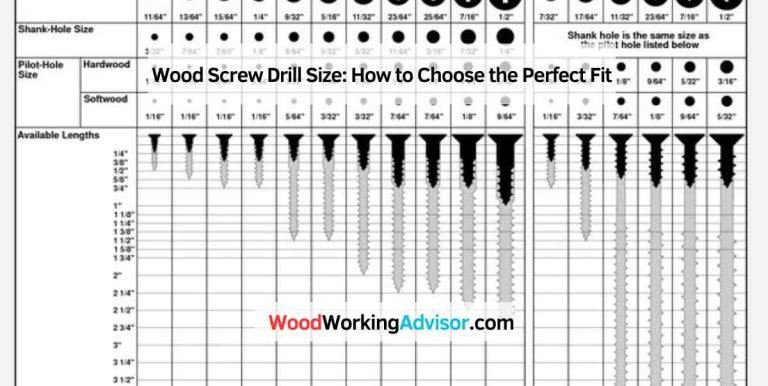
Pilot hole size is tied to the screw shank diameter, the wood species, and whether the screw is near an edge. Hardwood usually needs a pilot closer to the shank size to avoid splitting and burning. Softwood often tolerates a slightly smaller pilot. Plywood needs care because veneer layers can chip at the face.
When the recess should sit flush versus slightly below
For exposed joinery, flush seating is usually enough. For painted work or places that will be filled, a screw head set slightly below the surface is common. Over-countersinking is a problem because it removes too much surrounding wood and weakens the hole, especially in plywood and soft species.
Which countersink angle should you buy?
Buy the angle that matches the screw head. For many wood screws, that often means 82° for standard U.S. flat-head screws and 90° for many metric flat-head screws. A 100° bit is usually reserved for wider head profiles and specialty fasteners, not typical wood screw seating.
82-degree bits for standard flat-head wood screws
Eight-two degree bits are the most common choice for flat-head wood screws because many U.S. screws are cut to that geometry. If the bit angle matches the screw head angle, the screw seats on the whole cone instead of binding early. That gives a cleaner flush result and reduces head wobble.
90-degree bits and when they make sense
Ninety-degree countersinks make sense for metric flat-head screws and for hardware that lists a 90° head angle. They are also common in shops that work with imported hardware. If the screw spec calls for 90°, use 90° rather than forcing an 82° bit to do the job.
100-degree bits for wider head profiles and specialty fasteners
One hundred degree countersinks are less common for typical wood screws, but they can suit certain wider head profiles and specialty fasteners. Bugle-head screws, often used in drywall, are a different case entirely: they are shaped to sit in a matching tapered seat, but that geometry is not the same as a flat-head wood screw recess.
Do you need a countersink bit with a drill stop?
A drill stop is worth buying when you need repeatable depth, especially in production work, visible joinery, or thin stock where blowout is easy to create. Freehand countersinking is fine for occasional hidden screws, but a stop collar prevents overdriving, oversized recesses, and inconsistent head depth across a batch.
When a stop collar helps repeatable work
A stop collar matters most when you are placing many screws to the same depth, such as cabinet face frames, jigs, or repeated shop fixtures. It helps control how deep the conical recess cuts, which keeps screw heads uniform and limits accidental breakthrough in thin stock.
When freehand countersinking is enough
Freehand countersinking is usually enough for one-off repairs, hidden screws, or rough carpentry where appearance is secondary. If the screw head is not visible and the wood is thick enough, a stop collar may add setup time without much benefit. The key is still to avoid cutting too deep.
How stop collars reduce blowout and over-countersinking
A stop collar gives a physical limit on depth, which helps prevent blowout in softwood end grain and thin plywood faces. It also keeps the recess from growing wider and deeper than needed, which can happen fast if the bit is sharp and the feed pressure is heavy.
Best countersink bit by material and screw type
Material choice changes the right countersink more than many buyers expect. Softwood tolerates faster cutting but tears more easily at the edges. Hardwood burns if the bit rubs too long. Plywood chips at the veneer. MDF cuts cleanly but can crumble if the recess is forced or overcut.
Hardwood
For hardwood, choose a sharp 82° or 90° bit that matches the screw head, preferably carbide or carbide-tipped if you cut a lot of holes. Pair it with a pilot hole sized to the screw shank and use moderate speed. Hardwood rewards sharp tools and punishes dull edges with heat and scorch marks.
Softwood
Softwood is more forgiving on pilot size but more prone to tear-out and over-countersinking. A single-flute bit can help evacuate chips and reduce chatter. A stop collar is useful when the face of the wood will remain visible, because soft fibers crush and flare more easily around the recess.
Plywood and MDF
Plywood needs the most caution at the face veneer. Use a sharp bit, light feed pressure, and a backing board when possible. MDF usually cuts cleanly, but the edges can fuzz or crumble if the bit is dull. In both materials, depth control matters more than speed.
Screw-to-bit decision table
This table gives a practical starting point for common wood screw sizes and head types. It does not replace the screw maker’s spec, but it maps the usual geometry to a sensible bit angle, pilot-hole approach, and depth-control method for hardwood, softwood, and plywood.
| Screw size and head type | Recommended countersink angle | Pilot hole approach | Depth-control method | Best material notes |
|---|---|---|---|---|
| #6 flat-head | 82° for U.S. screws; 90° if the screw spec says 90° | Pilot near shank size in hardwood; slightly smaller in softwood; verify veneer support in plywood | Freehand okay for hidden screws; stop collar for visible faces | Good general choice for trim and light joinery |
| #8 flat-head | 82° most often; 90° for metric hardware | Use a pilot that matches the shank closely in hardwood to reduce splitting | Stop collar recommended for repeatable cabinet and fixture work | Watch for burning in hardwood and chip-out in plywood |
| #10 flat-head | 82° for standard U.S. screws; 90° for metric | Start with a properly sized pilot; do not rely on the countersink to create the pilot | Stop collar strongly recommended to avoid oversized recesses | Better for thicker stock; less forgiving near edges |
| Oval-head screw | Match the head angle, then check head profile depth | Pilot hole still sized to shank and wood species | Shallow depth control; the decorative head should land cleanly | Often used where the head is meant to sit partly proud |
| Bugle-head screw | Do not assume it matches a flat-head countersink | Use the fastener’s specified pilot and driver setup | Usually not a standard wood-screw countersink task | Common in drywall, not the same geometry as flat-head wood screws |
How to use a countersink bit without tear-out
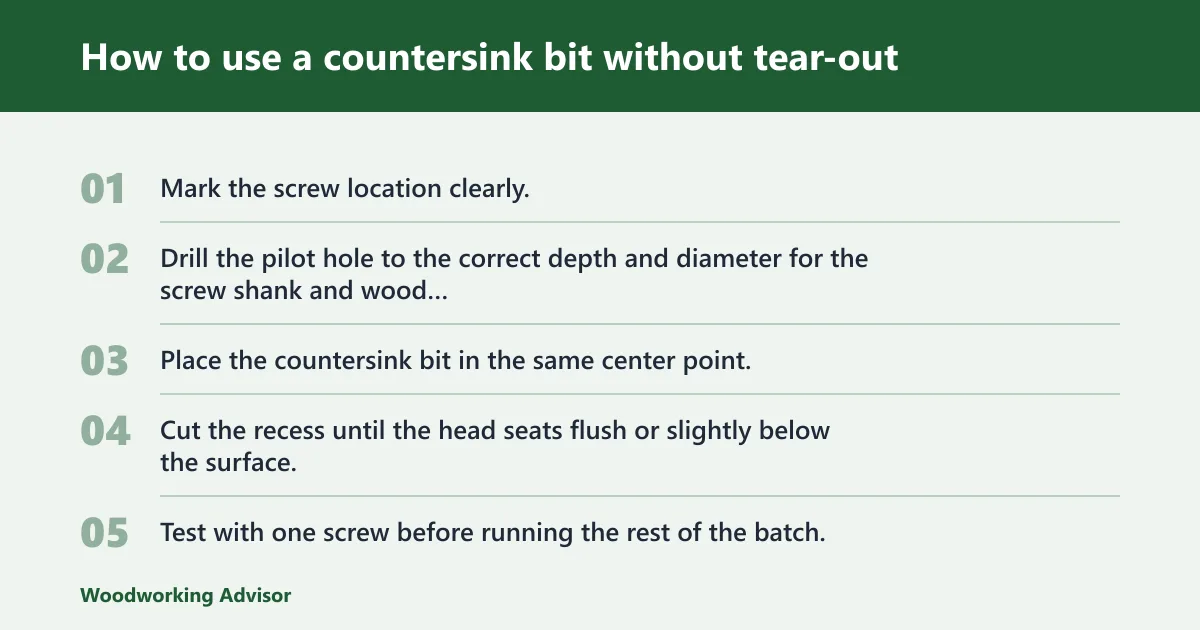
To avoid tear-out, drill the pilot hole first, keep the bit aligned, and set the depth before you cut the recess. Slow feed, sharp tooling, and a backing board matter most in plywood and near board edges. In hardwood, avoid rubbing the bit at high speed without cutting.
Drill the pilot hole first
- Mark the screw location clearly.
- Drill the pilot hole to the correct depth and diameter for the screw shank and wood species.
- Place the countersink bit in the same center point.
- Cut the recess until the head seats flush or slightly below the surface.
- Test with one screw before running the rest of the batch.
Set depth before you cut the recess
Depth should be set before the work starts, not after the screw is already buried too far. A stop collar gives you a consistent recess depth, which matters in plywood and finish work. Without it, the bit can cut faster than expected and leave a recess too wide for the screw head.
Reduce burning and edge breakout in plywood and hardwood
Burning usually comes from too much speed, too little feed, or a dull bit. Edge breakout usually comes from drilling too close to the edge without support. Use a sharp bit, back up the exit face if possible, and keep the flute clear so chips do not pack and heat the cut.
Say your project uses #8 flat-head screws in maple face frames. An 82° bit with a matched pilot hole and stop collar will seat the heads cleanly and reduce scorch marks. Suppose the same screws go into birch plywood; a sharp single-flute bit and a backing board become more important than speed.
What is the difference between a countersink bit and a counterbore?
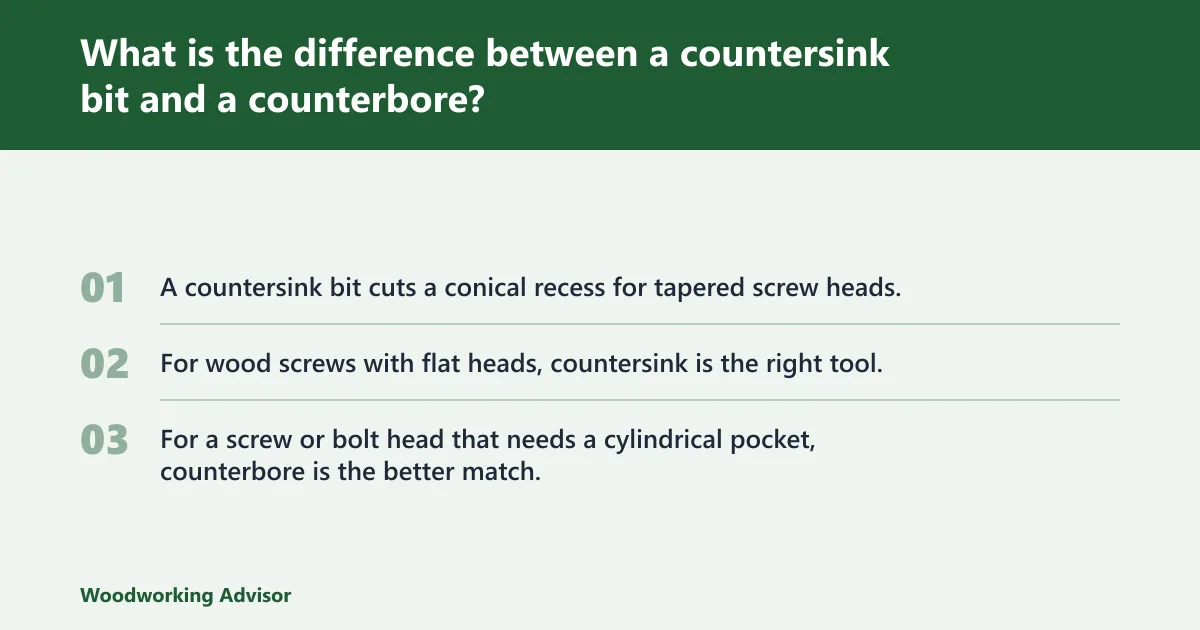
A countersink bit cuts a conical recess for tapered screw heads, while a counterbore cuts a flat-bottomed pocket for socket-head or washer-head fasteners. For wood screws with flat heads, countersink is the right tool. For a screw or bolt head that needs a cylindrical pocket, counterbore is the better match.
Frequently asked questions
What is the best countersink bit for wood screws?
The best countersink bit for wood screws is usually an 82° bit with a pilot drill and a stop collar, because it matches standard U.S. flat-head screws and gives controlled depth. If you work with metric flat-head hardware, a 90° version is the better fit. Match the head, not the price.
Do I need a countersink bit for wood screws?
You need a countersink bit when the screw head should sit flush or below the surface, or when the head would otherwise split fibers and catch on the workpiece. If the screw is fully hidden or the hole is oversized for another reason, countersinking may be unnecessary. Flat-head screws are the common case.
Should I buy a countersink bit with a drill stop?
Buy a drill stop if you need repeatable depth, work near visible edges, or drill many holes in a row. It helps keep screw heads uniform and reduces over-countersinking and blowout. If you only need an occasional hidden recess in thick stock, a freehand bit can be sufficient.
What angle should a countersink bit be for wood screws?
For most U.S. flat-head wood screws, use 82°. For many metric flat-head screws, use 90°. A 100° bit is for wider head profiles and specialty fasteners, not the usual wood-screw recess. The correct angle lets the screw seat on the full cone instead of binding at one edge.
How do I stop a countersink bit from tearing out wood?
Use a sharp bit, drill the pilot hole first, support the back side with scrap, and slow the feed as the bit exits the cut. Tear-out is most common in plywood veneer, softwood end grain, and brittle finish faces. Depth control also helps by preventing the bit from cutting too long.
Are combination drill-and-countersink bits worth it?
Combination drill-and-countersink bits are worth it when you need speed, repeatability, and fewer tool changes. They are especially useful for production drilling, jigs, and site work. They are less ideal when you need to fine-tune pilot size, angle, or recess depth for delicate veneer or hardwood.
Sponsored / affiliate links. As an Amazon Associate I earn from qualifying purchases. I may earn additional commission from eligible campaigns.