3 Best Borer Treatments for Furniture (2026): research shows
For finished wooden furniture with active borer holes, start with a furniture-safe borate or permethrin treatment for bare or accessible wood, but choose professional heat or fumigation only for active termite infestation in structural pieces; severe damage often needs replacement. Miss the pest or use the wrong chemical, and you can stain the finish, trap live insects, or let hidden galleries keep spreading. This guide compares DIY and pro options by pest, finish, and damage stage.
This guide is part of our Wood care and protection series.
Quick comparison
| Product | Badge | Best for | Price | ||
|---|---|---|---|---|---|
 |
Bora-Care Termiticide Insecticide and FungicideNisus | Our pick | 1 Gal · Wood · Termiticide | $89.94
Price as of 10 Oct 2026
|
View |
 |
Spectracide Terminate Termite & Carpenter Ant Killer, 1.33Spectracide | Budget pick | 1.33 Gal · Indoor/Outdoor · Barrier | $23.74
Price as of 10 Oct 2026
|
View |
 |
BASF Termidor Foam 20 oz – Termiticide Insecticide forBASF | Also great | 20 oz · Foam · Hard-to-Reach Voids | $35.95
Price as of 10 Oct 2026
|
View |
Use this comparison to match the pest to the treatment, then check finish compatibility before you touch the furniture. The safest choice changes fast once you move from unfinished wood to veneer, antiques, or upholstered pieces.
How we chose
We compared the options by furniture compatibility, pest target, and reach into hidden wood. We also weighed whether a method fits bare wood, finished surfaces, veneer, or voids already opened by active damage.
Two more factors matter: whether the treatment can handle wood borers and termites separately, and whether the furniture is worth saving after repair, isolation, or treatment.
That approach matters because wood borers are wood damaging insects. They can invade furniture, doors, and floors, and the wrong treatment can protect the surface while leaving the infestation untouched.
Quick picks
- Best overall for hidden or mixed infestation: professional inspection and targeted treatment.
- Best for unfinished furniture: borate treatment.
- Best for localized active damage: injection or foam treatment.
- Best for severe or uncertain cases: professional service, and replacement if the wood is structurally weak.
Best overall: professional inspection and targeted treatment
Professional inspection is the best first move when the pest is unclear, the finish matters, or the damage may involve more than one insect. You need correct identification because beetle larvae, termite activity, finish type, and furniture construction all change what can be treated safely.
Why inspection comes first
Adult beetles lay eggs in cracks in wood. Larvae burrow deep into wood and feed there, which means surface cleaning alone can miss the real problem. Fine frass, small round holes, or visible insects are useful clues, but they do not tell you whether the infestation is active, old, or mixed with termite damage.
When targeted treatment makes sense
Targeted treatment makes sense when the item has localized holes, accessible raw wood, and no major structural loss. A professional can decide whether a surface treatment, borate, injection, or foam product fits the infestation stage without stripping a finish that still looks sound.
When treatment is not enough
If the furniture is badly weakened, cracked through load-bearing joints, or full of galleries, treatment may not restore strength. Untreated infestation may weaken timbers and cause structural failure. At that point, repair or replacement can be safer than repeated chemical treatment.
Bora-Care Termiticide Insecticide and Fungicide Concentrate, Wood Treatment for Termite and Beetle Prevention, 1 Gallon: best for unfinished wood
This fits unfinished or accessible bare wood where you want a treatment that can move deeper into the wood fibers. Based on the spec sheet, it is aimed at termite and beetle prevention and is the strongest match when the furniture has no delicate finish to protect.
It stands out because it is designed for long-lasting residual protection and can be used on wood where a finish does not block access. That matters for unfinished furniture, exposed undersides, and parts opened during repair.
The drawback is that it is not a casual spray for polished furniture. Finished surfaces, veneer, and antiques may not tolerate a flood application, and you still need correct identification before applying anything to a collectible piece.
Spectracide Terminate Termite & Carpenter Ant Killer, 1.33 Gal, with AccuShot Sprayer, Indoor and Home Barrier Treatment, Kills Carpenter Ants, Bees and Other Insects on Contact, Stops Spiders: best for surface spray
This is the better fit for surface-level treatment on accessible furniture where the finish can handle a light application and the pest is active on the outside rather than deep inside the wood. It may help with visible insects around entry points, but it is not a deep-wood cure.
Its clear formula and sprayer are practical when you need a barrier treatment on exposed wood edges, backs, or undersides. It can be useful for contact control around a piece that is isolated from the rest of the room.
The drawback is depth. Surface spray often fails on larvae already tunneling inside the wood, and it should be used with extra caution on veneer, antiques, or polished finishes that can spot, swell, or stain.
BASF Termidor Foam 20 oz – Termiticide Insecticide for Termites, Ants & Wood Destroying Pests & Insects: best for active, localized damage
This fits active, localized damage where small entry holes or voids make foam application practical. It is the strongest choice in this set for reaching hidden spaces, especially when the infestation is centered in one leg, joint, or cavity.
The foam format is useful because it expands to penetrate voids and targets wood-destroying pests. That makes it a better match than a simple surface spray when larvae or termites are active inside the furniture rather than on top of it.
The drawback is precision. It still needs careful placement, and it is not a cure for furniture that has lost strength, has widespread tunneling, or has a finish that should not be disturbed by treatment.
What is the best treatment for wood borers in furniture?
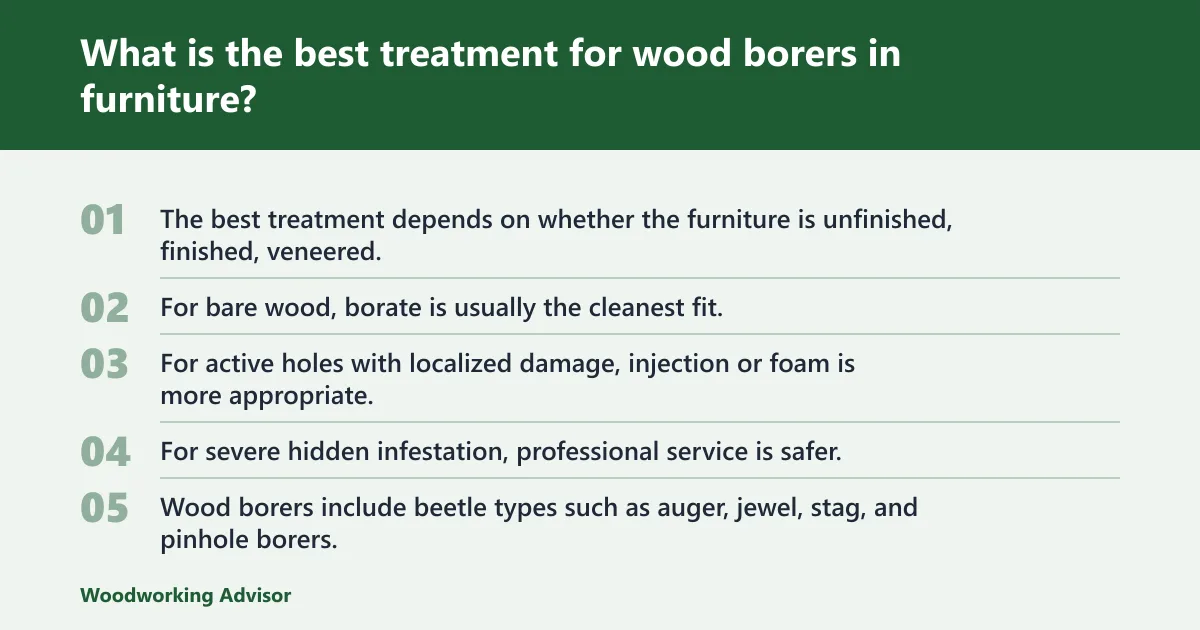
The best treatment depends on whether the furniture is unfinished, finished, veneered, antique, or upholstered, and on how deep the infestation has gone. For bare wood, borate is usually the cleanest fit. For active holes with localized damage, injection or foam is more appropriate. For severe hidden infestation, professional service is safer.
Match the pest to the treatment
Wood borers include beetle types such as auger, jewel, stag, and pinhole borers. They lay eggs in wood cracks, and the larvae tunnel deep into the wood, often in material that is already moist. Those tunnels can go unnoticed for years, so a visible hole is often the start of a larger hidden problem.
Match the finish to the method
Unfinished wood can usually accept borate treatment more easily than sealed or veneered furniture. Finished furniture needs a method that will not cloud the coating or drive moisture into a delicate surface. Veneer is especially vulnerable because the top layer is thin and can lift or blister.
Match the damage stage to the outcome
If the damage is active and local, isolate the furniture and treat it. If the item is structurally weak, repair may be possible only after the infestation is stopped. If the wood is heavily tunneled or the joints are collapsing, discard or replace it instead of trying to save a shell.
Can you use insecticide spray on furniture?
You can use a surface spray on some furniture, but only when the finish tolerates it and the infestation is shallow or active on exposed wood. Surface spray can help with visible insects or perimeter control, yet it often does not reach larvae already buried inside the wood.
Where surface spray can help
Surface spray is most useful on bare backs, undersides, or unfinished parts of furniture where insects are moving through exposed wood. It can also help around isolated pieces after you have removed them from other furniture and cleaned up frass around the site.
Why it often fails on deep larvae
Larvae feed inside the wood. If the beetles have already tunneled deep, spraying the outside may reduce activity you can see while leaving the hidden galleries intact. That is why a quick spray can buy time but not solve the problem.
Finish and veneer limits
Polished finishes, lacquer, shellac, and veneer can react poorly to spray. Test compatibility in an inconspicuous area first, or skip DIY surface treatment and get a professional opinion if the piece is valuable, antique, or already damaged along the surface grain.
Injection or foam treatment: best for active, localized damage
Injection or foam treatment is best when you can identify a few active holes, suspect a void, and want the treatment placed into the wood rather than just on top of it. It is a practical option for one leg, one rail, or a cabinet section with concentrated activity.
When holes make this option practical
Small, round holes are a listed sign of infestation. Fine, powdery sawdust near the wood is another listed sign. If those signs sit in one area and the surrounding finish is stable, foam or injection can target the active zone without covering the whole piece.
What this method can and cannot reach
This method can reach hidden voids and active galleries near the entry point. It cannot restore wood that has already been hollowed out, and it cannot guarantee control if the infestation is spread through multiple joints, rails, or unseen compartments.
Why professional application matters
Professional expertise is used for accurate identification, and that matters here. Termites often need separate detection and treatment consideration, and a furniture-safe approach for borers may not be the right answer for white-ant style termite activity in the same item or room.
Decision matrix: which treatment fits the furniture?
Use this matrix to match pest type, finish, and damage stage before you choose a method. If you are unsure whether the issue is wood borers, termites, or inactive damage, isolate the furniture and get an inspection before any treatment.
| Pest type | Finish type | Infestation stage | Recommended method | Isolate, treat, repair, or discard |
|---|---|---|---|---|
| Wood borers | Unfinished or bare wood | Early, with frass and small holes | Borate treatment | Isolate, treat, then repair if strength remains |
| Wood borers | Finished wood | Localized active holes | Injection or foam treatment | Isolate and treat; avoid flooding the finish |
| Wood borers | Veneer or antique finish | Any active infestation | Professional inspection first | Isolate; repair only after finish-safe plan is confirmed |
| Termites | Furniture with exposed structural wood | Active or uncertain | Professional termite treatment, possibly fumigation for the structure | Isolate immediately; treat only with expert guidance |
| Termites | Decorative finished piece | Old damage, no live activity | Inspection and monitoring | Repair or retain, depending on strength |
| Mixed or unknown | Any finish | Visible larvae, beetles, or powdery dust | Professional identification and targeted service | Isolate first; discard if structural damage is severe |
How do you know your wooden furniture has borers or termites?
Look for the type of hole, the type of dust, and whether you can see live insects. Small round exit holes, fine frass, and visible beetles or larvae point strongly toward wood borers. Termites need separate consideration, especially if the wood sounds hollow, feels soft, or has mud-like signs rather than dry powder.
Signs of wood borers
Small, round holes are a listed sign of infestation. Fine, powdery sawdust near the wood is another listed sign. Visible larvae or beetles are also listed signs. A common pattern is powder below a shelf, chair seat, or drawer bottom where activity has been ongoing.
Signs that point to termites instead
Termites are often described as white ants, but they require separate detection and treatment consideration. If several pieces in the same room show weakness, or if the damage seems to move through concealed structural wood rather than surface exit holes, termite inspection becomes the priority.
When old damage may be inactive
Old holes without fresh frass, new dust, or live insects may be inactive. Even then, the wood can still be weakened. If the furniture holds weight poorly, flexes at joints, or has a soft area under a finish, the safest call may still be repair or replacement.
Say your oak side table has six pinhole-sized exits under the top and a little powder on the floor. That pattern suggests active or recent borer activity, so isolate the piece, check the underside, and choose a treatment that fits the finish instead of spraying the whole room.
Suppose a veneered dresser has no fresh dust but a back leg feels spongy and the drawer side is hollow sounding. That may be old borer damage or termite damage, and the correct next step is identification before any chemical is used on the finish.
Which one should you buy?

Choose based on what the furniture is made of and how far the infestation has spread. For unfinished or accessible bare wood, Bora-Care is the strongest fit here. For visible surface activity on tolerant finishes, Spectracide can serve as a contact spray. For active voids or hard-to-reach pockets, BASF Termidor Foam is the better match.
Best choice for new, unfinished, or bare wood
Choose the borate option when you want preventive and curative treatment in wood that can absorb it. It is the cleanest fit for raw furniture parts, but not for polished surfaces that need a finish-first approach.
Best choice for antiques and veneer
Choose professional inspection before any chemical if the piece has veneer, old shellac, lacquer, or collector value. Those surfaces can react badly to direct spray, and a wrong choice can damage the finish more than the insects have.
Best choice for active termite damage
Choose professional termite service when the issue may involve live termites in furniture that is part of a larger structural system. Heat or fumigation belongs to the professional side of the aisle, not to a quick DIY furniture fix.
When replacement is the safer call
Replace the item if the galleries are widespread, the joints no longer hold, or the furniture is already crumbling under normal handling. If untreated infestation may weaken timbers and cause structural failure, no surface treatment can restore lost strength.
How do I stop wood borers from coming back in furniture?
You stop recurrence by making the wood less attractive, keeping new pieces dry, and treating hidden activity before it spreads. Moist wood is attractive to wood borers, and cracks give adults a place to lay eggs. Good storage and early checks matter more than repeated spraying.
Keep moisture under control
Moisture content affects wood borer risk because moist wood is more inviting to these insects. Keep furniture away from leaks, damp walls, and repeated condensation. Dry the source, not just the surface, or the same area can become a repeat entry point.
Seal cracks and watch repaired joints
Cracks are not only cosmetic. They can become egg-laying sites and let larvae move deeper into the wood. After a repair, inspect joints, backs, and drawer bottoms for fresh powder or new holes, especially in furniture stored against exterior walls or in damp spaces.
Use follow-up inspection, not guesswork
Professional pest control often includes preventative steps to reduce recurrence. That can mean rechecking the item after treatment, inspecting nearby wood furniture, and deciding whether the infestation was isolated or part of a broader problem in the room or structure.
When should damaged furniture be treated versus replaced?
Treat the furniture when the infestation is active but the wood still has usable strength, and replace it when tunneling has made the piece unsafe or not worth the labor. If the finish is valuable, treatment should also protect the surface rather than force a harsh fix onto delicate wood.
Choose treatment when…
Treatment makes sense when the problem is localized, the finish can be protected, and the furniture can be isolated. That is usually the case with early borer activity, a few exit holes, or a limited active area in raw wood or a repairable section.
Choose repair after treatment when…
Repair comes after the insects are controlled. Fill holes, stabilize joints, and replace compromised parts only after you know no active infestation remains. Repairing first can hide live activity and make later treatment harder.
Choose replacement when…
Replacement is the safer call when the frame is weakened, the infestation is widespread, or the item is upholstered or veneered in a way that makes treatment risky. A piece with heavy internal damage may look acceptable on top and still fail under normal use.
Frequently asked questions
Can termite treatment be used on furniture safely?
Sometimes, but not automatically. Termite treatment is not the same as a furniture-safe borer treatment, and some termite methods belong only with professional service. Use termite treatment on furniture only after identification confirms the pest and the finish can tolerate the method.
How do I know if my wooden furniture has wood borers?
Look for small round holes, fine powdery sawdust, and visible larvae or beetles. Those are listed signs of infestation. If the wood feels weak, the surface dust keeps returning, or the piece has moist or cracked areas, get a professional inspection.
What are the signs of a wood borer infestation in furniture?
The main signs are small round holes, frass, visible larvae or beetles, and wood dust around the item. You may also notice weak spots, damaged joints, or tunnels hidden inside the wood. New dust after cleaning is a strong clue that activity is still present.
Should I use DIY or professional treatment for borer damage?
Use DIY only for clearly localized, finish-compatible cases on accessible wood. Professional treatment is better when the infestation is uncertain, the furniture is valuable, or termites may also be present. Accurate identification is worth more than a quick spray.
Does moisture content affect wood borer infestations?
Yes. Moist wood is attractive to wood borers, and cracks can give adults a place to lay eggs. If the furniture sits near leaks, damp floors, or humid walls, treatment alone will not solve the cause. Dry conditions and inspection are part of prevention.
Sponsored / affiliate links. As an Amazon Associate I earn from qualifying purchases. I may earn additional commission from eligible campaigns.