Best UV Sealants for Outdoor Wood (2026): research shows
For most outdoor wood, choose a 100% acrylic or oil-based UV-blocking exterior sealant with solid pigment for full sun, semi-transparent for balanced looks, and clear only where shade and frequent recoat are acceptable. Skip that choice, and sun damage shows up as graying, checking, fading, and shorter service life. This guide matches UV exposure, finish look, and upkeep tolerance to the right sealant for decks, fences, and outdoor furniture.
What is the best UV-protective sealant for outdoor wood?
Seal-Once Marine Premium Wood Sealer is the best all-around UV-protective sealant for outdoor wood because it combines a clear finish with water, mold, decay, UV, and abrasion resistance. Bob Vila identifies it as the top pick and the best UV protection choice after testing over 40 wood sealers, which makes it the strongest broad match for decks, fences, siding, docks, piers, and furniture.
It is also a practical fit when you want the wood grain to stay visible. Bob Vila describes Seal-Once Marine as water-based and clear, while Advanced Painting and Drywall describes it as UV-stable and waterproof. That pairing matters if you want clear appearance retention without giving up moisture protection.
In practice, clear sealers often need more upkeep in strong sun than pigment-rich stains. On railings, stair treads, and furniture arms that face direct light, a clear finish can need recoating sooner than a semi-transparent or solid-color option.
Quick comparison
| Product | Badge | Best for | Price | ||
|---|---|---|---|---|---|
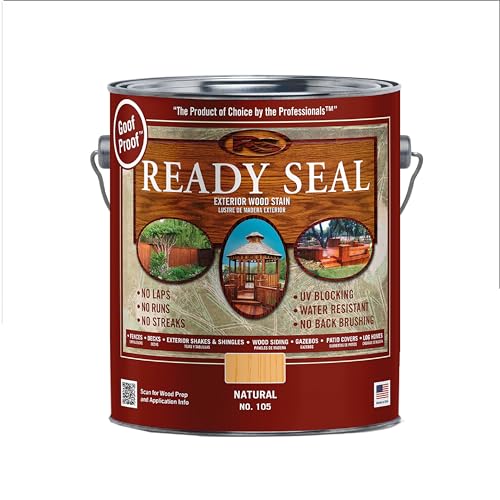 |
Ready Seal Exterior Wood Stain & Sealer, Natural Light Oak,Ready Seal | Our pick | 1 Gallon Natural Light Oak Stain & Sealer | $40.98
Price as of 11 Oct 2026
|
View |
 |
TotalBoat Gleam Marine Spar Varnish for Boats & OutdoorTotalBoat | Also great | Satin Pint Marine Spar Varnish | $30.99
Price as of 11 Oct 2026
|
View |
 |
DEFY Ultra Semi-Transparent Outdoor Wood Stain and SealerDEFY | Upgrade pick | 1 Gallon Semi-Transparent Wood Stain and Sealer | $64.93
Price as of 11 Oct 2026
|
View |
 |
RMP Finishes Outdoor Defense Oil, Wood Finish forRMP CO Finishes | Also great | 1 Gallon Outdoor Defense Wood Finish Oil | $109.99
Price as of 11 Oct 2026
|
View |
The table below separates the three finish families by pigment load, sun exposure, and maintenance demands, so you can match the coating to the wood before you compare brands. The main split is not brand name; it is how much color you add and how much UV the surface sees.
For full-sun decks and railings, a colored stain-and-sealer or solid-color finish usually gives better UV defense than a clear product alone.
How we chose
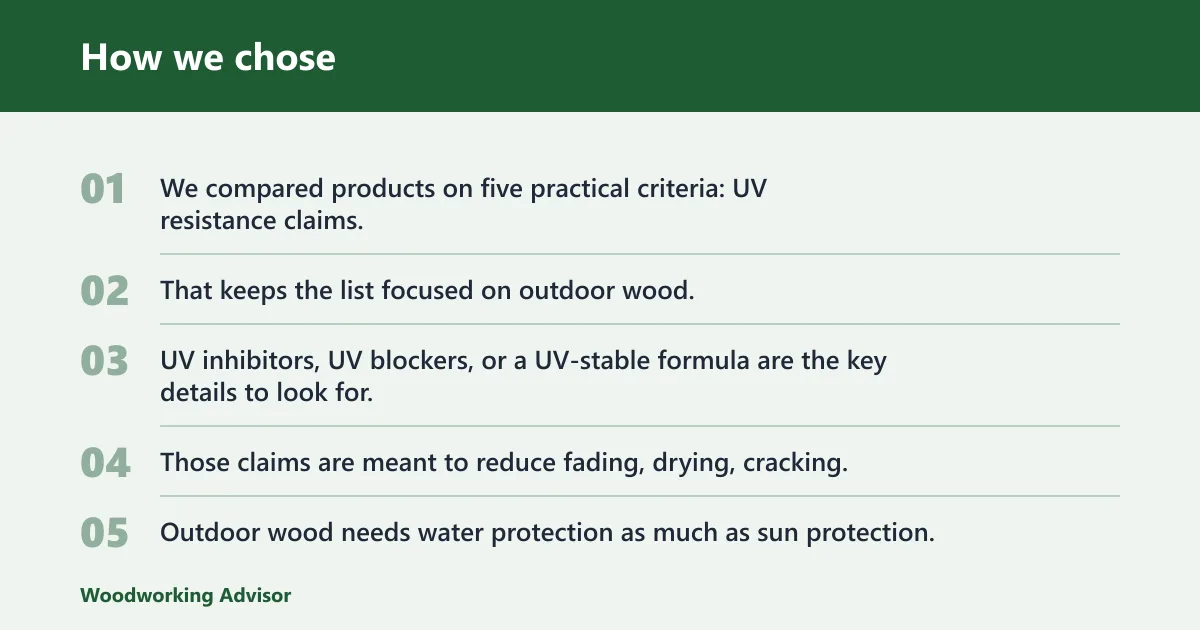
We compared products on five practical criteria: UV resistance claims, moisture protection, finish type, maintenance burden, and cleanup or VOC profile. That keeps the list focused on outdoor wood, not on general-purpose coatings that happen to be water resistant.
UV resistance and UV-stable formula claims
UV inhibitors, UV blockers, or a UV-stable formula are the key details to look for. Those claims are meant to reduce fading, drying, cracking, and splintering caused by sun exposure.
Water, mold, and decay resistance
Outdoor wood needs water protection as much as sun protection. A sealant that only addresses UV without moisture resistance leaves decks, fences, and dock boards vulnerable to swelling and biological damage.
Finish type, cleanup, and VOC profile
Clear sealers preserve appearance better. Stain-and-sealers and solid-color stains add pigment for more UV shielding. Water-based formulas usually clean up more easily and often carry lower odor, while oil-based formulas typically penetrate more deeply and may last longer between coats.
Maintenance interval and application practicality
Ease of application matters on large deck fields and vertical fence boards. Recoat timing matters too, especially where strong sun cuts service life short.
UV-sealer selection matrix
| Finish type | Sun exposure | Appearance retention | Maintenance ease | Typical recoat pressure | Best surfaces |
|---|---|---|---|---|---|
| Clear sealer | Low to moderate; shade helps | Best natural look | Easy to refresh, but more often | Highest in full sun | Furniture, shaded fences, covered siding |
| Stain-and-sealer | Moderate to high | Balanced grain and color retention | Moderate; easier than bare-wood stripping | Moderate | Decks, fences, siding, many docks |
| Solid-color finish | High to very high | Best color retention, least grain visibility | Easier to keep looking even once aged | Lowest visual aging, but still needs upkeep | Full-sun decks, railings, older wood |
Ready Seal Exterior Stain and Sealer: best for low-maintenance color
Ready Seal Exterior Stain and Sealer is the best fit when you want an oil-based, semitransparent finish that gives wood color as well as UV protection. Bob Vila lists it as the best oil-based pick, and the product’s no-priming, no-diluting, no-back-brushing application makes it a strong option for fences, decks, and outdoor furniture that need an easier finishing routine.
It works well on highly sun-exposed wood because pigment slows fading more effectively than a clear coat alone. The all-in-one stain-and-sealer approach also suits homeowners who want fewer steps and more forgiving application on larger exterior projects.
The drawback is transparency: you will not keep the same raw wood look as a clear sealer. If the goal is near-invisible protection, this is the wrong category. Bob Vila describes it as semitransparent and oil-based, so expect a colored finish with more visual change than a clear product.
Rain Guard Natural Finish Wood Sealer: best budget clear option
Rain Guard Natural Finish Wood Sealer is the budget-minded clear choice when you want basic UV resistance and water protection without moving to a stain. Bob Vila lists it as the best bang for the buck, which makes it worth considering for light-duty projects, less exposed fences, or wood that does not need a richer color shift.
It fits best where you want clear appearance retention and modest maintenance expectations. That makes it useful for shaded furniture, patio pieces, and vertical surfaces that are not hit all day by direct sun.
The downside is the same one most budget clear sealers share: less pigment means less sun shielding than a stain-and-sealer or solid-color product. On a south-facing deck, that usually means shorter recoat intervals and more visible weathering.
Bob Vila identifies Rain Guard Natural Finish Wood Sealer as water-based and clear, with UV resistance. If you choose it, plan for maintenance sooner than you would with a colored alternative.
SaverSystems #1 Deck Advanced Solid Color Wood Stain: best for maximum color retention
SaverSystems #1 Deck Advanced Solid Color Wood Stain is the best fit when the goal is maximum color retention and the least visible sun fading. Bob Vila says it resists fading and peeling, and that matters on full-sun decks, railings, and older wood that already looks uneven.
Solid color helps because pigment blocks more UV than a clear finish can. That makes it a safer choice for wood with mixed exposure, patchy grain, or prior discoloration that would still show through a semi-transparent finish.
The drawback is obvious: you give up most of the natural grain look. If the goal is to keep cedar, teak, or pressure-treated boards looking natural, this is more coverage than you may want.
Because solid-color finishes mask more of the substrate, they can also be the smarter route when a deck has already weathered unevenly. They will not restore damaged wood, but they can make aging more uniform.
Which one should you buy?
If you want the strongest all-around clear UV protection, start with Seal-Once Marine Premium Wood Sealer. If you want color plus easier sun resistance, choose Ready Seal Exterior Stain and Sealer. If your priority is budget clear protection, Rain Guard Natural Finish Wood Sealer is the lower-cost lane. For the harshest sun and the best color hold, SaverSystems #1 Deck Advanced Solid Color Wood Stain is the safer bet.
Clear sealer vs stain-and-sealer vs solid-color finish
Choose clear when appearance matters most and the wood sits in light to moderate sun. Choose stain-and-sealer when you want a middle ground between look and UV defense. Choose solid-color when the wood gets hammered by sun and you care more about staying even than showing grain.
Say your cedar fence faces west and gets afternoon sun for six hours. A clear sealer may look best on day one, but a semi-transparent or solid-color option will usually hold its appearance longer.
Water-based vs oil-based for UV exposure
Water-based sealers usually clean up faster, smell less, and often fit lower-VOC goals better. Oil-based sealers often penetrate more deeply and can be a better match where you want longer service life from a pigmented finish. For UV protection, the pigment or UV-blocking package matters more than the solvent type alone.
Best choice by surface
For decks, choose a stain-and-sealer or solid-color finish if the surface gets full sun. For fences, a clear sealer can work on shaded sections, but sunny fence runs usually age better with pigment. For outdoor furniture, clear products are popular for preserving the look, but furniture in direct sun often benefits from more frequent maintenance or a lightly tinted finish.
How often you should plan to reseal
Most outdoor wood needs attention before it looks visibly worn. A shaded furniture piece may go longer between coats than a south-facing deck board, but full-sun surfaces usually need more frequent checks. A common rule of thumb is to inspect once a year and recoat when water stops beading or the finish starts to look dry.
A common first-timer mistake is expecting one coat to last through full sun exposure on a deck railing. That usually leads to early graying at the top rail and post caps first, because those surfaces take more direct UV and heat.
Product notes on the rest of the field
Olympic WaterGuard Clear Wood Sealer is one of the clearer mainstream options to consider when you want water-based protection in clear, transparent, or semitransparent variants. It is useful to know that transparency alone does not equal strong UV defense, so it is better matched to moderate exposure than to the hottest deck zones.
Thompson’s WaterSeal Clear Multisurface Waterproofer is Bob Vila’s best clear option, which places it in the same clear-sealer lane as Seal-Once Marine but with a more general waterproofer profile. It suits readers who want a clear look first, but it still asks more of the maintenance schedule than pigmented finishes do.
Eco Advance Exterior Wood Water Repellent is another clear, water-based option, and its product position centers on water, mold, decay, oil, salts, and pool chemicals. That makes it a useful pick where splash exposure matters, but it is still a clear repellent rather than a high-pigment UV shield.
SaveSystems #1 Deck Premium Wood Stain sits between clear sealers and solid-color products because it is semitransparent and water-based. It is a good fit for readers who want some grain to show while still adding more UV protection than a clear finish alone.
Common failure cases to avoid
Do not apply any sealer over dirty or chalky wood and expect a clean bond. Dirt, mildew residue, and loose fibers interfere with adhesion and shorten service life.
Do not use a clear sealer on already-gray wood if your goal is to make it look new again. Clear products protect better than nothing, but they do not reverse weathering.
Do not expect a single coat to survive full sun on a horizontal deck surface for long. Exposure level, wood species, and previous weathering all change maintenance timing.
Wood species matters too. Cedar and teak often weather differently from pressure-treated pine, and older, drier boards usually need a more cautious maintenance schedule than newer lumber.
How to choose the right type
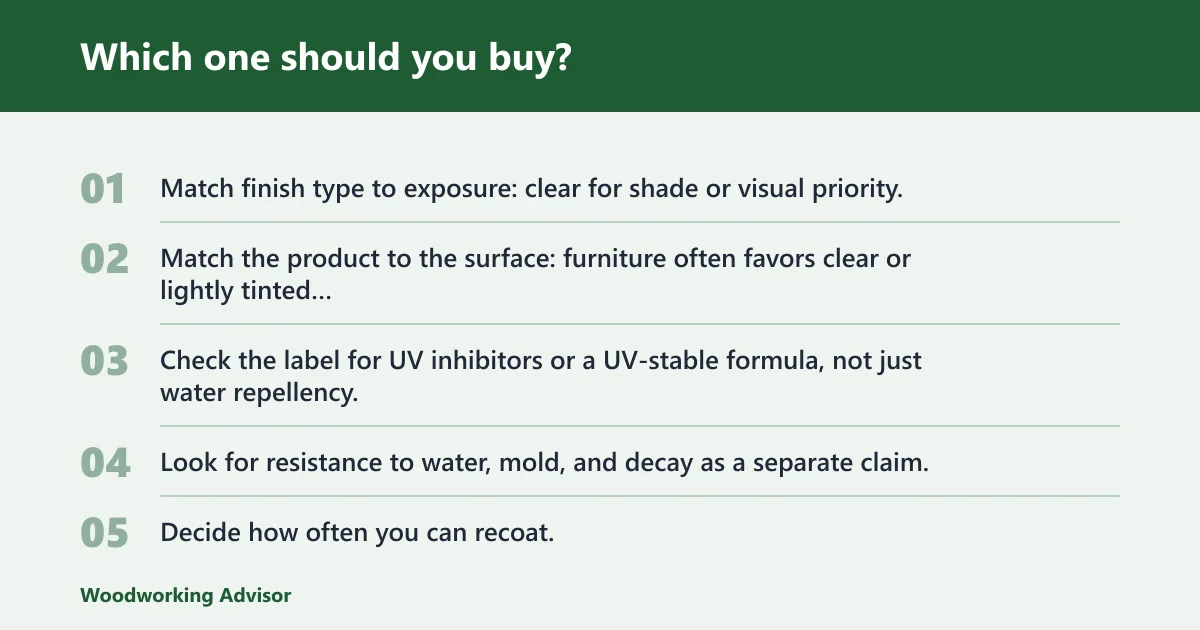
- Match finish type to exposure: clear for shade or visual priority, semitransparent for balance, solid color for full sun.
- Match the product to the surface: furniture often favors clear or lightly tinted finishes, while decks and railings often need stronger pigment.
- Check the label for UV inhibitors or a UV-stable formula, not just water repellency.
- Look for resistance to water, mold, and decay as a separate claim.
- Decide how often you can recoat. If yearly maintenance feels realistic, a clear sealer is more workable.
Frequently asked questions
Do I need a clear sealer or a stain and sealer for outdoor wood?
Choose a clear sealer when the wood is shaded or when appearance matters most. Choose a stain-and-sealer when the wood gets more sun and you want longer-looking color with better UV defense. For full-sun decks and railings, stain-and-sealer usually makes more sense than clear.
Which outdoor wood sealer lasts longest in sun and rain?
Solid-color finishes usually hold up best in heavy sun because they carry more pigment. SaverSystems #1 Deck Advanced Solid Color Wood Stain is the clearest example in this list. If you want a less opaque look, an oil-based semitransparent stain-and-sealer is often the next-best compromise.
Is water-based or oil-based sealer better for UV protection?
Neither solvent type automatically wins on UV protection. The finish color, UV blockers, and pigment level matter more. Water-based sealers are often lower odor and easier to clean up, while oil-based products often penetrate deeply and can be easier to justify on weathered exterior wood.
Can I use a clear wood sealer on a deck or fence?
Yes, but clear sealers work best where the wood is shaded or where you are comfortable reapplying more often. On a deck or fence with full sun exposure, clear protection usually ages faster than a colored finish, especially on top rails and horizontal boards.
What is the best sealer for outdoor wood furniture?
For furniture, clear products are often the first choice because they preserve appearance. Seal-Once Marine Premium Wood Sealer and Thompson’s WaterSeal Clear Multisurface Waterproofer both fit that goal. If the furniture sits in strong sun, a lightly tinted finish may last longer between recoats.
How often should outdoor wood be resealed?
Inspect outdoor wood at least once a year, and sooner for full-sun surfaces. Recoat when water stops beading, color fades, or the finish starts to dry out. Sun-exposed decks and railings usually need more frequent attention than shaded fences or covered furniture.
Does outdoor wood sealer also protect against mold and decay?
Some do, and that claim matters. Seal-Once Marine Premium Wood Sealer, Ready Seal Exterior Stain and Sealer, and several others in this guide list mold and decay resistance. If mildew is a problem in your climate, do not settle for a product that only promises water repellency.
Which outdoor sealer is best for low-VOC or eco-friendly use?
Water-based sealers are usually the first place to look if low odor or lower VOCs matter. Seal-Once Marine Premium Wood Sealer is a strong option because it is water-based and clear. Eco-friendly claims still vary by product, so check the label instead of assuming every water-based formula is low impact.
Sponsored / affiliate links. As an Amazon Associate I earn from qualifying purchases. I may earn additional commission from eligible campaigns.
 #1 Deck Premium Advanced Solid Color Outdoor Wood Stain and Sealer in One – Water Based Sealant for Wood Decks, Fences, & Siding - 1 Gal - Made in USA - Simply White
 #1 Deck Premium Advanced Solid Color Outdoor Wood Stain and Sealer in One – Water Based Sealant for Wood Decks, Fences, & Siding - 1 Gal - Made in USA - Gray