Cabot Cedar Stain Review: Which Line Works Best?
For cedar, choose Cabot’s penetrating, semi-transparent exterior stain for new or weathered wood; use a solid stain only when you need maximum color uniformity over patches or old finish, because lighter films show blotching and lap marks most. Bad prep or the wrong sheen can leave cedar patchy, peel sooner, and force earlier recoats. This guide compares Cabot lines for new, weathered, and previously finished cedar, with prep and application tips to reduce flashing and maintenance.
Cabot stain picks based on cedar condition

Cabot is a good brand to shop for cedar, but the best line depends on the board condition, not the logo. For most cedar projects, a penetrating transparent or semi-transparent Cabot stain is the safest starting point; for weathered or patched cedar that needs more hiding, semi-solid is the better compromise. Use solid stain only when you want the most uniform color.
On cedar, thin finishes usually look more natural and are easier to refresh. More opaque finishes hide defects better, but they also move you closer to a film that can peel or look uneven if the wood is dirty, damp, or still releasing extractives.
Best overall choice by cedar condition
If the cedar is new and sound, Cabot Transparent Wood Toned Stain + Sealer or Cabot Semi-Transparent Stain + Sealer are the most practical choices. If the cedar is gray, dry, and irregular, Cabot Semi-Solid Stain + Sealer usually gives a cleaner result. If the wood already has an uneven coating or patchy color, Cabot Solid Color Stain gives the highest visual forgiveness.
When to choose oil, stain and sealer, or solid color
Choose a penetrating oil or stain-and-sealer when you want cedar grain to stay visible and you want easier spot maintenance. Choose a solid finish when the surface has too many color swings, repairs, or old stain shadows for a lighter coating to look even. The tradeoff is simple: more opacity means less grain and more coating maintenance.
Cabot cedar stain decision table
| Cedar condition | Recommended Cabot line | Risk notes | Warning |
|---|---|---|---|
| New cedar | Cabot Transparent Wood Toned Stain + Sealer | Good for bare or reconditioned exterior wood; slightly darkens at first and leaves a flat, translucent-toned finish. | Watch for blotching if the wood is unevenly sanded or still very resinous. |
| Gray weathered cedar | Cabot Semi-Solid Stain + Sealer | Hides some grain and gives a stronger weather barrier than lighter stains. | Lap marks can show if you stop mid-board; recoat timing matters. |
| Previously stained cedar | Cabot Solid Color Stain | Best when the old finish is patchy, uneven, or difficult to match. | Recoat difficulty rises if the old coating is failing or chalky. |
| Vertical siding | Cabot Semi-Transparent Stain + Sealer | One-coat finish with high grain visibility and mildew, UV resistance. | Blotchiness is the main concern on end grain and repair areas. |
| Fences | Cabot Semi-Solid Stain + Sealer | Better for mixed board quality and sun exposure; still shows some wood texture. | Overlapping spray or brush passes can leave lap marks if you work too slowly. |
| Outdoor furniture | Cabot Gold | Designed for decks and outdoor furniture, with a satin sheen and a two-coat system. | More coating steps mean more chance of application marks if the surface is oily or dirty. |
Why cedar stains differently
Cedar is not difficult because it is soft. It is difficult because it is inconsistent. The wood can absorb stain at different rates across earlywood, latewood, knots, and repaired areas, so one board may look darker than the next even when you apply the same product at the same pace.
Cedar oils and extractives
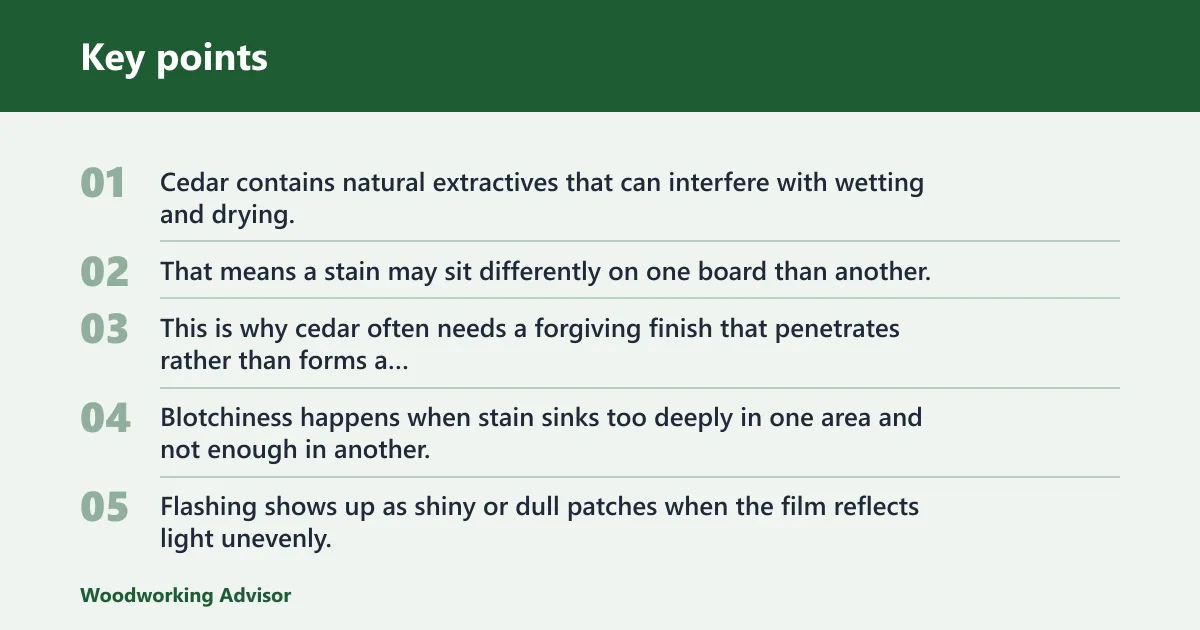
Cedar contains natural extractives that can interfere with wetting and drying. That means a stain may sit differently on one board than another, especially when some boards are fresher, denser, or more resinous. This is why cedar often needs a forgiving finish that penetrates rather than forms a heavy skin.
Blotchiness, flashing, and lap marks
Blotchiness happens when stain sinks too deeply in one area and not enough in another. Flashing shows up as shiny or dull patches when the film reflects light unevenly. Lap marks appear when a wet edge dries before you blend the next pass. Cedar makes all three more likely if prep is uneven or the product flashes too fast.
Say your cedar fence has a pale new replacement board next to a year-old board. The fresh board may drink more stain and read darker, while the older board looks thinner and drier. A semi-solid or solid finish can narrow that contrast, but only if the surface is clean and dry first.
Why opacity matters on cedar
Opacity changes both appearance and maintenance. Transparent and semi-transparent Cabot finishes keep more grain visible and are easier to refresh before wear becomes obvious. Semi-solid and solid products hide more defects, but they also reduce how much of the wood you see and can demand a more careful recoating schedule.
Which Cabot line should you use?
Use the line that matches the cedar’s condition and your tolerance for visible grain. Cabot Australian Timber Oil is the best fit when you want a penetrating oil look on dense hardwoods, not cedar as the main target. Cabot Gold suits furniture and deck-style use. For cedar siding, fences, and trim, the stain-and-sealer lines are usually the better fit.
Cabot Australian Timber oil
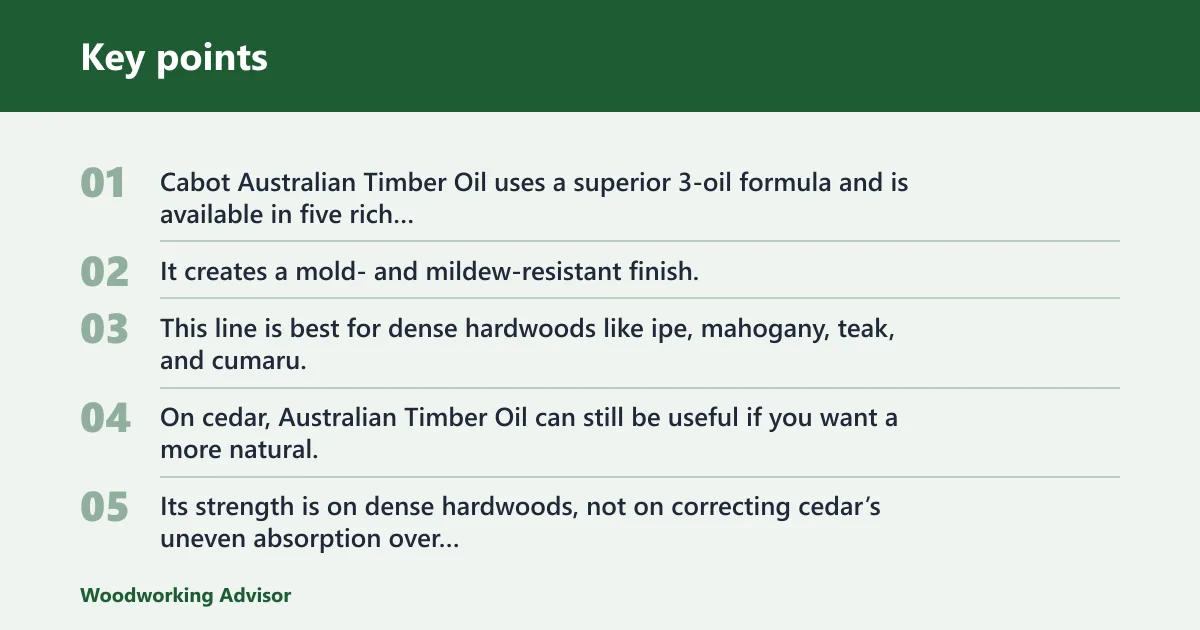
Cabot Australian Timber Oil uses a superior 3-oil formula and is available in five rich colors. It creates a mold- and mildew-resistant finish, and it also comes in low VOC and aerosol variants. This line is best for dense hardwoods like ipe, mahogany, teak, and cumaru, where penetration and pigment control matter more than heavy hiding.
On cedar, Australian Timber Oil can still be useful if you want a more natural, penetrating look on fine exterior details, but it is not the first pick for broad siding or fence runs. Its strength is on dense hardwoods, not on correcting cedar’s uneven absorption over large areas.
Cabot Gold
Cabot Gold is designed for decks and outdoor furniture and uses a two-coat system. It has a satin sheen and is commonly reported to offer UV, rain, moisture, and temperature protection, with a low-VOC option available. On cedar furniture or deck-adjacent pieces, it is the right Cabot line when you want more surface protection and a finished look.
Because it uses two coats, Cabot Gold asks more from your prep and application rhythm. That is fine on tabletops, benches, and small furniture pieces. On large vertical cedar siding, a simpler stain-and-sealer system is usually easier to keep even.
Cabot Transparent wood toned Stain + sealer
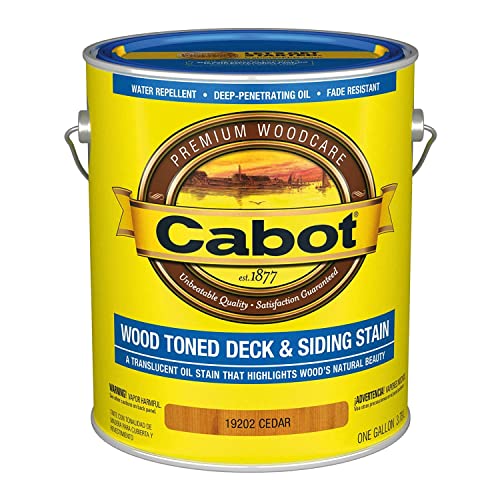
Cabot Transparent Wood Toned Stain + Sealer is for bare new or reconditioned exterior wood. It is also commonly used on decks, siding, fences, trim, shingles, shakes, and log homes. The resin and oil blend slightly darkens wood at first, then leaves a flat, translucent-toned finish.
This is one of the best starting points for new cedar when you want low visual change and a natural grain read. It is also practical on reconditioned cedar that has been cleaned and stripped back enough to accept a lighter finish evenly.
Cabot Semi-Transparent, Semi-Solid, and solid color stain
Cabot Semi-Transparent Stain + Sealer is available in 100 colors and is a one-coat finish with oil-based performance preferred by pros. It gives good visibility of grain and is commonly reported to offer mildew and UV resistance. For many cedar projects, this is the most balanced choice.
Cabot Semi-Solid Stain + Sealer is also available in 100 colors, hides some wood grain, and provides a stronger weather barrier. It works well on mid-life weathered wood that needs more coverage without jumping all the way to a full film.
Cabot Solid Color Stain is a film-forming solid finish with acrylic and alkyd resin variants. It is water-repellent and fade-resistant and is used on decks, outdoor furniture, fencing, patios, and walkways. If cedar has old stain shadows, patch repairs, or color mismatch, this is the most forgiving visual option.
Pros and cons
Cabot strengths on cedar
- Several lines fit cedar at different ages and wear levels.
- Penetrating and semi-transparent options keep grain visible.
- Semi-solid and solid products help hide patchwork or old finish lines.
- Cabot offers finish choices for siding, fences, furniture, and trim.
- Some lines add mildew, UV, and moisture resistance.
Cabot tradeoffs on cedar
- Light finishes can still blotch if cedar prep is uneven.
- Solid stain can reduce the natural cedar look many buyers want.
- Two-coat products take more time and give more room for application errors.
- Previously stained cedar can be hard to match with a lighter finish.
Who it’s for
This line-up suits you if you are choosing stain for cedar siding, fences, trim, or outdoor furniture and want a product matched to the board condition. It is also a good fit if you want grain visibility on new cedar or better color control on weathered cedar.
It is not ideal if you want the least visible finish possible or if you expect one product to solve every cedar problem. A semi-transparent stain will still show defects, and a solid finish will still need proper prep and ongoing maintenance.
Best for new cedar projects: Transparent Wood Toned Stain + Sealer or Semi-Transparent Stain + Sealer. Best for weathered cedar refreshes: Semi-Solid Stain + Sealer. Best for low-maintenance owners who want the most uniform look: Solid Color Stain. For small furniture or deck pieces, Cabot Gold is the better fit.
A common first-timer mistake is choosing color first and opacity second. On cedar, that usually backfires. Start with the finish level that fits the wood condition, then narrow the color within that line.
How long does Cabot stain last on cedar?
Cabot stain life on cedar depends more on opacity, exposure, and prep than on the label alone. In general, thinner penetrating finishes usually wear gradually and are easier to refresh, while more opaque films can last longer visually but may be more difficult to repair cleanly if they fail.
Durability by opacity
Transparent and semi-transparent finishes usually fade and wear before they peel heavily, which makes recoat timing easier to manage. Semi-solid finishes last longer in harsh sun and can better hide aging. Solid stain provides the strongest color hold, but once a film starts breaking down, the repair can be more involved.
Maintenance and recoat difficulty
Recoat difficulty rises as opacity rises. A semi-transparent cedar finish is often easier to clean and refresh. A solid finish may need more careful cleaning, scraping, and spot correction before recoating, especially if water intrusion or UV damage has already started to lift the film.
Suppose a cedar fence in full sun starts fading along the top rail after a few seasons. A semi-solid or solid finish may hide the fade longer, but the next refresh will be less forgiving if the old coating is already chalking or lifting. That is the maintenance tradeoff, not a flaw unique to Cabot.
What to expect from peeling versus wear
On cedar, a penetrating stain usually wears away, while a film-forming finish is more likely to peel if moisture gets trapped or prep is poor. That is why you should match the product to the substrate and not assume the most opaque finish is always the most durable in practice.
What Cabot colors and finishes work on cedar?
Transparent and semi-transparent finishes work best when you want cedar grain and color variation to remain visible. Semi-solid and solid finishes work better when you need to even out repairs, sun fade, or patchy board color. The right sheen also matters, because gloss level changes how much the surface telegraphs flaws.
Transparent versus semi-transparent
Transparent finishes give the least color change and the most wood character. Semi-transparent finishes add more color and usually give better visual balance across mixed cedar boards. If the cedar is new and fairly consistent, transparent can work well. If the cedar has color swings, semi-transparent is usually safer.
When to use semi-solid or solid color
Use semi-solid when the cedar is weathered but still worth showing through. Use solid when you need the finish to cover past repairs, old stain shadows, or severe color mismatch. Cabot Solid Color Stain is the one most likely to tame visual noise, but it also gives up the most grain.
How sheen changes the look
Satin and similar higher-sheen looks reflect more light, so surface flaws can read more clearly. Flat and translucent-toned finishes look more natural on cedar because they reduce glare. That is one reason Cabot Transparent Wood Toned Stain + Sealer often suits cedar better than a shinier finish on broad siding.
Frequently asked questions
Is Cabot oil based stain good?
Yes, Cabot’s oil-based exterior stains are a strong option for cedar when you want better penetration and a more natural grain read. Oil-based formulas are often preferred for their application feel and color depth, especially on new or weathered wood. The key is matching the opacity to the cedar condition.
Which Cabot stain is best for cedar?
For most cedar, Cabot Semi-Transparent Stain + Sealer is the best all-around choice because it balances grain visibility, color control, and one-coat application. For new cedar, Transparent Wood Toned Stain + Sealer is a close second. For badly weathered or uneven cedar, Semi-Solid or Solid Color Stain is safer.
What Cabot stain colors work on cedar?
Warm browns, cedar-toned reds, and muted natural wood shades usually work best on cedar because they follow the wood’s own color family. Cabot Semi-Transparent and Semi-Solid lines offer 100 colors, so you can tune the look from subtle to more opaque. Very dark colors hide grain faster.
Does Cabot stain peel on cedar?
It can, especially with more film-like finishes or when cedar was not properly cleaned, dried, or prepared. Penetrating products are less likely to peel because they wear more gradually. Solid stain can peel if moisture gets trapped or if the previous finish was failing underneath the new coat.
Which Cabot line should I use on new cedar siding?
Cabot Transparent Wood Toned Stain + Sealer is the safest starting point for new cedar siding when you want a natural look and predictable maintenance. If the boards are very uniform and you want more color, Cabot Semi-Transparent Stain + Sealer is the next step up. Avoid a heavy film unless you need more hiding.
Is Cabot Australian Timber Oil good for cedar?
It can be used on cedar, but it is not the main Cabot line to reach for on broad cedar siding or fences. Its superior 3-oil formula, five rich colors, and mold- and mildew-resistant finish are better aligned with dense hardwoods like ipe, mahogany, teak, and cumaru. On cedar, other lines usually fit better.
What is the difference between Cabot transparent and semi-transparent stain?
Transparent stain shows more of the wood with less color change, while semi-transparent stain adds more pigment and usually gives better visual balance on uneven cedar. Both keep grain visible, but semi-transparent hides minor color swings better. Transparent is better for very uniform new cedar; semi-transparent is better for mixed board tone.
Is cabot oil based stain good?
Yes. For cedar, Cabot’s oil-based options are often a smart choice because they tend to penetrate well and leave a more natural look than thicker coatings. The better question is which oil-based Cabot line fits your cedar: transparent for new wood, semi-transparent for general use, or semi-solid for weathered boards.
Sponsored / affiliate links. As an Amazon Associate I earn from qualifying purchases. I may earn additional commission from eligible campaigns.